
Managing a household's credit cards well comes down to four habits: see every card in one place, pay every account on time, keep each card's utilization low, and send extra money to the right balance first. Doing this across three, four or six cards by memory and email reminders is where interest and late fees creep in. Finja is built for that job: it shows all your cards together and gives AI-powered guidance on when and how much to pay, so the system below runs with less effort.
TL;DR
- List every card with its balance, limit, interest rate, due date and minimum payment. You cannot optimize what you cannot see.
- Never miss a due date: late payments bring fees and are reported to the credit bureaus, according to the FDIC.
- Pay more than the minimum on every card, and put the extra on one target card chosen by interest rate, balance size or utilization.
- Keep each card's usage at roughly 20% to 30% of its limit, not just the total across all cards.
- Review the system monthly, or let an app watch the dates and amounts for you.
Table of Contents
- Why several cards are harder to manage than one
- Step 1: Build one inventory of every card
- Step 2: Make on-time payment automatic
- Step 3: Pay more than the minimum
- Step 4: Choose which card gets the extra money
- Step 5: Watch utilization on every card
- Step 6: Keep records and check them
- A monthly routine that takes 15 minutes
- One place for every card in your household
- Our perspective
- FAQ
- Sources
Why several cards are harder to manage than one
One card has one due date, one rate and one statement. Add a spouse's cards, a store card and a travel card, and a household suddenly has four due dates, four rates and four different statement closing days. Each card can be fine on its own while the household as a whole drifts.
The scale is national. The New York Fed reported that credit card balances stood at $1.26 trillion in the second quarter of 2026, a figure the bank updates every quarter in its household debt report. The point for your household is not the national number but the mechanism behind it: balances that carry month to month accrue interest, and interest is what turns a manageable bill into a long repayment.
A note on income, since readers search for this: a household shares spending, but a card application is about an individual. The Federal Reserve Board clarified in 2011 that applications generally cannot ask for "household income" because the term is too vague. More on that in the FAQ below.
Step 1: Build one inventory of every card
Start with a single list. The state of Michigan's financial toolkit suggests a spreadsheet with each card's issuer, interest rate, balance, credit limit, utilization ratio and minimum payment. Add three columns the toolkit does not list but your calendar needs: the due date, the statement closing date and which household member holds the card.
| Card | Balance | Limit | Utilization | APR | Minimum | Due date |
|---|---|---|---|---|---|---|
| Card A | $2,400 | $4,000 | 60% | 27.99% | $72 | 6th |
| Card B | $900 | $6,000 | 15% | 21.49% | $25 | 14th |
| Card C | $3,100 | $5,000 | 62% | 24.99% | $85 | 22nd |
The figures above are an illustration, not market data. Utilization is the balance divided by the limit. In this example, Card A and Card C are both above 60%, which is the first thing to fix.
Where this goes wrong: the list is accurate on the day you build it and stale within two weeks. Balances change with every purchase, and statement dates shift. A spreadsheet needs a human to update it every time. Finja pulls your cards into a consolidated view so the inventory is the app itself rather than a file you have to maintain, and it tracks credit health alongside it.
Step 2: Make on-time payment automatic
The single costliest mistake is a late payment. The FDIC's consumer guide says late payments trigger fees and are reported to credit bureaus. The CFPB adds that card companies may raise your interest rate if you pay more than 60 days late.
The usual safeguard is automatic payment. MyCreditUnion.gov recommends automating payments and reviewing spending to free up money for repayment. A sensible setup:
- Set autopay for at least the minimum on every card, so a missed reminder never costs you a fee.
- Make your larger, deliberate payment manually on your target card, ahead of its due date.
- Keep enough cash in the paying account to cover all the autopay amounts. An overdraft just moves the problem.
If you want to go deeper on timing, our guide on when to pay your credit card for fees, interest or score walks through the choices, and optimizing payments with timing and Regulation Z covers the U.S. rules behind them.
Step 3: Pay more than the minimum
The minimum payment keeps an account in good standing, and it is designed to be small. MyCreditUnion.gov points out that your statement shows how long payoff would take at minimum payments, sometimes years, and recommends paying the full balance when you can, or at least more than the minimum.
Timing matters too. The CFPB notes that most issuers calculate interest daily, so the sooner you pay all or part of a balance, the less interest you pay. The FDIC says interest is generally charged on the unpaid balance at the start of a new billing cycle, so paying even slightly more than the minimum reduces interest costs.
If you are unsure what the minimum actually is and how it is built, read what a minimum payment on a credit card is.
A watch-out for households with store or promotional cards: with deferred-interest "no interest for 12 months" offers, the FDIC warns that if the purchase is not paid in full by the end of the promotional period, you may be charged all the interest that accrued since the purchase date. Put the promotional end date in your inventory next to the due date, and divide the purchase by the number of months so the balance reaches zero in time.

Step 4: Choose which card gets the extra money
After minimums, you have one pot of extra money. Where it goes is the decision that separates a flat balance from a falling one. The Michigan toolkit lists three targets: the smallest balance, the highest interest rate, or the highest utilization. The CFPB's debt booklet names the first two methods:
- Snowball: pay extra on the smallest debt, then roll that payment into the next smallest. It shows quick progress by reducing the number of debts, but can cost more overall when larger debts carry high rates.
- Avalanche: pay extra on the highest-interest debt first. It removes the most expensive debt first, though it may feel slow if that debt is large.
Apply that to the sample table. Card A has the highest rate (27.99%) and the smallest balance of the two heavy cards, so it is the target under both avalanche and utilization logic. The extra $150 a month goes to Card A, while Card B and Card C get their minimums. When Card A is paid off, its $72 minimum plus the $150 roll onto Card C, the next-highest rate.
If you want to see how large your own debt is relative to others when thinking about priorities, debt per person by country gives context on how much debt people carry in different economies. For the mechanics of the avalanche approach specifically, see the real benefits of the avalanche payoff method, and for a quick decision, which card to pay first uses statement timing to settle it in about 15 minutes.
Many households find the ranking changes as balances move. A card that was third in line becomes first after a large purchase. That is why a payment recommendation that updates with your balances is more useful than a one-time plan. Finja's AI-powered guidance on payment timing and amounts is designed to do exactly this recalculation for you.
Step 5: Watch utilization on every card

Utilization is the share of a card's limit you are using. The FDIC's Money Smart program advises no more than 30% of the limit, and some experts say 20%. It also stresses that utilization, not only balance, drives credit scores: using a large share of the limit at any point in the month can hurt scores even if you pay the full balance each month.
For a household, this has a practical consequence. If you pay a card in full on its due date but run it to 80% of its limit during the month, the balance that gets reported to the bureaus can still look high. Two ways to handle it:
- Make a mid-cycle payment, before the statement closes, on any card that runs high.
- Spread regular spending across cards so no single card carries most of it.
For the household in our example, Card A at 60% and Card C at 62% would each need to drop by roughly half to reach the 30% guideline. Card A would need to fall from $2,400 to $1,200 or less, and Card C from $3,100 to $1,500 or less. That gives the extra payments a concrete finish line.
Step 6: Keep records and check them
The FDIC's Money Smart guide suggests keeping records and comparing receipts to statements. If you find an error, report it in writing within 60 days, according to the same guide. In a household with several cardholders, a monthly ten-minute review, ideally with everyone who uses a card, catches duplicate charges, forgotten subscriptions and unfamiliar transactions early.
Also check your credit reports. Federal law entitles you to one free report every 12 months from each of the three nationwide bureaus, Equifax, Experian and TransUnion, through AnnualCreditReport.com. Confirm that every card's balance, limit and status match your inventory.
A monthly routine that takes 15 minutes
- Update balances, limits and due dates in your inventory.
- Confirm autopay covers each minimum and the paying account holds enough.
- Check utilization per card and make a mid-cycle payment on any card above your threshold.
- Send the extra payment to this month's target card.
- Scan statements for charges you do not recognize.
- Note any promotional rate end dates in the next 60 days.
If a spiral has already started, a 72-hour plan to stop a credit card debt spiral gives the first steps, and a payoff schedule built in 20 minutes turns the target into dates. More ideas are in our multiple credit card management tips and the guide on reducing financial stress from credit cards.
One place for every card in your household
Finja is an AI-powered credit card coach for people who carry more than one card. It displays all your cards in one place, recommends payment timing and amounts to reduce interest costs, tracks credit health, and includes budgeting tools and spending limit controls. It is a dedicated credit card coach rather than a general budgeting tool, and it focuses on lowering interest and improving credit health rather than chasing rewards.
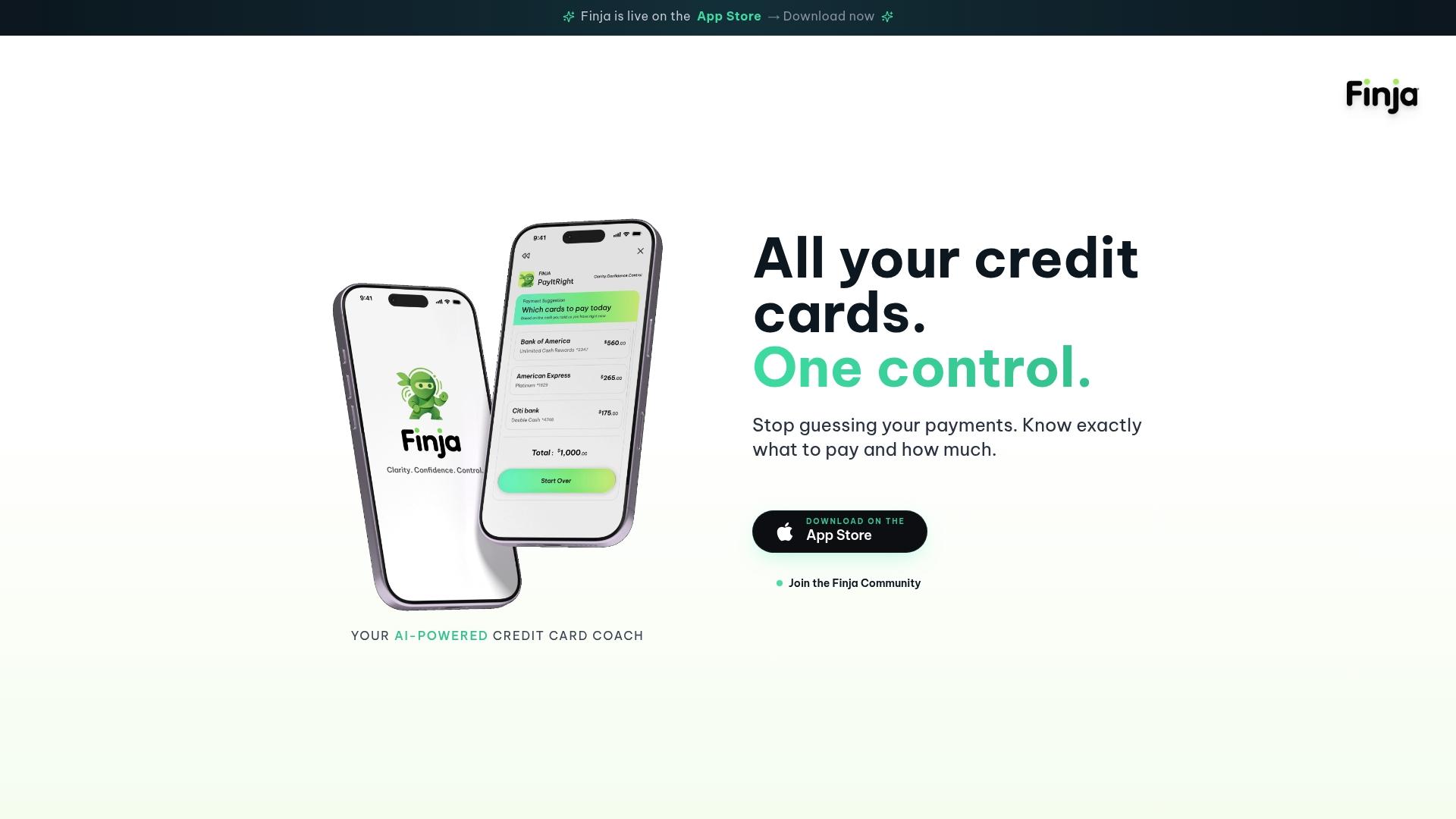
If the inventory, the due dates and the payoff order above sound like a monthly chore you would rather hand off, see how Finja works.
Our perspective
Most people who struggle with several cards are not careless. They are managing a moving target with tools built for a single card: one app per issuer, one reminder per due date, and no view of how the cards affect each other.
We built Finja around a simple idea: the best next payment depends on all your cards at once. Which card carries the highest rate, which one is closest to its limit and which due date comes first are questions with one answer when you see everything together.
That is why we focus on interest costs and credit health instead of rewards. A household that stops paying avoidable interest and keeps utilization sensible gets more out of its cards than one chasing the next bonus.
The system in this article works with a spreadsheet and discipline. We want it to work with less friction, so the decision each month is a clear recommendation, not a recalculation.
Grace K.
FAQ
Can you use household income on a credit card application?
Generally, no. The Federal Reserve Board said in 2011 that applications cannot ask for "household income" because it is too vague. The CFPB says applicants who are at least 21 and have a spouse or partner may be evaluated individually or as a couple using combined income or assets. Applicants under 21 must use their own income or assets, and may add a co-signer who is at least 21.
What is the best way to manage multiple credit cards?
Keep one inventory of balances, limits, rates and due dates, automate at least the minimum on each card, and pay as much above the minimum as you can. Then direct the extra to one target card, chosen by highest rate, smallest balance or highest utilization. Review it monthly.
Should I pay the smallest balance or the highest rate first?
The CFPB describes both: snowball for quick wins, avalanche for the most expensive debt first. If your cards have meaningfully different rates, targeting the highest rate usually costs less in interest. If motivation is the issue, the smallest balance can keep you going. Either beats paying only minimums.
How much of my credit limit should I use?
The FDIC's Money Smart guidance advises staying under 30% of each card's limit, with some experts suggesting 20%. Check each card separately, since a high balance on one card shows up even if your overall usage looks low.
Sources
- New York Fed: Household Debt and Credit Report, Q2 2026
- Federal Reserve Board: 2011 clarification on household income
- State of Michigan: Ways to Pay Off Credit Card Debt
- FDIC: Take Charge of Your Credit Cards
- CFPB: Debt getting in your way? Get a handle on it
- MyCreditUnion.gov: Paying Off Credit Cards
- CFPB: Credit cards consumer tool
- FDIC: Money Smart for Adults Module 9 Instructor Guide
- CFPB: Stay-at-home spouse or partner and credit cards
- Fiatmap: Debt per person by country