
Pay the minimum on every credit card you hold, then send extra money to either your highest-APR card (to save the most on interest) or your smallest balance (to build momentum). Your next two moves: write down every balance and APR you owe, then schedule the extra payment before your statement closes. That single decision, repeated every month, is what actually moves the needle on debt.
TL;DR:
- Paying extra on your highest-APR card can save more interest, but targeting small balances may provide faster psychological wins that boost motivation.
- Double-check for promotional or 0% APR balances before prioritizing, as they do not accrue interest during the promotional period.
- Paying before the statement close date reduces reported utilization, which can improve your credit score more than paying after, even if total payments remain the same.
- Use a simple worksheet to track balance, APR, minimum, and statement date, ensuring your payoff plan is based on accurate, current data.
- If struggling to make minimum payments, immediately contact your issuer for hardship options and avoid companies asking for upfront settlement fees.
Table of Contents
- Step-by-step checklist: how to pick the first card today
- How to calculate and document balances, APRs, minimums, and statement dates
- Avalanche vs. snowball: which repayment strategy to choose
- Payment timing, utilization, and credit-score effects
- If you can't cover minimums or are falling behind: urgent next steps
- Expert validation: how these rules hold up in practice
- Publisher perspective: why pick a single, repeatable rule
- How Finja helps: automated payment prioritization
- Sources
- FAQ
Step-by-step checklist: how to pick the first card today
You do not need a financial planner to make this decision. You need your numbers in front of you and about fifteen minutes.
- Pull up every card account and record the current balance, APR, minimum due, credit limit, and statement closing date.
- Add up all your minimum payments and confirm you can cover them this month, on every card, with room to spare.
- Pick your goal: lowest total interest paid, or fastest visible progress.
- Based on that goal, choose your target card and calculate how much extra you can send its way.
- Set up autopay for every minimum, then schedule or automate the extra payment to the target card.
Before you commit, run through this:
- Confirm the minimums are covered first. No exceptions, even for a card you're excited to pay off.
- Double check whether any balance carries a promotional or 0% APR rate. That balance usually should not be your target, since it isn't accruing interest yet.
- Note your statement close dates. Paying a few days before close, rather than right on the due date, can lower what gets reported to the bureaus.
- Write the plan down somewhere you'll see it, a notes app, a spreadsheet, or a whiteboard on the fridge.
Once the target is chosen, the plan runs mostly on autopilot. That's the point: a decision made once now saves you from relitigating it every payday.
How to calculate and document balances, APRs, minimums, and statement dates
Your payoff order is only as good as the numbers behind it. Most of this is already sitting in your online account or your last paper statement.
- Balance: your current statement balance, found on the account summary or homepage of your card's app.
- APR: listed on your statement, often broken out separately for purchases, cash advances, and balance transfers.
- Minimum due: shown on every statement, along with the due date.
- Credit limit: on your statement or account dashboard, used to calculate utilization.
- Statement close date: the date your balance is reported to the credit bureaus, usually a few days before your due date.
Some cards carry more than one APR at once, for instance a lower promotional rate on a balance transfer and a much higher standard rate on new purchases. When that happens, target the highest-rate segment first, since issuers calculate interest daily on the balance carrying that rate, and the most expensive dollars are the ones costing you the most every day they sit unpaid.
Build a simple worksheet with one row per card and columns for each figure above, plus a final column for your calculated extra payment. That single page becomes your monthly reference.
Avalanche vs. snowball: which repayment strategy to choose
The avalanche method targets your highest-APR balance first, paying only minimums elsewhere. The snowball method targets your smallest balance first, regardless of rate. The CFPB's debt-action guidance treats both as legitimate, noting that avalanche generally minimizes total interest paid, while snowball often keeps people motivated because they see balances disappear faster.
Use these triggers to decide:
- Choose avalanche when your APRs vary a lot, since the interest savings compound quickly on the highest-rate card.
- Choose snowball when you have several small balances and have struggled to stick with a debt plan before.
- Choose avalanche when your balances are similar in size but rates differ sharply.
- Choose snowball when the psychological win of closing an account matters more to you than shaving off extra interest.
Snowball would target the $1,000 balance too in this case, since it's also the smaller one, but if the smaller balance carried the lower rate, snowball would cost more in total interest while still delivering an earlier "paid off" moment. The avalanche method's interest savings tend to show up most clearly when APR gaps are wide.
Pro Tip: Run both methods on paper for your actual balances before choosing. Ten minutes of math beats months of guessing.
Payment timing, utilization, and credit-score effects
Interest accrues daily on most cards, so paying earlier in your billing cycle, not just by the due date, reduces what you owe. If you pay your full statement balance by the due date, most issuers waive interest on new purchases entirely thanks to the grace period.
Timing also affects your credit score, separately from interest. Card issuers typically report your balance to the bureaus as of your statement close date, not your due date. Paying down a chunk of your balance before that date, rather than after, lowers the utilization number that gets reported, even if your total monthly payment doesn't change.
Utilization makes up 30% of a FICO score, second only to payment history at 35%, according to myFICO's guidance. That weighting is why timing can matter as much as the amount you pay.
- If you're optimizing for a credit-score goal, like an upcoming mortgage application, prioritize lowering utilization before your statement closes.
- If you're optimizing for total interest saved, prioritize the highest-APR balance and pay it down whenever you have extra cash.
- A two-payments-per-month plan, one mid-cycle and one by the due date, can address both goals at once.
- Check your statement close date a week ahead if you're planning a payment specifically to lower reported utilization before a credit application.
If you can't cover minimums or are falling behind: urgent next steps
Missed payments cause more credit damage than almost anything else, since payment history carries the heaviest weight in your FICO score. If you're at risk of missing a minimum, act before the due date, not after.
- Call your card issuer immediately and ask about hardship programs or temporary payment arrangements.
- Prioritize keeping every account current, even if that means paying less toward your target card this month.
- Avoid any company that asks for money upfront to "settle" your debt.
- Consider a nonprofit credit counseling agency or a personal loan for consolidation if multiple accounts are unmanageable.
Charging fees before a debt-relief company settles or reduces a customer's debt violates federal law, and consumers can seek free help directly from their card issuers instead. FTC guidance on debt-relief practices, summarized by the Washington State Attorney General's Office
Expert validation: how these rules hold up in practice
This guidance follows the CFPB's own debt-action framework and FICO's published scoring weights, not a proprietary formula. An AI-powered credit card management platform can apply these same principles—balance, APR, utilization, and timing—when recommending which card a user should pay and when. For readers who want a deeper walkthrough of any single tactic, Finja's blog covers high-interest card prioritization and compound interest avoidance in more detail.

Publisher perspective: why pick a single, repeatable rule
Most people don't fail at debt payoff because they picked the wrong method. They fail because they never picked one, and re-decide every month based on mood or a surprise expense. Momentum from an early win keeps people going even when the math favors a slower path. Pairing a simple rule with automated minimum payments removes the chance of a missed month wrecking your progress. Pick avalanche or snowball, automate what you can, and revisit the plan monthly instead of daily.
— Grace K.
How Finja helps: automated payment prioritization
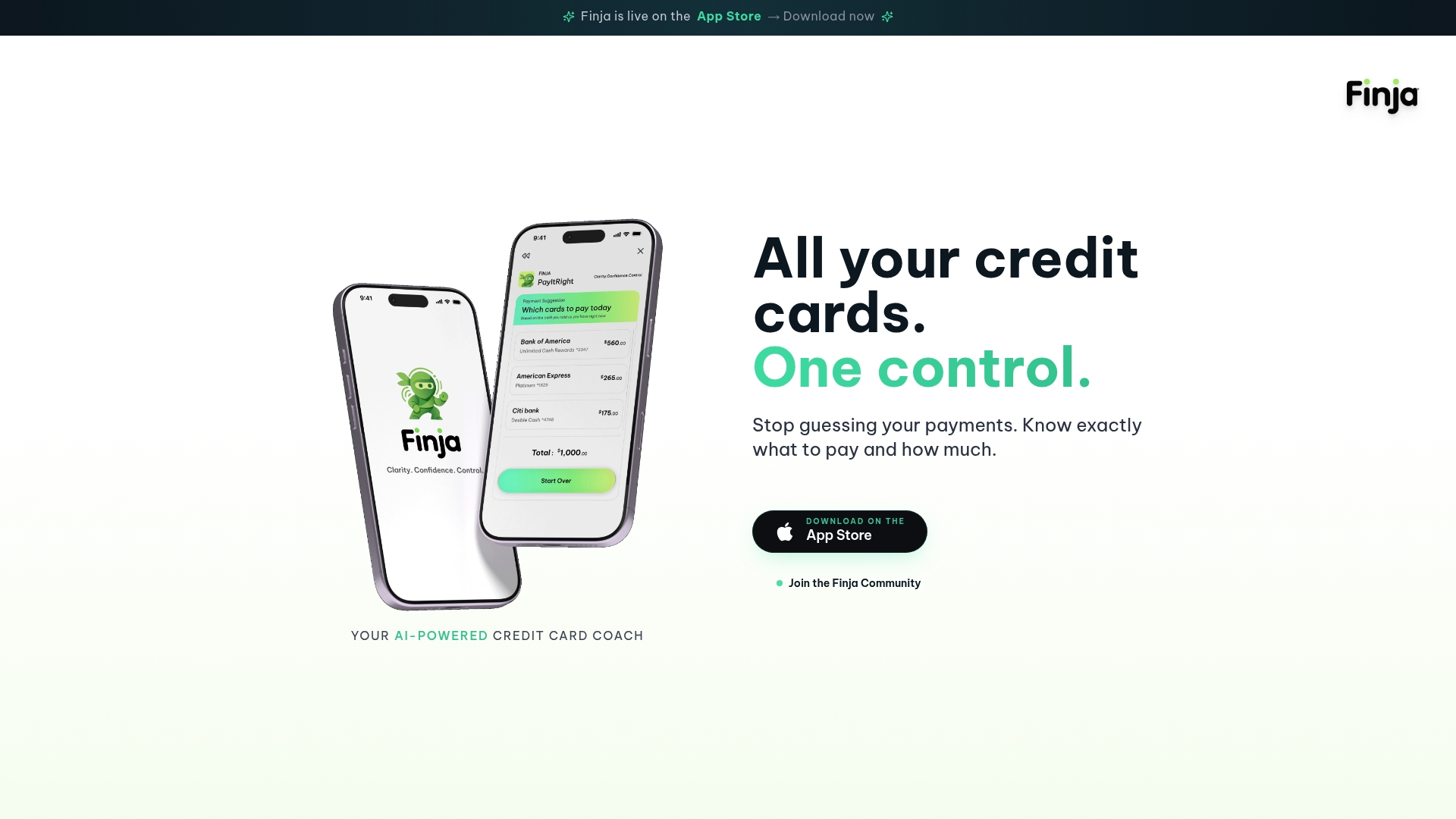
Tracking balances, APRs, and statement dates across several cards by hand is where most payoff plans quietly fall apart. Finja consolidates every card into one view and recommends which one to pay and when, using the same balance, APR, and timing logic covered above. If you're managing more than one card and want the calculations done for you, visit Finja's site to see how the app works.
This article is general information, not a substitute for advice from a qualified financial advisor. Consult a qualified financial professional about your own circumstances before acting on anything here.
Sources
- How does my credit card company calculate the amount of interest I owe? | CFPB
- What Should My Credit Utilization Ratio Be? | myFICO
- FTC bans upfront fees for some debt-relief companies | Washington State AGO (summary)
FAQ
Which card should you pay off first?
Pay minimums on every card, then target either your highest-APR card to save the most on interest or your smallest balance for faster visible progress. The CFPB treats both approaches as valid, with the better choice being whichever one you'll actually stick with.
What is the avalanche versus snowball rule for credit cards?
Avalanche means paying off the card with the highest interest rate first while making minimums on the rest, which typically minimizes total interest paid. Snowball means targeting the smallest balance first regardless of rate, which can build motivation faster even if it costs a bit more in interest.
Should I pay off my credit card or my line of credit first?
Compare the APR on each account rather than the account type, since a line of credit isn't automatically cheaper or more expensive than a card. Whichever balance carries the higher interest rate is generally the one to target first if your goal is minimizing total interest paid.
Should you pay off small or large credit card balances first?
Paying the smallest balance first, the snowball method, gets you a quick win and can help you stick with a payoff plan. Paying the balance with the highest APR first, regardless of size, generally saves more money in total interest according to CFPB guidance.
What should I do if I can't afford my minimum payments?
Contact your card issuer right away to ask about hardship programs or temporary payment plans before you miss a due date. Avoid any company that charges an upfront fee to settle your debt, since the FTC has flagged this practice as illegal, and free help is available directly from issuers or nonprofit credit counselors.