
The most effective compound interest avoidance strategy comes down to six actions you can start this week: pay more than the minimum on your highest-APR debt, automate that extra payment, call your issuer to request a rate reduction, evaluate any 0% balance-transfer offer against its fees, build a $500–$1,000 emergency buffer so you stop adding to revolving balances, and track your interest paid monthly so you see the math moving in your favor. Resources from Investor.gov and NASAA confirm that minimum payments on high-rate debt are one of the costliest financial habits an American consumer can have. Finja's payment optimizer maps directly to this checklist, automating the sequencing so you don't have to track it manually.
Here's the prioritized checklist:
- Pay above the minimum on your highest-APR card. Every extra dollar reduces the principal that interest compounds against.
- Automate the extra payment. Automation removes the behavioral friction that kills most repayment plans.
- Call your issuer and request a rate reduction. Experian notes lenders often grant temporary reprieves of 1–3 percentage points for customers with solid payment history.
- Evaluate balance-transfer offers carefully. A 0% promo with a 3% transfer fee can save hundreds, but only if you pay it off before the promotional period ends.
- Build a small emergency fund. Without one, an unexpected $400 expense goes straight onto a revolving balance and starts compounding immediately.
- Track interest paid, not just balances. Watching the interest line drop is the feedback loop that keeps you motivated.
Table of Contents
- How compound interest quietly inflates your debt balance
- Ranked strategies that actually stop compound interest from growing
- How to evaluate balance transfers and consolidation loans before you commit
- A 30/60/90-day repayment plan you can start today
- Avalanche vs. snowball: which one saves you more money?
- Compound interest on debt vs. compound interest on investments
- Tax implications of debt repayment and interest
- Key Takeaways
- The mistake most borrowers make (and how to avoid it)
- Finja makes the math automatic for multi-card borrowers
- Sources and calculators for running the numbers yourself
How compound interest quietly inflates your debt balance
Compounding means interest is calculated on your principal plus previously accrued interest, so the balance grows faster than a simple-interest loan of the same rate. On credit cards, most issuers compound daily. Your annual percentage rate (APR) is divided by 365 to get a daily periodic rate, and that rate is applied to your average daily balance each day of the billing cycle.
A concrete example: carry a $3,000 balance at 22% APR and make only the minimum payment each month. In the first month alone, roughly $55 in interest accrues. That $55 gets added to your principal, so next month's interest is calculated on $3,055, not $3,000. The Teachers Federal Credit Union explains that paying the full statement balance each billing cycle avoids this entirely, because most cards include a grace period that waives interest for accounts paid in full. The moment you carry a balance, the grace period disappears and daily compounding begins.
| Month | Balance | Interest Accrued | Minimum Payment | Ending Balance |
|---|---|---|---|---|
| 1 | $3,000 | $55 | $75 | $2,980 |
| 2 | $2,980 | $55 | $75 | $2,960 |
The numbers shrink slowly because minimum payments barely outpace interest. At this pace, paying off $3,000 takes years and costs far more than the original balance.
Pro Tip: Check your card's daily periodic rate on your statement (it's usually listed as "DPR" or "daily periodic rate"). Paying a partial extra payment mid-cycle, before the billing-cycle close date, lowers your average daily balance and reduces that month's interest charge.
Key mechanics to keep in mind:
- APR vs. daily rate: 22% APR ÷ 365 = 0.0603% per day.
- Average daily balance: issuers sum your balance for each day of the cycle and divide by the number of days. Paying early in the cycle cuts this number.
- Payment timing: splitting one monthly payment into two smaller ones mid-cycle can reduce average daily balance, but only if it increases your total annual payment volume, as The Conversation's analysis of extra-payment math confirms.
Ranked strategies that actually stop compound interest from growing
The order here matters. Start with the highest-leverage move for your situation, then layer in the others.
-
Pay the highest-APR debt first (debt avalanche). This is mathematically the most efficient interest reduction technique. Keep minimums on every other account and throw every spare dollar at the card charging you the most. The avalanche method minimizes total interest paid across all your debts.
-
Negotiate a rate reduction directly with your issuer. This is the lowest-friction win available. Call the number on the back of your card, reference your on-time payment history, and ask for a lower rate. Experian's guidance on negotiation shows that lenders are more likely to say yes when you have competing offers or a recent credit score improvement. Ask again every 3–6 months if the first attempt fails.
-
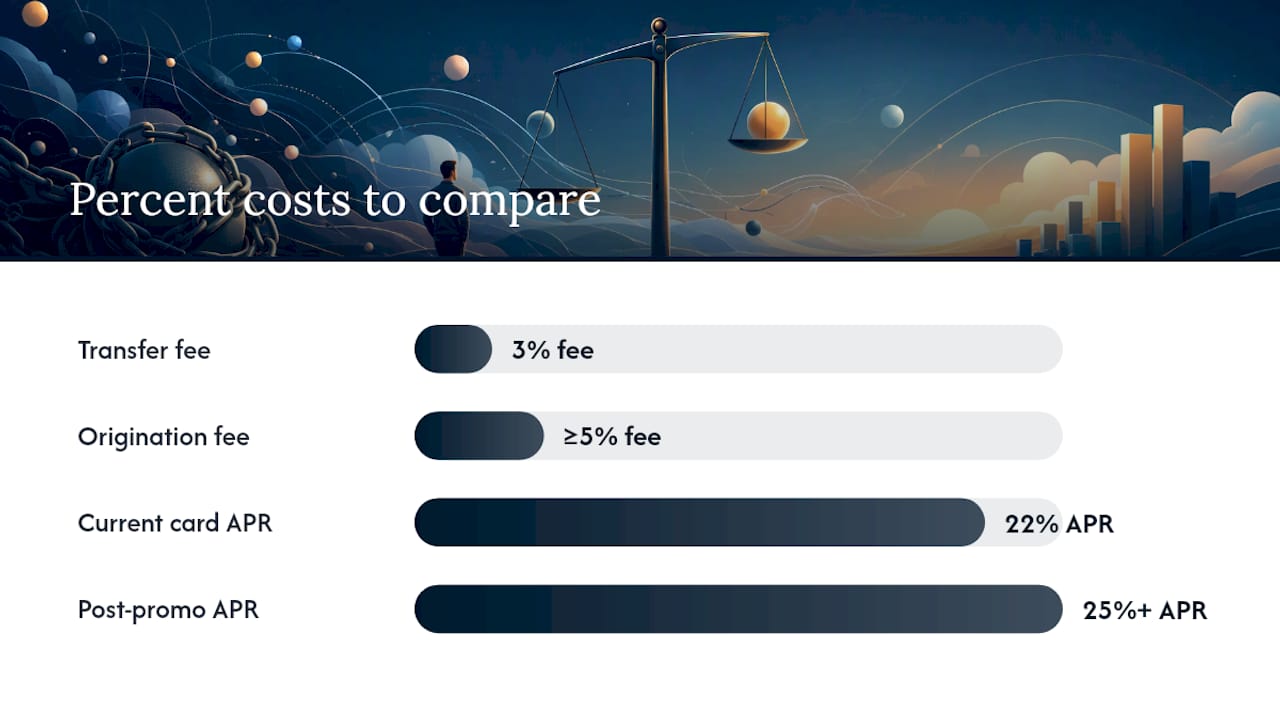
Use a 0% balance-transfer offer, but run the math first. A 3% transfer fee on $5,000 costs $150 upfront. If the promo period is 12 months and you can pay the balance in full before it expires, you save the interest you would have paid at 22% APR. If you can't pay it off in time, the post-promo rate often resets higher than your original card.
-
Consolidate to a lower-rate personal loan. This makes sense when your credit score qualifies you for a rate meaningfully below your current card APRs and when the origination fee doesn't wipe out the savings. LegalClarity's breakdown of loan-beating tactics confirms that restructuring to a fixed lower rate removes the compounding risk of revolving credit entirely.
-
Automate overpayments. Set a fixed extra amount, even $25–$50 per month, to hit your highest-rate card automatically. Consistency beats size here. Small recurring overpayments compound to meaningful savings over time and are easier to sustain than sporadic large payments.
-
Build a $500–$1,000 emergency fund first. Without a buffer, every unexpected expense lands on a credit card and starts compounding. This fund is not an investment; it's a circuit breaker for new debt.
Red flags to check before accepting any offer:
- Deferred-interest clauses (common on store cards): if you don't pay the full promotional balance by the deadline, all the deferred interest is charged retroactively.
- Post-promo APR: some balance-transfer cards revert to rates above 25%.
- Origination fees on consolidation loans above 5%: they can eliminate the interest savings.
- Hardship program terms: Phroogal's interest-reduction guide notes that hardship programs may close or restrict your account, which can affect your credit utilization ratio.
Pro Tip: Before calling your issuer to negotiate, pull your credit report and note any score improvements since you opened the account. A higher score is your strongest negotiating lever, and issuers can see it too.
How to evaluate balance transfers and consolidation loans before you commit
Before accepting any offer, gather these numbers: promotional APR, promo length in months, transfer fee percentage, post-promo APR, payment allocation rules (does the issuer apply payments to the lowest-rate balance first?), any origination or application fees, and whether autopay earns a rate discount.
Here's a worked comparison on a $5,000 balance at 22% APR:
| Scenario | Total Interest + Fees Paid (12 months) | Notes |
|---|---|---|
| Keep current card, pay minimum monthly | significant interest | Paid off in ~12 months |
| 0% transfer, 3% fee, pay $417/month | $150 fee, $0 interest | Paid off exactly at 12 months |
| 8% consolidation loan, $100 origination | interest plus transfer fee | Paid off in ~12 months |
The 0% transfer wins if you can pay it off in time, while the consolidation loan beats staying put if you can't qualify for a 0% offer. Staying on the current card and paying aggressively is still a solid path if transfer fees are high or your credit score limits your options. Use the credit card calculator at ZENRG Finance to run your own numbers before deciding.
Offer vetting checklist:
- Confirm the promo end date and set a calendar reminder 60 days before it.
- Read the payment allocation policy: some issuers apply minimums to the lowest-APR balance first, leaving your transferred balance to accrue interest after the promo ends.
- Check whether the transfer fee is capped or uncapped.
- Verify the post-promo APR in the Schumer Box, not the marketing headline.
Pro Tip: Set autopay for the full monthly payoff amount on a 0% transfer card, not just the minimum. A single missed payment can trigger the penalty APR and void the promotional rate on some cards.
A 30/60/90-day repayment plan you can start today
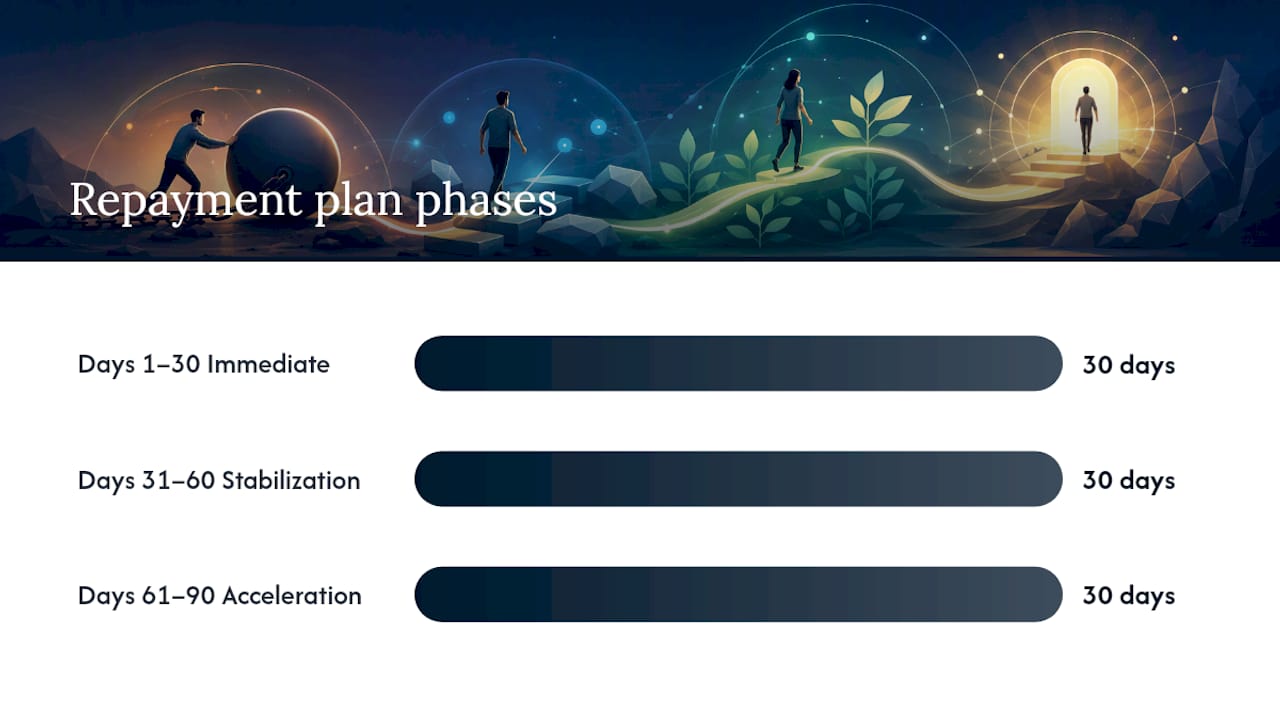
Days 1–30 (Immediate actions):
- List every debt: balance, APR, minimum payment, and issuer phone number.
- Call the issuer on your highest-APR card and request a rate reduction.
- Set up autopay for the minimum on every card to protect your credit score.
- Add one fixed extra payment to your highest-APR card, even $30.
- Open a separate savings account and transfer $25 to start your emergency buffer.
Days 31–60 (Stabilization):
- Review last month's statement: note interest paid vs. principal reduced.
- Evaluate one balance-transfer or consolidation offer using the comparison table above.
- Increase your extra payment by whatever you freed up from any rate reduction.
- Automate the emergency fund contribution so it happens without thought.
Days 61–90 (Acceleration):
- Apply any windfall (tax refund, bonus) entirely to the highest-APR balance.
- Re-request a rate reduction if the first attempt failed.
- Check your credit score: improvement may unlock better consolidation rates.
- Calculate your new payoff date using the Investor.gov compound interest calculator and adjust your extra payment to hit it.
Tracking template (copy this per account):
- Account name and issuer
- Current balance
- APR
- Minimum payment
- Average daily balance (estimate from last statement)
- Planned extra payment this month
- Interest paid this month
- Principal reduced this month
- Target payoff date
The minimum payment trap is real: paying only the minimum keeps you in debt for years while interest compounds on a barely-shrinking balance. Micro-overpayments, automated and consistent, are what break that cycle.
Avalanche vs. snowball: which one saves you more money?
The avalanche method saves more money. Full stop. Paying the highest-APR debt first minimizes the total interest you pay across all accounts, because you're eliminating the most expensive compounding first. The snowball method, paying the smallest balance first regardless of rate, costs more in total interest but delivers faster early wins that keep some borrowers on track.
| Method | Total Interest Paid* | Time to Debt-Free* | Best For |
|---|---|---|---|
| Avalanche | Lower | Slightly faster | Math-motivated borrowers |
| Snowball | Higher | Slightly slower | Motivation-driven borrowers |
*Relative comparison; actual figures depend on your specific balances and APRs.
Decision rules: choose snowball if you have one very small balance (under $300) that you can eliminate in 1–2 months, because the psychological win is worth the small interest cost. Choose avalanche if your highest-rate card also carries your largest balance, since the two methods converge anyway. For managing multiple cards, the avalanche is almost always the right default.
Pro Tip: Track interest paid this month, not just your total balance. Balances drop slowly at first, but interest paid drops faster once you've reduced the principal. That number is your real progress indicator.
Compound interest on debt vs. compound interest on investments
The same math that works against borrowers works powerfully for savers and investors. On the investment side, compounding means your returns generate their own returns over time, which is why Harvard FCU's explainer frames compound interest as a tool that rewards patience and consistency. On the debt side, it punishes delay with the same force.
The practical implication: no common investment reliably beats a 22% credit card APR on a risk-adjusted basis. Paying off high-rate debt is the equivalent of earning a guaranteed 22% return, tax-free, with no market risk. This is why Investor.gov recommends paying off high-interest accounts before directing money toward most investment accounts. The exception is employer 401(k) matching: a 100% match on contributions is a guaranteed return that beats even high-rate debt, so capture that first, then redirect to debt payoff.
Once your high-rate debt is gone, the same compounding mechanics that hurt you as a borrower start working for you as a saver. The behavioral habits you build during debt payoff, consistent contributions, automation, and avoiding withdrawals, are exactly the habits that build long-term wealth.
Tax implications of debt repayment and interest
Most consumer debt interest, including credit cards and personal loans, is not tax-deductible. Paying it off faster has no direct tax benefit, but it does improve your net financial position by eliminating a guaranteed after-tax cost.
Two exceptions worth knowing:
Student loan interest: You may deduct up to $2,500 in student loan interest per year on your federal return, subject to income phase-outs. For 2025 taxes, the deduction phases out at modified adjusted gross incomes above $75,000 for single filers. Confirm current thresholds with IRS Publication 970 or a tax professional.
Mortgage interest: Homeowners who itemize can deduct interest on up to $750,000 of qualified mortgage debt. This deduction effectively lowers the real cost of mortgage interest, which changes the math slightly when prioritizing which debt to pay down first. A 6% mortgage with a tax deduction may cost less in after-tax terms than a 9% personal loan with no deduction.
For most credit card borrowers, the tax angle is simple: there's no deduction, so every dollar of interest paid is a pure loss. That makes eliminating credit card debt the clearest financial priority.
This is general information, not tax advice. Confirm your specific situation with a qualified tax professional or the IRS website.
Key Takeaways
The single most effective compound interest avoidance strategy is to pay above the minimum on your highest-APR debt, automate that payment, and negotiate your rate down while you do it.
| Point | Details |
|---|---|
| Avalanche first | Pay the highest-APR debt first; it minimizes total interest paid across all accounts. |
| Negotiate your rate | Call your issuer every 3–6 months; lenders often grant 1–3 percentage point reductions for customers with on-time payment history. |
| Evaluate offers carefully | Check transfer fees, post-promo APR, and deferred-interest clauses before accepting any balance-transfer or consolidation offer. |
| Track interest paid monthly | Watching interest paid drop, not just your balance, is the feedback signal that confirms the plan is working. |
| Use Finja to automate | Finja consolidates your cards, sequences payments by APR, and tracks interest reduction so you don't manage it manually. |
The mistake most borrowers make (and how to avoid it)
Most people focus on their total balance and feel discouraged when it barely moves in the first month. That's the wrong metric to watch early on. In the first 30–60 days of an aggressive payoff plan, the number that moves fastest is interest paid per cycle, not the balance itself. If you paid $90 in interest last month and $72 this month, the plan is working, even if your balance only dropped by $150.
The second common mistake is treating the plan as an all-or-nothing commitment. Missing one extra payment doesn't undo the progress. What kills plans is the behavioral response to a miss: skipping the next month too, then the next. Use a commitment device, a calendar reminder, an automated transfer, or a shared goal with a partner, to make the default action the right one.
The third mistake is waiting for a perfect moment to start. A $25 extra payment made today is worth more than a $200 payment planned for next quarter, because compound interest doesn't pause while you prepare. The debt-free credit card strategy guide on Finja's blog lays out the full roadmap if you want a longer-term framework beyond the 30/60/90 plan here.
Finja makes the math automatic for multi-card borrowers
If you're carrying balances across two or more cards, the hardest part of this plan isn't knowing what to do. It's doing it consistently every month without losing track of which card to hit, how much to send, and whether a promo deadline is approaching. Finja handles that sequencing automatically.
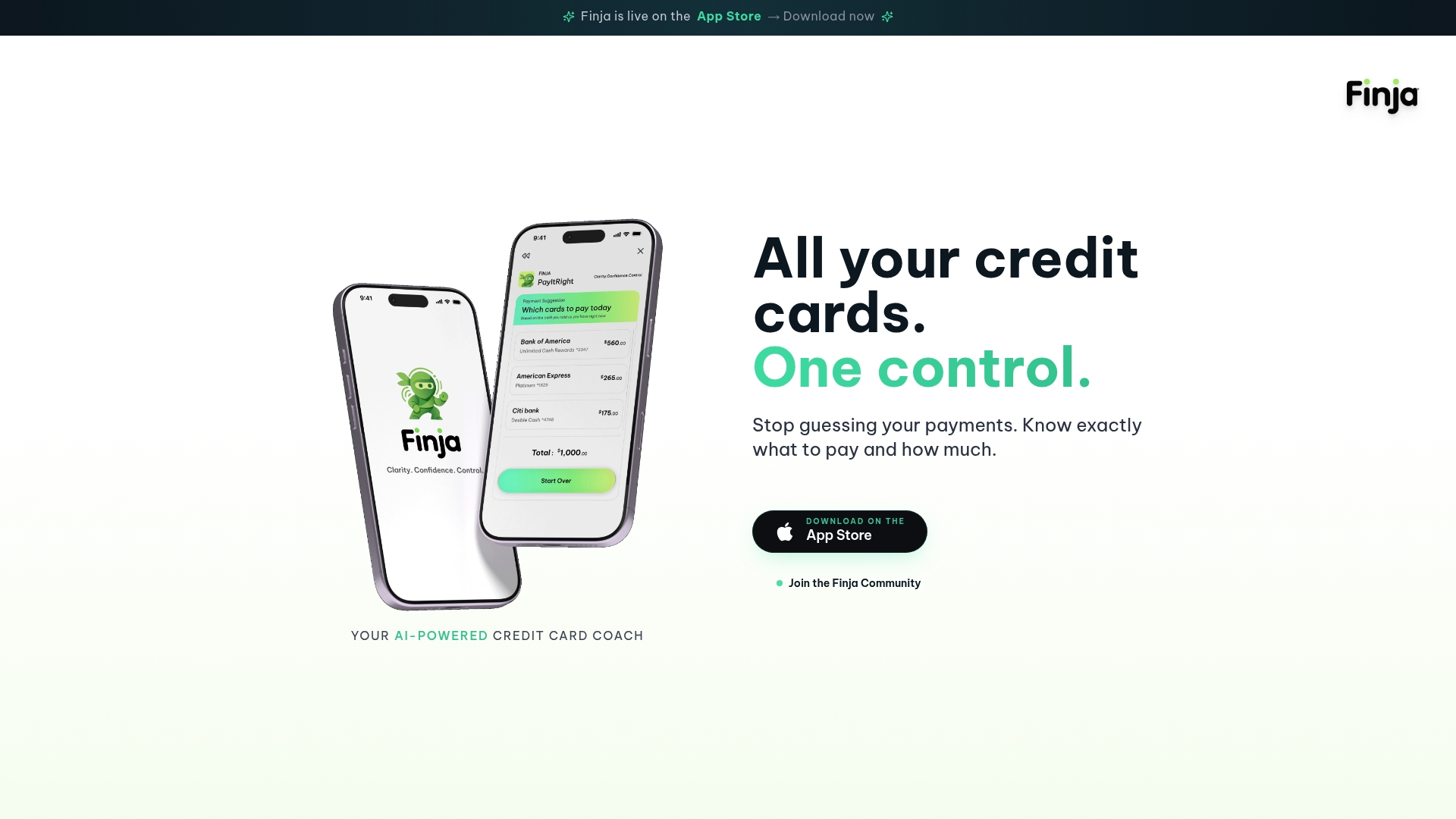
Connect your cards, run the payment optimizer, and Finja surfaces your highest-cost balance, calculates the extra payment that accelerates payoff the most, and routes it automatically. The interest-tracking dashboard shows you month-over-month progress in dollars saved, not just balance movement. For borrowers managing a 0% transfer alongside existing cards, the promo monitoring feature flags when you're off pace before the rate resets.
Start with Finja to link your accounts and run your first payment optimization in under five minutes.
Finja is a financial management tool, not a lender or financial advisor. Results depend on your specific balances, APRs, and payment behavior.
Sources and calculators for running the numbers yourself
- How to Negotiate a Lower Interest Rate on Your Credit Card
- compound interest calculator
- How compound interest works | Teachers Federal Credit Union
- How to Lower Your Interest Rates Without Refinancing
- You can’t beat the bank by paying $1 a day extra on your mortgage. Here’s how compound interest really works
- How to Beat Interest on a Loan: 7 Ways to Pay Less — LegalClarity