
High-interest card prioritization, formally known as the debt avalanche method, means paying the minimum on every account you carry and directing every extra dollar to the card with the highest APR until that balance hits zero. Then you roll that freed-up payment to the next-highest-rate card and repeat. Investor.gov frames it plainly: eliminating high-interest debt is often the highest guaranteed return available to a consumer, because no common investment reliably beats a 20%+ APR after risk. The method saves the most money over time and shortens your payoff timeline, but it requires patience since the first card may take months to clear.
Table of Contents
- What does "high-interest card prioritization" actually mean?
- How to execute the avalanche method step by step
- Avalanche vs. snowball: which one should you use?
- When high-interest prioritization is the right fit (and when it isn't)
- Practical tactics that make the avalanche work faster
- A worked example: how much does the avalanche actually save?
- Other options worth considering
- Key takeaways
- The math is right, but behavior is the real variable
- Finja helps you put the avalanche on autopilot
- Useful sources and further reading
What does "high-interest card prioritization" actually mean?
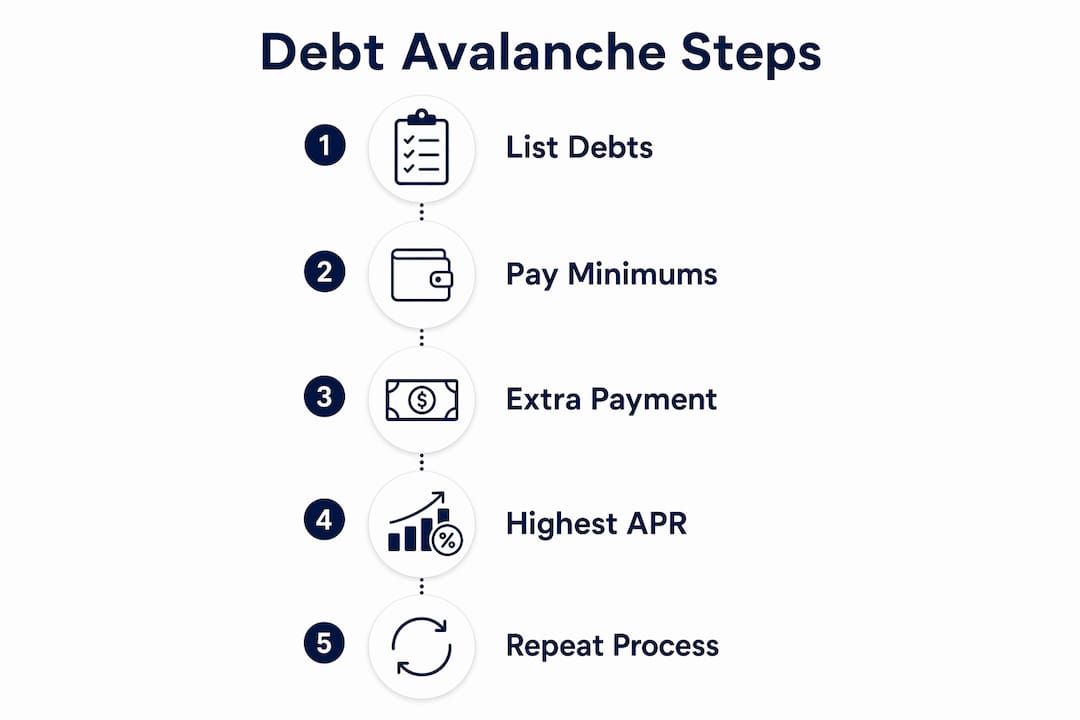
The core idea is simple: order your debts by APR from highest to lowest, pay the minimum on everything, and throw any extra cash at the top of the list. Once that card is gone, its minimum payment becomes your new extra payment on the next card. The debt avalanche method works because interest accrues daily on your outstanding principal, so the highest-rate balance generates the most new debt per unpaid dollar. Killing it first stops that bleeding fastest.
What counts as "high interest" on a credit card?
Any double-digit APR qualifies, but the practical threshold most financial professionals use is 18% and above. Average credit card APRs were reported at 21.52% in early 2026, which means the typical American card already clears that bar. Payday loans sit even higher, often in triple digits. Personal loans for borrowers with poor credit frequently land in the 25%–36% range.
Accounts that typically qualify as high-interest:
- Credit cards (most carry APRs of 18%–30%+)
- Store or retail cards (often 25%–30% APR)
- Payday loans and cash-advance products
- Personal loans issued to subprime borrowers
The method's three core steps:
- List every debt with its current balance, APR, and minimum payment.
- Pay the minimum on every account each month without exception.
- Apply all remaining available cash to the highest-APR balance until it's gone, then cascade to the next.
How to execute the avalanche method step by step
Start by pulling every statement or logging into each account. Write down the balance, APR, and minimum payment for each card. Sort the list from highest APR to lowest. If two cards share the same rate, put the smaller balance first so you clear one account sooner and simplify your stack.
Monthly workflow:
- Schedule minimum payments on all cards via autopay so you never miss one.
- Calculate what's left in your budget after essentials and minimums.
- Transfer that surplus to the highest-APR card before anything else.
- After the transfer, confirm with your issuer how payment allocation works. Federal rules require issuers to apply amounts above the minimum to your highest-rate balance first, but verifying this takes 30 seconds and prevents surprises.
Where to find extra payment dollars:
- Cancel or pause subscriptions you haven't used in 60 days.
- Redirect any windfall (tax refund, bonus, side income) entirely to the top card.
- Round up your extra payment to the nearest $25 or $50 each month.
- Switch to biweekly payments: half your normal extra payment every two weeks adds up to one extra full payment per year.
Pro Tip: Set your minimum payments on autopay the day after your paycheck clears, then schedule your extra avalanche payment as a separate transfer two days later. Treating the extra payment like a bill, not a discretionary choice, is the single biggest behavioral lever in this method.
Tracking dollars of interest saved, not just the balance remaining, also helps. Seeing "$340 in interest avoided so far" is more motivating than watching a $4,200 balance creep down by $80 a month.

Avalanche vs. snowball: which one should you use?
The debt snowball method, popularized by Dave Ramsey, orders debts by balance size rather than APR. You pay off the smallest balance first regardless of its rate, collect a quick win, and build momentum from there. It works well psychologically. The avalanche method wins on pure math.
Avalanche advantages:
- Minimizes total interest paid across all accounts.
- Shortens overall time-to-debt-free when APRs differ significantly.
- Works best when you have several cards with similar balances but different rates.
Snowball advantages:
- Delivers faster early wins, which sustains motivation.
- Reduces the number of open accounts sooner.
- Better fit for people who have struggled to stay consistent with past plans.
Avalanche disadvantages:
- The highest-APR card may also carry the largest balance, meaning months pass before you see a zero.
- Requires tracking and discipline without the psychological reward of a closed account.
Snowball disadvantages:
- You may pay significantly more interest if your smallest balance carries a low rate while a large high-rate card sits untouched.
- Slower total payoff when APR spreads are wide.
Decision rule: Choose the avalanche if you're numbers-oriented and can stay the course without frequent wins. Choose the snowball if past attempts at debt payoff stalled because the goal felt too distant. A hybrid works too: pay off one small card first for the psychological boost, then switch to strict APR ordering for everything else. The CFPB-referenced guidance is clear that attacking the highest-rate balance first is mechanically the fastest way to stop interest growth.
When high-interest prioritization is the right fit (and when it isn't)

The avalanche method delivers its biggest advantage in a specific situation: multiple revolving credit-card accounts with mid-to-high APRs and roughly comparable balances. When debt consists mainly of similar revolving accounts, APR ordering produces meaningful savings. When a large low-rate installment loan (car, student) dominates your interest column, the avalanche's edge shrinks because the rate differential is small.
Use the avalanche when:
- You carry two or more credit cards with APRs above 18%.
- You can consistently pay more than the minimum each month.
- Your primary goal is minimizing total interest cost.
- You're comfortable with slow, math-driven progress.
Red flags that suggest a different approach:
- One card is nearly maxed out and dragging your credit utilization above 30%, harming your score and blocking access to lower-rate consolidation offers.
- You need immediate cashflow relief and a closed account would free up a minimum payment you can't currently cover.
- Your debt mix is dominated by a low-APR auto or student loan where rate ordering barely changes the outcome.
The hybrid rule: If one card sits above 30% utilization and is hurting your credit score, pay it down to the 30% threshold first, even if it isn't your highest-APR card. Once utilization improves, your score may recover enough to qualify for a balance-transfer card or consolidation loan at a lower rate. Then resume strict avalanche ordering. Keeping utilization below 30% helps your credit score; some advisors recommend staying under 20% for the strongest effect.
Practical tactics that make the avalanche work faster
Negotiate your APR directly
Call the number on the back of your card and ask for a rate reduction. It costs nothing and works more often than most people expect. A simple script: "I've been a customer for [X] years and I've been paying on time. I'm working to pay down this balance and a lower rate would help me do that faster. Is there a retention offer or hardship rate available?" Ask specifically about hardship programs, promotional rates, and whether a supervisor can approve a temporary reduction. Even a 3–5 percentage-point drop on a $5,000 balance saves hundreds of dollars over a year.
Balance-transfer checklist
A 0% intro APR balance-transfer card can pause interest accumulation entirely for 12–21 months. Before you apply, run this math:
- Calculate the transfer fee (typically 3%–5% of the balance moved).
- Estimate interest you'd pay on the current card during the intro period.
- If interest saved exceeds the fee, the transfer makes sense.
- Model the post-intro APR: if you won't clear the balance before the intro period ends, the rate that kicks in afterward may be just as high as your current card.
- Check your credit score first. Balance-transfer offers with 0% rates generally require good-to-excellent credit.
Pro Tip: Never use a balance-transfer card for new purchases during the intro period unless the card explicitly offers 0% on purchases too. New charges often accrue interest immediately at the standard rate.
When a personal loan or consolidation makes sense
A personal loan at a fixed rate below your weighted average credit-card APR can replace multiple variable-rate balances with one predictable payment. The CFPB's consolidation guidance cautions that consolidation only helps if you stop adding to the cards you just cleared. Run the numbers: compare the loan's total interest cost plus any origination fee against what you'd pay continuing the avalanche at current rates.
Warnings to watch:
- Zero-percent offers that reset to 25%+ after the intro window.
- Consolidation loans with origination fees above 5% that eat the interest savings.
- Any plan that extends your repayment term so far that total interest actually rises.
A worked example: how much does the avalanche actually save?
Assumptions: Three credit cards, $500 extra per month available beyond minimums.
| Card | Balance | APR | Minimum Payment | Monthly Interest |
|---|---|---|---|---|
| Card A | $5,000 | 24% | $60 | $60 |
| Card B | — | 19% | $100 | — |
| Card C | — | 14% | — | — |
Avalanche order: Card A first (24%), then Card B (19%), then Card C (14%).
With $500 extra directed at Card A each month, Card A clears in roughly 5 months. The freed-up $560 (Card A's minimum + extra) then hits Card B. Card B clears in approximately 9 more months. Card C follows, clearing in about 3 months. Total payoff: roughly 17 months. Estimated total interest paid: approximately $1,650.
Paying minimums only on all three cards would extend repayment to well over 10 years and generate several thousand dollars in interest, with Card A alone compounding at 24% the entire time.
The math is the point. Directing $500 extra per month to the highest-APR card first, rather than splitting it evenly or applying it to the largest balance, can cut total interest by a meaningful margin on a $10,000 debt load. Run your own numbers with a free debt payoff calculator at Investor.gov or a spreadsheet using the same structure above.
Small changes compound quickly. Adding $100 more per month to the extra payment in this example shaves roughly 3 months off the timeline and reduces interest further.
Other options worth considering
The avalanche isn't the only path. Depending on your situation, one of these alternatives may be a better starting point or a useful complement.
Debt-management plans (DMPs) through nonprofit credit counseling:
- A nonprofit credit counselor negotiates reduced APRs and waived fees with your creditors on your behalf.
- You make one monthly deposit to the agency; they distribute payments to creditors.
- The FTC's guidance notes that creditors may agree to lower rates or waive fees under a DMP, which can make the avalanche math work even better inside the plan.
- DMPs typically run 3–5 years and require closing enrolled cards, which affects your credit mix.
When to call a credit counselor instead of going it alone:
- Your total balance exceeds what you can realistically pay in 5 years at current rates.
- You've missed payments and creditors are calling.
- You want professional negotiation without paying a for-profit debt-settlement company.
Immediate next steps:
- List all balances, APRs, and minimums today. The list itself clarifies the problem.
- Run a payoff calculator with your actual numbers before committing to a method.
- Call your highest-APR issuer and ask about rate reductions or hardship programs.
- If the numbers feel unmanageable, contact the National Foundation for Credit Counseling (NFCC) for a free or low-cost counseling session.
For a broader look at reducing credit card bills and when simplifying your card count helps, the Finja blog covers both in detail.
Key takeaways
The debt avalanche method saves the most money of any DIY repayment strategy by eliminating the highest-APR balance first and rolling freed payments forward.
| Point | Details |
|---|---|
| Core definition | Pay minimums on all cards; direct every extra dollar to the highest-APR balance first. |
| What counts as high interest | Any APR above 18% qualifies; the average U.S. card ran at 21.52% in early 2026. |
| Main caveat | Progress feels slow early on; track interest saved, not just balance, to stay motivated. |
| Hybrid rule | If one card exceeds 30% utilization, pay it to that threshold first, then resume APR ordering. |
| Finja's role | Finja automates payment prioritization across multiple cards so the avalanche runs without manual tracking each month. |
The math is right, but behavior is the real variable
The avalanche method is mathematically correct. There's no debate there. But "mathematically correct" and "works for you" are not the same thing, and most articles skip that gap entirely.
Here's what I think gets underestimated: the avalanche's weakness isn't the math, it's the timeline. If your highest-APR card also carries your largest balance, you might spend six or eight months paying it down before you close a single account. That's a long time to stay disciplined with no visible finish line. The people who abandon the avalanche mid-plan don't do it because they stopped caring. They do it because the method gave them nothing to celebrate.
The fix isn't to abandon APR-first ordering. It's to build milestones into the plan. Track the dollar amount of interest you've avoided, not just the balance remaining. Set a celebration point at every $500 of interest saved. Combine the avalanche with a rate-negotiation call on month one, so you get an immediate win (a lower rate) even before the balance moves much. These aren't compromises to the math. They're the behavioral scaffolding that keeps the math running.
The other thing worth saying plainly: if your utilization on one card is above 30%, fixing that first isn't cheating. It's smart sequencing. A better credit score in three months might qualify you for a balance-transfer card that cuts your effective APR to zero for 15 months. That outcome beats strict avalanche ordering by a wide margin. The goal is to pay the least interest possible, not to follow a rule for its own sake.
Real debt payoff stories, like the ones documented at Demivolt, consistently show that the people who succeed combine a clear method with behavioral tactics, not just discipline alone.
Finja helps you put the avalanche on autopilot
Knowing the avalanche method and executing it across four or five cards every month are two different things. Finja is an AI-powered credit card management platform built for exactly this situation: multiple cards, different APRs, and the constant mental load of deciding where each dollar goes.
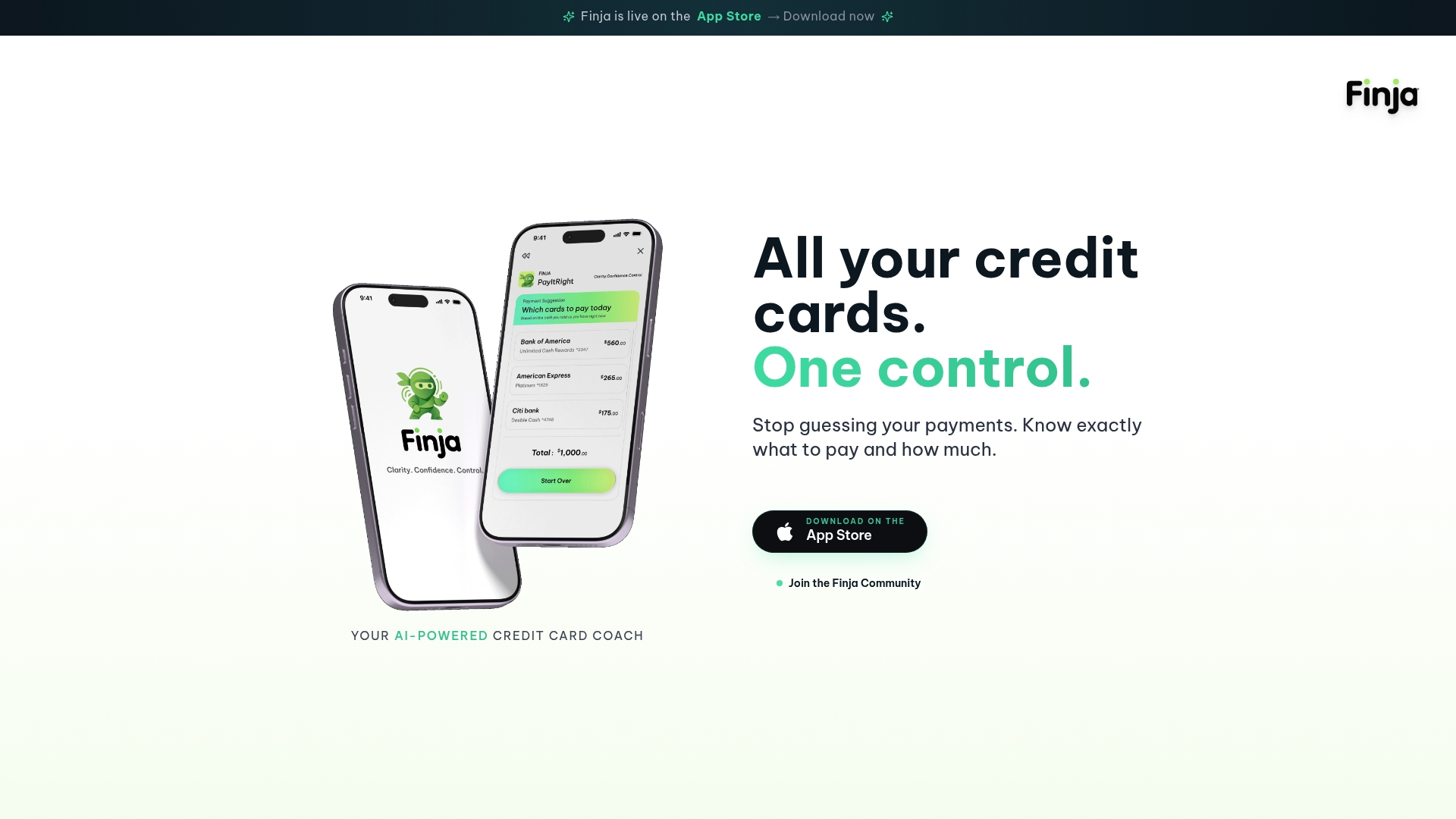
Finja aggregates your card balances and rates, identifies the optimal payment order, and schedules your extra payments automatically so the avalanche runs in the background without a spreadsheet. It also flags when a card's utilization is creeping toward a threshold that could hurt your credit score, so you can make the hybrid call before it costs you. The platform complements, not replaces, the rate negotiation and consolidation decisions covered above. Those calls are still yours to make. Finja just handles the monthly execution.
If you're ready to stop manually tracking which card gets the extra payment this month, start with Finja and let the math run itself.
This article is general financial information, not professional advice. Confirm current rates, program terms, and eligibility with your card issuers or a qualified financial counselor before making decisions specific to your situation.
Useful sources and further reading
- Investor.gov: Pay Off Credit Cards or Other High Interest Debt — The U.S. government's investor education site explains why eliminating high-interest debt often beats investing; useful for understanding the opportunity-cost argument.
- CFPB: Consolidating Credit Card Debt — Official guidance on what to evaluate before consolidating, including risks and conditions.
- FTC Consumer Advice: How to Get Out of Debt — Plain-language overview of negotiation, DMPs, and credit counseling options.
- Experian: Highest Balance vs. Highest Interest First — Covers the avalanche vs. snowball tradeoff and provides current APR context.
- BrightStar Credit Union: Strategies to Pay Off High-Interest Debt — Practical breakdown of the avalanche method with balance-transfer evaluation guidance.
- Finja blog: Debt-Free Credit Card Strategy — Step-by-step sequencing guide for becoming debt-free across multiple cards.
- Finja blog: Credit Card APR Explained — How APR is calculated and what compounding actually costs you month to month.
- Finja blog: Managing Multiple Credit Cards — Operational tips for keeping several cards organized while executing a payoff plan.