
Payment allocation is defined as the method credit card issuers use to distribute your payments across different balances, each carrying its own interest rate. The Credit CARD Act of 2009 mandates that any payment above the minimum goes to your highest APR balance first. That single rule can save you hundreds of dollars in interest, but only if you understand how payment allocation credit cards works in practice, including the exceptions issuers use to their advantage. Managing multiple cards adds another layer: each issuer runs its own internal hierarchy, and the rules are not identical across the industry.
How payment allocation on credit cards is governed by federal law
The CARD Act of 2009 is the primary federal law shaping how your payments are applied. Under the CARD Act, payments above the minimum must go to the balance carrying the highest interest rate first. That protection applies every billing cycle, not just once.
The minimum payment itself is a different story. Issuers retain full discretion over how they allocate the minimum portion of your payment. Most apply minimums to lower APR balances first, which keeps your high-rate debt alive longer and generates more interest revenue for them. This is the "minimum payment trap," and it persists despite federal protections.
A few key points clarify the scope of these rules:
- The CARD Act applies to consumer credit cards only. Business cards and charge cards are not covered.
- Minimum payment allocation remains entirely at issuer discretion, regardless of your APR mix.
- Deferred interest promotions are treated as 0% APR for most of the promotional period, so excess payments bypass them and go to higher-rate balances instead.
- The law sets a floor, not a ceiling. Issuers can choose to be more consumer-friendly, but they rarely are.
Pro Tip: Pay at least $1 above the minimum every month. That extra dollar triggers CARD Act protections and gets directed to your highest-rate balance instead of wherever the issuer prefers.
How does the internal payment hierarchy actually work?
Most U.S. issuers use a layered system of APR buckets. Purchases, cash advances, balance transfers, and promotional offers each sit in a separate bucket with its own rate. Your payment does not reduce your total balance uniformly. It flows through a hierarchy.

Here is how a typical payment waterfall works across common balance types:
| Balance type | Typical APR range | Allocation priority (excess payment) |
|---|---|---|
| Deferred interest promo | 0% (during promo) | Last, until final two billing cycles |
| Standard purchases | 20%–29% | High priority |
| Balance transfers | 15%–25% | Medium priority |
| Cash advances | 25%–30% | Highest priority |
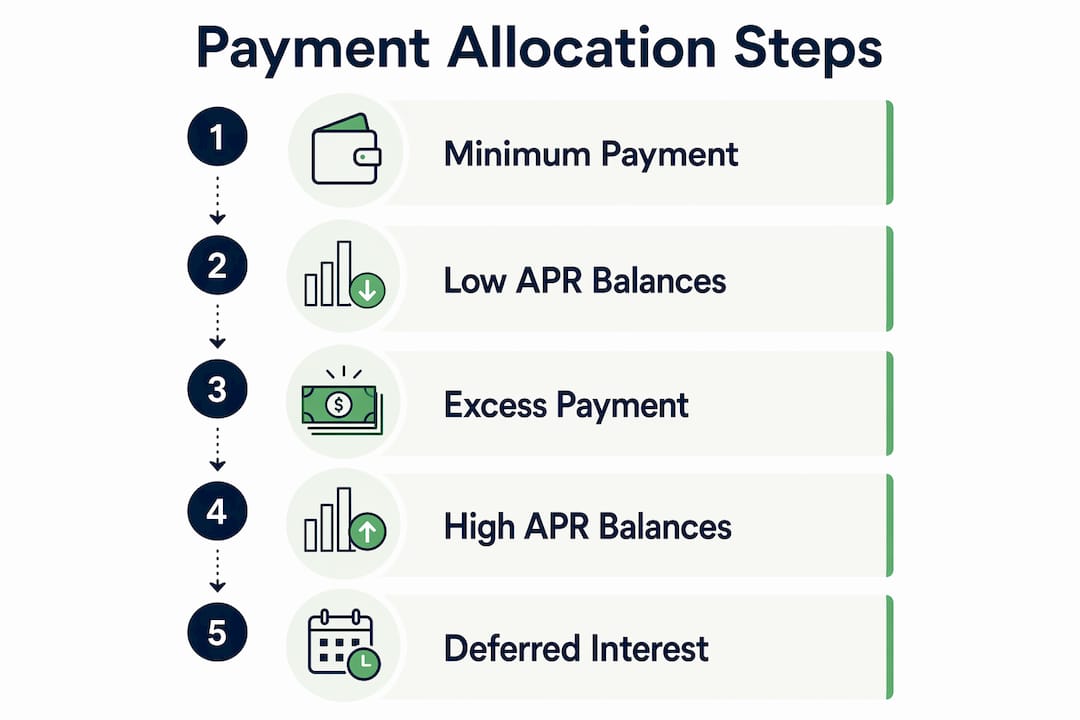
Allocation only begins after your payment reaches a fully posted state. Payments posted near a cycle close may not reduce interest on that statement. They affect the next cycle instead. This lag is not a glitch. It is how the billing system is designed.
The minimum payment portion of your payment gets allocated first, typically toward the lowest-rate balance. The excess portion then flows to the highest-rate balance per CARD Act rules. These two allocations happen separately inside the issuer's system. Consumers often confuse payment posting with payment allocation, which leads to incorrect assumptions about which balances are being reduced.
Pro Tip: Check your statement balance breakdown, not just the total. If you carry a cash advance balance alongside purchases, confirm your excess payment is hitting the cash advance bucket first.
How to manage payment allocation across multiple credit cards
Managing multiple cards means dealing with multiple hierarchies. Issuer-specific payment allocation rules vary, and federal law only sets minimum protections. What works on one card may not apply to another.
Follow these steps to stay in control:
- Read each card's disclosure. Your cardholder agreement spells out how minimum payments are allocated. Most issuers bury this in the terms, but it is there.
- Identify your highest APR balance across all cards. This is the balance costing you the most money each month. Direct any extra payment toward it first.
- Pay above the minimum on every card. Even a small excess triggers CARD Act protections on each account.
- Track your balance types per card. If one card holds a cash advance, that balance likely carries a higher rate than purchases on the same card.
- Set payment dates strategically. Paying several days before the statement closing date gives your payment time to post and allocate within that cycle.
When balancing payments across cards, consider these factors:
- Cards with deferred interest promotions need a payoff plan before the deadline, not just minimum payments.
- Cards with cash advance balances deserve priority because cash advance APRs are typically the highest on any card.
- Cards near their credit limit affect your credit utilization ratio, which influences your credit score independently of interest costs.
Finja's multi-card management tools help you map each card's allocation rules and identify where extra payments will have the greatest impact on your total interest costs.
What are deferred interest, trailing interest, and timing traps?
Deferred interest promotions are the most misunderstood feature in the credit card billing process. A retailer card offering "12 months same as cash" is not a true 0% APR offer. If you do not pay the full promotional balance before the deadline, retroactive interest on a $3,000 purchase can exceed $700. The interest was accruing the entire time. It was just deferred, not forgiven.
Here is what catches most cardholders off guard:
- During most of the promotional period, the deferred balance is treated as 0% APR. Excess payments skip it and go to higher-rate balances instead.
- In the final two billing cycles, the allocation rule flips. Excess payments then go toward the deferred balance to help you pay it off.
- If any balance remains after the deadline, the full retroactive interest posts immediately.
Trailing interest is a separate issue. It accrues between your statement's closing date and the date your payment actually posts. Even if you pay your statement balance in full, trailing interest can generate a small charge on your next statement. The CARD Act does not eliminate trailing interest. It only governs how payments are allocated once they post.
Paying your full statement balance eliminates new purchase interest going forward, but it does not erase interest that accrued between your closing date and your payment date. That trailing amount shows up on your next statement as a small, unexpected charge. The fix is to pay the next statement balance in full as well, which clears the trailing interest and resets your grace period.
Understanding how billing cycles affect interest is the clearest way to avoid these timing surprises.
Key Takeaways
Payment allocation determines which balances your money reduces first, and the difference between paying the minimum and paying above it is the difference between growing debt and shrinking it.
| Point | Details |
|---|---|
| CARD Act protects excess payments | Any amount above the minimum must go to your highest APR balance first, every billing cycle. |
| Minimum payments favor issuers | Issuers allocate minimums toward lower-rate balances, keeping high-rate debt alive longer. |
| Deferred interest is a deadline risk | Missing the payoff deadline on a deferred interest promo triggers retroactive interest on the full original balance. |
| Posting timing affects interest | Payments allocate only after posting, so payments near cycle close may not reduce interest until the next statement. |
| Multi-card strategy requires issuer knowledge | Federal rules set a floor; each issuer's hierarchy differs, so reading your disclosures is non-negotiable. |
Why I think most cardholders are losing money they do not have to lose
Grace K. here. After years of watching people manage credit card debt, the pattern I see most often is this: cardholders pay the minimum, assume the payment is working for them, and then wonder why their balance barely moves. The minimum payment trap is not a myth. It is a design feature that issuers rely on.
The CARD Act was a genuine win for consumers, but it only helps if you pay above the minimum. That is the activation condition most people miss. Paying $5 above the minimum on a card with a 27% APR cash advance balance is not a strategy. It is a starting point. The real leverage comes from understanding your balance breakdown and directing meaningful excess payments to the right bucket.
Deferred interest promotions deserve special attention. I have seen cardholders pay faithfully for 11 months on a furniture card, miss the final month, and receive a $600 interest charge. The promotional language sounds like a 0% deal. It is not. Read the fine print before you sign up, and set a calendar reminder for two months before the deadline.
The good news is that the mechanics are learnable. Once you understand the credit card payment hierarchy and how your issuer applies your money, you stop guessing and start making payments that actually reduce your cost of debt.
— Grace K.
How Finja helps you put payment allocation to work
Understanding the rules is one thing. Applying them across three or four cards with different APRs, promotional balances, and billing cycles is another challenge entirely.
Finja is an AI-powered credit card coach built for exactly this situation. It reads your card details, maps each issuer's allocation hierarchy, and tells you where your next payment will have the greatest impact on your total interest costs. You get a clear picture of which balances are costing you the most and how to reduce your credit card bills without guessing. Visit Finja to see how AI-driven payment guidance works for your specific card mix.
FAQ
What is payment allocation on a credit card?
Payment allocation is how your credit card issuer distributes your payment across different balances, each with its own interest rate. Federal law requires any amount above the minimum to go to the highest APR balance first.
Does the CARD Act cover all credit cards?
The CARD Act applies to consumer credit cards only. Business credit cards and charge cards are not covered by its payment allocation rules.
Why do I still owe interest after paying my full balance?
Trailing interest accrues between your statement closing date and the date your payment posts. Paying the next statement balance in full clears it and restores your grace period.
How does a deferred interest promotion affect my payments?
During most of the promotional period, the deferred balance is treated as 0% APR, so excess payments go to higher-rate balances instead. Missing the payoff deadline triggers retroactive interest on the full original balance.
How do I manage payment allocation across multiple cards?
Issuer allocation rules vary, so read each card's disclosure to understand its hierarchy. Pay above the minimum on every card, and direct the largest excess payments to the card with the highest APR balance.