
A credit card minimum payment is the lowest required monthly amount you must pay to keep your account in good standing and avoid late fees or penalty interest rates. Most cardholders treat it as a safe floor, but it functions more like a debt trap with a polite label. Paying only the minimum on a $3,000 balance can keep you in debt for decades while costing you far more than you originally charged. This article breaks down how minimum payments are calculated, what they actually cost you, and how to build a credit card minimum payment strategy that works in your favor.
What is minimum payment on a credit card, exactly?
The minimum credit card payment definition is straightforward: it is the smallest dollar amount your issuer will accept each billing cycle without penalizing your account. The industry standard term for this is the "minimum payment due," and you will see it listed on every monthly statement next to your total balance and due date.
Issuers set this number low by design. A low minimum keeps your account current, which satisfies regulators, while maximizing the interest you pay over time. The minimum payment is not a suggested repayment amount. It is the legal floor your issuer must accept to avoid reporting your account as delinquent.
Missing this floor triggers late fees, penalty APRs, and a negative mark on your credit report. Paying it on time does none of those things, but it also does almost nothing to reduce your actual debt.
How do credit card issuers calculate minimum payments?
Minimum payment formulas vary by issuer, but they follow one of two basic structures. Understanding how to calculate minimum payment amounts helps you predict your bill and plan around it.
The two most common methods are:
- Percentage of balance. The issuer charges 1–4% of your outstanding balance. On a $2,000 balance at 2%, your minimum is $40.
- Flat dollar floor. Most issuers set a minimum floor of $15–$40, regardless of how small your balance gets. If the percentage calculation falls below this floor, you pay the flat amount instead.
- Percentage plus interest and fees. Some issuers calculate a small percentage of the principal (often 1%) and then add the full month's interest charges and any fees on top. This method produces higher minimums but also retires principal faster.
- Greater of two formulas. Many issuers use whichever result is higher between a flat dollar amount and a percentage calculation.
The critical detail most cardholders miss: minimum payments change monthly when calculated by percentage. As your balance drops, your minimum drops too. That sounds helpful, but it actually slows your payoff because you are always paying a shrinking fraction of a shrinking number.
Pro Tip: Fix your payment at the original minimum amount even as your balance falls. You will pay off the debt significantly faster without changing your budget.
What happens when you pay only the minimum?
Paying only the minimum each month is the most expensive credit card payment option available to you. The consequences compound quickly and affect both your wallet and your credit file.
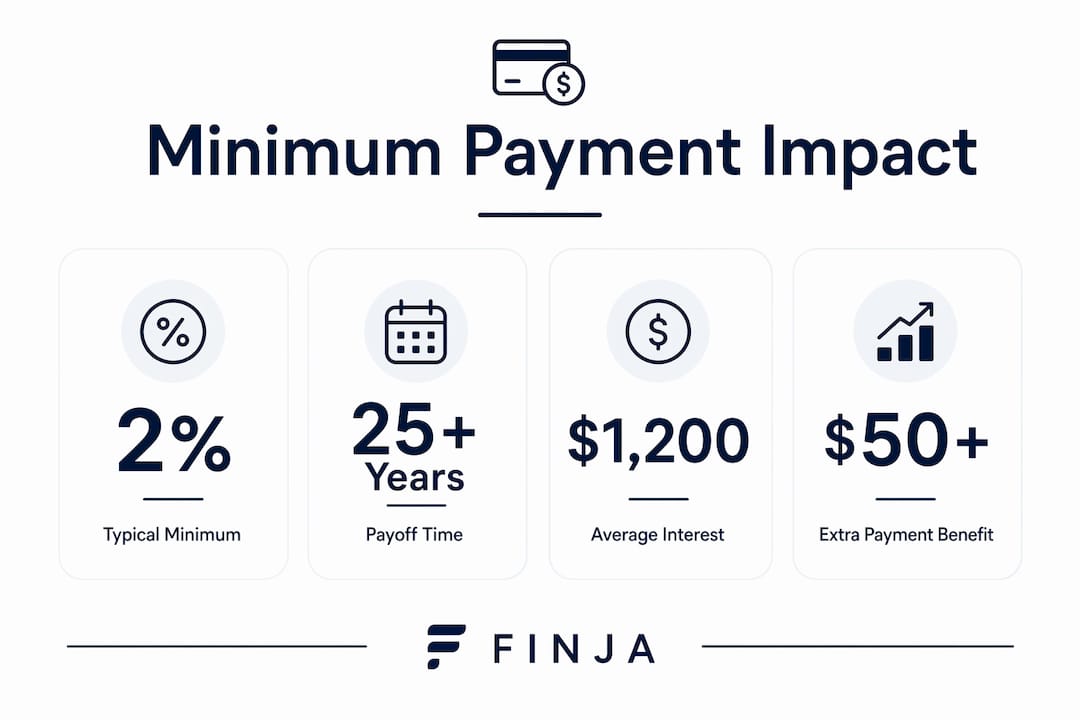
Paying only the minimum can extend your debt payoff timeline to 25–30 years, with total interest exceeding the original principal. That means a $3,000 vacation charge could cost you $6,000 or more by the time you finish paying it off.
The specific consequences include:
- Minimal principal reduction. Most of each minimum payment covers interest, not debt. Only a small fraction reduces what you actually owe.
- Loss of grace period. Once you carry a balance, your grace period disappears. New purchases start accruing interest immediately, not at the end of the billing cycle. Restoring the grace period requires paying your full statement balance for two consecutive months.
- Compounding interest. Interest charges get added to your balance each month. Next month's interest is calculated on a higher number, which accelerates the debt growth.
- High credit utilization. Carrying a large balance relative to your credit limit raises your credit utilization ratio. High utilization suppresses your credit score even when every payment is on time.
The math is stark. Adding just $50 to a fixed minimum payment can reduce your payoff time from decades to 5–6 years. That single adjustment costs you less than a dinner out each month and saves you thousands in interest.
How do minimum payments affect your credit score?
The relationship between minimum payments and credit health is more complicated than most cardholders realize. Payment timing and payment amount affect your score in completely different ways.
Making minimum payments on time builds positive payment history, which is the single largest factor in your credit score. Missing a payment by 30 days causes far more damage than paying only the minimum ever could. Your first priority is always to pay at least the minimum by the due date, every cycle.
That said, on-time minimums do not protect you from the second biggest score factor: credit utilization. High utilization suppresses credit scores until balances decrease significantly. Carrying $4,500 on a $5,000 limit card is a 90% utilization rate, and that single number can drag your score down by dozens of points regardless of your payment history.
Strategies to protect your credit health beyond the minimum:
- Pay down your highest-utilization cards first to lower your overall ratio.
- Request a credit limit increase on cards you manage responsibly. A higher limit lowers your utilization percentage without requiring you to pay down debt immediately.
- Monitor your credit card account status regularly so you catch problems before they hit your credit report.
- Avoid opening multiple new accounts in a short window, which temporarily lowers your average account age.
Credit bureaus report your balance and payment status each month. Paying the minimum keeps your account current in their records, but the balance stays visible. Lenders see both the on-time payment and the high balance when they review your file.
Effective strategies to go beyond the minimum payment
Minimum payments are not a viable long-term debt strategy. The good news is that you do not need a dramatic budget overhaul to do better. Small, consistent changes produce real results.
Here are four methods ranked by impact:
- Fix your payment amount. Set a payment above your current minimum and keep it there as your balance falls. This prevents the "gliding minimum" effect where your required payment shrinks alongside your balance, slowing payoff to a crawl.
- Use the debt avalanche method. Pay minimums on all cards, then direct every extra dollar to the card with the highest interest rate. This method minimizes total interest paid across multiple credit cards.
- Use the debt snowball method. Pay minimums on all cards, then attack the card with the smallest balance first. Each payoff frees up cash for the next card and builds momentum.
- Consider a consolidation loan. A personal loan at a lower interest rate than your cards can consolidate multiple balances into one fixed payment. This simplifies your billing cycle and reduces total interest if you qualify for a competitive rate.
Paying more than the minimum lowers your balance faster, reduces interest charges, and improves your credit utilization ratio. Even small additional payments accelerate payoff significantly.
Pro Tip: Automate a payment that is $25–$50 above your minimum. Automation removes the decision from your monthly routine and prevents the temptation to pay less during tight months.
The table below shows how payment amount changes the payoff timeline on a $3,000 balance at 20% APR:
| Monthly payment | Approximate payoff time | Approximate total interest |
|---|---|---|
| Minimum only (2%) | 25+ years | $3,000+ |
| $75 fixed | ~6 years | ~$2,400 |
| $150 fixed | ~2.5 years | ~$900 |
| Full balance | 1 month | $0 |
Tracking monthly interest charges is the fastest way to see whether your payments are actually reducing debt or just servicing it.
Key Takeaways
The minimum payment on a credit card keeps your account current but retires debt so slowly that total interest often exceeds the original balance, making any payment above the minimum the most effective debt reduction move you can make.
| Point | Details |
|---|---|
| Minimum payment definition | The lowest amount due each billing cycle to avoid late fees and penalties. |
| Calculation methods | Issuers use 1–4% of balance or a flat $15–$40 floor, whichever is greater. |
| Cost of paying minimums only | Payoff can stretch 25–30 years, with total interest exceeding the original balance. |
| Credit score impact | On-time minimums protect payment history, but high utilization still suppresses scores. |
| Best strategy | Fix payments above the minimum and apply the avalanche or snowball method to pay down debt faster. |
The uncomfortable truth about minimum payments
Grace K. here. After years of writing about personal finance, the pattern I see most often is this: cardholders who understand minimum payments intellectually still pay only the minimum when money feels tight. The minimum feels like the "responsible" choice because it keeps the account current. It is not. It is the most expensive choice available.
The detail that changed how I think about this: credit card issuers profit precisely because minimum payments keep accounts current while retiring principal at the slowest rate the law allows. The system is not designed to help you get out of debt. It is designed to keep you in it just comfortably enough that you do not panic.
My honest recommendation is to treat the minimum as a safety net, not a target. If you can only afford the minimum this month, pay it and protect your payment history. But the moment you have an extra $30 or $50, put it toward the highest-rate card you carry. That habit, repeated consistently, is what actually reduces credit card debt over time.
The misconception I hear most often is that minimum payments are fixed. They are not. If your minimum is percentage-based, it shrinks as your balance shrinks, which means your payoff slows down automatically unless you intervene. Fix your payment. Do not let the issuer decide how long you stay in debt.
— Grace K.
How Finja helps you pay down debt faster
Managing minimum payments across multiple credit cards is where most people lose track of their progress.
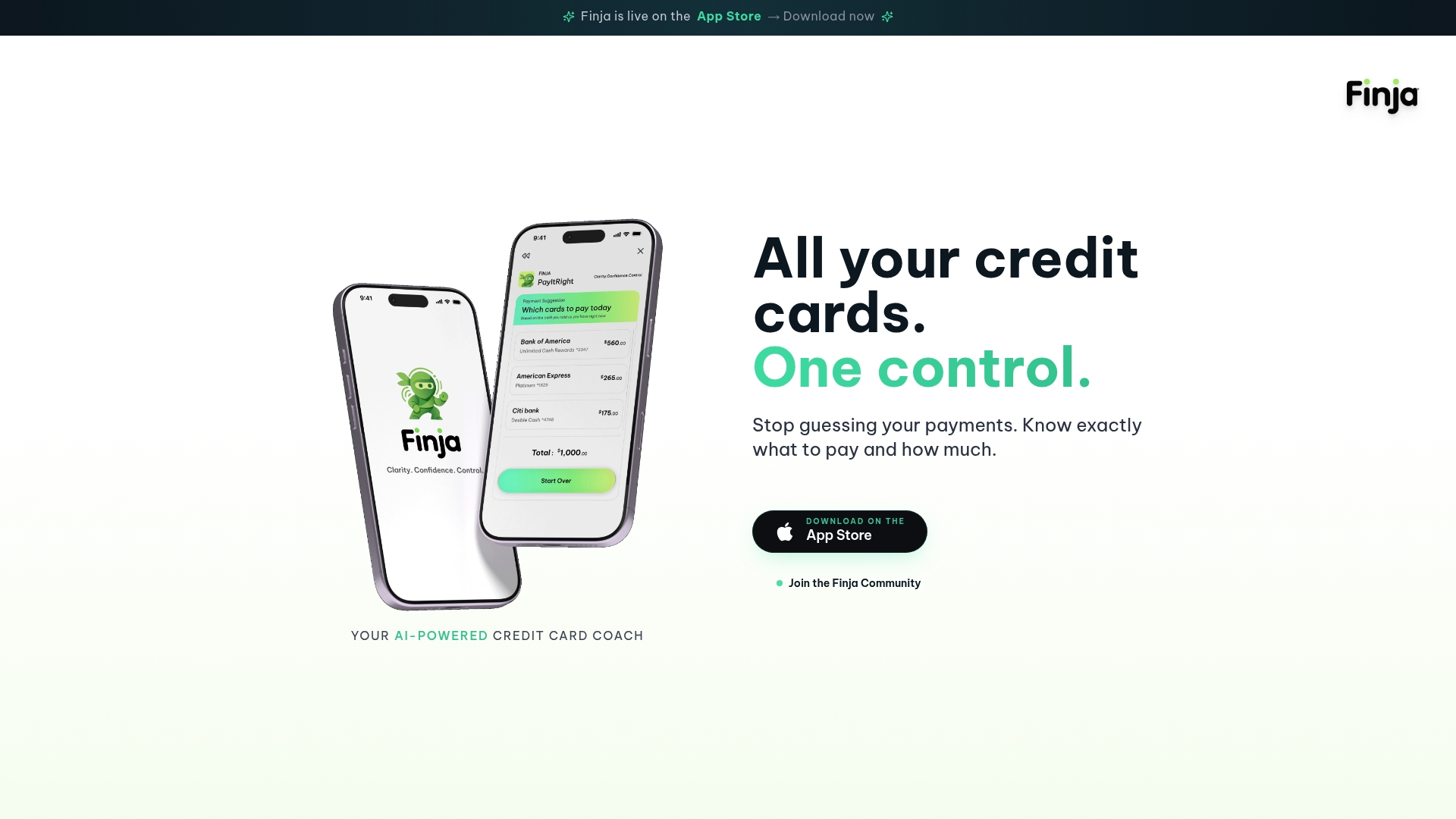
Finja is an AI-powered credit card management platform built for exactly this situation. It analyzes your balances, interest rates, and payment history to show you where minimum payments are costing you the most. Finja then recommends a payment sequence, whether avalanche, snowball, or a hybrid approach, that fits your actual budget. Instead of guessing whether you are making progress, you get a clear picture of your payoff timeline and total interest saved. Visit Finja's AI credit coach to see how much faster you could be debt-free.
FAQ
What is the minimum payment on a credit card?
The minimum payment is the lowest amount your issuer requires each billing cycle to keep your account in good standing and avoid late fees. It is typically 1–4% of your balance or a flat dollar floor, whichever is greater.
Does paying only the minimum hurt your credit score?
Paying the minimum on time protects your payment history, but the high balance it leaves behind raises your credit utilization ratio, which suppresses your score. Both factors appear on your credit report every month.
How long does it take to pay off a credit card paying only the minimum?
Paying only the minimum can extend your payoff timeline to 25–30 years on a typical balance, with total interest often exceeding the original amount charged.
What happens if I miss the minimum payment?
Missing a minimum payment by 30 days triggers a late fee, a potential penalty APR, and a negative mark on your credit report that can significantly damage your credit score.
Is it better to pay more than the minimum?
Yes. Even a small amount above the minimum reduces your balance faster, lowers total interest paid, and improves your credit utilization ratio over time.