
Tracking interest paid monthly is defined as recording the exact dollar amount your credit card charges you in interest each billing cycle, separate from your principal balance. Most credit card users watch their total payment but ignore this number entirely. That blind spot is expensive. Credit card APR compounds monthly, meaning unpaid interest generates more interest the following month. Understanding why tracking interest paid monthly matters is the first step toward turning abstract debt into a number you can actually act on.
How does tracking monthly interest reveal the true cost of debt?
Most credit card users confuse their total monthly payment with their actual interest expense. Tracking interest separately clarifies exactly how much of each payment reduces your balance versus how much disappears into the lender's pocket. That distinction changes everything about how you manage debt.
Credit card debt follows an amortization structure, even if your issuer never shows you a schedule. Early in a high balance period, a large share of every payment covers interest, with only a small slice reducing the principal. Banks use fixed payments to mask this heavy early interest load, which obscures the true cost of borrowing. Seeing the interest line item each month makes that structure visible.

The most dangerous scenario is negative amortization. When your payment is less than the monthly interest charge, your balance grows even though you made a payment. You are moving backward. Credit card users who pay only the minimum often fall into this trap without realizing it.
Compounding accelerates the damage. Credit cards typically compound interest daily, then bill monthly. That means interest accrues on your interest before you even see the statement. Clearing your full balance each month stops this cycle entirely. Tracking the monthly interest charge shows you exactly how close or how far you are from that goal.
Key distinctions to watch on every statement:
- Interest charge: The dollar amount the issuer added to your balance this cycle.
- Principal reduction: What actually came off your balance after interest was covered.
- Remaining balance: What you still owe, which compounds next month.
- Effective APR impact: Whether your payment is outpacing interest growth or falling behind it.
Pro Tip: Write down your interest charge the day your statement closes, not the day your payment is due. That single habit creates a monthly record you can compare over time.
What financial advantages come from monitoring your monthly interest paid?
The monthly interest tracking benefits go well beyond awareness. Watching this number each month creates specific, measurable opportunities to reduce what you owe faster.
-
You identify ineffective payment levels immediately. If your interest charge is $85 and your minimum payment is $90, you are barely moving the needle. Seeing that gap motivates you to pay more before the next cycle closes.
-
You find the right target for extra payments. Every dollar above your interest charge goes directly to principal. Knowing your exact interest amount tells you the minimum threshold you must clear before any real payoff progress begins.
-
You shorten your payoff timeline. Extra early payments applied to principal can significantly reduce both your loan term and total interest paid. On a credit card with a high balance, even $50 extra per month directed at principal compounds in your favor over time.
-
You catch the minimum payment trap before it costs you. Debt tracking tools that show a "months to payoff" calculation will display an error or undefined result when payments are insufficient to cover interest. That warning is a direct signal that your current payment level is causing your balance to grow, not shrink.
-
You save real money over time. Small differences in interest rates produce large differences in total cost. The same principle applies to payment amounts. Paying $200 instead of $150 on a $5,000 balance at 22% APR cuts months off your payoff and reduces total interest by hundreds of dollars.
The importance of tracking interest shows up most clearly when you compare two months side by side. If your interest charge dropped from $110 to $95, your principal payments are working. If it stayed flat or rose, your strategy needs adjustment.
How do monthly interest tracking methods and tools work?
Tracking monthly interest does not require specialized software. The method matters less than the consistency.
Manual tracking with a spreadsheet gives you the most control. Record your statement date, closing balance, interest charge, payment amount, and new balance in a simple table each month. A free Google Sheets template with a debt tracker section will calculate your months to payoff automatically. Monthly monitoring converts debt into actionable data, which is exactly what a well-built spreadsheet delivers.
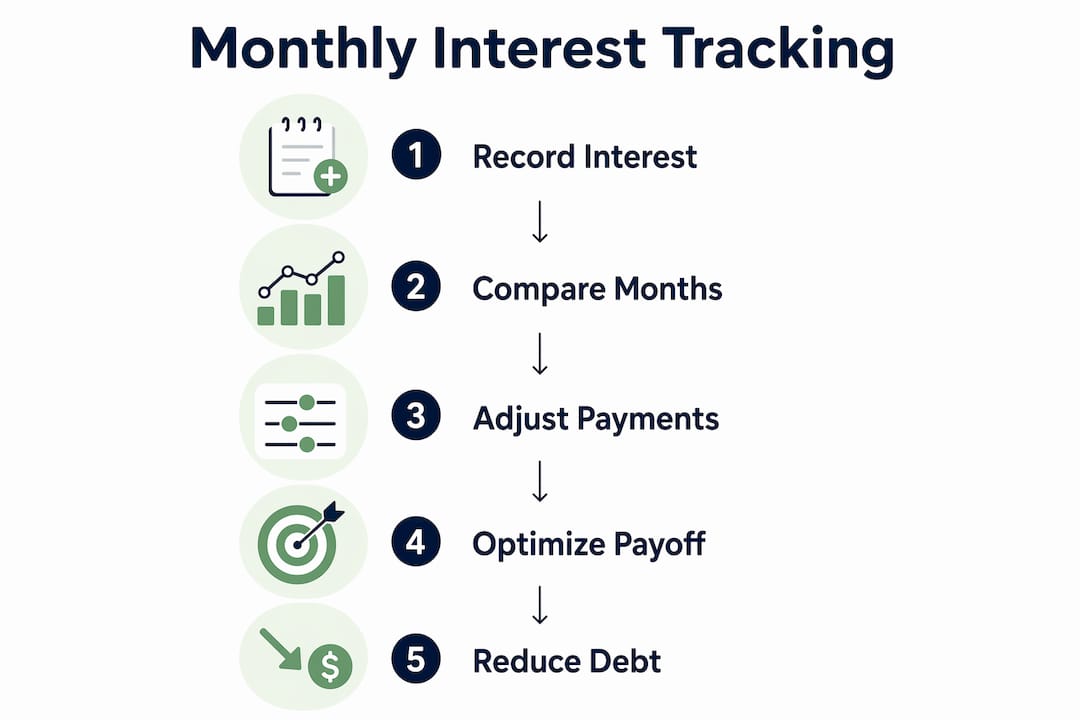
Budgeting and debt apps pull statement data automatically and categorize interest charges separately from principal payments. The best ones display a running total of interest paid year to date. That annual figure is often the number that motivates real behavior change.
Here is a simple tracking structure you can set up today:
| Field | What to record | Why it matters |
|---|---|---|
| Statement close date | Month and day | Anchors your record to the billing cycle |
| Closing balance | Dollar amount | Shows what compounds next month |
| Interest charge | Dollar amount | The core metric to watch |
| Payment made | Dollar amount | Compare to interest charge to confirm progress |
| Principal reduced | Payment minus interest | Measures real debt reduction |
- Pull your interest charge from the "Interest Charged" line on your statement, not the minimum payment box.
- Record it within 48 hours of your statement closing date so the habit sticks.
- Compare your interest charge month over month, not just your total balance.
- Flag any month where your interest charge equals or exceeds your payment.
Pro Tip: Set a recurring calendar reminder for the day after each statement closes. Spend five minutes updating your tracker. That five minutes each month is worth more than any budgeting app you will ever download.
How does understanding monthly interest shape your payoff strategy?
Recognizing interest expense monthly shifts your mindset from "how much did I pay" to "how much did I actually owe." That shift directly changes which payoff strategy makes sense for your situation.
Avalanche vs. Snowball: which method wins with interest data?
The Avalanche method targets your highest APR card first. The Snowball method targets your smallest balance first. Both work, but only the Avalanche method is mathematically optimized to reduce total interest paid. Monthly interest tracking makes the Avalanche method concrete. You can see exactly how much each card costs you per month and rank them by that number.
The Snowball method has a psychological advantage. Paying off a small balance creates momentum. If your monthly interest data shows that your smallest balance also carries a high rate, the two methods align and the choice is easy.
When to consider refinancing
Refinancing or balance transfers make sense when your monthly interest charge is high relative to your balance. Transparent amortization schedules reveal hidden interest costs, and the same logic applies to credit card statements. If you track your monthly interest and see that 80% of your payment covers interest rather than principal, a balance transfer to a 0% promotional APR card can reset that ratio entirely.
Key strategic moves informed by monthly interest data:
- Redirect any month where your interest charge drops to an extra principal payment on your highest rate card.
- Use your year-to-date interest total as a benchmark when evaluating balance transfer fees.
- Avoid the payment trap of rounding down to a convenient number. Pay at least your interest charge plus a fixed extra amount every month.
Key Takeaways
Monthly interest tracking is the single most direct way to measure whether your credit card payments are reducing debt or simply covering the cost of carrying it.
| Point | Details |
|---|---|
| Interest vs. payment confusion | Tracking interest separately shows how much of each payment actually reduces your balance. |
| Negative amortization risk | Paying less than your monthly interest charge causes your balance to grow despite making payments. |
| Extra payments hit harder early | Directing extra dollars to principal early in a high balance period cuts payoff time significantly. |
| Tools signal payment traps | A "months to payoff" error in a debt tracker means your payments are not covering interest. |
| Mindset shift drives results | Viewing debt by monthly interest cost rather than total balance leads to faster, smarter payoff decisions. |
The number most credit card users never look at
I have reviewed a lot of personal finance habits over the years, and the pattern is consistent. Credit card users check their balance. They check their due date. They almost never check their interest charge line.
That one number tells you more about your financial health than your balance does. Your balance is a snapshot. Your monthly interest charge is a rate of loss. If it is rising month over month, your strategy is not working. If it is falling, you are making real progress.
The procrastination cost is real. Every month you delay tracking, that interest charge compounds. A $120 monthly interest charge on a $6,500 balance at 22% APR does not stay at $120 if you only pay the minimum. It grows. And because it grows quietly, most people do not notice until the balance has climbed by hundreds of dollars.
The mindset shift I recommend is simple. Stop thinking about your credit card debt as a balance to pay off someday. Start thinking about it as a monthly cost you are choosing to pay or not pay. Treating debt like a business with monthly tracking gives you the data to make that choice deliberately. Once you see your interest charge as a recurring expense, you start treating it like one. You look for ways to reduce it. You make extra payments. You compare cards by their monthly cost to you, not just their APR.
That shift is where real financial control begins.
— Grace K.
How Finja helps you track monthly interest and cut debt costs
Credit card interest is easier to manage when you can see it clearly every month.
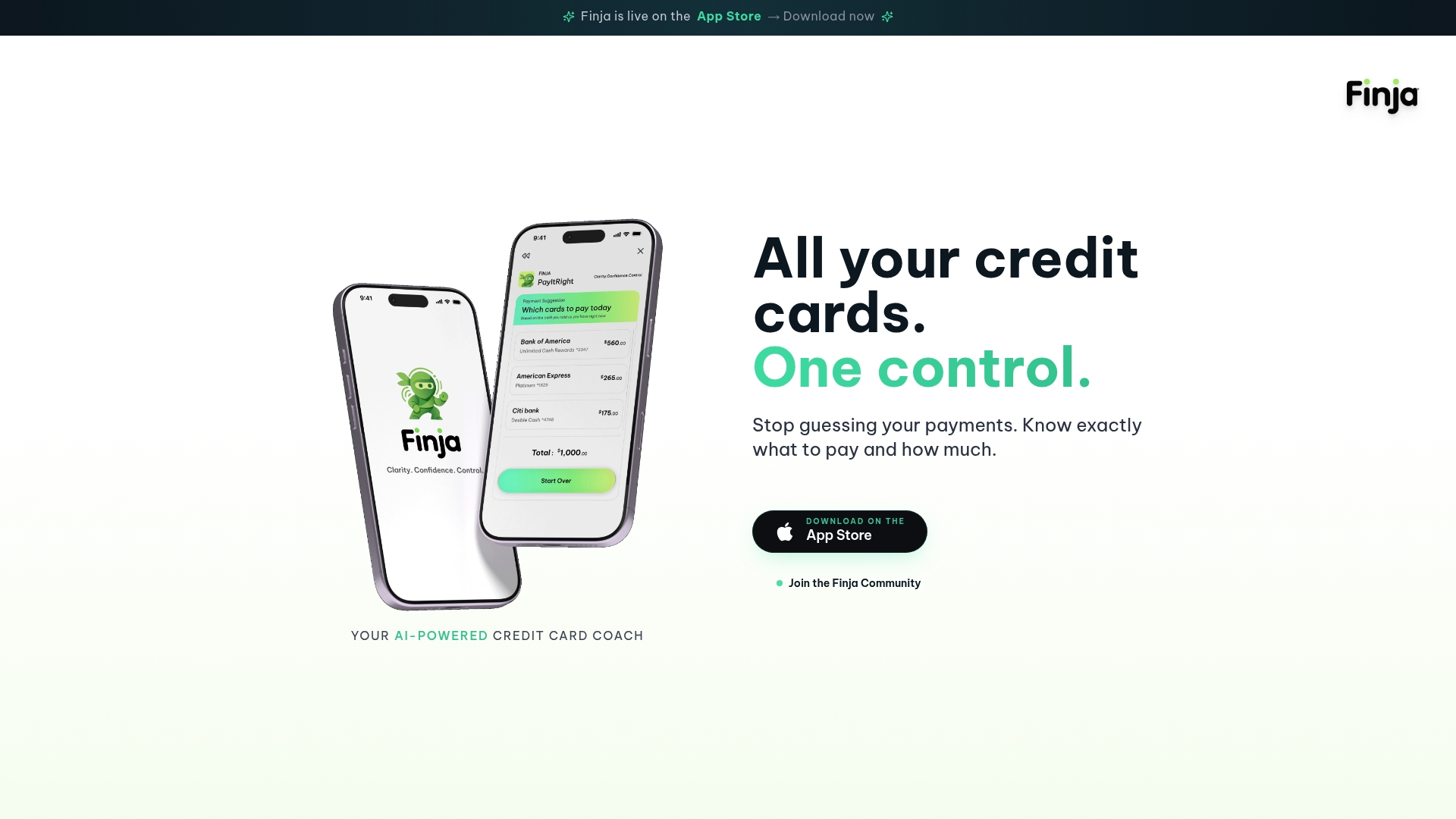
Finja is an AI-powered credit card management platform built for people carrying balances across multiple cards. It tracks your monthly interest charges, shows you how each payment splits between interest and principal, and flags when a payment level is too low to make progress. Finja also models payoff timelines so you can see exactly how much faster you pay off debt by adding $50 or $100 to a specific card. For credit card users who want to stop guessing and start managing debt with real numbers, Finja puts the right data in front of you every billing cycle.
FAQ
What is monthly interest tracking for credit cards?
Monthly interest tracking means recording the exact interest charge on your credit card statement each billing cycle, separate from your total payment. It shows how much of your payment reduces your balance versus how much covers borrowing costs.
What happens if I only pay the minimum each month?
If your minimum payment is less than your monthly interest charge, your balance grows despite the payment. This is called negative amortization, and it causes debt to increase even when you pay on time.
How does tracking interest help me pay off debt faster?
Knowing your exact monthly interest charge identifies the threshold your payment must clear before any principal reduction occurs. Directing extra dollars above that threshold to principal cuts your payoff timeline and reduces total interest paid.
Which payoff method works best with monthly interest data?
The Avalanche method, which targets your highest APR card first, is mathematically optimal for reducing total interest. Monthly interest tracking makes it concrete by showing the exact dollar cost of each card per billing cycle.
Does paying the full balance eliminate interest charges?
Paying your full statement balance each month stops compounding interest entirely. No carried balance means no interest charge on the next statement.