
What is credit card APR and why it matters
APR stands for annual percentage rate, and on a credit card it represents the yearly cost of carrying a balance. The Consumer Financial Protection Bureau describes it simply: a credit card's interest rate is the price you pay for borrowing money, expressed as an annual figure. If you pay your full balance every month, your APR is essentially irrelevant. The moment you carry even a dollar forward, it starts working against you.
Here is what APR actually controls:
- The amount of interest that builds up on unpaid balances each billing cycle
- The rate at which debt increases if only minimum payments are made
- The portion of each payment that reduces the principal instead of covering interest
- The costs associated with balance transfers, cash advances, or late payments
How credit card APR affects your interest charges
Credit card interest compounds daily, meaning each day's interest gets added to your balance before the next day's charge is calculated. That compounding effect is what separates credit card debt from a simple loan. A balance that feels manageable in month one can grow noticeably by month six without a single new purchase.

The table below gives a qualitative sense of interest generated over a year on a $3,000 balance with various APR levels, assuming no new purchases and minimum payments only.
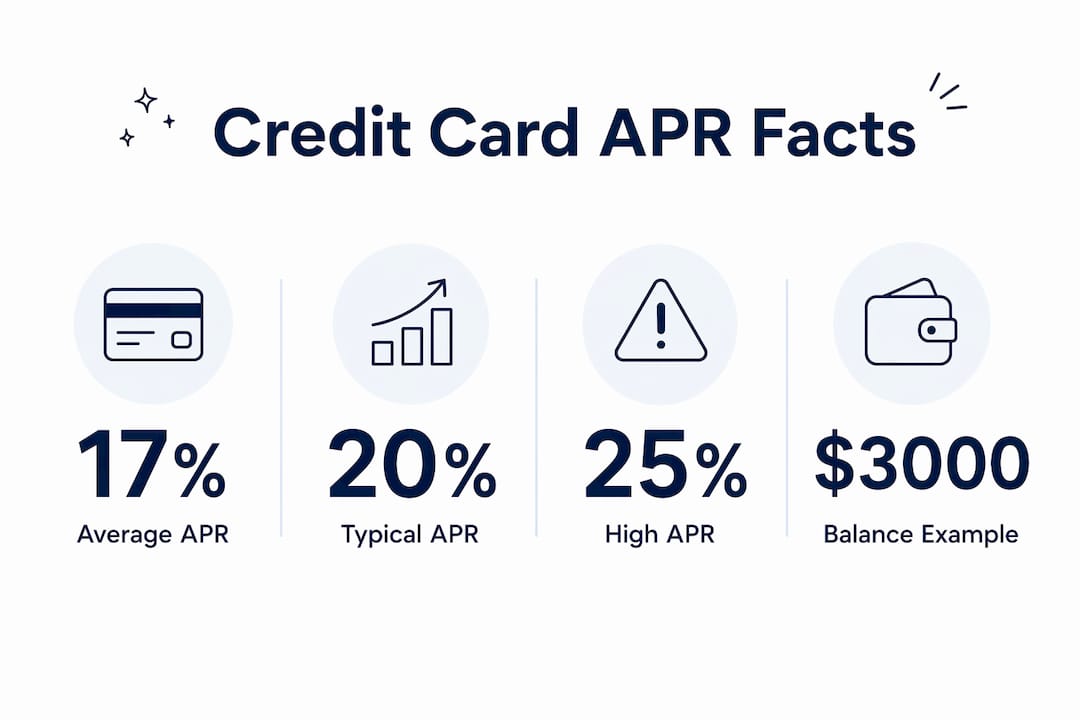
| APR | Approximate interest paid (12 months) | Balance remaining |
|---|---|---|
| Lower range (around 17%) | Significant interest paid | Significant principal remains |
| Moderate (around 20-23%) | More interest paid | More principal remains |
| Higher range (around 25%) | Majority interest paid | Majority of balance persists |
| Penalty-level (29.99% or higher) | Interest almost equals payment | Debt barely shrinks |
Carrying a balance has a second, less obvious cost. Once you carry a balance from one billing cycle to the next, you lose your grace period, and new purchases begin accruing interest from the day they post rather than from the statement due date. That means even a small unpaid balance can trigger interest on every new transaction you make.
Key effects to keep in mind:
- Daily compounding accelerates debt growth beyond what the stated APR suggests
- Grace period loss means new spending costs more than the APR alone implies
- Higher APR cards direct a larger share of each payment toward interest, not principal
How to calculate credit card interest using APR
The standard formula issuers use is straightforward: average daily balance × daily rate × days in billing cycle. Each term has a specific meaning.
- APR: The annual percentage rate listed in your card agreement, expressed as a decimal (e.g., 20% becomes 0.20).
- Daily rate: Your APR divided by 365. At 20% APR, the daily rate is roughly 0.0548%.
- Average daily balance: Add up your balance at the end of each day in the billing cycle, then divide by the number of days in that cycle.
- Days in billing cycle: Typically 28–31 days, stated on your monthly statement.
Sample calculation: Suppose your average daily balance is $2,000, your APR is 20%, and your billing cycle is 30 days. Daily rate = 0.20 ÷ 365 = 0.000548. Interest = $2,000 × 0.000548 × 30 = approximately $32.88 for that month.
Pro Tip: Making a mid-cycle payment lowers your average daily balance, which directly reduces the interest charge even if you cannot pay the full balance. Two smaller payments often cost less than one payment at the end of the cycle.

Issuers vary slightly in how they count days (some use 360 rather than 365) and how they handle compounding frequency. Check your cardholder agreement for the exact method your issuer applies. For a deeper look at how these calculations fit into broader credit card financial modeling, the math extends naturally to multi-card scenarios.
What is a good APR on a credit card?
As of May 2024, the average credit card APR was 22.76%, according to the Federal Reserve. Anything meaningfully below that average is generally considered favorable for a standard purchase APR. Anything at or above it warrants scrutiny, especially if you plan to carry a balance.
Several factors determine the rate you are offered:
- Credit score: Higher scores consistently unlock lower APRs, though a high credit score alone does not guarantee the best rate because issuers also apply proprietary risk models.
- Card type: Rewards cards and retail store cards tend to carry higher APRs than basic cards from credit unions or community banks.
- Card issuer: APR ranges vary widely even within a single institution.
A lower APR reduces how much of each payment goes to interest, freeing more dollars to cut into the principal. If you carry a balance regularly, the difference between a 17% and a 25% APR is not trivial over 12 months on a $3,000 balance.
Types of APR on credit cards you should know
Most cards carry several distinct APRs, each applying to a different type of transaction. Knowing which rate applies when prevents surprises on your statement.
- Purchase APR: The rate applied to everyday spending when you carry a balance. Introductory purchase APRs as low as 0% are available on some new cards for a limited period, after which the standard rate takes over.
- Balance transfer APR: Applied to balances moved from another card. Promotional rates can be very low or 0%, but transfer fees (typically 3%–5% of the transferred amount) still apply.
- Cash advance APR: Cash advances carry a higher APR than purchases and begin accruing interest immediately, with no grace period at all. They are among the most expensive ways to use a credit card.
- Penalty APR: Triggered by late or missed payments. Penalty APRs can reach 29.99% or higher and can apply indefinitely, making a single missed payment extremely costly over time.
- Promotional APR: A temporary low rate, sometimes 0%, offered on purchases or balance transfers for a set period. Once it expires, the standard rate applies to any remaining balance.
- Variable vs. fixed APR: Most credit cards carry variable APRs tied to the prime rate, meaning your rate adjusts automatically when the Federal Reserve moves rates. Fixed APRs are rare and still subject to change with 45 days' notice from the issuer.
How to lower your credit card APR
Paying your full statement balance every month is the most direct way to make APR irrelevant. Paying the full statement balance by the due date preserves your grace period and eliminates interest charges entirely.
When carrying a balance is unavoidable, these strategies reduce what you pay:
- Negotiate directly with your issuer. Cardholders with a solid payment history often succeed in requesting a rate reduction. A single phone call costs nothing.
- Transfer to a lower-rate card. A 0% balance transfer offer can pause interest accumulation while you pay down the principal, though transfer fees apply.
- Improve your credit score. Reducing credit utilization and maintaining on-time payments over time qualifies you for better rates on existing and future cards.
- Pay on time, every time. A late payment can trigger a penalty APR that persists well beyond the missed payment itself.
- Make multiple payments per month. Paying earlier in the cycle reduces your average daily balance, which cuts the interest charge even if you cannot pay in full.
Pro Tip: If your card has a variable APR, watch Federal Reserve rate announcements. When the Fed raises rates, your APR typically rises within one to two billing cycles. That is the right moment to accelerate payoff or pursue a balance transfer before the higher rate compounds.
Tracking credit card due dates across multiple cards is one of the most practical ways to avoid the penalty APR trap.
What to consider about APR when applying for a new credit card
Before you apply, read the full rate disclosure, often called the Schumer box, in the card's terms and conditions. It lists every APR the card carries.
- Review all APR types: Purchase, balance transfer, cash advance, and penalty APRs each apply in different situations. A low purchase APR means little if the penalty APR is 29.99%.
- Understand introductory offers: A 0% intro APR is genuinely useful if you have a plan to pay off the balance before the promotional period ends. Without that plan, the standard rate kicks in on whatever remains.
- Check how variable rates adjust: Your agreement will specify which index (usually the prime rate) drives your APR and how often it can change.
- Factor in your credit score: The APR you are offered depends heavily on your credit profile. Applying when your score is strong typically yields a better rate.
- Consider your usage pattern: If you pay in full every month, a higher APR matters less. If you expect to carry a balance, the APR is the single most important number on the card.
- Watch penalty APR triggers: Know exactly what actions can trigger the elevated rate and how long it can last.
Expert insights on APR compounding and credit card debt growth
Daily compounding is the mechanism that makes credit card debt grow faster than most people expect. Each day, interest is calculated on the principal plus any interest already added, not just the original balance. Over months, this creates an exponential curve rather than a straight line.
Variable APRs amplify that effect when rates rise. Because most cards are tied to the prime rate, Federal Reserve rate increases flow directly into your card's APR, often without any advance notice from your issuer. The credit card interest environment in 2026 reflects several years of elevated rates, making this dynamic especially relevant right now.
Grace period loss is a compounding accelerant that often goes unnoticed. Once you carry a balance, new purchases accrue interest from the day they post, not from the due date. A cardholder who carries even a small balance forward effectively pays interest on every new transaction immediately.
Key insight: A high credit score is necessary but not sufficient for the lowest APR. Issuers apply proprietary risk models that go beyond credit score tiers, meaning two cardholders with identical scores can receive meaningfully different rates from the same institution.
Understanding how APR compares across credit products can also clarify why credit card rates feel so much higher than mortgage rates. Credit cards are unsecured, revolving debt, which carries more risk for the lender and a higher cost for the borrower.
Finja is an AI-powered credit card management platform built for people juggling multiple cards. It analyzes your balances, APRs, and payment timing to show you exactly where interest is costing you the most and what to do about it.
Take control of your credit card interest with Finja and start paying down debt faster.
Key Takeaways
Credit card APR compounds daily, meaning even a small unpaid balance grows faster than the stated rate suggests, and losing your grace period makes every new purchase more expensive immediately.
| Point | Details |
|---|---|
| APR drives your interest cost | The annual percentage rate determines how much interest accrues on any balance you carry forward. |
| Daily compounding accelerates debt | Interest is charged on principal plus prior interest each day, not just on the original balance. |
| Average APR benchmark | The average credit card APR was 22.76% as of May 2024; rates below that are generally favorable. |
| Grace period loss costs more | Carrying any balance eliminates the grace period, so new purchases accrue interest from the day they post. |
| Penalty APR can reach 29.99% | A single late payment can trigger a penalty rate that applies indefinitely until the issuer removes it. |