
A credit card interest forecast is a projection of where credit card interest rates are headed over a defined future period, giving you a clearer picture of what borrowing on plastic will cost. Bankrate projects the average credit card APR will fall slightly to around 19.1% by the end of 2026, down from 19.7% at the start of the year. That sounds like good news, but the relief is modest at best. Understanding what drives these forecasts, how interest is actually calculated, and what you can do about it now is far more useful than watching the headline number inch downward.
What is a credit card interest forecast and why does it matter?
A credit card interest forecast is the industry's best estimate of where average APRs are heading, based on Federal Reserve policy, inflation data, and lending conditions. The term "APR forecast" is the standard industry phrase for this concept. Both terms describe the same thing: a forward-looking view of the interest rate environment that shapes what issuers charge cardholders.
The forecast matters because credit card debt is expensive. Fed rate hikes pushed average APRs from 16.28% in 2020 to over 21% in early 2026. That 5-point climb translated directly into hundreds of extra dollars per year for anyone carrying a balance. Knowing where rates are likely to go helps you decide whether to pay down debt aggressively now, pursue a balance transfer, or hold steady.

Your individual rate also depends on your personal financial profile, not just the market average. Credit score and debt-to-income ratio both shape the specific APR your issuer assigns you. The forecast tells you the direction of the market; your credit health determines where you land within it.
What factors influence credit card interest rate forecasts?
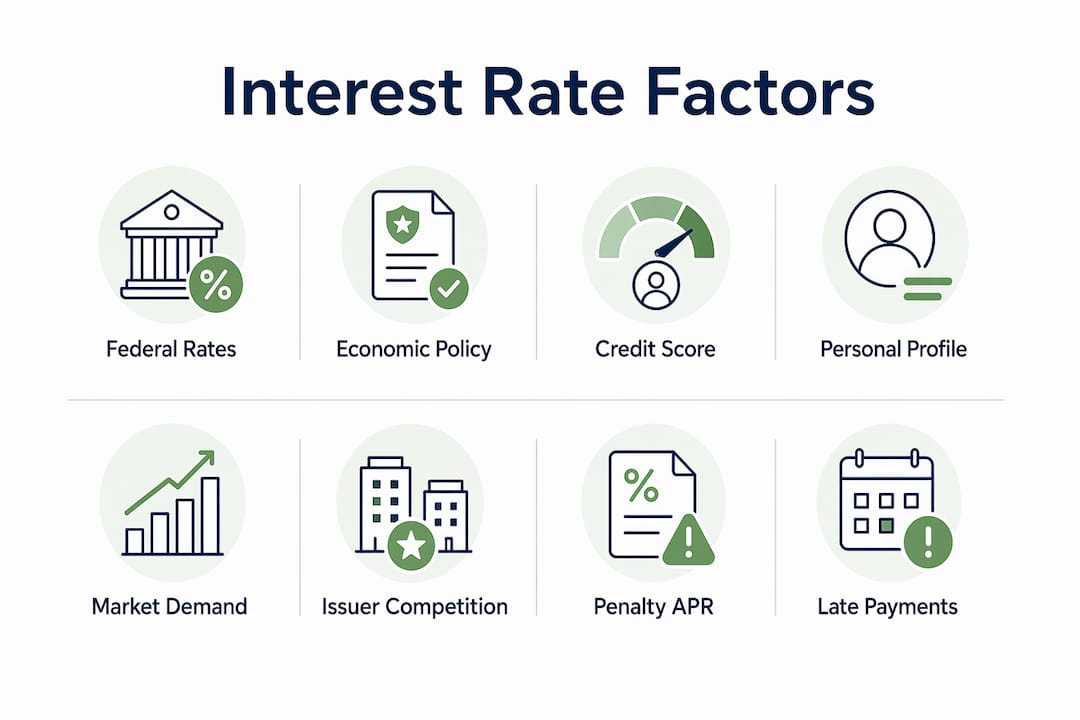
Credit card APRs do not move in isolation. Several forces push them up or pull them down, and understanding each one helps you read any forecast with more confidence.
Macroeconomic drivers:
- Federal Reserve policy. Credit card rates are variable and tied to the prime rate, which moves with the federal funds rate. When the Fed cuts rates, issuers typically lower APRs within one to two billing cycles.
- Inflation. High inflation pressures the Fed to raise rates, which flows directly into credit card APRs. The 2020–2024 inflation cycle is the clearest recent example of this chain reaction.
- Economic growth signals. Strong employment and consumer spending data often give issuers confidence to compete on rate, while recession fears push them toward caution and higher margins.
Personal credit factors:
- Credit score. A FICO score above 750 typically qualifies you for the lowest available APR on a given card. Scores below 670 often land you in the upper tier of the rate range.
- Debt-to-income ratio. Issuers assess how much of your income already goes to debt payments. A high ratio signals risk and results in a higher rate offer.
- Card type. Rewards cards and travel cards carry higher base APRs than no-frills cards. The premium for points is baked into the rate.
Pro Tip: Check your credit report at AnnualCreditReport.com before applying for any new card. A single error dragging down your score could cost you 3–5 percentage points on your APR.
No legal cap often exists on credit card interest rates in the United States. Consumers must monitor their own agreements rather than rely on market averages for protection. The forecast gives you context; your card agreement gives you the actual number.
What is the current credit card interest rate environment for 2026?
The 2026 rate picture is one of slow, grinding improvement rather than meaningful relief. Bankrate's forecast projects the average APR will move from 19.7% at the start of 2026 to a low of around 19.1% by year-end. That is a 0.6-point drop across 12 months.
The spread between the best and worst rates is striking. Credit card rates currently range from 5.75% to 36%, depending on creditworthiness and card type. The gap between those two numbers is larger than most people realize, and it underscores why your personal credit profile matters more than the national average.
"Federal Reserve rate cuts may only cause minor decreases in credit card APRs, offering little relief to cardholders carrying balances. Projected decreases in average APR are small and unlikely to significantly lower interest expenses for most consumers." — Bankrate / Yahoo Finance, 2026 credit card interest rate forecast
The table below shows the key rate benchmarks for 2026:
| Rate Type | 2026 Figure |
|---|---|
| Average APR at start of 2026 | 19.7% |
| Projected average APR by end of 2026 | 19.1% |
| Average rate on new card offers (June 2026) | 22.18% |
| Average rate on existing balances (June 2026) | 21.52% |
| Rate range across all card types | 5.75%–36% |
New card offers carry a higher average rate than existing balances. That gap reflects the fact that issuers price new credit more aggressively than they reprice accounts already on their books. If you are shopping for a new card, the 2026 rate trends suggest waiting for a promotional 0% APR offer rather than accepting a standard variable rate near 22%.
Minor projected rate decreases in 2026 will not provide significant financial relief for consumers carrying existing balances. A 0.6-point drop on a $5,000 balance saves roughly $30 per year before compounding. That is not a strategy. It is a rounding error.
How is credit card interest calculated, and why does the forecast affect your payments?
Credit card interest is calculated daily, not monthly. APR is divided by 365 to produce a daily periodic rate, which is then applied to your average daily balance across the billing cycle. The monthly interest charge you see on your statement is the sum of those daily charges.
Here is a simple example. A 20% APR divided by 365 gives a daily rate of 0.0548%. On a $3,000 average daily balance over a 30-day cycle, that produces about $49 in interest for the month. Over a year, that is nearly $600 on a balance that never moves.
How to calculate your monthly interest charge:
- Divide your APR by 365 to get the daily periodic rate.
- Multiply the daily periodic rate by your average daily balance.
- Multiply that result by the number of days in your billing cycle.
- The final number is your monthly interest charge before any payments.
Grace periods of at least 21 days between statement closing and payment due date let you avoid interest entirely on new purchases, as long as you pay the full statement balance on time. Paying in full every month makes the APR forecast almost irrelevant to your monthly cost. The forecast only bites when you carry a balance.
Penalty APRs are the hidden danger most consumers overlook. Missing a payment for 60 or more days can trigger a penalty APR near 29.99%, which can remain in effect for six months or longer. At that rate, a $3,000 balance costs roughly $75 per month in interest alone. No forecast improvement will offset that kind of rate jump.
Pro Tip: Set up autopay for at least the minimum payment on every card. This protects you from penalty APRs even during months when cash flow is tight.
What strategies can consumers use to manage forecasted interest rate changes?
The 2026 forecast confirms that rates will stay high. Waiting for the market to rescue you is not a plan. These strategies put you in control regardless of where the average APR lands.
- Pay the full statement balance every month. This is the single most effective move. A grace period of at least 21 days means you pay zero interest on purchases when you clear the balance in full. No rate forecast affects you if you never carry a balance.
- Use 0% APR balance transfer offers strategically. Many issuers offer 12 to 21 months at 0% on transferred balances. Moving high-rate debt to a 0% card and paying it down aggressively during the promotional period can save hundreds of dollars. Read the transfer fee terms carefully; a 3%–5% fee is still cheaper than 20%+ APR over a year.
- Improve your credit score before applying for new credit. Moving from a 680 to a 740 FICO score can drop your offered APR by 4–6 points on a new card. Pay down balances to lower your credit utilization ratio below 30%, and dispute any errors on your credit report.
- Audit your card portfolio. Not every card you hold serves your current financial situation. A multiple card management review can reveal which cards carry the highest rates and which offer the best terms for your spending patterns.
- Never miss a payment. Penalty APRs near 29.99% can nearly double your interest cost overnight. Autopay and calendar reminders cost nothing and protect you from the most expensive rate outcome possible.
- Track the interest you actually pay each month. Most consumers underestimate how much interest they pay annually. Tracking monthly interest creates the awareness that motivates faster payoff decisions.
Key Takeaways
The most effective response to a high-rate credit card environment is to pay balances in full, avoid penalty APRs, and use your credit score as a tool to access better rates.
| Point | Details |
|---|---|
| 2026 forecast is modest relief | Average APR is projected to drop from 19.7% to 19.1%, saving most cardholders very little. |
| Rate range is wide | Rates span 5.75%–36%, so your credit profile matters far more than the market average. |
| Daily compounding adds up fast | Interest accrues daily on your average balance; even a 20% APR costs nearly $600 per year on a $3,000 balance. |
| Penalty APRs are the real risk | Missing a payment by 60+ days can trigger a 29.99% penalty rate lasting six months or more. |
| Grace periods are your best tool | Paying the full statement balance on time eliminates interest charges regardless of the prevailing APR. |
Why the forecast matters less than your own financial habits
The slow pace of rate decreases in 2026 tells a story that most financial headlines bury. The Fed has cut rates, and credit card APRs have barely moved. That gap exists because issuers are under no legal obligation to pass rate cuts through quickly or fully. I have watched this pattern play out across multiple rate cycles, and the lesson is always the same: the forecast is a useful reference point, not a rescue plan.
What I find more telling than the average APR number is the spread between 5.75% and 36%. That range is not random. It reflects exactly how much your personal credit behavior determines your actual cost of borrowing. Consumers who treat their credit score as a financial asset, pay on time, and keep utilization low consistently land in the lower half of that range. Those who carry high balances and miss payments drift toward the top.
The forecast also tends to anchor people to the wrong question. The right question is not "will rates go down?" It is "how much interest am I actually paying right now, and what is the fastest path to paying less?" A debt-free credit card strategy built around your specific balances and income will outperform any market movement the Fed delivers in 2026.
Use the forecast as one input in your financial planning. Let your own habits be the primary variable.
— Grace K.
Finja: Your AI Credit Card Coach for a High-Rate Environment
Rates are staying high in 2026, and the difference between paying $600 a year in interest and paying nothing often comes down to knowing exactly where your money is going.
Finja is an AI-powered credit card management platform built for consumers who want to stop guessing and start making smarter payment decisions. Finja tracks the interest you pay across all your cards, flags which balances cost you the most, and surfaces payment strategies tailored to your actual accounts. Whether you are managing two cards or six, Finja gives you a clear view of your credit card costs and a concrete path to reducing them. Visit Finja to see how much interest you could be saving right now.
FAQ
What is a credit card interest forecast?
A credit card interest forecast is a projection of where average credit card APRs are expected to move over a future period, based on Federal Reserve policy, inflation trends, and lending conditions. Bankrate projects the average APR will reach approximately 19.1% by the end of 2026.
How is credit card interest calculated?
Credit card interest is calculated daily by dividing your APR by 365 to get a daily periodic rate, then multiplying that rate by your average daily balance and the number of days in your billing cycle.
Will credit card rates go down significantly in 2026?
No. The projected decrease from 19.7% to 19.1% is small and will not provide meaningful relief for most cardholders carrying balances. Personal payoff strategies will deliver far more savings than the forecasted rate movement.
What is a penalty APR and how does it affect me?
A penalty APR near 29.99% can be triggered when you miss a payment by 60 or more days. It can remain in effect for six months or longer, significantly increasing the cost of any balance you carry.
How can I avoid paying credit card interest regardless of the forecast?
Pay your full statement balance before the payment due date every month. Grace periods of at least 21 days mean you owe zero interest on new purchases as long as you clear the balance in full each cycle.