
Credit card due date management is the practice of organizing your payment schedule, reminders, and financial habits so you always pay on time, avoid fees, and protect your credit score. Miss one payment by a single day and you can face a late fee up to $41 as of 2026. Miss it by 30 days and your credit score takes a hit that can last years. The good news is that a few deliberate habits, the right alerts, and a clear understanding of key billing dates put you firmly in control.
What are the key credit card dates and terms you must know?
Every credit card bill runs on two critical dates: the statement closing date and the payment due date. Confusing them is one of the most common and costly mistakes cardholders make.
The statement closing date is the last day of your billing cycle. Your issuer tallies your balance on this date and reports it to the credit bureaus. The balance reported on closing date directly affects your credit utilization ratio, which is one of the biggest factors in your credit score. Paying down your balance before the closing date, not just before the due date, keeps your reported utilization lower and your score higher.
The payment due date is the deadline to pay at least the minimum amount without triggering a late fee or a negative mark on your credit report. Federal law requires a grace period of at least 21 days between the statement closing date and the payment due date. Most major issuers offer 23–25 days. That window is your grace period, and no interest accrues on purchases during it if you pay your full balance.
Here are the core terms every cardholder needs to know:
- Statement closing date: The last day of your billing cycle; your balance is locked and reported to credit bureaus.
- Payment due date: The deadline to pay without a late fee or credit score damage.
- Grace period: The legally required minimum 21-day window between closing date and due date.
- Minimum payment: The smallest amount you can pay to avoid a late fee. Paying only the minimum, however, leaves a balance that accrues interest. Learn more about what minimum payment means before relying on it as a habit.
- Late fee: A penalty charged when payment is not received by the due date, up to $41 per occurrence.
Understanding these five terms gives you the foundation to build a payment system that works.
How can you schedule and track your credit card payments effectively?
The most reliable payment system is one you do not have to remember manually. Automation and alerts remove human error from the equation.
Start with autopay. Setting up autopay for at least the minimum amount protects your credit by preventing 30-day late marks even when life gets busy. Set autopay for the minimum as a safety net, then make a separate manual payment for the full balance when your budget allows. This two-layer approach gives you protection without locking in a partial payment as your only option.
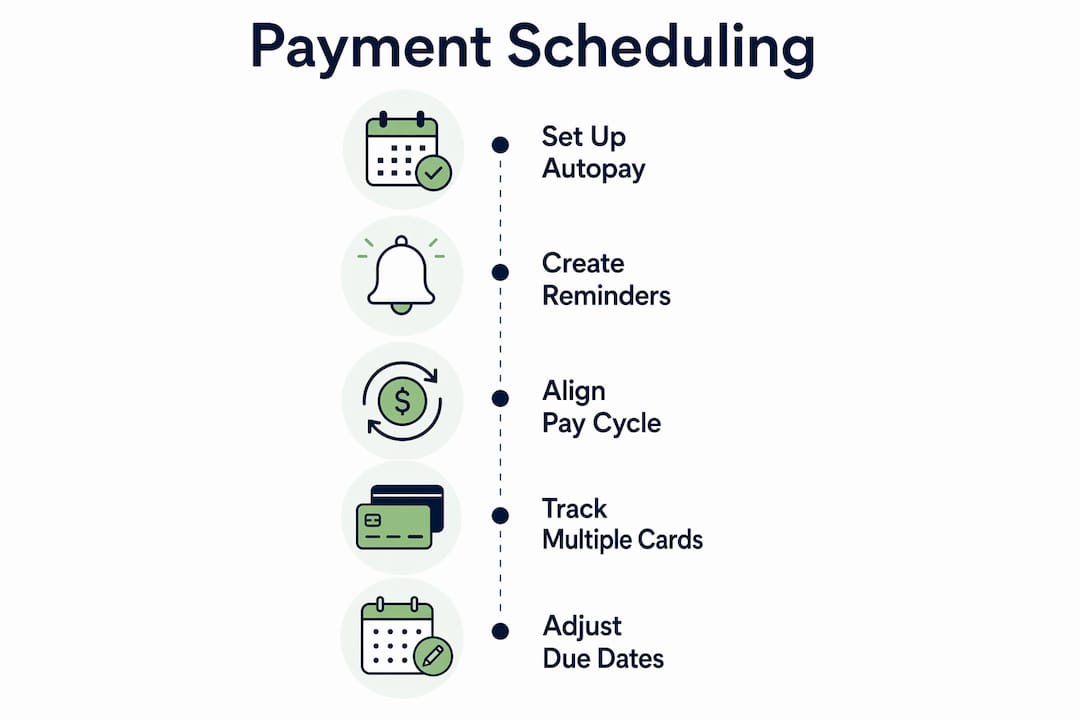
Layer in reminders on top of autopay. Most card issuers send free text and email alerts for upcoming due dates. Turn these on in your issuer's app or website. Set a personal calendar reminder 5–7 days before each due date so you have time to check your balance and adjust your payment amount if needed.
For cardholders managing multiple cards, a single tracking system is non-negotiable. Options include:
- Your issuer's mobile app: Most major issuers display all upcoming due dates on a dashboard.
- A shared calendar: Add each card's due date as a recurring monthly event with a 5-day advance alert.
- A budgeting or credit management app: Platforms like Finja consolidate due dates across all your cards in one view, so nothing slips through.
- A simple spreadsheet: List each card, its closing date, its due date, and the minimum payment due. Review it weekly.
Pro Tip: Set your payment reminder for 5 days before the due date, not the day of. That buffer covers weekends, bank processing delays, and any technical issues with your payment method.
Tracking multiple credit card due dates in one place is the single biggest habit shift that prevents missed payments.
What strategies help optimize due dates with your pay cycle?
Aligning your due dates with your paycheck is the most underused tactic in personal finance. Most cardholders accept whatever due date their issuer assigns at account opening. That date may fall a week before your paycheck arrives, creating a cash flow gap every single month.
The fix is straightforward. Spreading due dates 3–5 days after your payday removes that gap and reduces the risk of missing a payment because funds were not yet available. If you get paid on the 1st and 15th, stagger your card due dates to fall around the 6th and 20th. Each payment draws from a paycheck that has already landed.
Here is a four-step process to build a payment schedule that works with your income:
- List every card and its current due date. Write down the card name, current due date, and your typical balance.
- Map your pay dates. Identify when money reliably hits your account each month.
- Request due date changes. Contact each issuer and ask to move the due date to 3–5 days after your nearest payday.
- Stagger multiple cards. If you have three cards, do not stack all three on the same day. Spread them across your pay cycle to avoid a single large outflow.
Pro Tip: Use the micro-payment strategy on your highest-balance card. Pay roughly half the balance a week before the closing date, then pay the remainder on or before the due date. Two payments per billing cycle lower your average daily balance, reduce interest charges, and keep your reported utilization lower.
This approach also helps with reducing credit card bills over time, since lower average daily balances mean less interest accumulates each cycle.
How to change your credit card due date
Requesting a due date change is simpler than most cardholders expect. The process takes about five minutes and the benefit lasts for years.
| Step | Action | What to expect |
|---|---|---|
| 1 | Log into your issuer's app or call the number on the back of your card | Customer service or a self-service menu handles the request |
| 2 | Choose a new due date that falls 3–5 days after your payday | Issuers typically offer a range of available dates, not every calendar day |
| 3 | Confirm the change and note the effective date | The change takes 1–2 billing cycles to take full effect |
| 4 | Keep paying on the old due date until the new one is confirmed active | Skipping a payment during the transition triggers late fees |
| 5 | Check your next statement for the updated due date | One statement may cover a longer or shorter period than usual |
Most major issuers allow one due date change every 6–12 months. That limit means you should choose your new date carefully. Pick a date you can commit to long term, not just one that works for your current pay schedule.
During the transition, your statement may look unusual. A longer billing cycle means a higher-than-normal balance on that statement. Do not panic. Keep paying on time and the cycle normalizes within two months.
What common mistakes cause missed payments and how do you fix them?
Most missed payments are not caused by a lack of funds. They are caused by timing errors and process gaps that are easy to close once you know what to look for.
Watch the clock, not just the calendar. Payment cutoff times are often 5 p.m. Eastern, and a payment submitted at 6 p.m. on the due date can trigger a late fee even though it is the same calendar day. If you are in a western time zone, your "end of day" is not your issuer's end of day.
The most common mistakes and their fixes:
- Ignoring the cutoff time. Pay by noon on the due date to give yourself a buffer. Electronic payments submitted by 5 p.m. ET on the due date are generally processed on time.
- Mailing a check too late. Mail payments need at least 7 days of lead time for processing. If you mail a check on the due date, it will arrive late.
- Setting autopay but not checking the account balance. Autopay fails if your bank account does not have enough funds. A failed autopay counts as a missed payment.
- Tracking due dates in your head. Memory is not a system. Use a calendar, an app, or a spreadsheet.
- Ignoring a missed payment. If you miss a payment, pay it immediately. A payment reported as late to the credit bureaus requires 30 days past due to appear on your credit report. Catching up within that window protects your score. Call your issuer and ask for a one-time late fee waiver. Most issuers grant one if you have a clean payment history.
Key Takeaways
Effective credit card due date management requires knowing your key billing dates, automating payments, aligning due dates with your paycheck, and acting fast when a payment is missed.
| Point | Details |
|---|---|
| Know your two critical dates | The statement closing date affects your credit score; the due date triggers fees if missed. |
| Automate as a safety net | Set autopay for at least the minimum to prevent late marks, then pay more manually. |
| Align due dates with payday | Request due dates 3–5 days after your paycheck lands to avoid cash flow gaps. |
| Use the micro-payment method | Pay half your balance before the closing date and the rest by the due date to cut interest. |
| Act within 30 days if you miss | A missed payment only hits your credit report after 30 days; pay immediately and request a fee waiver. |
Why I think most cardholders manage due dates backwards
Most people treat the due date as the only date that matters. That is the wrong frame. The closing date is where the real credit score action happens. I have seen cardholders pay their full balance on the due date every month and still carry a high utilization ratio because their balance was already reported to the bureaus two weeks earlier.
The shift that changed how I think about this: treat the closing date as your real deadline for paying down balances, and treat the due date as the administrative deadline for avoiding fees. Those are two different goals, and they require two different habits.
Autopay is non-negotiable in my view. Not because it replaces attention, but because it catches the months when life gets in the way. A job change, a family emergency, a travel week with no Wi-Fi. Autopay for the minimum means your credit score survives those months intact.
The due date change request is also one of the most underused tools available. I have spoken with cardholders who have been fighting a cash flow crunch for years because their due dates fall before their paychecks. One phone call to the issuer fixes that permanently.
— Grace K.
How Finja helps you stay ahead of every payment deadline
Managing due dates across multiple cards gets complicated fast. Finja is an AI-powered credit card management platform built specifically for cardholders who want to stop guessing and start paying with a plan.
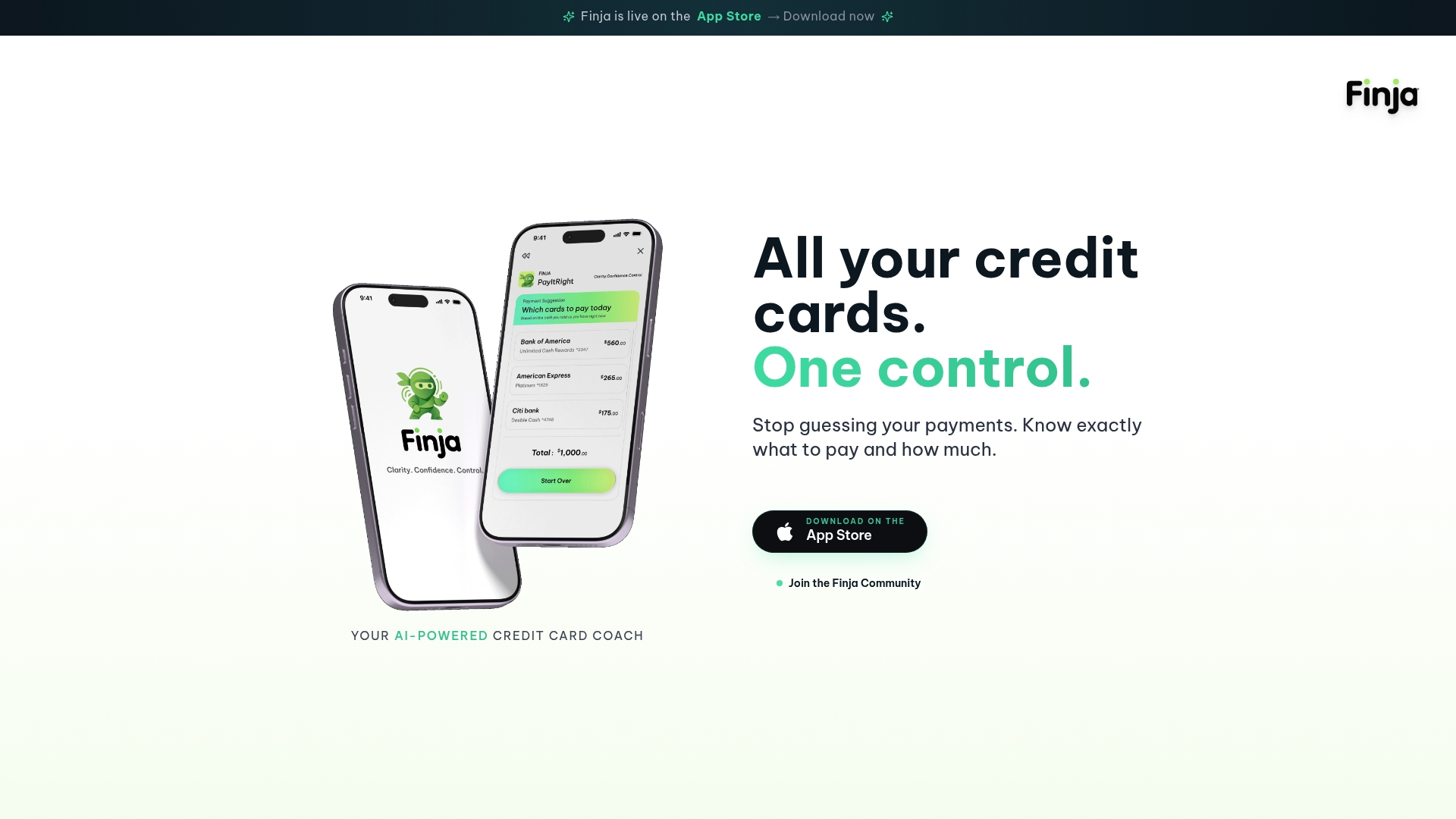
Finja tracks your due dates, closing dates, and payment history across all your cards in one place. It surfaces the right payment at the right time, flags when your utilization is climbing before your closing date, and helps you align your payment schedule with your actual cash flow. For cardholders working toward better credit card portfolio management, Finja provides the structure and visibility to make confident decisions every billing cycle.
FAQ
What is a credit card payment due date?
The credit card payment due date is the deadline to pay at least the minimum amount without incurring a late fee or a negative credit report entry. Federal law requires issuers to give you at least 21 days between your statement closing date and your due date.
How do I change my credit card due date?
Contact your issuer by phone or through their app and request a new due date. Most issuers allow one change every 6–12 months, and the new date takes 1–2 billing cycles to take effect.
What happens if I miss my credit card due date?
A late fee of up to $41 applies immediately. Your credit score is only affected if the payment remains unpaid for 30 days, so paying as soon as you notice the miss protects your credit report.
What is the best time of day to pay a credit card bill?
Pay by noon on the due date to avoid cutoff-time issues. Most issuers set their payment cutoff at 5 p.m. Eastern, so late-day payments from western time zones can still be flagged as late.
Does paying twice a month help my credit score?
Yes. Making two payments per billing cycle, one before the closing date and one by the due date, lowers your average daily balance and reduces the utilization ratio reported to the credit bureaus, which can improve your score over time.