
The credit card minimum payment trap is the cycle where paying only the smallest required amount each month keeps your balance almost frozen while interest quietly consumes most of what you send. Three things you can do right now:
- Pay more than the minimum this month. Even a small fixed add-on breaks the glide.
- Set a fixed automatic payment above the minimum. Automation removes the monthly decision and prevents the payment from drifting down as your balance shrinks.
- Find the minimum-payment warning box on your statement. Federal law requires it. It shows exactly how long payoff takes at the minimum and what a 36-month payment would cost instead.
Those three steps matter because the minimum is designed to stay affordable while keeping your balance high for as long as possible. The math behind that design is worth understanding before you pay another bill.
Table of Contents
- How issuers calculate your minimum payment
- The math: what minimum-only payments actually cost you
- Why the minimum payment works so well as a trap
- How the trap damages your finances beyond the interest charge
- Step-by-step escape plan from the minimum payment cycle
- Tools and calculators that make the numbers real
- When to get professional help
- Worked scenario: before and after, step by step
- Key Takeaways
- The minimum payment habit is harder to break than it looks
- Finja helps you pay more than the minimum, automatically
- Authoritative sources and calculators to check next
How issuers calculate your minimum payment
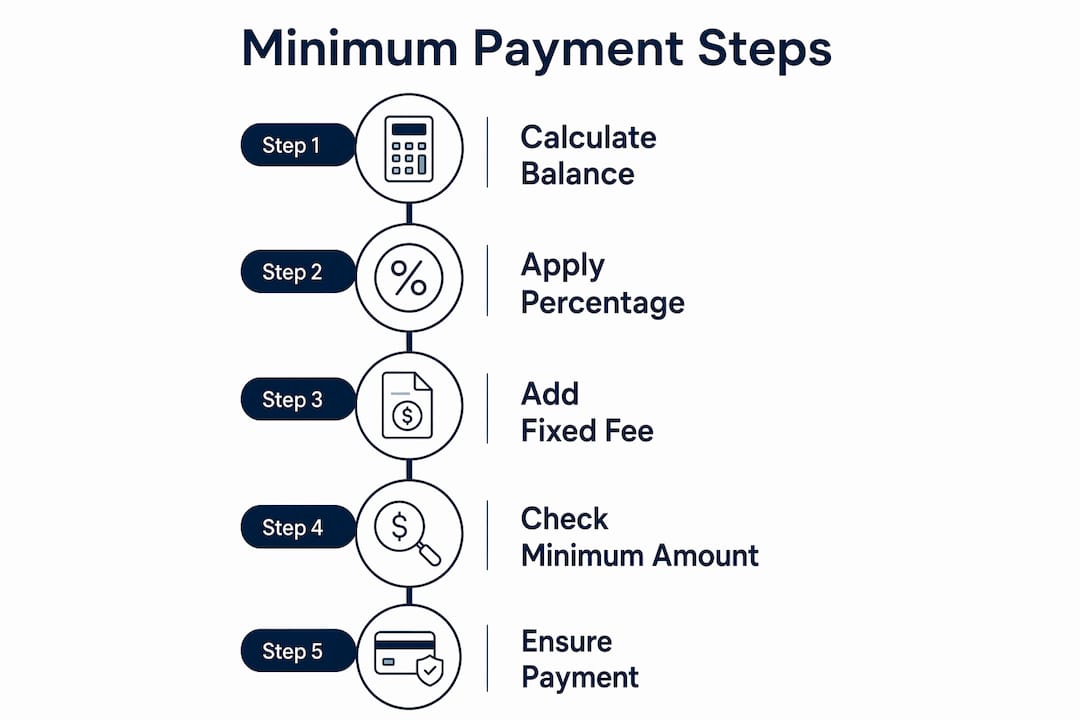
Most U.S. card issuers use one of three formulas, and knowing which one applies to your card tells you how slowly your balance will actually fall.
- Percentage of balance only: typically 1–3% of the outstanding balance.
- Percentage of balance plus interest and fees: usually 1–2% of principal added to that cycle's interest charge, which is the most common formula at large banks.
- Fixed dollar floor: commonly $25–$40, which kicks in when the percentage calculation produces a number smaller than the floor.
In practice, minimum payments run at a small percentage of the balance, and the floor prevents the payment from dropping below a set threshold even on small balances. Your cardholder agreement spells out the exact formula, usually in a section titled "Minimum Payment" or "Payment Calculation."
The CARD Act — the Credit Card Accountability Responsibility and Disclosure Act — requires every U.S. statement to include a minimum-payment warning box. It shows the total interest cost and payoff date if you pay only the minimum, plus the fixed monthly amount needed to pay off the balance in 36 months. Most people glance past it. Don't.
Pro Tip: Open your most recent statement and find that warning box before your next due date. Write the 36-month payment amount on a sticky note and use it as your new payment target — it's already calculated for you.
The math: what minimum-only payments actually cost you
The numbers here are not hypothetical. A Montana State University Extension analysis worked through a $4,000 balance at a typical minimum rate and found the total repayment cost would reach $13,843, spread across 34 years. Doubling the monthly payment cuts that to roughly 10 years and saves about $7,621 in interest.

A $4,000 balance at a typical minimum rate can cost $13,843 and take 34 years to repay if paid at minimums, but doubling the payment can cut that to about 10 years and save roughly $7,621 in interest. The table below shows how a $4,000 balance behaves under three payment approaches.
| Payment strategy | Monthly payment | Approximate payoff | Total interest paid |
|---|---|---|---|
| Minimum only (gliding down) | Starts at a modest amount, falls over time | ~34 years | $9,843 |
| Fixed at today's minimum | Fixed monthly amount | ~10 years | Around $2,200 |
| 36-month amortization | A higher fixed monthly payment | About three years | Much less interest |
Actual numbers are from the Montana State University Extension example; your balance, APR, and issuer's formula will change the figures.
The CARD Act disclosure assumes no new purchases and a static APR. In real life, new purchases and variable rate changes almost always push the actual payoff date past what the statement shows. If you carry a balance and keep using the card, the disclosed timeline is optimistic.
Pro Tip: Run your own numbers at the Consumer Financial Protection Bureau's credit card payoff calculator. Enter your balance, APR, and current minimum — then enter your minimum plus $50 and watch the payoff date collapse.
Why the minimum payment works so well as a trap
The minimum payment is not just a math problem. It's a behavioral one, and issuers understand that better than most cardholders do.

Minimum payments are intentionally calibrated to keep revolving balances high while staying affordable enough that delinquencies don't spike. The business model depends on it: interest income from cardholders who carry balances (called "revolvers") is far more profitable than fees from those who pay in full each month ("transactors").
The psychological mechanism is anchoring. When a statement shows a minimum of $47, that number becomes the mental reference point. Paying $47 feels like handling the bill. The prominent display of the minimum amount on statements creates a "check the box" relief effect — the account stays current, no late fee appears, no derogatory mark hits your credit report. The damage is slow and invisible.
Several design nudges reinforce this:
- The minimum is printed in large, easy-to-find type; the total balance and interest charge are smaller.
- Autopay defaults at many issuers are set to the minimum, not the full balance.
- No immediate negative consequence follows a minimum payment, so the feedback loop that would normally signal a problem never fires.
- Behavioral research from Chicago Booth shows that people systematically underestimate how their future selves will handle ongoing obligations — making the "I'll pay more next month" intention unreliable.
Pro Tip: Change your autopay to a fixed dollar amount above the minimum right now, before you close this tab. The anchoring effect only works if you let the statement number be the last number you see.
How the trap damages your finances beyond the interest charge
Paying only the minimum keeps your balance high, and a high balance relative to your credit limit drives up your credit utilization ratio. Utilization is one of the most heavily weighted factors in your credit score, and it can suppress your score even when your payment history is spotless. A score suppressed by high utilization costs you on every subsequent borrowing decision.
The debt-to-income (DTI) effect is just as concrete. Mortgage underwriters, auto lenders, and even some landlords calculate your monthly debt obligations as a share of gross income. A card balance that barely moves keeps your DTI elevated, which can mean a higher rate, a smaller loan, or an outright denial. Paying down principal quickly is one of the fastest ways to improve DTI before a major application.
Statistic to know: At a 22% APR, roughly 90 cents of every dollar in your minimum payment goes to interest in the early months of repayment. Principal reduction is almost negligible until the balance falls substantially.
Opportunity cost is the quietest damage. Every dollar that goes to interest is a dollar that didn't go into a high-yield savings account, a 401(k) match, or an emergency fund. Carrying a balance also removes your grace period, so new purchases begin accruing interest immediately rather than after the billing cycle closes. That effect compounds fast on a card you still use regularly.
Step-by-step escape plan from the minimum payment cycle
Getting out requires a sequence, not just willpower. Here's the order that works.
- Stop adding new charges to the card you're paying down. Use a debit card or a different card you pay in full. New purchases at high APR undo principal progress immediately.
- Calculate your true minimum vs. a fixed payment. Pull your statement, find the 36-month payment amount, and set that as your new floor. If that's unaffordable, fix the payment at today's minimum dollar amount and never let it glide down.
- Set automatic overpayment. Log into your account and schedule a fixed payment above the minimum. Automation materially increases adherence to above-minimum payments — the decision is made once, not monthly.
- Choose avalanche or snowball. The debt avalanche targets your highest-APR card first and minimizes total interest paid. The debt snowball targets the smallest balance first and generates motivational wins. Avalanche is mathematically superior; snowball is behaviorally superior for people who've struggled to stay consistent. Pick the one you'll actually follow through on.
- Apply windfalls directly to principal. Tax refunds, bonuses, and any irregular income should hit the highest-APR balance before they hit your checking account.
- Consider a balance transfer or personal loan when the APR difference is material. A 0% promotional balance transfer can freeze interest for 12–21 months, but watch the transfer fee (typically 3–5%) and the rate that kicks in after the promotional period. A credit card payment plan or personal loan at a lower fixed rate can also reduce total interest if you commit to not recharging the card.
| Method | Best for | Key risk |
|---|---|---|
| Debt avalanche | Maximizing interest savings | Slow early wins may reduce motivation |
| Debt snowball | Building momentum, multiple cards | Pays more total interest |
| Balance transfer | High-APR balances you can pay in 12–21 months | Revert rate after promo period |
| Personal loan consolidation | Multiple cards, stable income | Requires good credit for low rate |
Pro Tip: If you manage multiple credit cards, list every card's balance, APR, and minimum in a single spreadsheet before choosing a method. Seeing all the numbers together makes the avalanche vs. snowball decision obvious.
Tools and calculators that make the numbers real
Running the math yourself takes about five minutes and changes how you see every statement.
- CFPB credit card payoff calculator (consumerfinance.gov): Enter balance, APR, and payment amount. Compare minimum-only, fixed-add-on, and fixed-term scenarios side by side.
- Your statement's minimum-payment warning box: Already calculated for your exact balance and APR. The 36-month figure is your ready-made target.
- A simple spreadsheet: Three columns — balance, APR, minimum payment — one row per card. Add a fourth column for your target fixed payment. Update monthly. Tracking interest paid monthly is one of the strongest behavioral motivators to keep overpaying.
- Finja's consolidated dashboard: Pulls all your card balances and APRs into one view and flags which card to overpay first, removing the spreadsheet step entirely.
Pro Tip: Set a calendar reminder for the day after each statement closes. Spend three minutes updating your spreadsheet or app. The habit of watching the balance fall is more motivating than any budgeting rule.
For a broader look at financial independence strategies that complement debt payoff, the Infinite Banker checklist covers how to redirect freed-up cash once balances start falling.
When to get professional help
DIY tactics work for most people, but there's a threshold where professional help is the faster and safer path.
Signs you've crossed it: your minimum payments across all cards exceed 15–20% of your take-home pay, two or more cards are near their limits, or you've relied on minimums for six or more consecutive months without a plan to change that.
What credit counseling actually does: A nonprofit credit counselor (look for NFCC-member agencies) reviews your full debt picture, negotiates reduced interest rates with issuers, and enrolls you in a Debt Management Plan (DMP) where you make one monthly payment to the agency, which distributes it to creditors. DMPs typically run 3–5 years and can reduce APRs to 6–10%. Consolidated Credit and similar counseling resources offer this path when overpayments are genuinely out of reach.
Debt settlement and legal options (bankruptcy) carry real tradeoffs: settlement damages your credit report for years and the forgiven amount may be taxable income. These are last resorts, not shortcuts. If someone promises to settle your debt for pennies on the dollar with no credit impact, that's a scam.
Worked scenario: before and after, step by step
This example uses the Montana State figures so you can verify every number.
Before (minimum-only):
| Input | Value |
|---|---|
| Starting balance | $4,000 |
| Minimum payment | ~2% of balance, gliding down |
| Total repaid | $13,843 |
| Payoff timeline | ~34 years |
After (doubled payment):
| Input | Value |
|---|---|
| Starting balance | $4,000 |
| Monthly payment | Approximately 2× the original minimum |
| Total interest saved | $7,621 |
| Payoff timeline | ~10 years |
How to replicate this for your own balance:
- Find your current balance and APR on your statement.
- Note your current minimum payment dollar amount.
- Enter those three numbers into the CFPB payoff calculator.
- Record the total interest and payoff date at minimum-only.
- Change the monthly payment to 2× the minimum and record the new figures.
- The difference between step 4 and step 5 is your potential savings.
One sensitivity note: if your APR is variable and rates rise, or if you add new purchases, the "after" timeline lengthens. The CARD Act disclosure assumes neither happens. Running the scenario at your APR plus 2–3 percentage points gives a more conservative estimate.
Key Takeaways
Paying only the credit card minimum is the single most expensive long-term financial habit most U.S. cardholders have, and fixing a higher payment amount is the fastest way to break it.
| Point | Details |
|---|---|
| Minimum payments are designed to be slow | Issuers calibrate minimums to keep balances high; the "glide down" effect extends payoff by decades. |
| The math is dramatic | A $4,000 balance costs $13,843 and 34 years at minimums; doubling the payment saves $7,621 in interest. |
| Utilization and DTI suffer too | High balances suppress credit scores and raise debt-to-income ratios, affecting mortgage and loan approvals. |
| Fix the payment, then automate | Setting a fixed dollar amount above the minimum and automating it is more reliable than deciding each month. |
| Finja consolidates and optimizes | Finja's AI-powered dashboard shows all card balances and APRs in one place and recommends which card to overpay first. |
The minimum payment habit is harder to break than it looks
The conventional advice is simple: pay more than the minimum. But the reason most people don't isn't ignorance. It's that the minimum payment is designed to feel like enough. The statement is current. No late fee appeared. The account is in good standing. Every signal in the system says you handled it.
What the system doesn't show you is the 34-year clock that just started ticking.
The clients I see who break this cycle fastest aren't the ones who suddenly find extra money. They're the ones who make one structural change: they fix their payment at a number that doesn't move, automate it, and stop looking at the minimum line on the statement entirely. The minimum becomes irrelevant once you've decided it isn't your number.
The behavioral research backs this up. Anchoring to the minimum is a choice, even if it doesn't feel like one. Replacing that anchor with a fixed, automated payment is the single highest-leverage move available to anyone carrying a revolving balance. Everything else — avalanche, snowball, balance transfers — builds on that foundation.
Finja helps you pay more than the minimum, automatically
Knowing you should pay more than the minimum is one thing. Actually doing it every month, across multiple cards with different APRs and due dates, is where most people slip. Finja is built for exactly that gap.
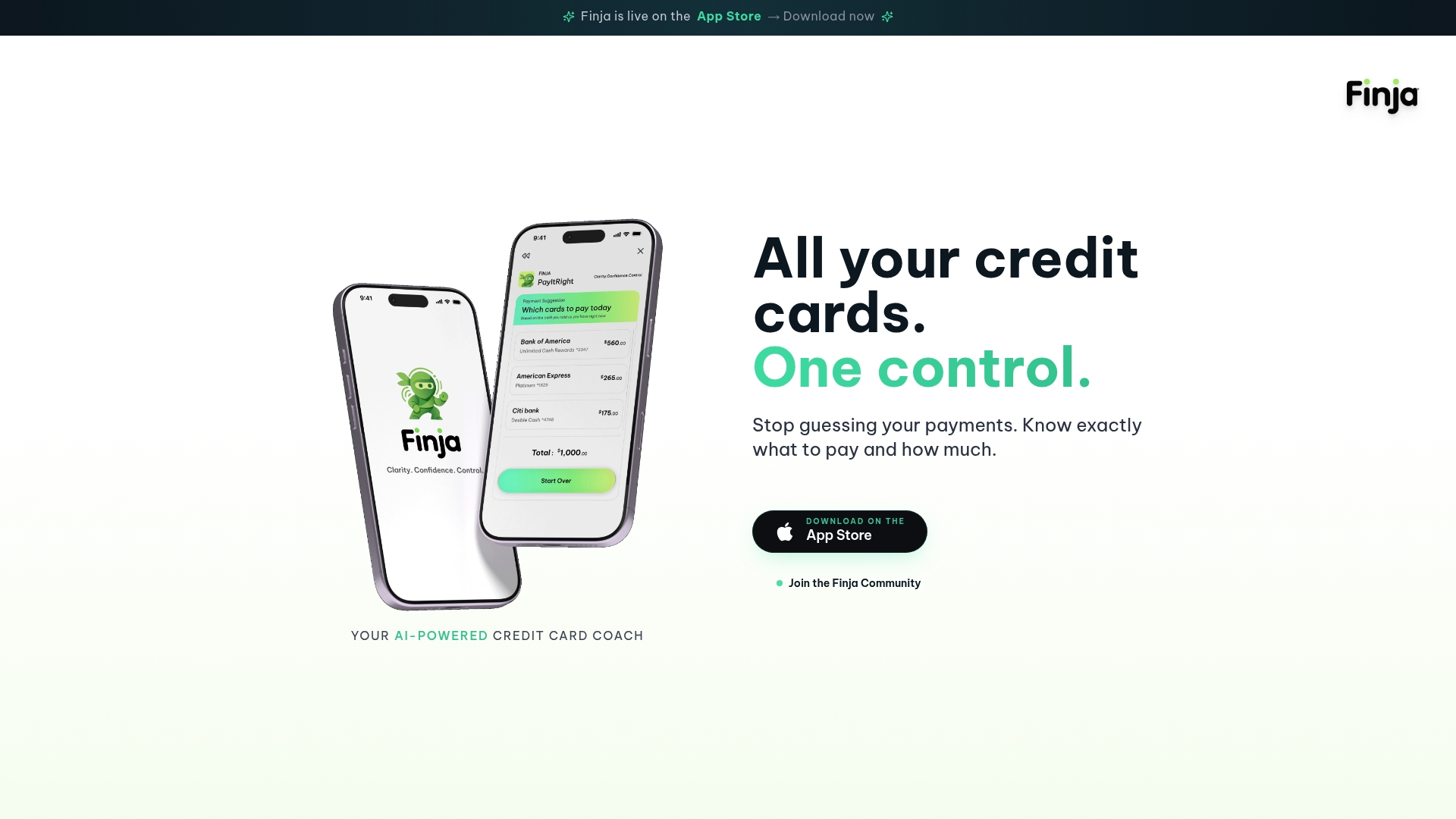
Finja's AI-powered platform consolidates all your credit card accounts into a single view, calculates which balance costs you the most in interest, and recommends a specific payment amount for each card. You set the automation once, and Finja keeps your payments above the minimum without requiring a monthly decision. Users with multiple cards often find that redirecting even $50–$100 per month to the right card, consistently, produces faster payoff than any one-time lump sum.
If you're ready to stop watching interest consume your payments, start with Finja and see exactly how much you could save this year.
Authoritative sources and calculators to check next
- Montana State University Extension — Credit Card Minimum Payment Trap: The source for the $4,000/$13,843/34-year worked example used throughout this article. Free, government-affiliated, and replicable.
- Consumer Financial Protection Bureau (CFPB): The primary U.S. regulator for credit card disclosures. Their payoff calculator and CARD Act explainers are the most authoritative free tools available.
- Consolidated Credit: NFCC-affiliated nonprofit counseling resource; used in this article for the DMP and counseling mechanics section.
- Bankrate credit card roundtable: Expert consensus on avalanche vs. snowball and automation strategies cited in the escape plan section.
- Finja — AI Credit Card Management: Consolidated dashboard, payment optimization recommendations, and automated overpayment tools for U.S. cardholders with multiple cards.
- Finja blog — What Is a Minimum Payment?: Deeper explanation of how minimum payments are calculated and what happens when you pay only that amount.
- Finja blog — Debt-Free Credit Card Strategy: Avalanche and snowball frameworks with planning templates for U.S. cardholders.
This article is general financial information, not professional advice. Confirm current rates, terms, and program eligibility with your card issuer or a qualified financial counselor before making changes to your repayment plan.