
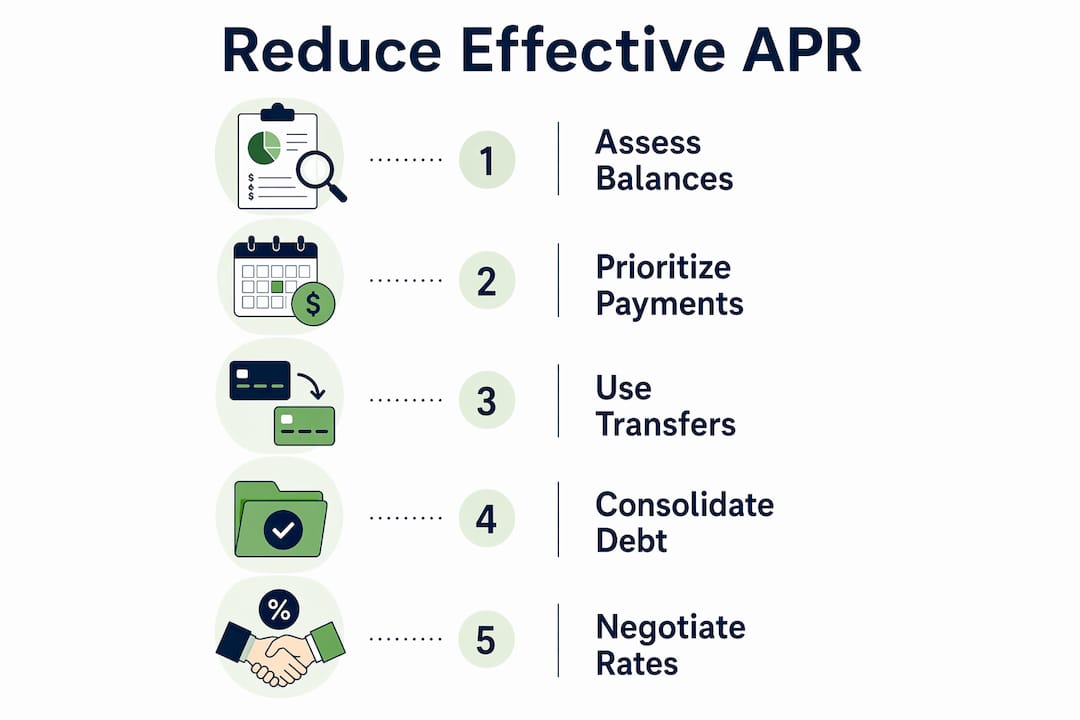
The fastest way to reduce effective APR across cards is to direct every extra dollar to your highest-rate balance, lock in any available 0% balance-transfer window before it closes, and negotiate or consolidate whatever remains. Average credit card APRs were reported in the low- to mid-20% range (approximately 21.76%–23.3% as of late 2024), so even shaving a few points off your weighted average saves real money. Dropping a $10,000 balance from 25% APR to 15% cuts roughly $1,000 in annual interest. Your next step in the next 24 hours: pull every statement, write down each balance, APR, and minimum payment, then check your inbox and mail for 0% transfer offers. That list is the foundation for everything below.
Table of Contents
- Which repayment method reduces your effective APR fastest?
- How to use balance transfers without creating a bigger problem
- When does debt consolidation actually lower your effective APR?
- How to call your card issuer and ask for a lower rate
- How to calculate and optimize your weighted APR across cards
- When does an app actually help you manage this?
- Key Takeaways
- The part most guides skip: behavior is the actual bottleneck
- Finja puts this plan on autopilot for you
Which repayment method reduces your effective APR fastest?
The Avalanche method wins on math. You pay minimums on every card and throw every extra dollar at the highest-APR balance first. Once that card is cleared, you roll its payment to the next-highest rate. The Snowball method does the opposite: smallest balance first, regardless of rate. Snowball feels good because you eliminate accounts quickly, but it costs more in interest when the small balances carry lower rates than the big ones.
Where the difference shows up in dollars:
- Avalanche: Suppose you have Card A ($3,000 at 26%), Card B ($5,000 at 20%), and Card C ($1,500 at 14%). With $500/month in extra payments, you attack Card A first. Total interest paid over the payoff period is lower because the 26% balance stops compounding soonest.
- Snowball: You'd clear Card C first ($1,500 at 14%), which feels like progress but leaves the 26% balance accruing longer. You'll pay more in total interest, sometimes by hundreds of dollars depending on balances and timeline.
- Hybrid approach: Pay off one small balance first for a quick behavioral win, then switch to strict Avalanche. This works well when one card has a balance under $500 and the psychological lift keeps you on track.
The payment allocation mechanics behind each method matter more than most people realize, especially when promotional rates are expiring on different timelines.
Pro Tip: If you're not sure which method fits you, run both scenarios in a free debt payoff calculator for 15 minutes. The interest difference is usually the deciding factor — but if you've quit debt payoff plans before, the Snowball's early wins may be worth the small extra cost.
How to use balance transfers without creating a bigger problem
A 0% balance-transfer offer can effectively reduce your interest cost to zero for its promo window, but the math only works if you pay down the transferred balance before the promo expires. Balance transfer fees typically run 3%–5% of the transferred amount, so you need to factor that cost in before assuming you're saving money.

The break-even formula: Divide the transfer fee by the monthly interest you'd pay on the original card. That gives you the number of months you need to stay in the promo window just to break even.
Example: You transfer $6,000 from a card at 22% APR to a 0% card with a 3% fee ($180) and a 15-month promo. Monthly interest on the original card: $6,000 × 22% ÷ 12 = $110. Break-even: $180 ÷ $110 = 1.6 months. After that, every month in the promo window is pure savings. If you pay $400/month, you clear the $6,000 in 15 months and pay only the $180 fee versus $825 in interest on the original card. Net savings: $645.
Before moving any balance, verify four things in this order: the new card's credit limit (transfers are capped at your available credit), the exact transfer fee percentage, the promo expiry date to the day, and whether new purchases on the transfer card accrue interest immediately (most do, at the card's standard rate).
| Scenario | Transfer fee | Interest saved (15 months) | Net savings |
|---|---|---|---|
| $6,000 at 22% → 0% promo, 3% fee | $180 | $825 | $645 |
| $6,000 at 22% → 0% promo, 5% fee | $300 | $825 | — |
| $6,000 at 22% → stays on original card | $0 | $0 | $0 (pays $825) |
Pro Tip: When you have two staggered 0% promos expiring at different times, prioritize paying down the one expiring soonest. Set a calendar alert 60 days before each expiry date — that's enough runway to either pay it off or arrange another transfer if your credit supports it.
When does debt consolidation actually lower your effective APR?
Consolidation helps when the new loan's APR is meaningfully lower than your current weighted average APR after you account for origination fees. The rule of thumb: if the consolidation loan rate is at least 3–5 percentage points below your weighted average and you can commit to the payment schedule, consolidation is worth modeling.
A concrete example: consolidating $17,500 of credit card debt at 20% into a personal loan at 12% can save over $200 per month and thousands in total interest over a five-year term. That's a real difference, not a rounding error.
| Dimension | Balance transfer | Personal loan | HELOC |
|---|---|---|---|
| Impact on effective APR | Drops to 0% during promo | Moderate reduction (fixed rate) | Potentially large reduction |
| Fees and upfront costs | 3%–5% transfer fee | 1%–5% origination fee | Closing costs, appraisal |
| Credit score / eligibility | Good–excellent credit needed | Fair–good credit accepted | Requires home equity |
| Ease of setup | Fast (days) | Moderate (about 1 week) | Slow (weeks to months) |
| Timeline to payoff | Short (promo length) | Fixed term (5 years) | Variable, risk of extension |
Decision checklist before consolidating:
- Your credit score is high enough to qualify for a rate below your current weighted average (generally 670+ for competitive personal loan rates).
- The origination fee doesn't erase the first year of interest savings.
- You can afford the fixed monthly payment without leaning on the cards you just paid off.
- The loan term doesn't extend your payoff so far that total interest exceeds what you'd pay staying put.
A HELOC can offer a lower rate than an unsecured personal loan, but it puts your home on the line. For most people carrying $5,000–$20,000 in card debt, a fixed-rate personal loan is the cleaner choice: predictable payment, no collateral risk, and a defined end date.
How to call your card issuer and ask for a lower rate
Negotiation works most reliably when you have three things: a clean payment history (no recent lates), an improved credit score since you opened the account, and at least one competing offer you can reference. Issuers that run automated review cycles roughly every six months may already have flagged your account for a rate adjustment — your call just accelerates that process.
Before you dial, gather:
- Your current APR and account open date
- Your last 12 months of on-time payments
- Your most recent credit score (free from most issuers)
- Any competing card offer with a lower stated APR
Keep it short and factual. You're not asking for a favor; you're presenting a business case. If the rep says no, ask whether there's a temporary promotional rate or when the account is next eligible for an automated review. Then ask for the rep's name and a reference number.
Bringing data to the call materially improves your odds. Issuers hear vague requests all day; a caller who names a specific competing rate and cites their payment history stands out.
If a rate increase happened because you were 60 or more days late, the CFPB's guidance is specific: six consecutive on-time payments obligates the issuer to consider restoring the prior rate. That's procedural leverage worth knowing.
Pro Tip: Always ask for written confirmation of any rate change before you hang up. A verbal agreement that doesn't appear on your next statement is effectively worthless.
How to calculate and optimize your weighted APR across cards
Your effective APR across multiple cards is a weighted average: multiply each card's balance by its rate, sum those products, then divide by your total balance.

Formula: Weighted APR = Σ(Balance × Rate) ÷ Σ(Balance)
Worked example with three cards:
| Card | Balance | APR | Balance × APR |
|---|---|---|---|
| Card A | — | 26% | — |
| Card B | $3,000 | 20% | — |
| Card C | — | 14% | — |
| Total | $9,000 | $1,920 |
Weighted APR = $1,920 ÷ $9,000 = 21.3% (which falls within the recent average APR range of 21.76%–23.3% reported for late 2024).
Now redirect $300/month of extra payments from Card C (14%) to Card A (26%). After 12 months, Card A's balance drops faster, its contribution to the numerator shrinks, and your weighted APR falls even before any negotiation or transfer. The annual interest savings from that reallocation alone can reach $150–$200 on this example set.
When you're managing three or more cards with variable rates or staggered promos, promo end-dates become the biggest risk to your plan. A promo expiring unnoticed can spike your effective APR overnight. Automating payment dates and monitoring expiry windows is the difference between a plan that holds and one that quietly unravels.
Pro Tip: Align all your card due dates to the same week of the month. Most issuers let you shift your due date with one phone call. Clustering payments makes it far easier to see your total monthly outflow and catch any missed minimums before they trigger a late fee.
For a deeper look at due date management and how it affects allocation efficiency, Finja's guide covers the mechanics in detail.
When does an app actually help you manage this?
DIY math works fine for two cards with fixed rates and no active promos. Once you add a third card, a variable rate, or a promo expiring in the next six months, the manual tracking burden grows fast enough that errors become likely.
A tool earns its keep when:
- You carry three or more cards with different rates and balances.
- At least one card has a promotional rate expiring within 12 months.
- You want payment recommendations that update when balances or rates change.
- You'd rather spend 10 minutes reviewing a recommendation than 45 minutes rebuilding a spreadsheet.
What to look for in any credit card management app: real-time APR weighting across all linked accounts, alerts when a promo is 60–90 days from expiry, suggested payment reallocation when a rate changes, and a consolidated view that shows your weighted APR at a glance. On the security side, read-only account aggregation (no transaction authority) and standard encryption are the baseline. Check the privacy policy for data-sharing practices before linking any account.
Finja does exactly this: it consolidates your cards into one view, calculates your weighted APR dynamically, flags promo expirations before they become problems, and recommends which card to pay extra on each month. AI-driven spending pattern detection is what makes those recommendations sharper over time, adapting as your balances and rates shift. For readers who want to understand the automation layer, Finja's multiple card management guide walks through how consolidated dashboards work in practice.
Pro Tip: Before linking accounts to any app, confirm it uses read-only access. You want the tool to see your data, not move money. That single check eliminates the most common security concern.
Key Takeaways
Directing extra payments to your highest-APR balance, using 0% transfer windows strategically, and negotiating with data in hand are the three moves that most reliably reduce effective APR across cards.
| Point | Details |
|---|---|
| Avalanche beats Snowball on interest | Targeting your highest-rate card first minimizes total interest paid across all cards. |
| Balance transfers need a payoff plan | A 3%–5% transfer fee only saves money if you clear the balance before the promo expires. |
| Weighted APR formula guides allocation | Use Σ(Balance × Rate) ÷ Σ(Balance) to find where extra payments cut costs fastest. |
| Negotiation requires data, not just a request | Bring payment history, your credit score, and a competing offer before calling your issuer. |
| Finja automates dynamic allocation | Finja consolidates cards, tracks weighted APR in real time, and alerts you to promo expirations. |
The part most guides skip: behavior is the actual bottleneck
The math in this article is not complicated. The hard part is executing it consistently for 12–24 months while life keeps happening. Most people who fail at APR reduction don't fail because they picked the wrong method. They fail because they opened a new card to chase a promo, spent on the card they just transferred a balance to, or missed a promo expiry by two weeks.
A few guardrails worth naming: don't open more than one new card per 12-month period, even for a compelling 0% offer. Each new account temporarily dips your credit score and adds another expiry date to track. Don't treat a paid-off card as free spending capacity. The card is still open, the credit line is still there, and it's genuinely easy to rebuild a balance you just spent months eliminating. Keep a small emergency fund separate from your credit lines so an unexpected expense doesn't derail your payoff plan.
The variable rate mechanics behind credit cards also matter here. Most cards are tied to the prime rate, which means your APR can rise without any action on your part. Building a plan that accounts for rate movement, not just today's snapshot, is what separates a durable strategy from one that looks good on paper for six months.
Realistic savings expectations: a consumer carrying $9,000 across three cards at a weighted 21.3% APR (in line with recent averages of 21.76%–23.3% as of late 2024) who successfully negotiates one card down, transfers another, and reallocates payments can realistically cut their weighted APR to 14%–17% within six months. That's not a dramatic headline, but it's $500–$900 in annual interest savings that compounds forward every year the lower rate holds.
Finja puts this plan on autopilot for you
Pulling balances, recalculating weighted APR, tracking promo expiry dates, and deciding where to send extra payments every month is a lot to manage manually. Finja handles all of it in one place.
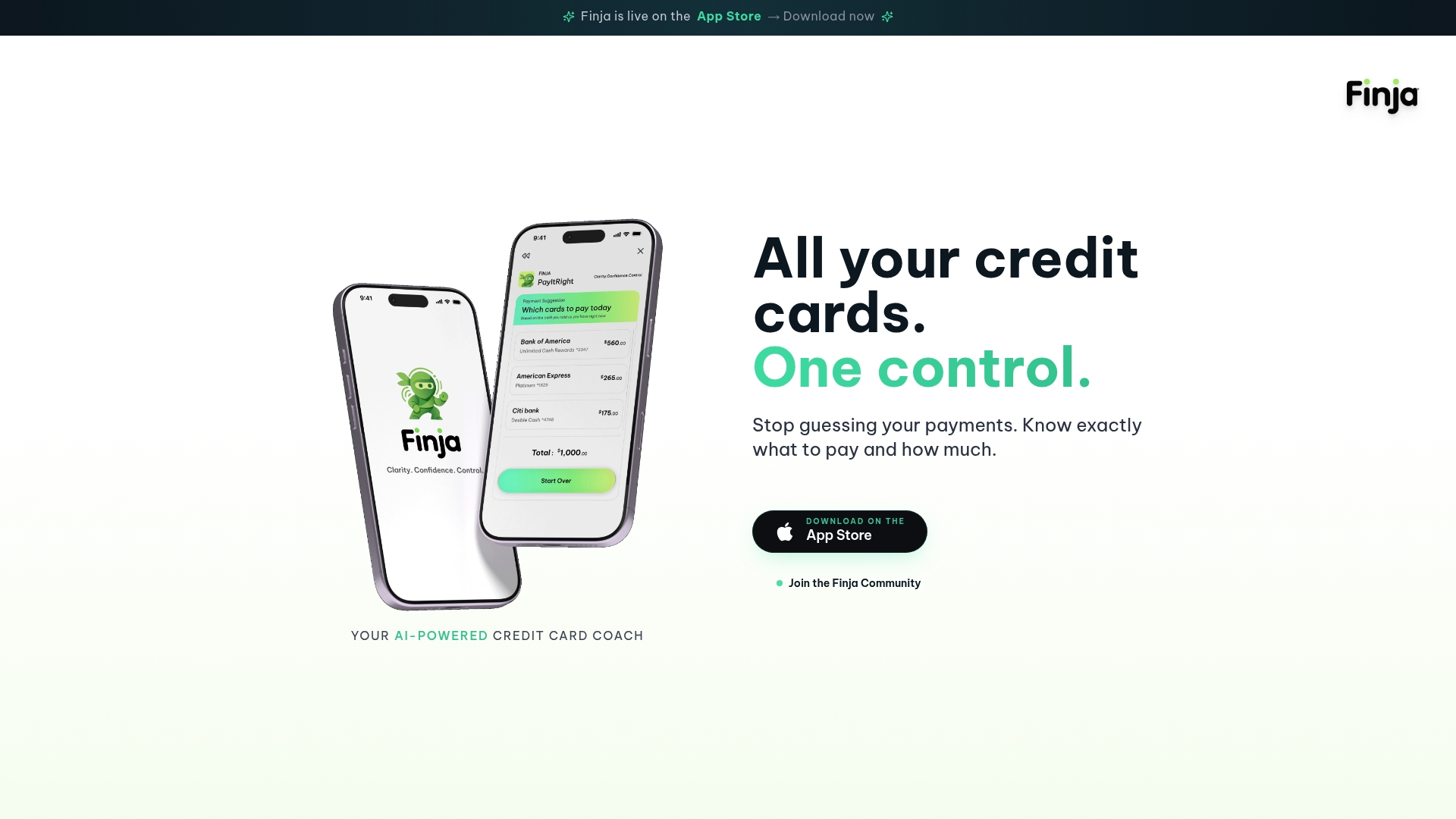
Connect your cards and Finja immediately shows your consolidated balance, your real-time weighted APR, and a prioritized payment recommendation. When a promotional rate is 60 days from expiring, you get an alert before the spike hits. When a balance shifts or a rate changes, the allocation recommendation updates automatically. Account aggregation is read-only, data is encrypted, and you control what you share.
Most users see their first concrete recommendation within minutes of setup, and the biggest wins typically show up in the first 30 days: a reallocation that cuts monthly interest, a promo expiry flagged in time to act, or a negotiation prompt timed to an automated issuer review cycle. Start with Finja and let the math work for you.
Useful calculators and sources
- Federal Reserve G.19 Consumer Credit release — authoritative source for average credit card interest rate data; check the most recent release for current APR benchmarks.
- CFPB: When can my credit card company increase my interest rate? — the primary source for your rights around rate increases and the six-payment reinstatement rule.
- Clever Calcs Debt Consolidation Calculator — enter your current balances, rates, and a proposed loan rate to see monthly and total-interest savings side by side.
- FTC: Coping with Debt — practical consumer guidance on debt management options and your rights.
- Finja blog: Credit Card APR Explained — covers how daily periodic rates and compounding work, which is the foundation for the weighted-APR formula above.
- Finja blog: High-Interest Card Prioritization — deeper comparison of Avalanche and Snowball with worked examples.
To use any calculator effectively, have three numbers ready from each statement: current balance, APR (not the promotional rate, the standard rate), and minimum payment. Those inputs are all you need to model any scenario in this guide.
This article is general financial information, not personalized financial advice. Confirm current rates, terms, and your eligibility with your card issuers or a qualified financial professional before making decisions.