
Most changes to your credit card's variable APR happen automatically because your card's rate is built from a formula: Prime rate + issuer margin = your APR. When the Federal Reserve moves the federal funds rate, the prime rate follows, and your APR adjusts with it. Your margin stays fixed. The index moves. That's the whole mechanism.
Three facts to hold onto right now:
- Your cardholder agreement specifies the exact index your card uses (almost always the U.S. prime rate) and your fixed margin. That document is the authoritative source, not your statement alone.
- Index-driven APR changes are automatic and contractual. The Consumer Financial Protection Bureau (CFPB) confirms these adjustments typically do not require the 45-day advance notice that issuer-initiated increases do.
- If you pay your balance in full every month, a rate change costs you nothing. If you carry a balance, even a quarter-point move adds real dollars to your monthly interest.
Pro Tip: Pull up your cardholder agreement today and search for the phrase "Index" or "Prime." You'll find the exact formula and your margin listed there. Screenshot it so you have a baseline when rates move again.
Table of Contents
- What a variable APR really means: the formula and how the pieces fit
- How the Fed connects to your credit card rate
- When and how issuers can change your variable APR
- How a rate increase actually changes what you pay
- What to do if your variable APR rises
- Why rate changes matter more when you carry a balance
- Key Takeaways
- Variable rates are manageable — if you know what you're looking at
- Finja helps you stay ahead of rate changes
- Sources and where to read more
What a variable APR really means: the formula and how the pieces fit
A variable APR is not a single number your issuer picks arbitrarily. It's a two-part formula: APR = Index + Margin. The index is a public benchmark rate, almost always the U.S. prime rate. The margin is a fixed percentage your issuer set when you opened the account, based on your creditworthiness at the time.
The margin is the issuer's leverage point. It rarely changes after account opening, and when it does, that's a separate event governed by different rules. The index does all the moving. So when people ask about the causes of credit card rate changes, the answer is almost always: the index moved.
Here's a quick worked example. Say your card's terms read "Prime + 14.99%." If the prime rate is 8.50%, your APR is 23.49%. The Fed cuts rates by 0.25 percentage points, prime drops to 8.25%, and your APR becomes 23.24%. Same margin, lower index. The math is exactly that direct.
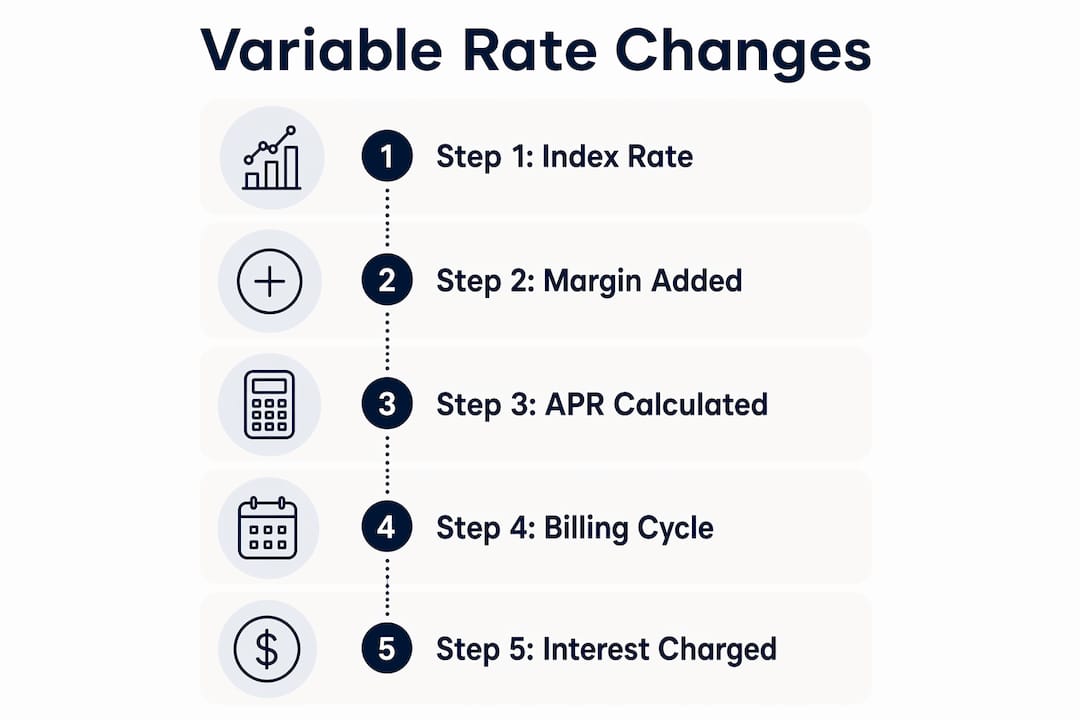
You'll find your formula on your statement's interest-charge disclosure or in the pricing table of your cardholder agreement, usually written as "Index + X.XX%" or listed in an APR table with a footnote explaining the index. If you've never looked, it's worth two minutes of your time.
How the Fed connects to your credit card rate
The transmission path from Washington to your wallet has three steps, and it moves faster than most people expect.

The Federal Reserve sets the federal funds rate, the overnight rate banks charge each other to lend reserves. The prime rate closely tracks the federal funds rate and is typically set at FFR + 3.00 percentage points. Most major U.S. banks move their prime rate within days of a Fed decision. Your card APR then follows within one to two billing cycles, depending on where you are in your billing period when the change takes effect.
The common indexes card contracts reference in the U.S.:
- U.S. Prime Rate — by far the most common; used by the vast majority of consumer credit cards
- LIBOR — historically used by some cards, now largely phased out and replaced with SOFR-based benchmarks
- SOFR (Secured Overnight Financing Rate) — increasingly referenced in newer card agreements as LIBOR's successor
The delay between a Fed move and your APR change comes from billing-cycle timing. If the Fed acts on November 7 and your billing cycle closes November 3, you won't see the new rate until your next cycle. That's normal, not an error. To confirm which index your card uses, look for the index name in your terms, usually in the section titled "How We Calculate Your Balance" or "Variable Rate Information."
Pro Tip: The Wall Street Journal Prime Rate is the most widely cited benchmark. Bookmark it and check it after every Fed meeting — if it moves, your APR will follow.
When and how issuers can change your variable APR
Not all APR changes are the same, and the rules governing them differ significantly depending on the cause.
Index-driven changes are automatic. Your cardholder agreement already authorized them when you signed up. Because the adjustment is contractual, issuers are generally not required to send you an individualized 45-day advance notice for index-driven moves. The CFPB is explicit on this point: variable-rate adjustments tied to a public index are treated differently from discretionary issuer increases.
Issuer-driven changes are a different matter. If your issuer raises your rate because you missed a payment, exceeded your limit, or your account triggered a risk review, that's a behavioral or account-specific increase. Those typically require advance notice under the CARD Act and related Federal Reserve regulations. You should receive written notice at least 45 days before the new rate takes effect on existing balances.
The CARD Act's 45-day notice requirement is a meaningful consumer protection — but it applies to issuer-initiated increases, not to the automatic index adjustments that move with the prime rate. Knowing which type of change you're looking at tells you whether you have recourse.
Most cards also carry a contractual APR ceiling, usually close to thirty percent. Once your APR hits that ceiling, further prime-rate increases stop flowing through to your account. That ceiling creates a kink in the prime-to-APR relationship: below the ceiling, every basis-point move in the prime translates directly to your rate; above it, your rate is capped regardless of where the prime goes.
To find the notice language, check your monthly statement for a section labeled "Important Notice" or "Changes to Your Account Terms," or look for a separate mailing from your issuer.
How a rate increase actually changes what you pay
The math behind your monthly interest charge is straightforward: issuers convert your APR to a daily rate, multiply it by your average daily balance, then multiply again by the number of days in your billing cycle.

Daily rate = APR ÷ 365
Here's what a modest rate increase looks like on a $2,000 revolving balance:
| Scenario | APR | Daily Rate | Avg. Daily Balance | Days in Cycle | Monthly Interest |
|---|---|---|---|---|---|
| Before Fed hike | 23.49% | 0.06438% | $2,000 | — | $37.34 |
| After +0.25% hike | 23.24% | 0.06410% | $2,000 | — | $37.80 |
| After a 1 percentage-point increase | 23.24% | 0.06384% | $2,000 | — | $38.16 |
A single quarter-point move costs you about $0.41 per month on a $2,000 balance. That sounds trivial. But a full percentage-point increase adds roughly $1.65 per month, and if the Fed raises rates multiple times in a cycle (as it did in 2022–2023), those increments stack. On a $5,000 balance, a cumulative 3-point rise adds over $12 per month in interest.
The behavioral split matters here. Transactors (cardholders who pay in full each cycle) pay zero interest regardless of the APR. Revolvers (those who carry a balance) feel every rate move directly. If you're in the second group, APR changes are not abstract — they're a line item in your monthly budget.
What to do if your variable APR rises
When you notice your APR has moved, work through these steps in order:
- Verify the change. Pull your cardholder agreement and confirm the index name and your margin. Check your statement for the effective date and the new APR. Determine whether it was index-driven (prime moved) or issuer-driven (behavioral trigger).
- Pay more than the minimum. Every extra dollar reduces your average daily balance, which directly cuts your interest charge. Even an extra $50 per month makes a measurable difference on a $2,000 balance.
- Consider a balance transfer. If your APR has climbed significantly, a balance transfer to a lower-rate card or a 0% promotional offer can pause interest accumulation. Factor in the transfer fee (typically 3–5%) against the interest you'd save.
- Call your issuer and ask for a rate reduction. This works more often than most people expect, especially if you have a clean payment history.
Script template: "Hi, I've been a customer for [X] years and I've always paid on time. I noticed my APR recently increased. I'd like to request a rate reduction. Is that something you can offer me today?" Keep it simple and direct. If the first rep says no, ask to speak with the retention department.
- Dispute if the change seems incorrect. If the increase doesn't match what your terms describe, or if you received no notice for what appears to be an issuer-driven change, file a complaint with the CFPB at consumerfinance.gov or contact your bank's regulatory body.
Pro Tip: Time your largest payment just before your statement closing date, not the due date. This reduces your average daily balance for the entire cycle, cutting the interest calculation at its base.
Why rate changes matter more when you carry a balance
The impact of APR moves isn't uniform across cardholders, and the research makes that gap concrete. A Federal Reserve Bank of Boston study found that a 1 percentage-point increase in a credit card's APR reduces aggregate card spending by roughly 9% in the following month. Among revolvers specifically, that spending reduction reaches approximately 15%.
"The effects are heterogeneous: lower-credit-score revolvers cut spending most sharply when APRs rise, while higher-credit-score revolvers tend to respond by paying down balances rather than cutting purchases." — Federal Reserve Bank of Boston
That behavioral split has real planning implications. If you're a lower-credit-score revolver, a rate increase may force spending cuts before you can address the balance itself. If you have stronger credit, your instinct to pay down is the right one — and it's worth acting on quickly, since the prime-to-APR transmission is nearly one-to-one until a contractual ceiling applies.
The practical takeaway: revolvers should treat a Fed rate-hike cycle as a signal to accelerate paydown, not just absorb the higher cost. Monitoring your credit card financial health indicators during a rising-rate environment gives you early warning before the interest compounds into a harder problem.
Key Takeaways
Variable APR changes are almost always automatic and index-driven, meaning the prime rate moved, your margin stayed fixed, and your contract authorized the adjustment without any notice required.
| Point | Details |
|---|---|
| Check your cardholder agreement | Find the index name and your fixed margin — that formula governs every automatic rate change. |
| Index-driven vs. issuer-driven | Index moves require no 45-day notice; issuer-initiated increases for behavioral reasons typically do. |
| Transactors pay nothing extra | If you pay in full each cycle, a rate increase has zero cost to you regardless of how far the prime moves. |
| Revolvers should act fast | A rise in APR significantly reduces revolver spending — prioritize paydown when rates climb. |
| Finja helps you track and respond | Finja's AI-powered platform monitors your APRs across cards and flags when a rate change affects your interest costs. |
Variable rates are manageable — if you know what you're looking at
The thing most people miss about variable APRs is that the rate change itself isn't the problem. The problem is carrying a balance when it happens. I've seen cardholders panic over a 0.25-point move on a card they pay in full every month — that's a non-event. Meanwhile, someone revolving $4,000 across two cards barely notices a cumulative 2-point climb until the interest charges start crowding out their monthly budget.
Check your statement after every Fed meeting. Save your issuer's customer-service number somewhere accessible. And if you're revolving a balance, treat a rate hike as a deadline, not a background event. Index-driven changes are normal, predictable, and manageable once you understand the formula. The cardholder agreement has the answer. Most people just never read it.
Finja helps you stay ahead of rate changes
Carrying multiple cards means tracking multiple APRs, and when the prime rate moves, the math across your wallet changes all at once. Finja is an AI-powered credit card management platform built for exactly that situation. It monitors your APRs, models how a rate change affects your total interest costs, and helps you prioritize which balance to pay down first.
There's no guesswork about which card is costing you the most after a Fed move. Finja surfaces that answer and shows you the payment sequence that gets you out of interest fastest. Visit myfinja.com to see how it works. Finja is a financial management tool, not a licensed financial advisor — use it alongside your own judgment and, when needed, a qualified professional.
Sources and where to read more
These are the primary and high-authority sources behind this article. Start with the official guidance if you want to verify anything specific to your account.
- CFPB: Fixed vs. Variable APR — The Consumer Financial Protection Bureau's plain-language explanation of how variable APRs work and when notice is required. The most accessible starting point for consumer questions.
- HelpWithMyBank.gov: How often can the bank change my rate? — Official OCC-affiliated guidance on the frequency and conditions under which card rates can change.
- Federal Reserve: Limitations on increasing APRs, fees, and charges — The regulatory text governing when issuers must provide advance notice for rate increases.
- Boston Fed: How interest rate changes affect credit card spending — The primary research source for the spending-reduction findings cited in this article.
- Boston Fed Working Paper WP2510 — The underlying academic paper on APR transmission and contractual ceilings.
- Investopedia: Variable interest rate — A solid consumer-facing explainer on the trade-offs between variable and fixed rates.
- CardRates: 5 Reasons Your Credit Card Interest Rate Changes — Practical breakdown of the margin-and-index formula and how issuers compute monthly interest.
- Finja Blog: Credit Card Interest Forecast 2026 — Macro context on where APRs may head and what cardholders should watch for.
- Finja Blog: 10 Ways to Reduce Credit Card Bills — Practical strategies for lowering your interest costs when rates rise.