
Credit cards carry different interest rates because issuers price each account based on your default risk, their own cost structure, and the type of transaction you make. That's the short answer. The longer one involves a mix of economic research, federal regulation, and some genuinely surprising math about who actually pays for your rewards points.
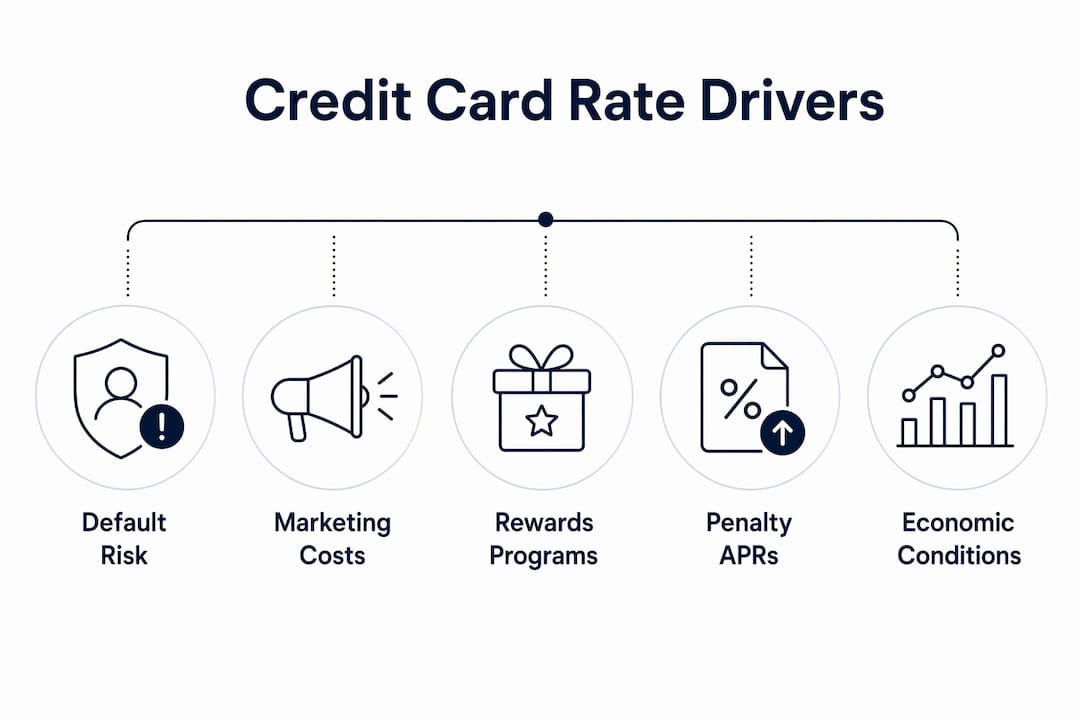
A few things drive the variation:
- Default risk: Unsecured credit card debt carries no collateral, so issuers build the cost of potential losses directly into your rate.
- Your credit profile: A 600 FICO score and an 850 FICO score can face spreads that differ by nearly 14 percentage points.
- Transaction type: The same card charges different APRs for purchases, cash advances, and balance transfers.
- Marketing and operating costs: Card issuers spend between 1% and 2% of assets annually on marketing alone, roughly 10 times what other banks spend.
- Regulatory limits: The CARD Act of 2009 restricts how and when issuers can raise your rate after you open an account.
- Market conditions: Variable APRs move with the prime rate, but credit card rates are notoriously slow to fall when the prime rate drops.
Why credit cards have different rates: the key drivers explained
The gap between a 15% APR and a 29% APR on two different cards isn't random. Each percentage point traces back to something specific.
Default risk is the biggest single factor
Credit card default losses accounted for more than 53% of all bank losses in an average year between 2010 and 2023. Unlike a mortgage or auto loan, credit card debt is unsecured. There's no house or car to repossess. When a borrower stops paying, the issuer absorbs the loss entirely. That risk can't be diversified away the way a stock portfolio can, because defaults tend to spike during recessions precisely when issuers are already under pressure. The result: issuers price a default risk premium into every account from day one.
Charge-off rates illustrate how dramatically risk varies by borrower. A cardholder with a 600 FICO score defaults at a rate of 9.3% per year, while someone with an 850 FICO defaults at just 1.3%. Those aren't small differences, and they show up directly in the APR you're offered.

Marketing costs you probably didn't expect to pay for
Wharton finance professor Itamar Drechsler and co-authors found that marketing spending is one of the largest contributors to high credit card rates, second only to default losses. Card issuers spend at a scale comparable to major consumer brands. That spending builds brand loyalty and pricing power, and cardholders foot the bill through higher APRs. Drechsler put it plainly: consumers respond more to rewards features than to interest rates, which gives issuers little incentive to compete on price.

Rewards programs raise rates less than you'd think
Here's the counterintuitive part. Rewards programs look expensive, and they are: the six largest card issuers paid out $67.9 billion in rewards in 2023 alone. But those costs are largely covered by interchange fees, not by your APR. Interchange income averages 1.82% while rewards expenses run about 1.57%, leaving a thin but positive margin. So rewards aren't the primary reason your rate is high. They're more of a marketing vehicle that keeps you from shopping around for a lower rate. For a deeper look at how rewards program costs interact with APRs, the structure matters more than the headline cashback percentage.
Penalty APRs respond to your behavior
A penalty APR kicks in when a payment is more than 60 days late. It's a contractual rate increase, not a market-driven one, and it can push your rate well above what you were originally offered. The CARD Act limits how issuers can raise rates on existing balances, but penalty APRs are an explicit carve-out. They're also a behavioral signal: issuers use late payments to identify borrowers who are either in financial distress or, in some cases, simply price-insensitive.
Economic conditions move rates, but slowly
Variable APRs are typically set as a fixed margin over the prime rate. When the prime rate falls, you'd expect card rates to follow. They don't, at least not quickly. The prime rate dropped to 3% in 2021, yet credit card margins hit all-time highs that same year. The CFPB has documented this pricing stickiness explicitly. Issuers benefit from the asymmetry: rates rise with the prime rate but resist falling with it.
| Driver | How it affects your APR |
|---|---|
| Default risk | Higher charge-off probability = higher spread at origination |
| Marketing costs | 1%–2% of assets annually, passed through to cardholders |
| Rewards programs | Mostly offset by interchange fees; modest direct APR impact |
| Penalty APR | Triggered by 60+ day late payment; overrides standard rate |
| Prime rate changes | Variable APRs rise quickly, fall slowly |
| CARD Act limits | Restricts mid-account repricing; locks in origination spread |
The CARD Act locked in your origination rate
Before 2009, issuers could raise your rate at almost any time for almost any reason. The CARD Act of 2009 changed that. Issuers can no longer reprice existing balances based on new information they learn about you during the lending relationship, with narrow exceptions like penalty APRs. The practical effect: the rate you get when you open a card is largely the rate you keep. Issuers responded by front-loading risk into origination pricing, which is one reason initial APRs are higher than they might otherwise be.
Research also found that before the CARD Act, roughly 52% of borrowers experienced a discretionary rate increase within a year of opening an account. That practice is now largely prohibited, but the pricing behavior it reflected didn't disappear. It just moved to the application stage.
Why your single credit card has multiple APRs
One card, three or four different rates. This confuses a lot of people, but the logic is straightforward once you see how each APR applies.
The CFPB requires issuers to disclose every APR category on your billing statement, along with the balance subject to each rate. Your cardholder agreement spells out which transactions fall into which bucket.
- Purchase APR: The standard rate for everyday spending. Most cards offer a grace period, meaning you pay no interest if you pay the full balance by the due date.
- Cash advance APR: Higher than the purchase APR, and there's no grace period. Interest starts accruing the day you take the advance. This applies to ATM withdrawals, convenience checks, and sometimes gambling transactions.
- Balance transfer APR: Often starts at a promotional rate (sometimes 0%) for a set period, then reverts to a standard rate. The promotional rate is a customer acquisition tool, not a permanent feature.
- Penalty APR: Replaces your standard purchase APR after a serious delinquency. It applies to new purchases and, in some cases, existing balances.
Pro Tip: When you pay more than the minimum, federal law requires your issuer to apply the excess to the balance carrying the highest APR first. That rule alone can save you money if you have a mix of purchase and cash advance balances.
Managing multiple APRs across cards gets complicated fast, especially when promotional periods expire at different times.
How your credit score shapes the rate you're offered
Your credit score is the single most visible input into the APR you receive at application. The spread between what a low-score and high-score borrower pays is wider than most people realize.
According to New York Fed research, the average interest rate spread across all cardholders is 14.5%. For borrowers, spreads are 21% for a 600 FICO and 7.22% for an 850 FICO.
Even at the top of the credit score range, the spread doesn't disappear. That's because issuers maintain pricing power even over their best customers. Research on price dispersion in credit card APRs shows that two consumers with identical credit scores can face meaningfully different rates depending on how actively they shop and which lender they approach. The market rewards comparison shopping in a way that most cardholders never take advantage of.
- 600 FICO: 21% spread, charge-off rate of 9.3% annually
- 850 FICO: 7.22% spread, charge-off rate of 1.3% annually
- All cardholders: 14.5% average spread
Secured cards, which require a cash deposit as collateral, typically carry lower rates than unsecured cards for the same borrower profile. The deposit reduces the issuer's default exposure directly, so the risk premium built into the APR shrinks. For someone rebuilding credit, a secured card can be a way to access lower rates while demonstrating payment reliability.
The spread also tends to lock in at origination. Because the CARD Act limits repricing, improving your credit score after opening a card doesn't automatically lower your rate. You'd generally need to apply for a new card or negotiate directly with your issuer to capture the benefit of a better score.
Pro Tip: Checking your APR against current offers for your credit score band every 12 months is a simple way to see whether you're paying more than you need to. If your score has improved by 50 or more points since you opened a card, you likely qualify for better terms somewhere.
Understanding why your rate is what it is puts you in a better position to do something about it. Finja's AI-powered platform helps you see exactly how much each card is costing you in interest, which balances to pay down first, and where your credit profile gives you room to negotiate. Start managing your cards smarter and stop paying more than you have to.
Key Takeaways
Credit cards carry different rates primarily because issuers price default risk, marketing costs, and transaction type into every account from the moment it opens.
| Point | Details |
|---|---|
| Default risk drives spreads | Credit card losses made up 53% of bank losses annually from 2010 to 2023, forcing higher APRs. |
| Credit score determines your spread | Spreads range from 21% for a 600 FICO to 7.22% for an 850 FICO, per New York Fed data. |
| One card, multiple APRs | Purchase, cash advance, balance transfer, and penalty APRs each apply to different transactions. |
| Marketing costs raise rates | Issuers spend 1%–2% of assets annually on marketing, about 10 times the rate of other banks. |
| CARD Act locks in origination pricing | Rates set at account opening largely stay fixed; improving your score requires applying for a new card. |