
A credit score is a numerical measure of your creditworthiness that directly determines which credit cards you qualify for and what terms you receive. The FICO Score, the industry standard used by 90% of lenders, runs from 300 to 850. A 135-point score difference can cost you $8,000 more over five years on loans alone. Understanding why credit score matters for cards is not abstract financial literacy. It is the difference between a 0% intro APR offer and a 29% rate that compounds every month.
Why does your credit score matter for credit cards?
Your credit score determines whether a card issuer approves your application at all. Issuers sort applicants into risk tiers based on score ranges, and each tier unlocks a different set of products and pricing.
The FICO scoring model uses five broad categories. Scores of 800 and above are considered Exceptional. Scores from 740 to 799 are Very Good. The Good range runs from 670 to 739. Fair covers 580 to 669, and anything below 580 is classified as Poor. These categories are not just labels. They translate directly into card access.

Applicants with Exceptional scores qualify for premium travel cards, high credit limits, and the lowest available APRs. Applicants in the Fair range typically access secured cards or entry-level products with higher fees and interest rates. The gap in borrowing costs between these tiers is significant. A higher score on the FICO scale unlocks premium cards and reduces the total cost of carrying a balance.
Hard inquiries add another layer. Every time you apply for a card, the issuer pulls your credit report. That pull is a hard inquiry, and it reduces your score by fewer than 5 points in most cases. One inquiry is manageable. Several in a short window signal financial stress to lenders and compound the damage.
Pro Tip: Use a card issuer's prequalification tool before applying. Prequalification uses a soft inquiry, which does not affect your score, and gives you a realistic read on your approval odds.
| Score range | Tier label | Typical card access |
|---|---|---|
| 800–850 | Exceptional | Premium travel, cash-back, 0% intro APR |
| 740–799 | Very Good | Rewards cards, competitive APRs |
| 670–739 | Good | Standard rewards, moderate APRs |
| 580–669 | Fair | Entry-level, secured, higher fees |
| Below 580 | Poor | Secured cards, limited options |
How do credit utilization and payment history shape your score?
Two factors drive the majority of your FICO score. Payment history accounts for 35% of the total calculation. Credit utilization accounts for up to 30%. Together, they represent nearly two-thirds of your score. Managing both well is the fastest path to better card terms.
Payment history is the most influential factor in your score. One 30-day late payment can damage your score for years. Late payments stay on your credit report for seven years. That single missed payment can push you out of a Good tier and into a Fair tier, costing you access to better cards and lower rates.
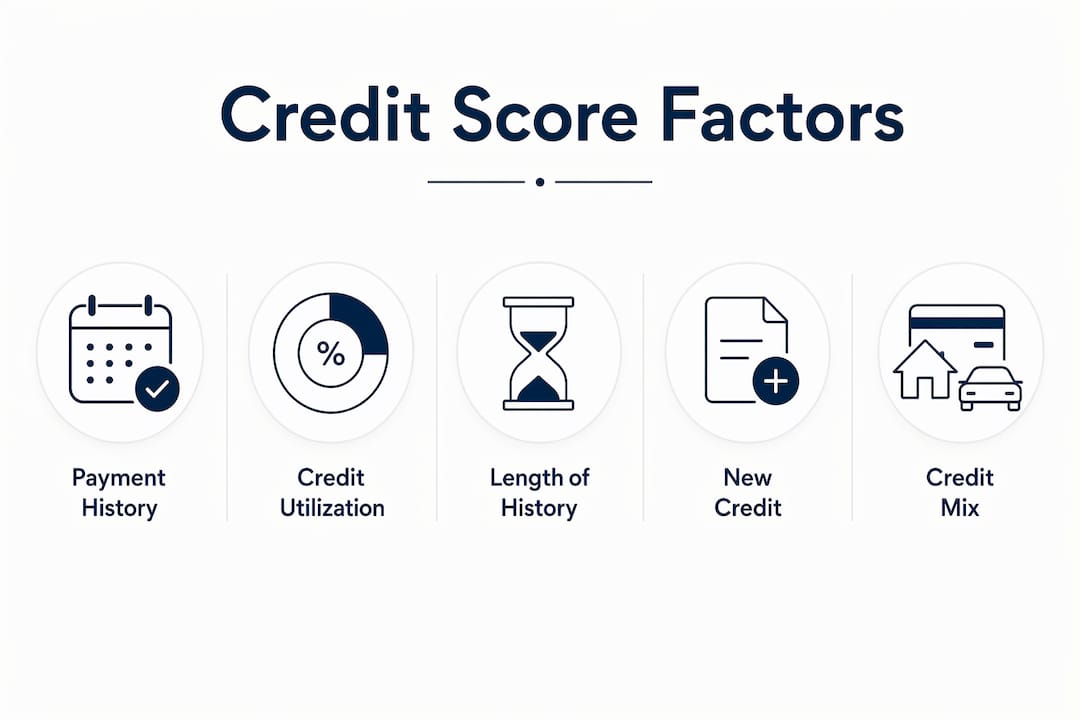
Credit utilization is the ratio of your current balances to your total credit limits. Keeping utilization below 30% signals to issuers that you are not overextended. Crossing that threshold regularly tells lenders the opposite, even if you pay your balance in full each month.
The good news is that utilization resets monthly. FICO Score 8 and VantageScore 3.0 both use the most recently reported utilization data. Paying down a high balance before your statement closing date can improve your score within a single billing cycle. That is a faster lever than almost any other credit action.
Here are the core habits that protect both factors:
- Pay every bill on or before the due date, without exception.
- Set up autopay for at least the minimum payment to avoid accidental late payments.
- Keep individual card balances below 30% of each card's limit, not just your overall limit.
- Pay down balances before the statement closing date, not just the payment due date.
- Avoid closing old cards, since that reduces your total available credit and raises your utilization ratio.
Pro Tip: If you carry balances across multiple credit cards, prioritize paying down the card closest to its limit first. That single move can drop your overall utilization faster than spreading payments evenly.
What are the biggest misconceptions about credit card applications?
The most common misconception is that one credit card application causes serious, lasting score damage. A single hard inquiry typically drops your score by fewer than 5 points, and the effect fades within 12 months. The real risk comes from applying for multiple cards in a short period.
Six or more hard inquiries increase the likelihood of bankruptcy eightfold, according to FICO research. Lenders see a cluster of applications as a sign of financial distress. The score drop from multiple inquiries compounds, and the signal it sends to underwriters is worse than the point loss itself.
A second misconception is that your credit score is the only thing lenders evaluate. Lenders supplement credit scores with income verification, employment history, and debt-to-income ratio. Two applicants with identical scores can receive different decisions based on their financial capacity. A score of 720 with a high debt-to-income ratio may get denied while a score of 700 with strong income and low debt gets approved.
A third misconception is that responsible credit card use cannot improve your score meaningfully over time. The opposite is true. On-time payments build a positive payment history. Low utilization demonstrates discipline. A longer account history raises your average account age, which is another scoring factor. The numbered steps below show how to apply for cards without triggering unnecessary damage:
- Check your credit score before applying so you target cards within your tier.
- Use prequalification tools to assess approval odds without a hard inquiry.
- Space applications at least six months apart to minimize inquiry clustering.
- Apply for one card at a time and let your score recover before the next application.
- Monitor your credit report after each application to confirm accuracy.
How do you build and maintain a strong credit score for better card benefits?
A strong credit score is built through consistent behavior over time, not through any single action. The benefits of a good credit score compound: better cards, lower rates, higher limits, and access to favorable interest terms as rates shift in 2026.
Checking your credit report regularly is the starting point. The three major bureaus, Equifax, Experian, and TransUnion, each maintain separate reports. Errors on any one of them can drag your score down without your knowledge. Credit monitoring services catch report errors before they cause lasting damage. Many card issuers now offer free score tracking directly in their apps.
Keeping older accounts open is a tactic most people overlook. Closing a card you no longer use seems tidy, but it reduces your total available credit and shortens your average account age. Both changes hurt your score. A card with no annual fee is almost always worth keeping open, even if you use it only occasionally.
Your credit score also extends beyond borrowing. Landlords and some employers review credit scores as part of their screening process. A strong score is not just a card qualification tool. It is a broader financial credential that affects housing, employment, and future borrowing capacity.
- Review your credit reports from all three bureaus at least once per year.
- Dispute any inaccurate accounts, balances, or late payment records immediately.
- Keep your oldest credit card active with at least one small purchase per quarter.
- Use a debt-free card strategy to avoid carrying balances that erode your utilization ratio.
- Set calendar reminders for payment due dates if autopay is not available.
Key Takeaways
Your credit score is the single most important factor in determining which credit cards you access and what those cards cost you.
| Point | Details |
|---|---|
| Score tiers determine card access | Scores above 740 unlock premium rewards cards; scores below 580 limit you to secured products. |
| Payment history carries the most weight | At 35% of your FICO score, one late payment can damage your credit for up to seven years. |
| Utilization resets monthly | Paying balances before the statement closing date can improve your score within one billing cycle. |
| Multiple applications compound risk | Six or more hard inquiries significantly increase lender concern and can lead to denials. |
| Credit scores affect more than cards | Landlords and employers also review credit scores, making a strong score a broad financial asset. |
What I have learned from treating my credit score as a long-term asset
I spent the first few years of my adult financial life treating credit scores as a bureaucratic hurdle rather than a tool I could actively manage. That mindset cost me. I applied for two cards within three months and watched my score drop more than I expected, not because of the inquiries alone, but because the combination of new accounts and a higher utilization ratio hit me from two directions at once.
The shift that changed everything was simple: I started treating my credit score the way I treat a savings account. You do not make one big deposit and walk away. You make consistent, small contributions over time and let the compounding do the work. Paying on time, every time, is the deposit. Keeping utilization low is the discipline that prevents withdrawals.
What most articles do not tell you is that patience is the actual strategy. There is no shortcut to a 780 score. But there is a clear path: space your applications, monitor your reports, and never let a payment slip. The readers who improve their scores fastest are not the ones chasing rewards sign-up bonuses. They are the ones who understand that credit card account activity is a long-term record, not a short-term game.
— Grace K.
How Finja helps you manage your credit score and card choices
Understanding your credit score is one thing. Knowing exactly which card to pay first, which balance to reduce, and how your decisions affect your score in real time is another level entirely.
Finja is an AI-powered credit card coach that gives you personalized guidance across all your cards. It monitors your credit health, flags decisions that could hurt your score, and recommends the payment moves that reduce your interest costs fastest. Whether you are building credit from scratch or managing several cards at once, Finja turns credit score knowledge into a concrete plan. Visit Finja's AI credit coach to get started with free, personalized credit card guidance today.
FAQ
What credit score do you need to get approved for a credit card?
Most standard rewards cards require a score of 670 or above. Premium travel and cash-back cards typically require scores of 740 or higher, while secured cards are available to applicants with scores below 580.
How much does applying for a credit card hurt your score?
A single credit card application triggers a hard inquiry that typically reduces your score by fewer than 5 points. The effect is temporary and usually fades within 12 months.
What is the fastest way to improve your credit score for a card?
Pay down balances before your statement closing date to lower your reported utilization, and make sure every payment is on time. Both actions can show results within one to two billing cycles.
Does having multiple credit cards hurt your credit score?
Multiple cards do not hurt your score if you manage them responsibly. Higher total credit limits can actually lower your utilization ratio, which helps your score, as long as you keep balances low.
Why do lenders look at more than just your credit score?
Credit scores are relative risk indicators, not absolute predictors of default. Lenders also review income, employment history, and debt-to-income ratio, so two applicants with the same score can receive different decisions based on their full financial picture.