
Calendar rewards credit cards deliver 5% cash back on specific purchase categories that rotate every three months, requiring you to activate each quarter to earn the bonus rate. The industry term for these programs is "rotating bonus category rewards," and understanding how credit card calendar rewards work is the difference between earning $300 a year and leaving most of that on the table. These cards follow a fixed quarterly schedule tied to the calendar year, with category changes on january 1, april 1, july 1, and october 1. Miss the activation window, and you earn the base rate of 1% on spending that could have earned five times more.
How credit card calendar rewards work: the quarterly mechanics
Rotating bonus category cards run on a strict four-quarter calendar. Category changes take effect on january 1, april 1, july 1, and october 1 every year. Each quarter brings a new set of spending categories, such as gas stations, grocery stores, restaurants, streaming services, or online retailers.
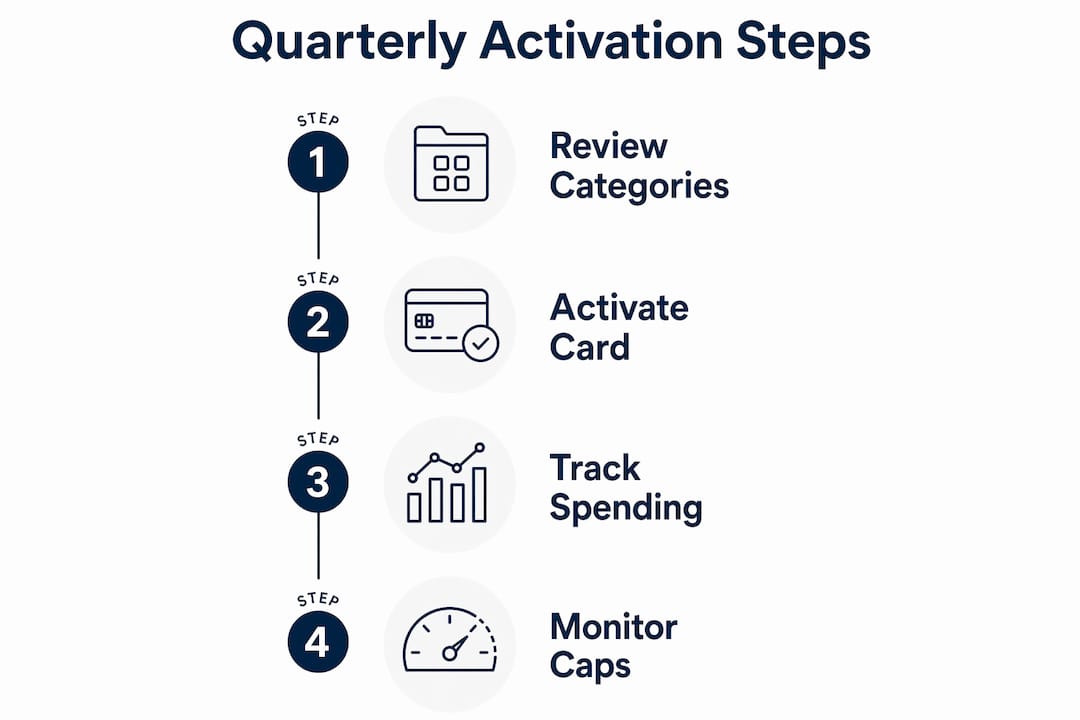
Activation is not automatic. You must log into your issuer's website or app and manually opt in before the deadline each quarter. Activation deadlines vary by issuer. Some issuers require activation by mid-quarter, while others allow you to activate right up to the last day of the quarter.
Here is the standard activation sequence most major issuers follow:
- Quarter opens (january 1, april 1, july 1, or october 1): New categories go live.
- Activation window opens: Log into your account and opt in through the rewards portal or mobile app.
- Deadline passes: After this date, you cannot earn the 5% bonus for that quarter.
- Quarter closes: Earnings are calculated and posted to your account.
- New quarter begins: The process repeats with fresh categories.
One detail most cardholders miss: activating mid-quarter does not mean you lose the bonus on purchases made before activation. Major issuers apply the 5% bonus retroactively to all eligible purchases from the quarter's start date, as long as you activate before the deadline. That means a grocery run on january 3 still earns 5% if you activate by the issuer's cutoff in march.
Pro Tip: Set a recurring calendar reminder on the first day of each quarter to activate your rotating rewards. Five minutes of effort protects an entire quarter of bonus earnings.

How spending caps and reward limits affect your cash back
The standard structure for rotating bonus category cards is 5% cash back up to $1,500 in quarterly spending, then 1% on everything after that. Spending exactly $1,500 in a bonus category earns $75 per quarter. Across four quarters, that totals $300 per year in bonus cash back.
That $300 figure is the maximum annual cash back from rotating categories under the standard quarterly cap model. Some issuers sweeten the deal further. Discover, for example, offers a first-year cashback match that effectively doubles your first-year earnings to $600.
Not every card uses quarterly caps. The Citi Dividend card applies a $6,000 annual cap for 5% rewards instead of a per-quarter limit. That structure lets you concentrate heavy spending into one or two favorable quarters rather than spreading it evenly across all four.
| Spending scenario | Quarterly spend | Cash back earned |
|---|---|---|
| Full cap, bonus category | $1,500 | $75.00 |
| Half cap, bonus category | $750 | $37.50 |
| Over cap, bonus category | $2,000 | $78.00 ($75 + $5) |
| No activation, any category | $1,500 | $15.00 |
| Base rate only, non-bonus | $1,500 | $15.00 |
The table makes one thing clear: missing activation costs you $60 per quarter on $1,500 of spending. Over a full year, that gap reaches $240.
Spending beyond the $1,500 cap still earns 1%, so there is no penalty for going over. The cap simply stops the bonus rate, not the rewards entirely. Non-bonus category spending earns 1% all year, regardless of activation status.
Pro Tip: If your spending in a bonus category will clearly exceed $1,500 in a quarter, switch to a flat-rate card for purchases above that threshold. A flat-rate card earning 2% beats the 1% fallback rate on every dollar.
Strategies for maximizing calendar rewards alongside flat-rate cards
Pairing a rotating category card with a flat-rate rewards card is the most effective way to maximize total cash back without tracking every single purchase. The rotating card handles high-earning bonus categories each quarter. The flat-rate card covers everything else at a consistent rate, typically 1.5% to 2%.
Proactive spenders who track quarterly category changes earn significantly more from rotating rewards cards than passive users. The card rewards intentional behavior, not just spending volume. Here is how experienced cardholders build that system:
- Map your spending habits to the calendar. Before each quarter starts, check which categories are active and estimate how much you naturally spend there. If Q2 covers restaurants and you eat out regularly, that quarter's cap fills itself.
- Use reminders for activation deadlines. A missed deadline is a permanent loss for that quarter. Phone alerts, calendar events, or app notifications all work. Pick one and use it every quarter.
- Rotate your default card by category. When a bonus category is active, make that card your default for those purchases. When spending falls outside the bonus category, switch to your flat-rate card.
- Track your progress toward the quarterly cap. Once you hit $1,500 in a bonus category, stop using the rotating card for that category and shift to the flat-rate card.
- Review your credit card portfolio at the start of each year. Quarterly categories shift year over year. A card that matched your habits in 2025 may not align as well in 2026.
- Avoid overspending to chase rewards. Spending an extra $200 on dining to hit the cap only makes sense if you would have spent that money anyway. Rewards never justify unnecessary purchases.
Embedding activation and category review into your monthly financial routine is the single habit that separates cardholders who earn maximum rewards from those who earn almost nothing from these cards.
Common misunderstandings about calendar rewards credit cards
Several misconceptions cause cardholders to earn far less than they should. Clearing them up protects your rewards.
- "I have to activate before I make any purchases." False. As noted, major issuers apply the bonus retroactively to purchases made since the quarter's start, provided you activate before the deadline. You do not lose early-quarter spending.
- "Any grocery store qualifies for the grocery bonus." Not always. Merchant Category Codes determine bonus eligibility at the transaction level. Wholesale clubs like Costco and Sam's Club often carry a different MCC than standard grocery stores, which means purchases there may not qualify for the grocery bonus even when groceries are the active category.
- "Digital wallet purchases always earn the bonus." Some issuers restrict bonus earnings when a purchase is processed through a digital wallet rather than directly with the merchant. Read the fine print for your specific card before assuming Apple Pay or Google Pay transactions qualify.
- "All spending in the bonus category counts." Certain merchant types within a broad category may be excluded. A card offering a "restaurants" bonus might exclude fast-food chains coded differently from sit-down restaurants. Check your issuer's terms for the exact list of qualifying merchant types each quarter.
- "My rewards statement shows exactly what I earned." Statements show posted rewards, but they do not always flag which transactions earned the bonus rate versus the base rate. Log into your rewards portal and review transaction-level detail to confirm the 5% rate applied correctly.
Reading the fine print for each quarter's terms takes about ten minutes. That time protects hundreds of dollars in potential earnings. For a deeper look at managing multiple cards without losing track of which card to use when, the mechanics become much clearer with a structured system.
Key Takeaways
Rotating bonus category cards deliver their maximum value only when you activate on time, spend within the right merchant categories, and pair them with a flat-rate card for everything else.
| Point | Details |
|---|---|
| Activation is mandatory | You must opt in each quarter or forfeit the 5% bonus rate entirely. |
| Retroactive credit applies | Activating before the deadline credits the bonus on purchases made since the quarter's start. |
| Standard cap is $1,500 per quarter | Spending above the cap earns 1%, so shift to a flat-rate card after hitting the limit. |
| MCC codes determine eligibility | Wholesale clubs and superstores often do not qualify for grocery bonuses despite selling groceries. |
| Pairing cards maximizes returns | A flat-rate card covering non-bonus spending fills the gaps rotating cards leave behind. |
The habit that actually makes these cards worth carrying
I have watched cardholders sign up for rotating rewards cards with genuine excitement, then earn almost nothing from them by year's end. The card did not fail them. The system did.
The honest truth about calendar rewards is that they reward a specific type of person: someone who treats their credit card like a tool with settings, not a passive spending account. I have found that the cardholders who earn the full $300 or more per year are not necessarily the highest spenders. They are the ones who spend five minutes at the start of each quarter to activate, check the categories, and decide which card to use for which purchases.
The retroactive activation rule is the most underused feature in these programs. Most people assume they missed the boat if they forgot to activate in january. They have not. As long as the deadline has not passed, activating in march still captures every eligible purchase from january 1 forward. That single fact has saved cardholders a full quarter of bonus earnings.
My practical advice: treat activation like a bill payment. It has a deadline, it has consequences if you miss it, and it takes less than two minutes to complete. Build it into your financial calendar the same way you schedule a credit check or a budget review. The debt-free credit card strategy that works long-term always includes rewards management as a core component, not an afterthought.
The cards are genuinely worth it for the right user. The right user is simply someone who decides to pay attention.
— Grace K.
Finja and the rewards you are not earning yet
Rotating rewards cards are only as good as the system behind them. Finja is an AI credit card coach built for cardholders who want to stop leaving money behind.
Finja tracks your activation deadlines, monitors your spending against quarterly caps, and tells you which card to use for each purchase category. When a new quarter opens, Finja flags the category change and prompts you to activate before the deadline. You get the full 5% bonus without building a manual tracking system from scratch. Visit Finja's AI coaching platform to connect your cards and start earning what your rewards program actually promises.
FAQ
What does "activating" a quarterly category mean?
Activation is the manual opt-in process required each quarter to earn the 5% bonus rate. You complete it through your issuer's website or mobile app before the quarter's deadline.
What happens if I forget to activate my rotating rewards category?
Missing the activation deadline means all spending in that quarter's bonus categories earns only the base 1% rate. The lost bonus cannot be recovered after the deadline passes.
Do wholesale club purchases count as groceries for the bonus?
No. Merchant Category Codes classify wholesale clubs separately from grocery stores, so purchases at Costco or Sam's Club typically do not qualify for a grocery category bonus.
How much can I realistically earn from a rotating rewards card each year?
The standard maximum is $300 per year from bonus categories, based on $1,500 in quarterly spending at 5%. Some issuers offer first-year match programs that can double that figure to $600.
Should I use a rotating rewards card for all my spending?
No. Pairing a rotating card with a flat-rate card covers non-bonus spending at a higher rate than the 1% fallback. Use the rotating card for active bonus categories and the flat-rate card for everything else.