
Most people leave hundreds of dollars in rewards on the table every year, not because they lack the right cards, but because they lack a system. A credit card rewards maximization checklist fixes that. Here is the short version before the deep dive:
- Pick 2–4 cards that cover your top spending categories (groceries, dining, travel, gas)
- Use the best card for each purchase rather than defaulting to one card for everything
- Earn sign-up bonuses by timing applications around predictable large expenses
- Redeem through transfer partners when possible; transferable points like Chase Ultimate Rewards or American Express Membership Rewards can yield 1.5–3+ cents per point versus roughly 1 cent for straight cash back.
- Pay your full balance every month, no exceptions, because interest charges erase rewards faster than you earn them
- Set calendar reminders for quarterly category activations, expiring credits, and annual fee dates
- Read the fine print on benefit reset cycles, spending caps, and redemption rules
- Monitor your credit score and keep your card count manageable to protect approval odds
Each of those bullets has a strategy behind it. The sections below break them down.
Table of Contents
- 1. How to choose rewards structures that actually match your spending
- 2. Using multiple cards strategically without losing your mind
- 3. How to earn sign-up bonuses without manufacturing spend
- 4. Redeeming rewards for maximum value
- 5. The rule that makes everything else work: pay in full, every month
- 6. Reading the fine print before it costs you
- 7. How Finja helps you stay on top of every card you hold
- Key Takeaways
1. How to choose rewards structures that actually match your spending
The single biggest mistake in rewards optimization is picking a card based on a TV ad instead of your own spending data. Pull three months of bank and credit card statements, categorize every transaction, and find your top three or four categories by dollar volume. That data tells you which card earns the most for your actual life, not a hypothetical one.
Cash back vs. points vs. miles is the first fork in the road. Cash back cards are simple: you earn a percentage back, usually 1%–2% on general purchases and higher on bonus categories, and the value is fixed. Points and miles programs are more complex but can deliver far more value when you redeem through travel partners. If you rarely travel or hate managing multiple programs, a flat-rate cash back card removes friction and still earns meaningfully.
The 80/20 rule applies cleanly here. A focused card portfolio strategy of 2–4 cards covers the vast majority of your spending at elevated rates, while a sprawling collection of a dozen cards creates administrative chaos and missed credits. Chase Ultimate Rewards and American Express Membership Rewards are the two most flexible transferable point currencies in the US market. Both connect to a wide range of airline and hotel partners, which is where their real value unlocks.
Some cards offer flat-rate rewards on every purchase, which works well as a catch-all for categories where you have no bonus card. Others rotate bonus categories quarterly, like 5x on gas one quarter and 5x on groceries the next, which rewards active management. Match your card selection to your tolerance for that kind of upkeep.
Pro Tip: Export three months of transactions from your bank's website, paste them into a spreadsheet, and sort by merchant category. The category where you spend the most is the one that should earn you the highest multiplier.
2. Using multiple cards strategically without losing your mind
A multi-card approach works only when each card has a clear job. Assign one card to groceries, one to travel and dining, one to gas, and one catch-all for everything else. That structure, often called a trifecta or quadfecta depending on the issuer combination, covers most spending at elevated rates without requiring you to memorize a dozen cards' rules.

A focused portfolio of 2–4 cards reduces overlooked credits and administrative burden compared to managing a larger collection. The goal is broad category coverage, not card collecting.
Practical habits that keep a multi-card setup from becoming a headache:
- Label each card in your wallet or phone wallet with its primary category (e.g., "Groceries 4x," "Travel 3x")
- Set the correct card as default in each merchant app (grocery delivery, rideshare, streaming)
- Add authorized users on your highest-earning card to consolidate household spending and accumulate points faster
- Stack cards from the same issuer when possible; Chase cards, for example, let you combine Ultimate Rewards points across products, which accelerates redemption timelines
- Use shopping portals tied to your rewards program before buying online; the portal adds bonus points on top of whatever the card already earns
Tracking is where most people fall apart. Automated tools like Finja track real-time merchant categories, expiring benefits, and point balances, and they send personalized alerts before you miss a credit or a quarterly activation deadline. Doing this manually in a spreadsheet works, but it requires consistent attention that most people do not sustain.
Pro Tip: Set a recurring monthly calendar event called "Rewards Check" for the first of each month. Spend ten minutes reviewing point balances, confirming upcoming category activations, and checking which credits you have not yet used.
Setting calendar reminders at the start of each quarter with a buffer of a few days prevents losing use-it-or-lose-it credits that renew on a quarterly schedule.
3. How to earn sign-up bonuses without manufacturing spend
Sign-up bonuses can equal 6–12 months of typical spending in a single reward, which makes them the fastest lever in rewards optimization. A bonus worth 60,000 points on a card that earns 1x on most purchases would otherwise take years to accumulate through normal spending.
The key is timing applications around spending you were already going to do. Holiday shopping, a home renovation, a move, or a large insurance payment can all satisfy common minimum spend requirements without buying anything unnecessary. Manufactured spending, meaning buying gift cards or money orders purely to hit a threshold, violates most card agreements and can get your account closed.
Application strategy matters as much as timing:
- Chase's 5/24 rule denies applications if you have opened five or more credit cards across all issuers in the past 24 months. Apply for Chase cards first before your count climbs.
- Space applications roughly 3–6 months apart to protect your credit score and avoid automatic denials triggered by multiple recent inquiries.
- Track application dates and spending deadlines in a calendar with reminders set a week before each deadline, not the day of.
- Evaluate retention offers before canceling a card. Call the issuer roughly 60 days before your annual fee posts and ask what they can offer. Retention bonuses, statement credits, or fee waivers are common for cardholders with strong spending history.
Downgrading a card to a no-fee version rather than canceling it preserves your credit history and keeps the account open, which helps your credit utilization ratio. That matters if you plan to apply for more cards later.
4. Redeeming rewards for maximum value
Most people redeem for the first option they see, which is usually the worst one. Merchandise redemptions typically return 0.5–0.8 cents per point. Gift cards land around 1 cent. Cash back sits at roughly 1 cent. Travel portal bookings usually deliver 1.25–1.5 cents. Transfer partner redemptions through programs like Chase Ultimate Rewards and American Express Membership Rewards can reach 1.5–3+ cents per point, sometimes more on premium cabin flights.
The value hierarchy is worth memorizing: merchandise and gift cards at the bottom, cash back in the middle, travel portals above that, and direct transfers to airline or hotel partners at the top.
Chase Ultimate Rewards transfers 1:1 to partners including Hyatt, United, and Southwest. American Express Membership Rewards transfers to over 19 airline and hotel partners, including ANA at a 1:1 ratio, which is one of the most valuable routes for business class redemptions to Japan. Knowing a few high-value "sweet spots" in award charts, specific routes or hotel categories where the points-to-dollar ratio is unusually favorable, can multiply the effective value of your points.
A few practical rules for redemption:
- Do not hoard points indefinitely. Programs devalue their currencies over time, and points sitting unused lose purchasing power.
- Watch for transfer bonuses, which are limited-time promotions where a program offers 25%–50% more miles when you transfer points. Booking through a portal during a transfer bonus can shift the math significantly.
- Match your redemption goal to your lifestyle. If you never fly business class, chasing a 3-cent-per-point redemption that requires a specific international route is not worth the complexity. A 1.5-cent travel portal booking you will actually use beats a theoretical 3-cent redemption you never execute.
5. The rule that makes everything else work: pay in full, every month
Carrying a balance on a rewards card is the fastest way to turn a benefit into a cost. Credit card interest rates in the US are high, and a single month of carrying a balance can wipe out weeks of rewards earnings. Paying your balance in full every month is the foundational rule that makes every other strategy in this checklist worth following.
Automating your payment removes the risk of forgetting. Set up autopay for the full statement balance, not just the minimum, so you are never caught paying interest by accident. If you use a card with a 0% APR introductory offer for a large planned purchase, that is a legitimate use of the feature. Using it as an excuse to overspend and chase rewards is not.
Pro Tip: Review your billing cycle end date and payment due date once when you open a new card. Set a calendar reminder three days before the due date as a backup, even if autopay is active. Payment processing delays happen, and a missed payment can trigger a late fee and, on some cards, a penalty APR that eliminates rewards value for months.
Overspending to hit bonus categories or sign-up thresholds is a common trap. The math rarely works out. Spending an extra $200 on things you do not need to earn $20 in rewards is a net loss. Let your normal spending drive rewards accumulation, not the other way around.
6. Reading the fine print before it costs you
Card terms contain details that can quietly cost you credits you already earned. Benefit reset cycles are the most commonly misunderstood. Some credits reset on January 1 regardless of when you opened the card. Others reset on your account anniversary date. Confusing these cycles causes cardholders to miss credits they paid for through their annual fee.
A renewal audit roughly 60 days before your annual fee posts gives you time to calculate net card value: add up the credits you actually used plus the rewards you earned, then subtract the annual fee. If the number is negative, you have three options: use the remaining credits before the fee posts, call to request a retention offer, or downgrade to a no-fee version.
Critical terms to verify at least once a year:
- Bonus category caps: Many cards cap elevated earning at a specific annual or quarterly spend amount (e.g., 4x on groceries up to $25,000 per year, then 1x after)
- Redemption minimums: Some programs require a minimum point balance before you can transfer or redeem
- Point expiration rules: Certain programs expire points after 12–24 months of account inactivity
- Benefit reset dates: Calendar year vs. cardmember year, and which credits fall under each
- Quarterly activation requirements: Rotating category cards often require you to opt in each quarter; missing the activation means earning at the base rate instead of the bonus rate
- Annual fee posting date: Not always the same as your account anniversary; check your statement
Watch for program devaluations. Issuers and airline partners occasionally reduce the value of points by raising award prices or cutting transfer ratios. When a devaluation is announced, it is often worth accelerating redemptions before the change takes effect. Staying subscribed to issuer email updates and rewards program newsletters is the lowest-effort way to catch these changes early.
7. How Finja helps you stay on top of every card you hold
Managing two or three premium cards manually is possible. Managing four or more, each with different reset cycles, quarterly activations, annual fees, and point currencies, is where most people start missing credits and leaving money behind.
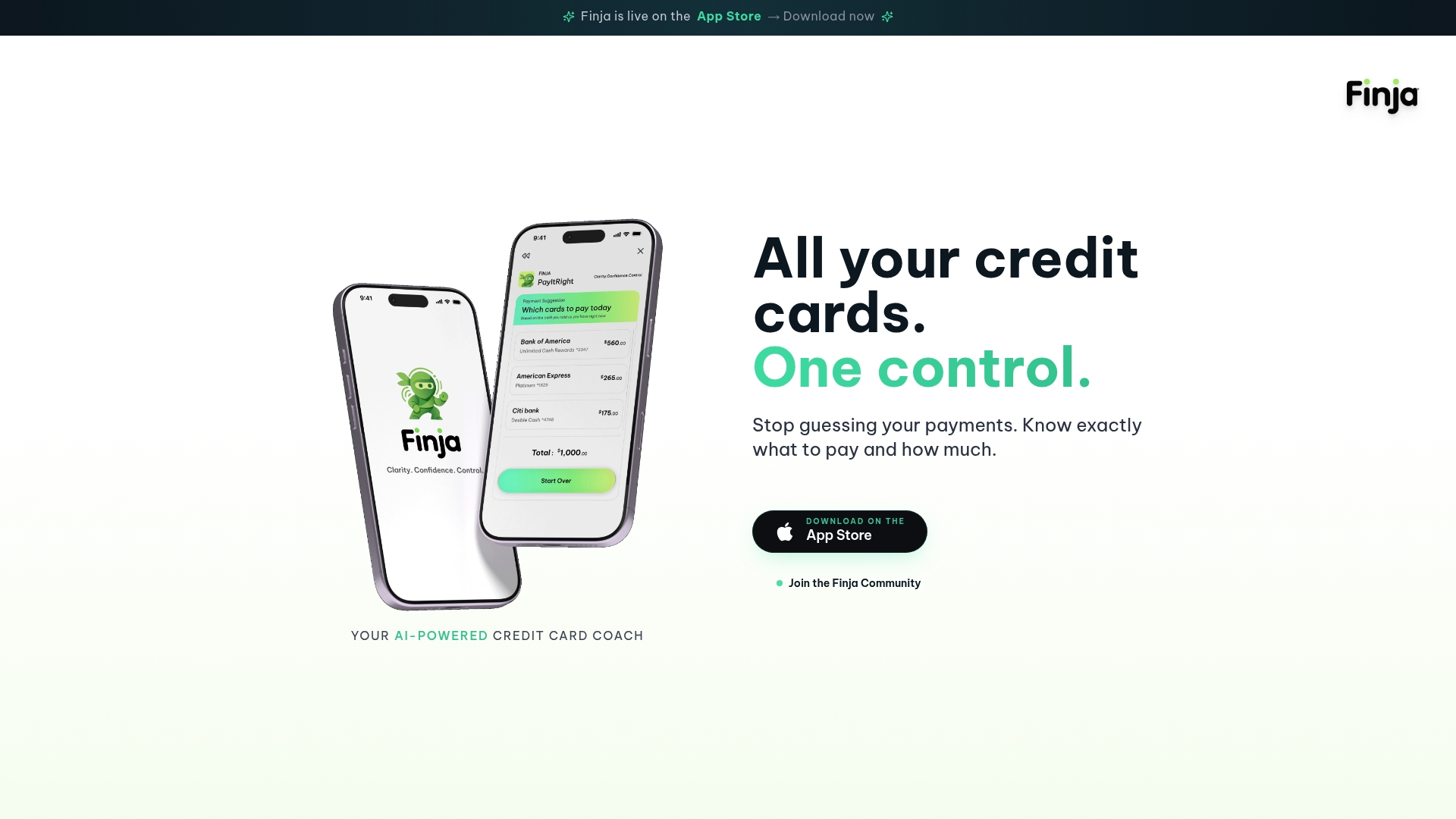

Finja is an AI-powered credit card management platform built specifically for this problem. It tracks your cards' benefits, monitors point balances, flags expiring credits before they disappear, and helps you decide which card to use for each purchase based on your actual spending patterns. For someone running a trifecta of Chase, Amex, and a cash back card, Finja surfaces the information that would otherwise require three separate logins and a spreadsheet to piece together.
The platform also addresses the credit health side of rewards optimization. Applying for multiple cards affects your credit score, and Finja helps you monitor that impact so you can time future applications without damaging your approval odds. For readers who want to go deeper on managing card count and its effect on credit health, that context matters as much as the rewards strategy itself.
If you are ready to stop guessing which card to use and start getting full value from every card you already hold, visit myfinja.com to see how Finja works for your specific portfolio.
Key Takeaways
A disciplined credit card rewards strategy built around 2–4 well-chosen cards, full monthly payments, and active tracking of benefits and reset cycles consistently delivers more value than a large, unmanaged card collection.
| Point | Details |
|---|---|
| Match cards to spending | Choose cards with the highest multipliers in your top 2–3 spending categories, not based on sign-up offers alone. |
| Transfer partners beat cash back | Transferable points through Chase Ultimate Rewards or Amex Membership Rewards can yield 1.5–3+ cents per point versus roughly 1 cent for cash back. |
| Sign-up bonuses are the fastest win | A single bonus can equal 6–12 months of typical spending; time applications around predictable large expenses. |
| Pay in full, always | Carrying a balance erases rewards value; autopay set to the full statement balance removes the risk entirely. |
| Finja tracks what you miss | Finja monitors expiring credits, point balances, and benefit reset dates across your full card portfolio so nothing slips through. |