
The debt avalanche method saves more on interest than many other common repayment strategies, and when you stick with it consistently, it can shorten your payoff timeline. That advantage is most pronounced when your debts carry meaningfully different APRs, you have a reliable extra payment each month, and you can tolerate slow early progress before your first account closes. According to Experian, the avalanche method is specifically designed to eliminate your most expensive debts first and save the most money over the life of your loans. If you carry a mix of high-APR credit cards alongside lower-rate installment debt, this approach is almost certainly the mathematically superior path.
Key Takeaways
The debt avalanche method saves the most on interest when your debts carry meaningfully different APRs and you consistently apply extra payments to the highest-rate account first.
| Point | Details |
|---|---|
| Core verdict | Avalanche saves more interest than any other common method when APR spread is wide. |
| When it saves the most | The advantage is strongest with a large gap between your highest and lowest APRs. |
| Main trade-off | Slower early account closures require patience; visual trackers and micro-habits help sustain motivation. |
| First action step | List every debt by APR today, set your extra payment amount, and automate it to the top-rate account. |
| Tool tip | Use a platform like Finja to auto-track APR changes and roll freed payments forward without manual effort. |
Table of Contents
- How the debt avalanche method works in practice
- What are the primary benefits of the avalanche payoff method?
- A short numeric example showing interest saved
- Avalanche vs. snowball: which method fits you better?
- Who should use the avalanche method?
- Common drawbacks of avalanche and how to stay on track
- A step-by-step plan to start the avalanche method today
- How credit-management tools (and Finja) make avalanche easier to follow
- The one behavioral shift that keeps avalanche plans alive
- Sources
How the debt avalanche method works in practice
The mechanics are straightforward, but the discipline required is real. Here is the exact sequence:
- List every debt you carry, including the current balance, minimum payment, and APR for each account.
- Rank them by APR, highest to lowest. The interest rate, not the balance size, determines the order.
- Pay the minimum on every debt each month without exception. Missing a minimum triggers fees and credit damage that undercut your progress.
- Direct every extra dollar you can free up toward the highest-APR debt on your list.
- Roll the payment forward the moment a debt is paid off. The minimum you were paying on the closed account, plus your extra payment, all moves to the next highest-APR debt. That compounding of freed payments is what accelerates the avalanche over time.
Why does APR order matter so much? Interest compounds daily on most credit cards. Targeting the highest rate first stops the most expensive compounding clock first. Investopedia's worked examples confirm that applying even modest extra payments to high-APR debts first can cut payoff time and save substantial interest compared with minimum-only payments.
What are the primary benefits of the avalanche payoff method?
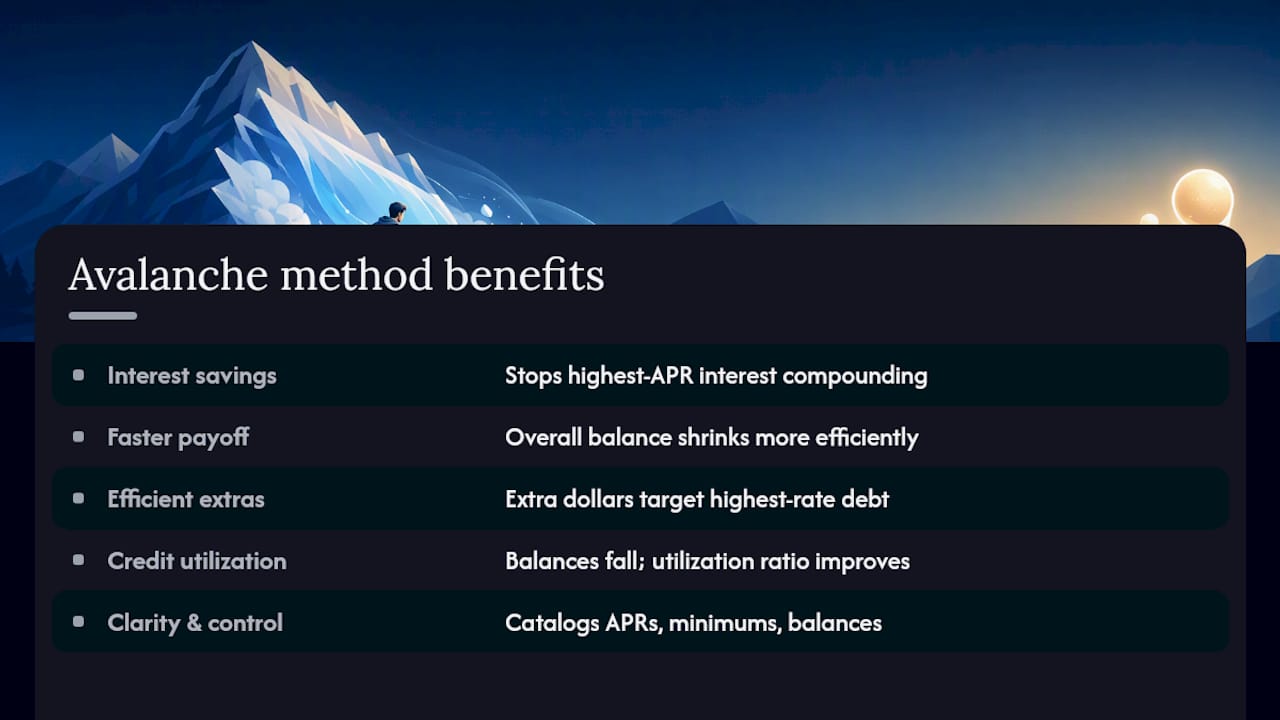
Maximum interest savings. Paying off the highest-APR debt first stops the most expensive interest from compounding further. Over a multi-year payoff, that difference can add up to thousands of dollars, depending on your balances and rate spread.
Potentially faster total payoff. Because you are reducing the debt that grows fastest, your overall balance shrinks more efficiently. The debt avalanche approach can shorten the repayment timeline when you maintain consistent payments, because less of each payment gets consumed by interest charges.
Efficient use of every extra dollar. When money is tight, where you direct your extra $100 or $200 a month matters enormously. Avalanche ensures that dollar works as hard as mathematically possible.
Improved credit utilization over time. As balances fall, your credit utilization ratio drops. That tends to lift your credit score, which can open doors to lower rates on future borrowing.
Clarity and financial control. Cataloging your APRs, minimums, and balances forces a level of organization that most people with multiple cards never had before. That visibility alone changes behavior.
One caveat worth naming: when your APRs are clustered close together, the interest savings advantage shrinks considerably. Fidelity's CFP guidance notes that when rates are similar, behavioral factors, meaning which method you will actually stick with, matter more than the math.
Pro Tip: Track the total interest you pay each month as a standalone metric. Watching that number fall, even before any account closes, gives you a concrete signal that the avalanche is working. Here is more on why tracking monthly interest paid can keep you motivated through the slow early phase.
A short numeric example showing interest saved
Consider three credit card debts with a fixed $200 extra payment each month and no new charges added.
Avalanche with $200 extra per month: The $200 goes entirely to Card A first. Once Card A is paid off, the freed $120 minimum plus the $200 extra, totaling $320, rolls to Card B. When Card B closes, the full $390 rolls to Card C. The result: total payoff time drops significantly, and the interest paid on Card A is cut substantially because the highest-rate balance is eliminated first rather than dragged out.
The exact savings depend on your specific balances, APRs, and payment consistency. Investopedia's analysis shows that adding modest extra payments and targeting high-APR debts first can reduce payoff duration by years and cut thousands in interest compared with minimum-only payments.
Key figure: The interest savings advantage grows with the spread between your highest and lowest APRs. Larger percentage-point spreads produce a much larger avalanche benefit than smaller ones.
If your extra payment drops or an APR changes mid-plan, recalculate. The avalanche's efficiency depends on the list staying accurate.
Avalanche vs. snowball: which method fits you better?
| Dimension | Debt Avalanche | Debt Snowball |
|---|---|---|
| Total interest paid | Lower (often significantly) | Higher |
| Time to debt-free | Shorter in most scenarios | Longer |
| Motivation / psychology | Slower early wins; requires patience | Fast early wins; strong momentum |
| Tracking burden | Moderate (APR audits needed) | Low (balance order is stable) |
| Best for | Wide APR spread, disciplined savers | Need quick wins, similar APRs |
Choose avalanche if: your highest-APR debt carries a rate meaningfully above your others, you have a steady extra payment you can commit to, and you can stay motivated without closing accounts quickly.
Choose snowball if: you have struggled to stick with payoff plans before, your APRs are clustered close together, or you need the psychological boost of eliminating accounts to stay engaged.
The honest reconciliation: Business Insider's reporting on planner perspectives makes the point plainly. A mathematically superior plan that gets abandoned costs more than a simpler plan you actually follow. Both methods work when you stick with them. The question is which one you will stick with. Navy Federal's practitioner guidance confirms the same trade-off: avalanche wins on interest; snowball wins on early momentum.
Who should use the avalanche method?
Prerequisites for avalanche to work well:
- You have multiple debts with meaningfully different APRs (at least a 4–5 percentage point spread between highest and lowest).
- You have a consistent discretionary amount each month beyond your minimums, even $50 or $100 counts.
- You have a basic emergency fund in place so an unexpected expense does not derail your extra payments.
- You can track APR changes, since credit card rates are variable and your list needs periodic auditing.
Red flags where avalanche may not be the right fit:
- You have no extra cash beyond minimums. The method still works on minimums alone, but the savings are smaller and the timeline longer.
- You have abandoned debt payoff plans before due to lack of visible progress. Snowball or a hybrid approach may serve you better.
- Your APRs are nearly identical across all accounts. The math advantage disappears, so behavioral preference should drive the choice.
A practical middle path: pay off one small balance first for the motivational win, then switch to strict APR ordering. You sacrifice a small amount of mathematical efficiency but preserve the psychological fuel to keep going. Many financial planners endorse this hybrid for borrowers who know themselves well enough to recognize they need early wins.
Common drawbacks of avalanche and how to stay on track
The biggest real-world problem with avalanche is the slow start. If your highest-APR debt also carries a large balance, you might go six months or more without closing a single account. That silence can feel like failure even when the math is working perfectly.
Common drawbacks:
- No early account closures, which removes a visible milestone many people rely on for motivation.
- APR volatility on credit cards can shift your priority order mid-plan if you do not audit regularly. Experian warns that failing to update a changed rate can erode the avalanche's efficiency.
- Emotional fatigue from a long runway before the first payoff.
Practical mitigations:
- Automate your minimum payments and your extra payment to the target account. Manual transfers get skipped; automation does not.
- Use a visual tracker, a spreadsheet, a whiteboard, or an app, to plot your target balance weekly. Watching a number fall is motivating even without a closure.
- Schedule a monthly 15-minute check-in to verify APRs and confirm your target is still the highest-rate account.
- If a high-APR balance is large, consider whether a balance transfer to a 0% promotional card makes sense. That resets the APR clock and can accelerate payoff. Explore ways to reduce your effective APR before committing to a long avalanche runway.
Pro Tip: Set a monthly alert for "interest paid this month" rather than waiting for account closures. When you see that figure drop by $20 or $30 from one month to the next, you have proof the avalanche is working, even if your account count has not changed yet.
Behavioral research cited by Business Insider suggests that visual trackers and hybrid approaches, closing one small account early then switching to APR order, reduce abandonment risk without giving up most of the mathematical advantage.
A step-by-step plan to start the avalanche method today
You can set this up in under an hour.
- Pull your statements. List every debt: balance, APR, and minimum payment. Use your lender's app or annual credit report to confirm current APRs.
- Rank by APR, highest first. This is your avalanche order. Write it down or put it in a spreadsheet.
- Set your extra payment amount. Be honest. A $75 extra payment you sustain beats a $300 one you drop after two months.
- Automate minimums on every account. Set up autopay for the minimum on each debt so you never miss a payment.
- Automate the extra payment to your top-APR account. Schedule a recurring transfer on payday so the money moves before you can spend it.
- Set a calendar reminder to roll the payment. When a debt closes, you have one job: redirect the freed payment to the next account on your list immediately. A calendar alert prevents that money from disappearing into spending. Managing due dates across multiple cards is easier when you have a system.
- Audit your APR list every 90 days. Credit card rates change. Confirm your target is still the highest-rate account.
Track these four numbers monthly:
| Metric | Why it matters |
|---|---|
| Current balance on target debt | Shows direct progress |
| APR on target debt | Confirms it is still the highest |
| Total interest paid this month | Proves the avalanche is working |
| Extra payment amount | Flags if your budget has shifted |
How credit-management tools (and Finja) make avalanche easier to follow
The avalanche's biggest operational risk is human error: forgetting to roll a freed payment, missing an APR change, or letting extra cash drift back into spending. The right tools close those gaps.
Features that matter for avalanche execution:
- Consolidated balance view across all accounts, so you see your full debt picture in one place.
- APR-sorted target list that updates when rates change, so your priority order stays accurate.
- Scheduled extra payments that auto-assign to the current top-APR account.
- Automatic roll-forward logic: when a debt closes, the freed payment reassigns to the next target without manual intervention. Navy Federal's guidance specifically flags this as the step where the avalanche advantage disappears if you do not execute it immediately.
- Progress dashboards showing interest paid over time, not just balance remaining.
Finja is built around exactly this problem. As an AI-powered credit card management platform, Finja consolidates your card balances, surfaces your highest-APR account automatically, and helps you direct extra payments where they do the most work. The platform also tracks credit health indicators so you can see utilization improvements as balances fall, giving you a second progress signal beyond account closures. For anyone managing three or more cards, that kind of automated organization removes the manual overhead that causes most avalanche plans to stall.
Practical automation tips:
- Enable APR-change alerts so a rate hike does not silently move a card up your priority list without your knowledge.
- Lock your "roll" behavior so freed payments auto-reassign rather than sitting idle in a checking account.
- Use a progress bar or interest-paid chart as your primary motivation metric during the slow early phase.
The one behavioral shift that keeps avalanche plans alive
The hardest part of the debt avalanche is not the math. It is the first three months, when you are paying extra every month and your account count has not moved at all. That silence is where most plans die.
A simple weekly ritual helps more than most people expect: every Sunday, open your target account, note the current balance, and write it down next to last week's number. The balance is falling. It might be falling by $40 or $60 a week, but it is falling. That small act of witnessing the progress, rather than waiting for a dramatic account closure, builds the habit loop that keeps the plan running.
Micro-habits that work alongside the math:
- A 15-minute weekly balance check, same day, same time.
- A small personal reward when your highest-APR balance drops by 25%, then 50%, then 75%. The milestone does not have to be an account closure to feel real.
- A monthly note of total interest paid. When that number drops from $180 to $155 to $130 over three months, you have evidence the avalanche is accelerating.
If you find yourself losing momentum, do not abandon the strategy entirely. Closing one small balance for a quick win, then returning to APR order, preserves most of the mathematical advantage while giving your motivation a reset. The goal is to stay in the plan, not to execute it perfectly.
Sources
- Debt Avalanche vs. Snowball: Which debt repayment strategy is best?
- The Debt Avalanche Method: How it Works and When to Use It
- Comparing Debt Snowball and Debt Avalanche Methods
- Avalanche vs Snowball Method: Which Debt Payoff Method is Best? | Navy Federal
This article is general information, not a substitute for advice from a qualified financial advisor. Consult a qualified financial professional about your own circumstances before acting on anything here.