
Yes, you can stack credit card benefits effectively — the rule is simple: use the card that delivers the highest net value after fees and interest risk, match it to your natural spending, and let an AI coach like Finja automate the routing so you never leave rewards on the table.
Here is what that looks like in practice:
- Pay in full, always. Credit card APRs frequently exceed 20%, which wipes out any reward gains the moment you carry a balance.
- Match cards to existing habits. Credit industry expert Matt Schulz puts it plainly: choose cards that fit your existing expenses, not the other way around.
- Automate the decision layer. Finja connects your accounts, maps each merchant to your best card, and schedules payments to minimize interest — so the strategy runs without mental overhead.
- Start with one rule. Pick your top spending category (groceries, dining, travel), assign the highest-earning card to it, and build from there.
Table of Contents
- How stacking credit card benefits actually works
- Prioritization rules: which card wins when several apply
- A step-by-step checklist to stack benefits on any purchase
- Three scenarios that show the math
- Pitfalls and credit risks to watch before you stack
- How Finja automates the stacking checklist for you
- Daily habits and monthly routines that keep stacking efficient
- Key Takeaways
- The case for a smaller, smarter card portfolio
- Finja puts the stacking checklist on autopilot
- Useful sources and further reading
How stacking credit card benefits actually works
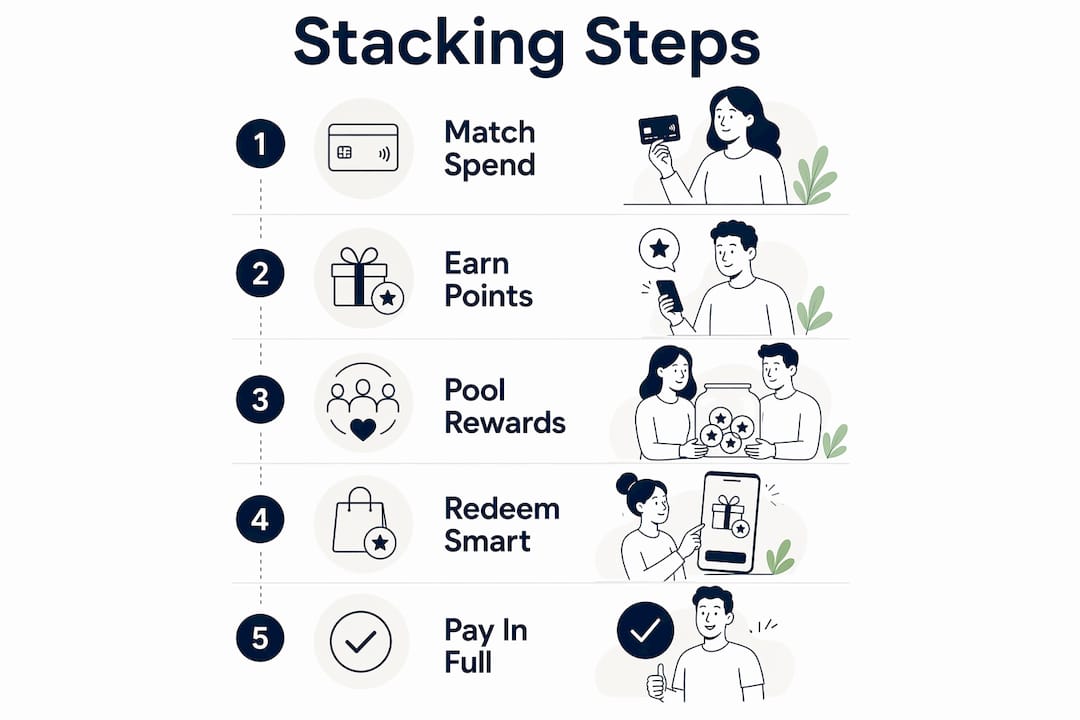
"Stacking" means combining the perks of multiple cards on a single purchase or across a spending portfolio so the total value exceeds what any one card could deliver alone. A quick example: you buy groceries, earn 6x points on a grocery-bonus card, apply a $10 monthly statement credit from a second card, and then transfer those points to an airline partner for 2¢ per point instead of redeeming them for 1¢ cash back. Three layers, one transaction.
The benefit types you can combine:
- Bonus-category multipliers — cards that earn 3x–6x on groceries, dining, travel, or gas
- Transferable points — currencies like Chase Ultimate Rewards or Amex Membership Rewards that pool across cards and transfer to airline or hotel partners for significantly stronger value
- Statement credits — monthly or annual credits for streaming, dining, travel, or specific merchants
- Purchase protection and extended warranty — covers damage or theft on eligible purchases
- Travel protections — trip delay, baggage, and car rental coverage that stacks on top of earnings
- Lounge access — Priority Pass or proprietary lounge benefits on premium travel cards
The mechanics follow a simple chain: earnings rate × category match → pool or transfer points → redeem at the highest-value option. Timing matters here. Rotating bonus categories require quarterly enrollment, statement credits often reset monthly, and sign-up bonus spend windows are fixed.
Pro Tip: Don't reshape your spending to chase a bonus category. If you don't naturally spend $500 a month on dining, a dining-bonus card won't serve you. Rewards should augment your habits, not drive them.

Prioritization rules: which card wins when several apply
When two or more cards could work for a purchase, run through this order:
- Avoid interest and fees first. If you might carry a balance, use the card with the lowest APR or a 0% promotional period — no reward rate justifies paying 20%+ interest.
- Highest net immediate value. Calculate: (earn rate × spend) minus pro-rated annual fee. A 3% cash-back card with no annual fee often beats a 3x points card with a $95 fee unless you redeem those points at 2¢+ each.
- Long-term transfer value. The Points Guy recommends pairing cards that share a transferable currency — concentrating points into one wallet for higher-value airline or hotel transfers.
- Protections and convenience. If two cards tie on value, the one with better purchase protection or travel coverage wins.
Two quick tie-breakers in action:
- 3% cash back vs. 3x transferable points on a $200 flight: 3% cash back = $6. Three hundred points transferred to an airline at 1.5¢ each = $4.50. Cash back wins here unless you have a high-value transfer partner redemption lined up.
- Same card, two categories: Your grocery card earns 6x but your travel card earns 3x on airfare. Book the flight on the travel card — the category match matters more than the raw multiplier when the travel card also carries trip delay insurance.
A step-by-step checklist to stack benefits on any purchase
Follow these steps manually or hand them to Finja's automated workflow:
- Export three months of transactions and sort by merchant category. Identify your top four or five spending buckets by dollar volume.
- Map each bucket to one primary card — the card with the highest net value (earn rate minus pro-rated annual fee) for that category.
- Assign a fallback card for uncategorized or miscellaneous spend. A flat 2% cash-back card works well here.
- Set enrollment reminders. Rotating bonus-category activations typically open at the start of each quarter. Missing enrollment means earning the base rate instead of the bonus.
- Note statement-close and payment-due dates for every card. Paying before the statement closes keeps reported utilization low; paying by the due date avoids interest.
- Track sign-up bonus windows. Sign-up bonuses can equal six to twelve months of normal spending rewards — set a calendar alert for the spend deadline.
- Review redemption windows quarterly. Points and credits expire; schedule a 15-minute check each quarter to confirm nothing is lapsing.
Pro Tip: The rewards maximization checklist from Finja's blog maps every one of these steps into a single repeatable workflow — worth bookmarking before your next statement cycle.
Three scenarios that show the math
| Scenario | Without stacking | With stacking | Net gain |
|---|---|---|---|
| $500/month groceries | 1x points (~$5 value) | 6x on grocery card + $10 monthly credit | ~$40/month |
| $800 flight booking | 1x points | 3x travel card + transfer to airline at 1.5¢/pt | $36 vs. $24 |
| $1,200 appliance | 1% cash back ($12) | 0% promo APR + 5% purchase protection card | $12 + $0 interest cost |
- Groceries: Routing $500 in monthly grocery spend to a 6x card and applying a $10 statement credit produces roughly $40 in monthly value versus $5 on a flat 1x card. Annual difference: around $420.
- Flight booking: Three hundred points on an $800 flight, transferred to an airline partner at 1.5¢ each, yields $36 in travel value. Redeeming the same points as a statement credit at 1¢ each gives $24. Transfers to travel partners consistently outperform statement credits and merchandise redemptions.
- Big purchase: On a $1,200 appliance, a card with 0% promotional APR for 12 months eliminates financing cost entirely. Pair it with a card that carries extended warranty coverage and you add a year of protection at no extra charge.
Pitfalls and credit risks to watch before you stack
- Carrying a balance erases rewards. Average credit card interest rates exceed 20% — one month of interest on a $1,000 balance costs more than most cards earn in rewards on that same amount.
- Annual fee miscalculation. A card earning $80 in rewards on a $95 annual fee is a net loss. Always calculate net value, not gross earnings.
- Missed enrollment. Rotating categories require activation. Skip it and you earn the base rate, not the bonus.
- Reward devaluations. Points programs change redemption rates. Redeem high-value points within a reasonable window rather than hoarding indefinitely.
- Utilization creep. Multiple cards make it easy to let total balances drift up. Keep utilization below 30% across all cards; below 10% is better for credit score purposes. Credit mix and utilization both factor into your score.
- Hard inquiries from new applications. Each new card application triggers a hard pull. Multiple applications in a short window can temporarily lower your score.
- Closing old accounts. Closing a long-standing card shortens your average account age and can spike utilization. Keep your oldest accounts open even if you rarely use them.
Mitigation is straightforward: pay in full every month, track utilization monthly, and resist the urge to open cards for bonuses you won't naturally earn.
How Finja automates the stacking checklist for you
Doing all of this manually across four or five cards is manageable once. Keeping it current every month is where most people slip. Finja handles the ongoing work:
- Consolidated account view — all cards, balances, due dates, and reward balances in one place
- Automated card routing rules — Finja maps each merchant category to your highest-earning card and surfaces the suggestion at checkout
- Payment sequencing — high-interest card prioritization so minimum payments never slip and interest costs stay low
- Redemption and enrollment reminders — alerts for rotating category activations, statement credit resets, and sign-up bonus deadlines
- Credit health tracking — monitors utilization, account age, and financial health indicators so stacking never quietly damages your score
Finja's card-routing engine turns a five-step manual checklist into a single setup session. Connect your accounts, review the suggested card map, and the rules run automatically from there.
The privacy model matters too. Finja uses read-only account connections, meaning it can see transaction data to generate recommendations but cannot move money without your explicit approval.
Daily habits and monthly routines that keep stacking efficient
Daily (takes under two minutes):
- Check Finja's card prompt for any new merchant or unusual spend category
- Confirm small balances are on track — micro-payments mid-cycle keep utilization low
- Flag any statement credit that needs a qualifying purchase before month-end
Monthly routine (15–20 minutes, or automated with Finja):
- Export or review the month's transactions by category
- Confirm all rotating bonus categories are enrolled for the current quarter
- Check sign-up bonus progress against the spend window deadline
- Review any expiring points or credits
- Verify multiple card management — utilization per card and total, not just overall
Turn the monthly routine into an automated workflow by connecting all accounts in Finja, enabling push notifications for enrollment windows, and scheduling a monthly summary review. The system flags anything that needs human attention; everything else runs on its own.
Key Takeaways
Stacking credit card benefits pays off when you match cards to natural spending, pay in full every month, and automate the routing rules so nothing slips through.
| Point | Details |
|---|---|
| Pay in full first | Interest rates above 20% erase rewards; paying in full is the non-negotiable foundation. |
| Match cards to natural spend | Assign each spending category to the card with the highest net value after pro-rated annual fees. |
| Transfer beats cash back | Transferring points to airline or hotel partners typically yields 1.5–3¢ per point vs. 1¢ for cash back. |
| Automate enrollment and reminders | Rotating categories and sign-up bonus windows expire; calendar alerts or Finja's reminders prevent missed value. |
| Finja handles the ongoing work | Finja's card-routing, payment sequencing, and credit health tracking convert a manual checklist into a low-effort monthly habit. |
The case for a smaller, smarter card portfolio
Most people with five or more cards are getting 80% of their rewards from two or three of them. That's the 80/20 portfolio rule in practice, and it argues for a curated stack of two to four cards rather than a sprawling collection.
A tighter portfolio means fewer enrollment deadlines to miss, lower risk of utilization creep, and a cleaner credit profile. The cognitive overhead of managing eight cards rarely pays for itself in incremental rewards. For most people, one strong everyday card, one travel card, and one category-specific card cover the vast majority of spending at near-optimal earn rates.
The one place where more cards genuinely add value is sign-up bonuses. A well-timed new card application, with a bonus you can hit through natural spending, can deliver more value in three months than a year of optimized category routing. But that is a targeted move, not a permanent expansion of your portfolio. Once the bonus is earned, reducing card count to the core two or three often makes more sense than holding every card indefinitely.
The honest advice: start with the cards you already have, automate one rule with Finja, and see what the data shows about where your spend actually goes. The right portfolio usually reveals itself within a month of tracking.
Finja puts the stacking checklist on autopilot
Managing multiple cards well comes down to one thing: consistent execution of rules you already know. The hard part is not the strategy — it's remembering to activate a rotating category in January, or catching that a $15 dining credit resets on the first of the month.
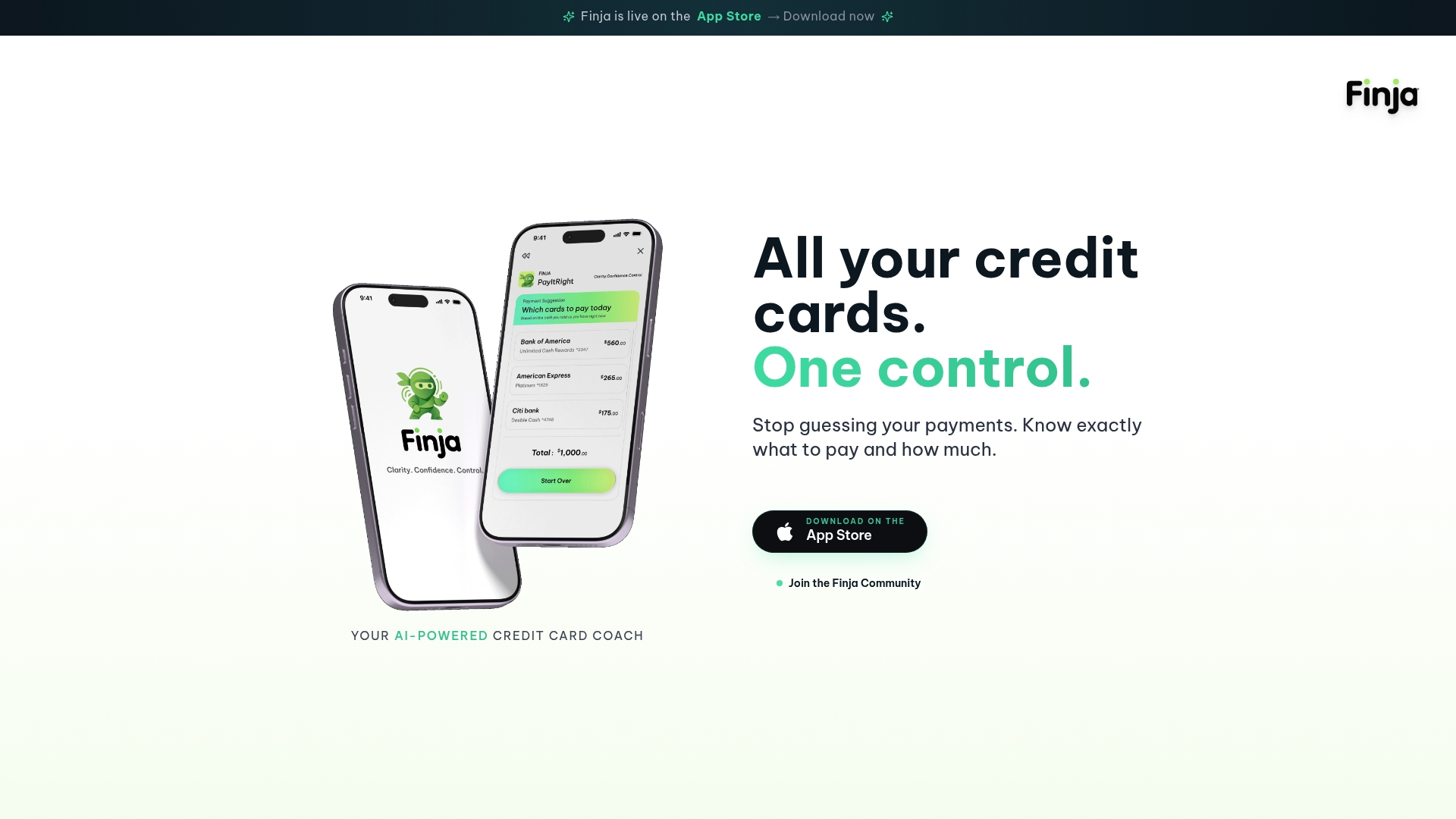
Finja connects all your cards in one place, generates a card-routing map based on your actual spending, sequences payments to protect your credit score and minimize interest, and sends reminders before anything expires. Onboarding takes one session: connect your accounts, review the suggested card assignments, and enable automated payment scheduling. From there, Finja surfaces the decisions that need your attention and handles the rest.
Start with a free trial at myfinja.com and see your full card portfolio, optimized, in under ten minutes.
Useful sources and further reading
- Credit Card Rewards Maximization Checklist — Finja's step-by-step 2026 checklist covering category activation, bonus timing, and redemption sequencing. Best starting point for building your own stacking workflow.
- How Credit Card Calendar Rewards Work in 2026 — Detailed guide to rotating categories, statement-close mechanics, and enrollment deadlines. Use this when setting up quarterly reminders.
- Multiple Credit Card Management Tips for 2026 — Practical guidance on tracking balances, utilization, and due dates across a multi-card portfolio.
- The Points Guy — Best Credit Card Combinations — Authoritative guide to pairing cards that share a transferable currency. Best resource for travel-focused stacking and transfer partner strategy.
- American Express — How to Maximize Reward Points — Issuer guidance on redemption timing and transfer partner value. Useful for understanding when to transfer vs. redeem as a statement credit.
- CardClassroom — Maximize Credit Card Rewards 2026 — Covers the 80/20 portfolio rule, sign-up bonus timing, and the redemption value hierarchy (merchandise vs. cash back vs. transfers).
- CNBC — Minimum Cards to Maximize Rewards — Matt Schulz's expert guidance on matching cards to natural spending and the interest-rate risk of carrying balances.
- Business Insider — How to Maximize Credit Card Rewards — Practical personal-finance framing on paying in full before optimizing rewards.
This article is general information, not financial advice. Confirm current rates, terms, and program details with your card issuers or a qualified financial professional before making changes to your credit strategy.