
The fastest way to get out of credit card debt is to actually see it: pick one tracking method, spreadsheet or app, and log every card's balance, APR, and due date this week. Pair that log with a payoff plan, run through a calculator or an AI coach like Finja, so every dollar you send to a card has a purpose. The tools that make this work fall into five buckets: synced trackers, standalone payoff apps, spreadsheets, calculators, and AI coaches. Setup takes less than an hour once you know what to record.
TL;DR:
- Connecting a tracking app to your bank accounts reduces manual input but requires sharing credentials and longer setup time, especially with banks needing extra verification.
- Using a spreadsheet is secure and fully customizable but depends on consistent manual updates to reflect your current balances and APRs.
- Prioritizing debt repayment with the avalanche method saves more in interest, but the snowball approach can provide faster psychological wins for motivation.
- Monitoring overall credit utilization and due dates weekly can prevent score damage and late payments, making regular reviews essential to stay on track.
- An AI coach like Finja automatically ranks which credit card to pay first, streamlining decision-making when managing multiple accounts and reducing math complexity.
Table of Contents
- Which Tools Actually Help You Track Credit Card Debt?
- How Do You Set Up a Tracking System You'll Actually Use?
- Snowball, Avalanche, or Hybrid: Which Payoff Strategy Wins?
- What Numbers Should You Actually Watch Each Week?
- Expert Tips: What an AI Coach Actually Adds to Your Routine
- How Does Credit Card Debt Actually Affect Your Credit Score?
- How Do You Read a Credit Card Statement for Accurate Tracking?
- How Do You Avoid New Debt While Paying Off What You Already Owe?
- How Do You Prioritize Multiple Cards When You're Tracking Several at Once?
- What Mistakes Quietly Sabotage Credit Card Debt Tracking?
- Why Consistent Tracking Beats a Perfect Plan
- Try Finja for Multi-Card Payment Prioritization
- Sources
- FAQ
Which Tools Actually Help You Track Credit Card Debt?
Four categories cover almost everyone. The right pick depends less on which app has the best reviews and more on how much access you're willing to grant and how much manual work you're willing to do.
Connected trackers link to your bank and card accounts and pull balances automatically. They're the least amount of ongoing effort, since numbers update themselves, but you're handing account credentials to a third party, and setup can take longer than you'd expect if your bank requires extra verification steps.
Standalone payoff apps don't always sync accounts. Instead, you enter balances manually and the app runs the math, showing you a payoff date and interest projection. Less automation, but also less exposure if you're wary of linking every card to one dashboard.
Spreadsheets give you full control. Nothing connects to your bank, nothing sends your data anywhere, and you can customize every column to match how you actually think about your debt. The tradeoff is manual entry, and manual entry means the tracker is only as accurate as your last update. Microsoft's Excel debt spreadsheet template is a solid starting point if you want a built-in structure rather than building one from scratch.
AI coaches, including Finja, sit somewhere between an app and an advisor. Instead of just showing you numbers, they rank which card to pay down next based on rate, balance, and timing, which matters more once you're juggling three or four cards instead of one.
Here's how they stack up in practice:
- Cost: spreadsheets and CFPB-style templates are free; many payoff apps offer a free tier with paid upgrades; AI coaches typically run on a subscription after a trial period.
- Setup time: spreadsheets take 15 to 30 minutes to populate manually; connected apps take a few minutes per card but require login verification.
- Accuracy: connected tools update automatically and rarely go stale; manual tools are only accurate if you update them consistently.
- Privacy: spreadsheets keep everything local; connected apps and AI coaches require account access, which some people are simply not comfortable granting.
If you're not ready to link accounts, start with a spreadsheet. If you have more than two cards and want less manual math, a connected tool or an AI coach saves real time.
How Do You Set Up a Tracking System You'll Actually Use?
A tracking system that dies after a week isn't a tracking system, it's a to-do list you ignored. The fix is making the first setup so simple there's no excuse to skip it.
Record these fields for every card:
- Card label (name it something you'll recognize instantly, not "Card 3")
- Current balance
- APR
- Minimum payment
- Statement closing date
- Payment due date
- Last payment made (amount and date)
- Notes (promotional 0% periods, annual fees, anything time-sensitive)
The CFPB's debt log tool uses almost this exact structure, and it's free to download if you want a template rather than building your own from scratch.
Once the fields exist, run two cadences. A weekly quick check takes two minutes: scan balances, flag anything close to a due date, confirm nothing unexpected posted. A monthly reconciliation takes longer, maybe 15 minutes: pull each statement balance and compare it to the current balance, log any extra payments you made, update APRs if a promotional rate expired, and confirm autopay is still set for at least the minimum on every card.
A typical monthly workflow looks like this: reconcile each statement against your log, record any extra payment beyond the minimum, recalculate your payoff timeline with that new balance, then decide which card gets next month's extra dollars.
Pro Tip: Set a recurring calendar reminder for the day after your latest statement closes, not the due date. That gives you a buffer to catch errors or dispute a charge before the payment is due.
On security: limit how many apps you link to live bank credentials, turn on multi-factor authentication everywhere it's offered, and if you're using a spreadsheet, keep an encrypted local backup rather than an unprotected file sitting in a shared drive.
Snowball, Avalanche, or Hybrid: Which Payoff Strategy Wins?
The strategy you pick changes your payoff date and your total interest cost, sometimes by a lot, and the right one depends on whether you're motivated by momentum or by math.
Snowball means paying minimums on everything and throwing extra money at the smallest balance first. It's built for behavioral wins: you close out a card fast, feel the progress, and roll that payment into the next target.
Avalanche means attacking the highest-APR card first regardless of balance size. It's the mathematically superior method for minimizing total interest paid, because every dollar goes toward the debt that's costing you the most.
Hybrid approaches blend the two, often starting with one small quick win for motivation before switching to rate-based prioritization for the rest.
Debt payoff calculators run these comparisons using a few core assumptions: a fixed extra payment amount each month, no new charges added to the balance, and APRs that stay constant. Change any of those assumptions and the projected payoff date shifts, which is exactly why it's worth rerunning the numbers whenever your situation changes.
Avalanche has you hitting the 24% card first, which saves more in interest over the life of both debts. Snowball has you clearing the $2,000 card first, which takes less time to see a card hit zero, even though it costs slightly more in total interest.
- Run a "what-if" scenario for a one-time extra payment (a tax refund, a bonus) to see how much it shortens your timeline.
- Run a second scenario for a permanent monthly increase, even $50, to compare against the one-time bump.
- Compare both against the minimum-only baseline so you can see the real cost of paying only what's required.
A debt-free strategy guide can help you map which approach fits your specific balances before you commit to one.
What Numbers Should You Actually Watch Each Week?
Tracking only matters if it changes what you do next. A handful of numbers tell you almost everything you need to know.
Check these weekly:
- Total outstanding balance across all cards, so you see the trend line, not just one account.
- Credit utilization, both per card and overall, since anything above 30% starts to work against your credit score.
- Days past due on any account, because even a few days can trigger a penalty APR.
Check these monthly:
- Interest paid month-to-date, which shows you exactly how much of your payment is going nowhere productive.
- Minimum payment coverage, confirming autopay is set correctly and won't fail.
- On-time payment percentage and how many cards currently carry a balance, since fewer open balances usually means less mental overhead.
Red flags deserve immediate action, not a wait-and-see approach. If utilization on one card creeps past 30%, stop using that card and redirect payments there. If a minimum payment jumps for no clear reason, check whether a promotional rate expired. If you're at risk of missing a due date, call the issuer before it happens, not after.
If a calculator's projected payoff date looks off, cross-check it against a manual amortization using Microsoft's debt spreadsheet template. A quick side-by-side often reveals a wrong APR entry or a missed extra payment. Watching interest paid monthly is one of the fastest ways to notice when a strategy isn't working.
Expert Tips: What an AI Coach Actually Adds to Your Routine
A workable routine is simpler than most people expect. Reconcile your statements once a month, run a quick what-if scenario any time you have extra cash, keep autopay set for at least the minimum on every card, and earmark whatever extra you can afford toward whichever card your strategy prioritizes.
Where an AI coach like Finja adds something a spreadsheet can't: it ranks payment opportunities across all your cards at once, weighing interest rate, balance size, and any upcoming promotional period that's about to expire. A spreadsheet tells you the numbers. A prioritization tool tells you which number to act on first, especially useful once you're managing more than two or three cards and the math gets tedious to redo by hand every week.
Consistency beats intensity with debt tracking. A five-minute weekly check sustained for six months moves the needle more than one exhaustive audit followed by three months of not looking at your balances at all.
Small behavioral nudges matter more than people give them credit for. A visual progress bar showing a balance shrinking, a reminder the day before a due date, a small "win" when one card hits zero, these keep momentum going when the novelty of a new tracking system wears off.
Pro Tip: After any extra payment, immediately rerun your payoff projection. Seeing the new debt-free date shift earlier is one of the most reliable ways to stay motivated to keep going.
How Does Credit Card Debt Actually Affect Your Credit Score?
Credit utilization, the percentage of your available credit you're using, is one of the most heavily weighted factors in most credit scoring models, second only to payment history. Carrying high balances relative to your limits pulls your score down even if you never miss a payment.
This is where tracking pays off directly. When you can see utilization per card and overall in one place, you catch the problem before it shows up as a scoring hit. A card sitting at 80% utilization is doing more damage to your score than a card at 20%, even if the 80% card has a smaller dollar balance.
Payment history matters just as much. A single missed payment can stay on your credit report for years, and tracking due dates alongside balances is the simplest defense against that. Reviewing multiple credit cards at once instead of card by card also helps you spot which account is quietly dragging your overall utilization up, something that's easy to miss when you're only glancing at one statement at a time.
The practical takeaway: don't just track balances to know what you owe. Track utilization specifically, because that's the number lenders look at, and it's the number most people ignore until they apply for something and get a worse rate than expected.
How Do You Read a Credit Card Statement for Accurate Tracking?
Every statement carries two numbers that matter more than the rest: the statement balance (what you owed when the billing cycle closed) and the current balance (what you owe right now, including anything charged since). Confusing the two is one of the most common tracking mistakes, and it throws off every calculation downstream.
Look for the minimum payment due, the payment due date, and the APR breakdown, most statements list separate rates for purchases, cash advances, and balance transfers, and they're rarely the same number. If you're only logging one APR per card, you might be tracking the wrong rate for how you actually use that card.
Check the transaction list for anything unfamiliar. A recurring subscription you forgot about, a fee you didn't expect, these add up quietly and inflate your balance without you noticing. Comparing statement balance against current balance every month is the single best habit for catching drift between what you think you owe and what you actually owe.
Also note the interest charged line, usually listed separately from the balance. That figure tells you exactly how much of last month's payment went to the balance versus went to the card issuer for the privilege of carrying it.
How Do You Avoid New Debt While Paying Off What You Already Owe?
Tracking existing balances only works if you're not quietly adding to them. The most common way people undo their own progress is treating available credit as available cash.
A few habits make the difference. First, remove saved card numbers from shopping sites you browse impulsively; friction is a legitimate defense against overspending. Second, set a spending limit notification on each card so you get a heads-up before a balance creeps toward your utilization threshold. Third, build a small buffer in checking for unexpected expenses so you're not reaching for a card the moment something breaks.
If a card carries a 0% promotional rate, write the expiration date somewhere you'll actually see it, that promo ending is when interest charges usually catch people off guard.
Look at ways to reduce your credit card bills as a companion to tracking rather than a separate project. Lowering what you spend and tracking what you owe reinforce each other; one without the other tends to stall out. Some tools include spending limit controls specifically to catch new charges before they compound the balance you're already working to pay down.
How Do You Prioritize Multiple Cards When You're Tracking Several at Once?
Once you're past two cards, prioritization stops being optional. The question isn't just "how much do I owe" but "which balance is costing me the most, and which one do I clear first."
Start by ranking cards by APR bands, highest to lowest. That ranking alone tells you where an avalanche approach would start. Then check balances: a small balance on a high-APR card is often the easiest win, since it clears fast and stops the most expensive interest.
Watch for cards with promotional rates about to expire; those deserve priority attention even if their current APR looks fine, because that changes the moment the promo period ends. Also flag any card close to its limit, since high utilization on even one card drags down your overall score regardless of what the rest of your accounts look like.
A simple ranking table, card name, APR, balance, and promo expiration date, gives you everything you need to decide where extra money goes next month. Reordering that list after every reconciliation keeps your priorities matched to your actual numbers instead of whatever felt urgent when you started.

What Mistakes Quietly Sabotage Credit Card Debt Tracking?
The biggest mistake is starting a tracker and never updating it. A log that's three weeks stale isn't giving you real information, it's giving you false confidence.
The second is tracking balance without tracking APR. Two cards with the same balance can have wildly different costs, and if you're only watching the dollar amount, you'll misjudge which one to prioritize.
Third: ignoring the minimum-payment-only trap. Paying only the minimum on every card feels manageable in the moment, but it can stretch payoff timelines out for years and multiply the total interest paid, which is exactly why running a calculator scenario matters.
Fourth: forgetting to log extra payments in the same place you log balances. If your payoff plan lives in one app and your extra payment history lives nowhere, you lose the ability to see whether your strategy is actually working.
Fifth: linking every account to a tracker without checking security basics first, no multi-factor authentication, no unique passwords, reused logins across financial apps.
And sixth, maybe the most common: treating tracking as a one-time setup instead of a habit. A log built once and never revisited adds financial stress rather than reducing it, because you're left guessing whether the numbers you remember are still accurate.
Why Consistent Tracking Beats a Perfect Plan
The best debt payoff plan on paper is worthless if you abandon it after two weeks. What actually moves the needle is showing up, checking balances, adjusting the plan slightly, and doing it again next week. Perfection isn't the goal here. Repetition is.
If you're staring at a pile of statements right now feeling stuck, don't try to build the perfect system today. Just record one card. Write down its balance, its APR, its due date. That's the whole first step, and it's enough to start.
— Grace K.
Try Finja for Multi-Card Payment Prioritization
This service is built specifically for people juggling more than one credit card who want a clearer view than a stack of statements can give. Instead of manually recalculating which card deserves your next extra payment, it consolidates every account in one place and ranks payment opportunities based on rate, balance, and timing, so the decision is made for you, not left to guesswork at the end of a long day.
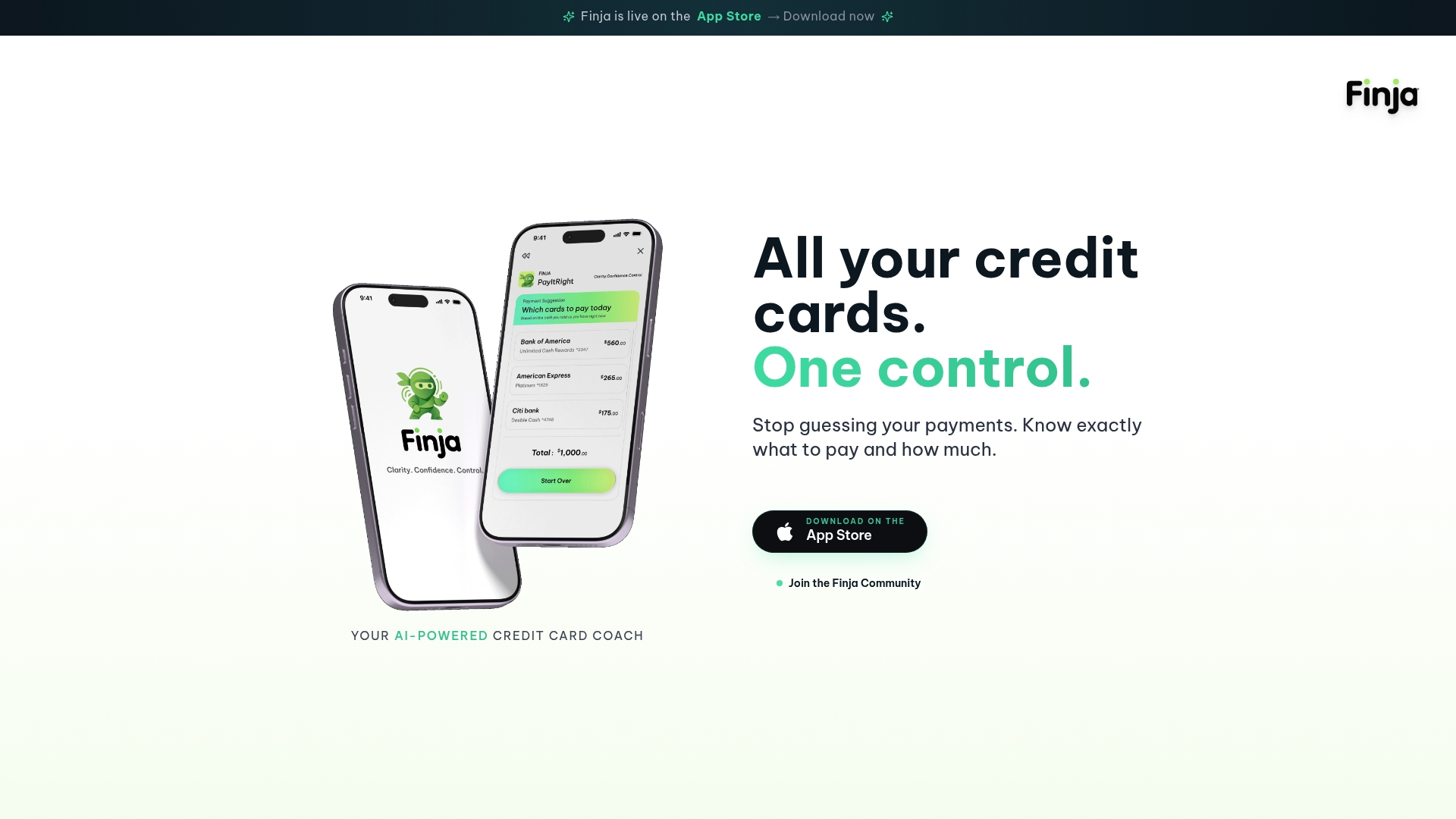
What you get: a consolidated view of every card's balance and APR, payment prioritization recommendations aimed at cutting interest costs, and spending limit controls to help stop new charges from undoing your progress. If you'd rather stick with a manual spreadsheet or a free calculator, that's a completely valid path too, tracking works whether it's automated or handwritten, as long as you keep at it.
Ready to see your cards in one place? Start with Finja and see how payment prioritization changes your payoff timeline.
Sources
- CFPB debt log tool
- Debt Spreadsheet | Microsoft 365
- Debt Snowball Calculator: Find Your Debt-Free Date
FAQ
Is a large amount of Credit Card Debt a Lot?
Yes, relative to typical household balances, $30,000 counts as a significant load, especially if it's spread across multiple high-APR cards where interest compounds quickly. The real risk indicator is less the total number and more your utilization ratio and how much of your monthly payment is going to interest rather than principal.
What Is the Best Free Debt Tracker?
The CFPB's debt log tool is a strong free option because it's built specifically for organizing multiple creditors, balances, and minimum payments in one worksheet. Microsoft's Excel debt spreadsheet template is a close second if you want more customization.
Is a substantial amount a Lot of Credit Card Debt?
It's a substantial balance that typically takes years to pay off on minimum payments alone, particularly at double-digit APRs. Running the number through a payoff calculator with snowball and avalanche scenarios shows exactly how much extra monthly payments would shorten that timeline.
A meaningful share of Americans carry significant credit card debt, though exact totals vary depending on economic conditions and source.
A meaningful share of cardholders carry significant balances, though the exact figure shifts with economic conditions and varies by source. What matters more for your own situation is your personal utilization and APR mix rather than how you compare to a national average.
Can an App Really Help Me Pay Off Credit Card Debt Faster?
An app or AI coach doesn't pay the debt for you, but prioritizing which card gets extra payments, rather than splitting extra money evenly or randomly, can meaningfully reduce total interest paid over time. Tools like Finja focus specifically on that prioritization step for people managing several cards at once.