To restore a lost credit card grace period, pay your full statement balance by the due date, then do it again the next cycle. Most large issuers want two consecutive billing cycles of full payments before purchases go back to interest-free. Your card agreement sets the exact rule, so confirm it there. This guide shows what to pay, what to expect while you wait, and how to keep the grace period once it is back.
TL;DR
- The grace period is the stretch between your statement closing and your due date when new purchases cost no interest, but only if you paid the previous balance in full.
- To get it back, pay the full statement balance on time, usually for two billing cycles in a row. Some issuers need one.
- While it is gone, interest accrues on new purchases from the day you make them, so the first full payment is not the end of the interest.
- Pay the statement balance, not just the current balance shown in your app, and pay the last cycle's leftover interest if a bill shows one.
- Cash advances and balance transfers usually never get a grace period, so restoring it only affects purchases.
Table of Contents
- What a grace period is and what you lose without it
- How to restore it: the steps
- What interest builds up while the grace period is gone
- What restoring the grace period does not cover
- Quick reference
- Why this gets hard with more than one card
- How Finja fits in
- Our perspective
- FAQ
- Sources
What a grace period is and what you lose without it
The Consumer Financial Protection Bureau (CFPB) defines the grace period as the time between the end of a billing cycle and your payment due date, when you are not charged interest if you pay the balance in full by that date. Think of it as an interest-free loan on purchases, as long as you keep clearing the bill.
When you pay less than the full balance, the CFPB explains, you are charged interest on the unpaid portion and on new purchases in the following billing cycle, starting on the date of each purchase. That last part is what surprises people. Purchases that would have been free now start costing money the moment you swipe.
Federal law does not require an issuer to offer a grace period at all. Chase notes that when one is offered it must be at least 21 days, and that the typical length is 21 to 25 days. Your cardholder agreement spells out the conditions on your own card.

Grace period is not the same as a late-payment buffer
Many searchers confuse two things. The grace period here is an interest-free window on purchases. It is not extra time to pay before a late fee. The Office of the Comptroller of the Currency's Truth in Lending handbook describes it as a period in which credit can be repaid without a finance charge from the periodic interest rate. Chase also warns that missing the payment date by even one day can bring interest plus a late fee. So the due date is the due date. If you are asking about the days around it, see how weekend credit card payments count as on time.
How to restore it: the steps
There is no form to file and usually no call to make. Restoring the grace period is a pattern of payments. Here is the routine.
1. Find your statement balance, not your current balance
Your statement shows a statement (or "new") balance: what you owed when the billing cycle closed. Your app also shows a current balance, which includes purchases made since. These differ whenever you have spent after the close date.
A card agreement filed with the CFPB, PNC's, shows how this reads in legal terms: no interest on new purchases if you paid the previous statement's new balance in full by the due date. The test is always the statement balance. Paying the current balance also satisfies it, but it is not required.
Example (hypothetical numbers): your statement says $2,200 and the due date is the 12th. Your app shows $2,550 because you spent $350 after the close. Paying $2,200 by the 12th counts as paying in full for grace period purposes. The $350 will appear on the next statement.

2. Pay that full amount by the due date
Pay the whole statement balance, not the minimum, and let it post before the due date. Payments can take time to register, so do not pay on the last evening. Our guide on how long credit card payments take to post covers the timing, and the due date management guide shows how to keep dates straight across several cards.
3. Expect residual interest on the next bill
Because interest accrued daily on the old balance until your payment landed, the next statement can show a small leftover charge, often called trailing or residual interest. WalletHub describes the two-payment pattern this way: the first payment clears most of the balance, and the second handles lingering interest and any new purchases. If that leftover shows up, pay the full new statement balance including it. We explain how to head it off in stopping trailing interest with payoff checks.
4. Repeat for the second cycle
Most issuers want a second consecutive full payment. WalletHub lists American Express, Bank of America, Capital One, Chase, Citibank and Wells Fargo as requiring two consecutive billing periods, and U.S. Bank as requiring one. Issuers change terms, so treat that as a guide and read your own agreement. Chase says it may reinstate the grace period after two consecutive cycles of paying in full.
5. Confirm on your statement
After the second full payment, look at the next statement. If new purchases show no interest charge and the interest line is zero, the grace period is back. If you still see interest, check whether the leftover was paid and whether the card agreement requires something more. Then ask the issuer's customer service what your card requires.
What interest builds up while the grace period is gone
The American Bankers Association gives a clear example: if you paid in full in January but only part of the bill in February, you owe interest from the first day of February on the full average daily balance for that billing period. In other words, a partial payment costs you interest on the paid-down portion's history for the cycle, not just the leftover.
Here is a rough illustration, not a quote from any issuer. At a 24% APR, a $1,500 balance carried through a month costs about $30 in interest (24% divided by 12 months, times $1,500). If you also spend $800 on new purchases early in the next cycle with no grace period, those purchases begin accruing interest immediately too.
The ABA also notes that paying late can lead to a higher APR, and that accrued interest can push a balance over the credit limit. Both are good reasons to make the restoring payments early.
Rules that protect you
Regulation Z limits how issuers can punish you for losing the grace period. Section 1026.54 prohibits finance charges in certain specified situations tied to losing the grace period, and does not require an issuer to provide one. In the OCC handbook's summary, issuers generally cannot charge interest on balances for days in earlier billing cycles because of a lost grace period. If you pay part of a balance before the grace period would have expired, they may not charge interest on the portion you repaid. The same handbook says that if a balance is paid in full within 30 days of the balance being disclosed, the issuer must waive or rebate trailing interest. The handbook also requires issuers to have reasonable procedures so statements go out at least 21 days before the due date.
What restoring the grace period does not cover
The CFPB says grace periods typically apply only to purchases. Cash advances and card-issuer checks generally accrue interest from the transaction date, and so, per the PNC agreement, do balance transfers. Paying in full will not change that.
The CFPB also warns that if you pay in full some months but not others, you can lose the grace period for the month you did not pay in full and the month after. A single slip costs you two cycles of interest-free purchases. That is why restoring it is only half the job.
Quick reference
| Situation | What happens | What to do |
|---|---|---|
| Paid less than the statement balance | Interest on carried balance and on new purchases from purchase date | Pay the full statement balance next time |
| One full payment made after losing it | Residual interest may still appear on the next bill | Pay the next statement balance in full |
| Two consecutive full payments | Most issuers restore the grace period | Check the statement for zero interest on purchases |
| Cash advance or balance transfer | Usually interest from the transaction date | Treat separately and pay it down on its own plan |
Why this gets hard with more than one card
With one card, restoring the grace period is simple. With three or four, each has its own closing date, due date and statement balance. A single missed full payment on any card restarts the clock on that card. The usual failure is not ignorance but timing: paying the current balance on one card, the minimum on another because cash is tight that week, and forgetting the third.
Two habits help. First, decide which card gets the full payment when money is limited, and our guide on which card to pay first walks through that using statement timing. Second, know when to pay for what outcome: when to pay your credit card for fees, interest or score. If a high utilization figure is also hurting your score, paying before the statement date can lower the balance that gets reported. Once the grace period is back, our piece on protecting your 21 days and the one on paying your statement in full to cut interest help you keep it. For the legal background on payment timing, see optimizing payments with Regulation Z.
How Finja fits in
Finja is an AI-powered credit card coach built for people with several cards. It shows all your cards in one place and gives guidance on payment timing and amounts, with the goal of reducing interest costs and improving credit health. For someone rebuilding a grace period across multiple cards, that means one view of what is due and which payments matter most, instead of a handful of separate logins.
Take a look at Finja to see how it organizes your cards.
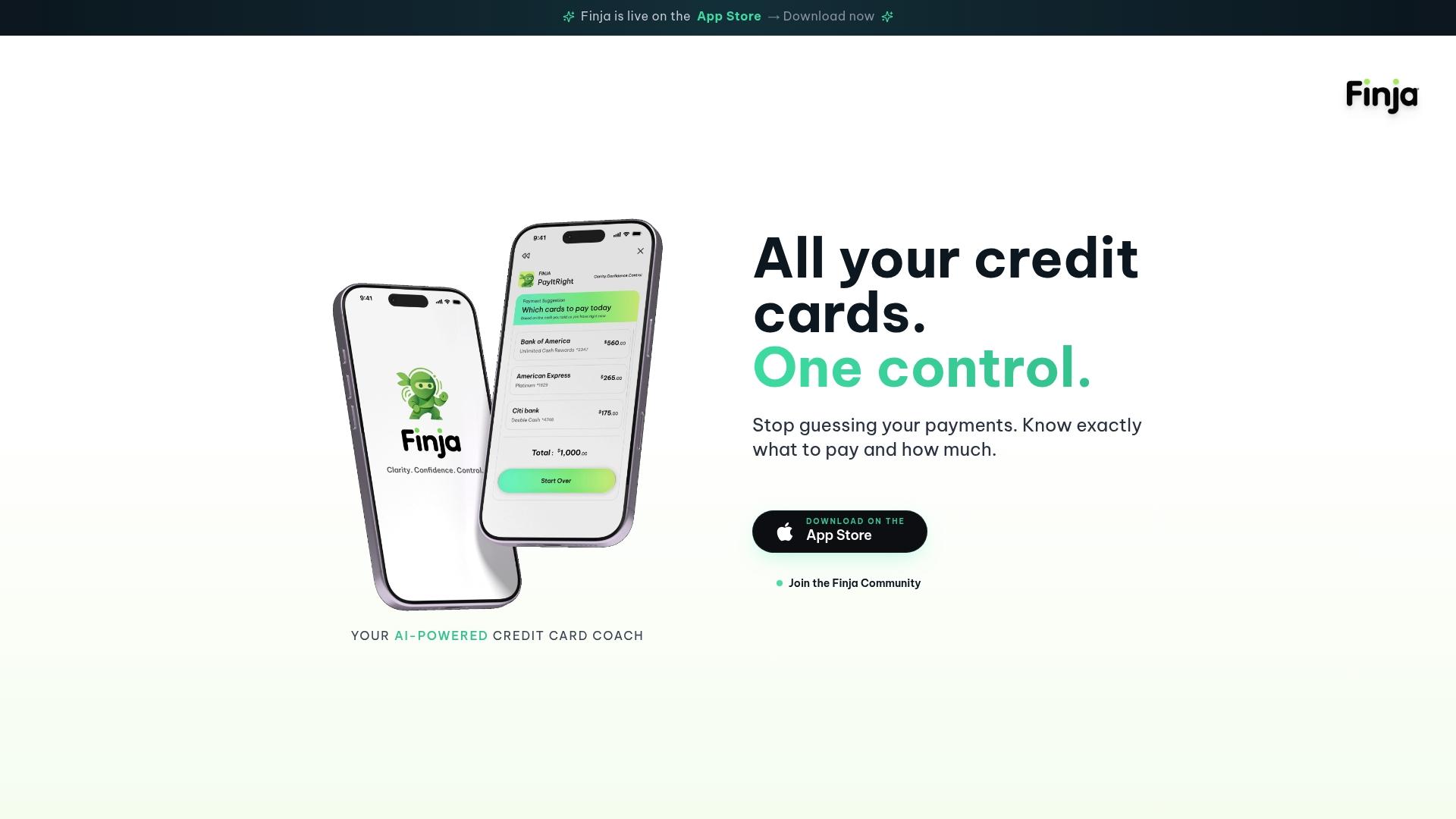
The app is positioned as a dedicated credit card coach rather than a general budgeting tool, and it focuses on interest reduction rather than rewards.
Our perspective
Losing a grace period rarely happens because someone does not understand it. It happens because a month got tight, one card was paid at the minimum, and nothing flagged that the interest-free window on every purchase had just closed.
We built Finja around that moment. People with multiple cards need to see every statement in one place and know what to pay, when, and why. Our approach is to focus on cutting interest costs and improving credit health, not on chasing rewards.
Restoring a grace period is two clean cycles of full payments. Keeping it afterward is a matter of routine. A coach that guides payment timing and amounts makes that routine a lot easier to hold.
Grace K.
FAQ
How long does it take to restore a credit card grace period?
Usually two consecutive billing cycles of paying the full statement balance by the due date, so about two months. Some issuers, such as U.S. Bank according to WalletHub, need only one. Your card agreement has the final word.
Do I need to call the issuer to restore it?
Normally no. It is based on your payment pattern, and the grace period returns automatically once you meet the issuer's conditions. You can call to ask what your card requires, and you should check your next statement to confirm.
Will I be charged interest on new purchases while it is lost?
Yes. The CFPB explains that new purchases accrue interest from the purchase date in the new billing cycle after you carry a balance. That is why paying the balance down quickly matters.
Does paying the minimum on time keep my grace period?
No. A minimum payment on time avoids a late fee, but it does not keep the interest-free window. You need to pay the full statement balance for that.
Sources
- CFPB: What is a grace period for a credit card?
- CFPB: Regulation Z, 12 CFR 1026.54
- OCC Comptroller's Handbook: Truth in Lending Act
- Chase: What is a grace period on a credit card
- WalletHub: How to restore a credit card grace period
- American Bankers Association: Credit card facts and tips
- PNC Visa credit card agreement, filed with the CFPB