
Trailing interest, also called residual interest, is the daily interest that keeps building after your statement closes but before your payment fully posts. It shows up even when you think you paid your bill in full, usually as a small leftover charge on your next statement. The fix is simple: preserve your grace period by paying your full statement balance every cycle, or pay the exact current payoff amount if you're clearing a balance mid-cycle.
TL;DR:
- Paying your full statement balance by the due date every cycle prevents residual interest and preserves your grace period for new purchases.
- Interest accrues daily from the statement close date until payment posts, with a 24% APR translating to about 0.0658% daily on a $1,000 balance.
- Requesting your current payoff amount and paying it promptly helps avoid unexpected trailing interest charges on carried balances.
- Small leftover balances, even as little as 0.01 dollars, can trigger a full cycle of residual interest and increase your costs.
- Trailing interest is a legal and disclosed practice, but understanding its mechanics requires reading your credit card agreement and tracking payment timing carefully.
Table of Contents
- How Trailing Interest Credit Cards Accrue Between Statement Close and Payment
- How to Calculate Trailing Interest on Your Own Balance
- Practical Tactics to Avoid Trailing Interest Credit Cards Charges
- What to Do if You Got Hit With a Trailing Interest Charge
- Is Trailing Interest Legal? Myths and Consumer Protections
- Does Trailing Interest Hurt Your Credit Score?
- How Trailing Interest Rules Differ Across Card Issuers
- Do Different Card Types Handle Trailing Interest the Same Way?
- Where Trailing Interest Regulation Stands Today
- What Finja Recommends for Staying Ahead of Trailing Interest
- Where to Verify These Trailing Interest Rules Yourself
- Sources
- FAQ
How Trailing Interest Credit Cards Accrue Between Statement Close and Payment
Interest doesn't pause the moment your statement prints. It keeps ticking on a daily basis until your issuer actually receives your payment, which is why residual interest catches so many people off guard.
Here's the timeline that trips people up. Your statement closes on a certain date of the month, listing a balance and a due date several weeks later. If you carry no balance from the prior cycle and pay that full statement balance by the due date, you owe nothing extra. But if you carried any balance into this cycle, your card issuer can charge interest for the days between the statement closing date and when your payment is received, even on a bill you paid on time.
That's the grace period disappearing act. Once you carry a balance, new purchases typically lose their interest-free window too, meaning everything you charge starts accruing from the transaction date instead of getting the usual buffer.
A few mechanics worth knowing before you assume you're in the clear:
- Interest is calculated using a daily periodic rate, applied to your balance every single day it's outstanding.
- Cash advances and balance transfers often skip the grace period entirely, accruing interest from day one regardless of your payment history.
- Payment posting delays (weekends, holidays, mail float) can add extra accrual days you didn't account for.
- Even a $0.01 leftover balance can trigger a full cycle of new residual interest charges.
Your card agreement spells out exactly how your issuer handles this. Credit card agreements filed with regulators detail the billing cycle length, grace period rules, and interest calculation method, and those details vary enough between issuers that it's worth a five-minute read of yours.
How to Calculate Trailing Interest on Your Own Balance
Estimating what you'll owe isn't complicated once you know the formula. Most issuers calculate a daily periodic rate by dividing your APR by 365 (some use 360), then apply that rate to your balance for every day it's outstanding.
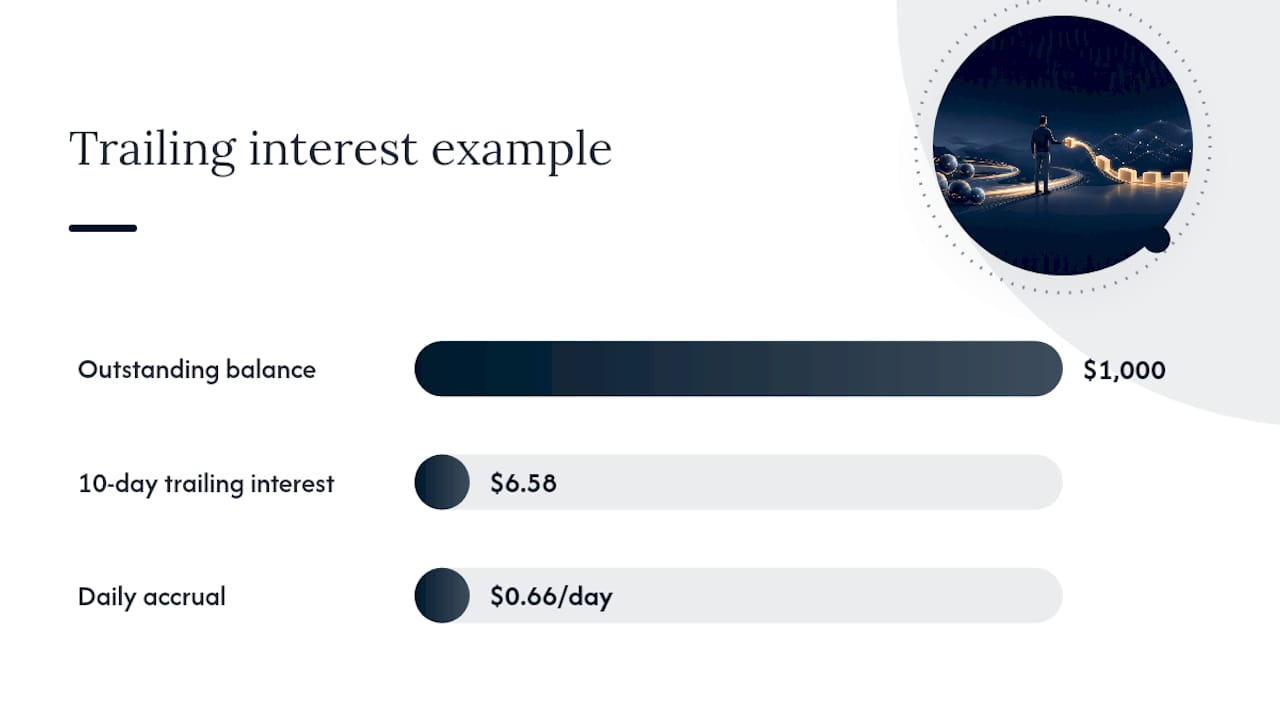
Statistic snapshot: A card with a 24% APR converts to roughly a 0.0658% daily rate ($24% \div 365$). On a $1,000 balance carried for 10 days between statement close and payment, that works out to about $6.58 in trailing interest, using the step-by-step daily accrual method banks publish as a guide.
Here's how to run the math yourself:
- Find your card's APR (listed on your statement or account portal).
- Divide by 365 to get your daily periodic rate.
- Multiply that rate by your outstanding balance.
- Multiply the result by the number of days between statement close and expected payment posting.
This is a simplified estimate, not an exact figure. Some issuers compound daily, others use average daily balance methods that shift slightly with each payment timing, and your actual payoff amount changes literally every day interest accrues. That's why the number you calculate at home is a planning tool, not a guarantee. For the real figure, call your issuer or check your online account for a current, dated payoff amount before you send your final payment.
Practical Tactics to Avoid Trailing Interest Credit Cards Charges
The single biggest lever is paying your full statement balance by the due date, every cycle, without exception. Do that consistently and your grace period stays intact, meaning no interest on new purchases and no residual interest surprise.
If you're carrying a balance and trying to pay it off mid-cycle, timing gets trickier. Paying down the account balance before your statement closes, rather than waiting for the statement to generate, reduces the base amount that interest gets calculated against going forward.
A few tactics that consistently work:
- Request your current payoff amount by phone or through your issuer's app rather than relying on last month's statement figure.
- Pay online or by phone close to your target date so the payment posts the same day instead of sitting in transit.
- Split one large payment into two or three smaller ones spread across the billing cycle, which shrinks the number of days interest has to accrue on the full balance.
- Set autopay to cover the full statement balance, not just the minimum, and schedule it a day or two before the due date as a buffer.
- If you juggle several cards, sync due dates where your issuers allow it and throw extra payments at the highest-APR card first.
Pro Tip: Call your issuer the same day you plan to pay off a balance and ask for the "payoff amount good through [today's date]." That figure already accounts for that day's accrued interest, so you won't underpay by a few cents and restart the whole cycle.
Managing this across multiple cards is exactly where things get messy, since each issuer has its own posting cutoff times and grace period rules. That's the kind of detail worth tracking when you're deciding what to pay and when, especially if you're rotating payments across three or four accounts every month.
What to Do if You Got Hit With a Trailing Interest Charge
A stray charge on your statement doesn't always mean you did something wrong. It usually just means the payoff math and your payment timing didn't quite line up.
- Verify the charge first. Log into your account or call the issuer to confirm the amount is genuinely residual interest and not a fee or a different transaction.
- Pay the full current payoff amount immediately rather than the old statement balance, since paying stale numbers just restarts the accrual cycle.
- Decide whether to ask for a courtesy credit. If this is your first trailing interest charge and you have a solid payment history, many issuers will waive it on request. If you routinely carry a balance, it's likely an expected cost rather than a billing error worth disputing.
- Confirm the accrual has stopped on your next statement, and check that no late fee or negative reporting followed if the charge delayed your total payoff.
Interest generally stops accruing the day your full payoff posts, not the day you initiate the payment, so build in a one or two day buffer if you're paying close to a deadline.
Is Trailing Interest Legal? Myths and Consumer Protections
Trailing interest is legal and disclosed, but it's widely misunderstood. The biggest myth: paying "your statement balance" always means you owe $0 going forward. It doesn't, if you carried a balance into that statement or made purchases after it closed.
Consumer advocates have flagged this confusion for years, arguing issuers should disclose the practice more clearly in hearings on credit card billing practices. The legal basis sits in your card's cardholder agreement and issuer disclosures, which the CFPB requires and archives.
Quick myth check:
- Myth: Paying the statement balance guarantees a zero balance next cycle.
- Reality: It does, only if you had no prior carried balance and made no new purchases after your statement date.
- Myth: Trailing interest is a fee issuers invented to trap consumers.
- Reality: It's standard daily interest accrual, disclosed in your cardholder agreement, not a hidden penalty.
If you believe an issuer miscalculated a charge or won't correct a clear error, you can file a complaint through the CFPB's consumer complaint portal, which routes disputes directly to the card issuer for a response.
Does Trailing Interest Hurt Your Credit Score?
A small trailing interest charge doesn't directly dent your credit score the way a missed payment does, but it can create a chain reaction that does. Here's how that works.
Credit utilization, the percentage of your available credit you're using, gets reported to credit bureaus based on your statement balance, not your real-time balance. A trailing interest charge nudges that reported balance up slightly, which can bump your utilization ratio a fraction of a point. On its own, that's rarely enough to move your score.
The real risk comes from what happens next. If you don't notice the trailing interest charge and it sits unpaid, it can snowball into a late payment if you assumed your balance was $0 and skipped a payment entirely. Late payments are one of the most damaging factors in credit scoring, far more than a few dollars of leftover interest. Repeated residual interest charges can also signal to you (if not to the bureaus directly) that you're chronically carrying balances, which keeps utilization elevated month over month and suppresses your score over time.
The practical takeaway: treat every statement as a checkpoint, not a final answer. Confirm your balance actually hit zero before assuming you're square, and keep an eye on your utilization percentage even when you think you paid in full.
How Trailing Interest Rules Differ Across Card Issuers
The core mechanic, daily accrual between statement close and payment posting, is consistent across nearly every major issuer, but the details around grace periods and disclosures vary. Citi's own explainer on residual interest describes the same daily accrual model that Bank of America and other large issuers use, which suggests this isn't an isolated practice at one bank. It's standard across the industry.
Where issuers genuinely differ is in the小 details: how many days a grace period lasts (typically 21 to 25 days from statement close to due date), whether cash advances and balance transfers get any grace period at all, and how quickly a payment posts once you submit it online versus by mail. Some issuers post same-day payments made before a specific cutoff time, often mid-afternoon; others take up to two business days to process and apply a payment, which stretches your accrual window even if you paid promptly.
Rewards cards, store cards, and secured cards from the same issuer often follow identical interest calculation rules internally, so the real variation is issuer-to-issuer, not product-to-product within one bank. That's why reading your specific cardholder agreement matters more than assuming a rule that applied to one card applies to all of them, even from the same bank.
Do Different Card Types Handle Trailing Interest the Same Way?
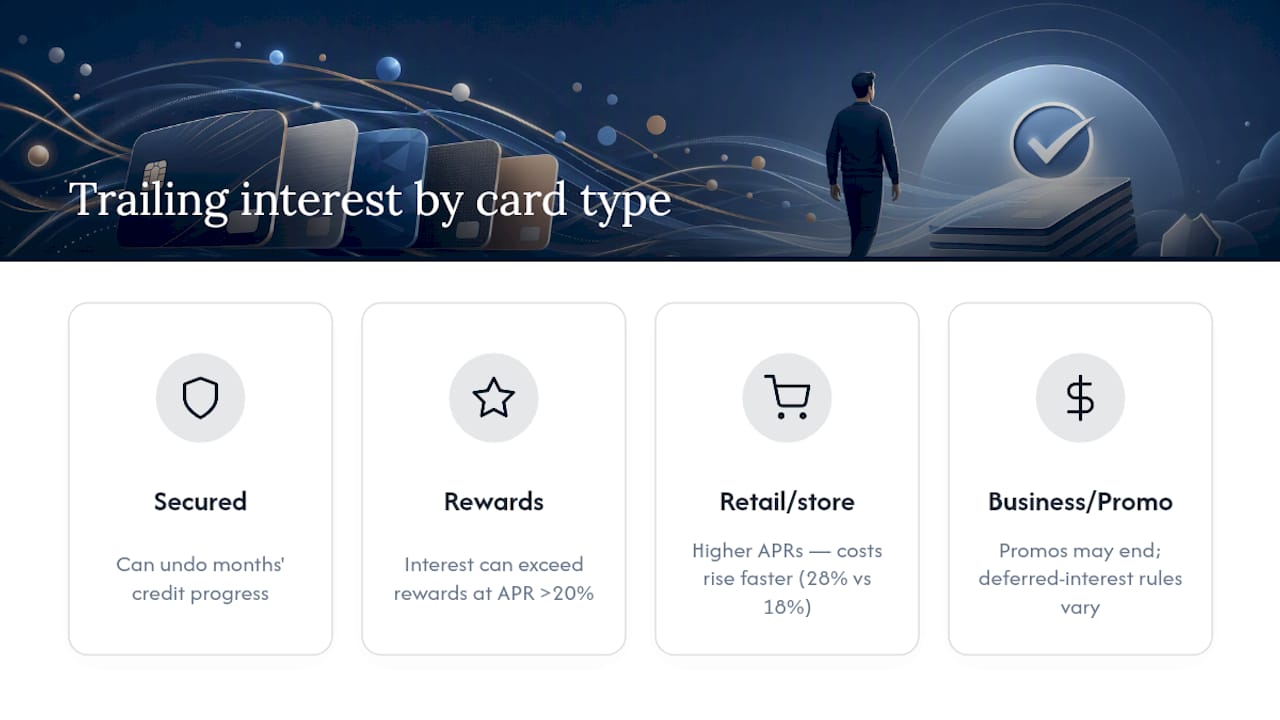
The interest math itself doesn't change based on what kind of card you hold. A secured card, a no-frills unsecured card, and a rewards card all calculate residual interest the same way: daily periodic rate applied to an outstanding balance until payment posts.
What changes is the context each cardholder brings to the table. Secured card holders are often building credit after a rough patch, and a surprise trailing interest charge that triggers a missed payment can undo months of progress on a card meant to rebuild trust with lenders. Rewards card holders face a different trap: the temptation to carry a balance to "maximize points" often costs more in trailing interest than the rewards are worth, especially on cards with APRs above 20%.
Retail and store cards deserve extra caution, since they frequently carry higher APRs than general-purpose cards, which means the dollar cost of even a short accrual window is larger. A $500 balance at 28% APR racks up trailing interest noticeably faster than the same balance on a card at 18%.
Business cards and cards with promotional 0% APR periods add another wrinkle. Once a promotional period ends, any remaining balance can start accruing interest immediately, and issuers vary on whether deferred interest applies retroactively to the whole balance or only going forward. Reading the fine print on promotional financing terms matters just as much as understanding standard trailing interest.
Where Trailing Interest Regulation Stands Today
Consumer complaints about confusing interest charges after the passage of the Credit CARD Act of 2009 pushed regulators to require clearer billing statement disclosures, including due dates and minimum payment warnings. Trailing interest itself wasn't eliminated by that law, but the disclosure requirements it introduced made it easier for consumers to spot when a "paid" balance wasn't actually zero.
Advocacy groups have pressed for even clearer language for years, arguing that terms like "residual interest" and "trailing interest" aren't intuitive to the average cardholder, a concern raised in congressional hearings on credit card billing practices more than a decade ago. Since then, the trend among issuers has leaned toward more explicit online account tools: real-time payoff calculators, daily-updated balance displays, and app notifications when a balance carries into a new cycle.
The CFPB continues to field consumer questions on this exact issue, publishing guidance that directs cardholders to their billing agreements as the authoritative source on timing and calculation. The practice hasn't disappeared, but the tools available to spot and avoid it have improved substantially compared to a decade ago, largely thanks to better mobile banking transparency rather than any single new law.
What Finja Recommends for Staying Ahead of Trailing Interest
The workflow that actually prevents these charges isn't complicated, but it does require consistency: pull your current payoff amount before paying off any balance, split payments across the month instead of waiting for one due date, and track how much interest you're actually paying month over month rather than just watching your balance drop.
That last habit is the one most people skip, and it's the one that catches trailing interest before it snowballs. Finja's approach centers on giving you a single view of interest costs across every card you carry, so you're not reconstructing payoff math by hand every cycle. Pairing that with a habit of comparing your statement balance against your current balance before you pay catches most trailing interest before it ever shows up on a bill.
If you manage several cards with different due dates and APRs, Finja is built specifically to flag which balance to pay first and when, so trailing interest stops being a guessing game.
— Grace K.
Where to Verify These Trailing Interest Rules Yourself
The CFPB's page on interest charges after paying a bill on time confirms the legal basis for residual interest, while its credit card agreements database lets you look up the exact billing terms your issuer has on file. For the actual math, Bank of America's residual interest walkthrough offers a clear worked example, and for broader consumer finance context, the Javitch Law Office's overview of card charge disclosures covers related billing transparency issues.
This article is general information, not a substitute for advice from a qualified financial advisor. Consult a qualified financial professional about your own circumstances before acting on anything here.
Sources
- If I pay off my credit-card balance when it is due, is the company allowed to charge me interest for that month? | CFPB
- Credit card residual interest: What it is and ways to avoid it | Better Money Habits (Bank of America)
FAQ
What Is Trailing Interest on a Credit Card?
Trailing interest, or residual interest, is interest that accrues daily on a credit card balance between the date your statement closes and the date your payment actually posts, even if you pay the statement balance in full.
How Do You Get Rid of Trailing Interest?
Pay your full statement balance every cycle to preserve your grace period, and if you're paying off a carried balance, request your current payoff amount and pay it by phone or online so it posts the same day.
What Is the 2/3/4 Rule for Credit Cards?
This isn't a standard, universally defined credit card rule, and definitions vary depending on the source; if you've seen it referenced elsewhere, check that source's specific context rather than assuming a fixed industry standard.
Is Trailing Interest Legal?
Yes. Trailing interest is a legal, disclosed practice governed by your cardholder agreement and CFPB guidance, though consumer advocates have long pushed for clearer disclosure of how it works.