
That's a real win, and it's replicable.
Three things you can do in the next 48 hours:
- Pull every card's APR and current balance (your issuer's app shows both).
- Calculate whether a balance transfer beats staying put (the formula is in Section 4).
- Set any payment above the minimum to auto-apply to your highest-APR card.
Typical households carrying revolving credit card debt pay over $1,000 in interest per year. Most of that is recoverable with the right sequencing.
Key Takeaways
| Point | Details |
|---|---|
| Prioritize highest APR first | Direct all excess payments to your highest-rate card; federal rules require issuers to apply them there. |
| Run the break-even formula | Subtract the transfer fee from projected interest saved; a positive result means the transfer wins. |
| Biweekly payments cost nothing | Splitting payments mid-cycle lowers average daily balance and cuts interest with no fees or new accounts. |
| Watch the promo expiry date | A residual balance when the intro period ends triggers the full go-to APR, erasing much of the saving. |
| Finja automates the sequencing | Finja routes excess payments to your highest-APR card and alerts you before promo windows close. |
Table of Contents
- How payment mechanics actually generate your interest savings
- Three dollar-by-dollar interest-cost reduction wins
- How to calculate whether a balance transfer is worth it
- Step-by-step checklist to start capturing interest savings
- When balance transfers and aggressive sequencing backfire
- The pattern that actually produces consistent wins
- Finja puts these tactics on autopilot for you
- Sources
How payment mechanics actually generate your interest savings
Interest on a credit card is calculated on your average daily balance, not your statement balance. Pay $500 on day 10 of a 30-day cycle instead of day 29, and you've reduced the balance that accrues interest for 19 extra days. That difference adds up across months.
Payment-application rules matter just as much. Under federal rules, payments above the minimum must go to your highest-rate balance, while minimum payments can be applied at the issuer's discretion — often to lower-rate balances. Pay only the minimum and your high-APR balance keeps compounding. Pay even $50 above the minimum and that excess hits the most expensive debt first.
Balance transfers work differently: they create a temporary interest pause. You move a balance to a card offering 0% intro APR for 12–21 months, pay a transfer fee of 3%–5%, and use the window to pay down principal without interest accruing. The math only works if you clear the balance before the promo expires.
The balance-matching trap: A Becker Friedman Institute working paper found that consumers direct only about 51.5% of excess payments to their high-APR card — far below the ~97.1% that would minimize costs. The gap between what people actually do and what they should do produces measurable, avoidable interest losses every year. Automation removes that gap entirely.
Pro Tip: Set up a payment allocation rule so any amount above your combined minimums routes automatically to your highest-APR card. Most issuers allow this in their online settings.
Three dollar-by-dollar interest-cost reduction wins
Scenario A: The balance transfer win
Over 12 months paying only minimums, you'd pay roughly $950 in interest. Total interest paid: $0. Net savings after the fee: $800.
The fee is the only cost.
Scenario B: Avalanche vs. proportional allocation
You have $400/month to put toward debt above minimums.
- Avalanche (all excess to Card A): You clear Card A in roughly 9 months, then redirect to Card B. Total interest over 18 months: approximately $620.
- Proportional (split $200/$200): Both balances shrink at the same rate. Total interest over the same period: approximately $780.
The avalanche method saves a meaningful amount in interest over a typical repayment period compared to proportional allocation. Scale that to larger balances or a third card and the gap widens considerably.
Scenario C: Biweekly payments vs. single end-of-cycle payment
Paying once at the end of the cycle, your average daily balance stays near $4,000 all month. Split that same total payment into two mid-cycle installments and your average daily balance drops meaningfully. Making multiple payments during a billing cycle can cut monthly interest by $10–$20 on a balance this size — zero cost, zero new accounts, just timing.

Scenario A produces the biggest single-move win. Combine all three and the annual savings compound quickly.
How to calculate whether a balance transfer is worth it
The break-even formula is straightforward:
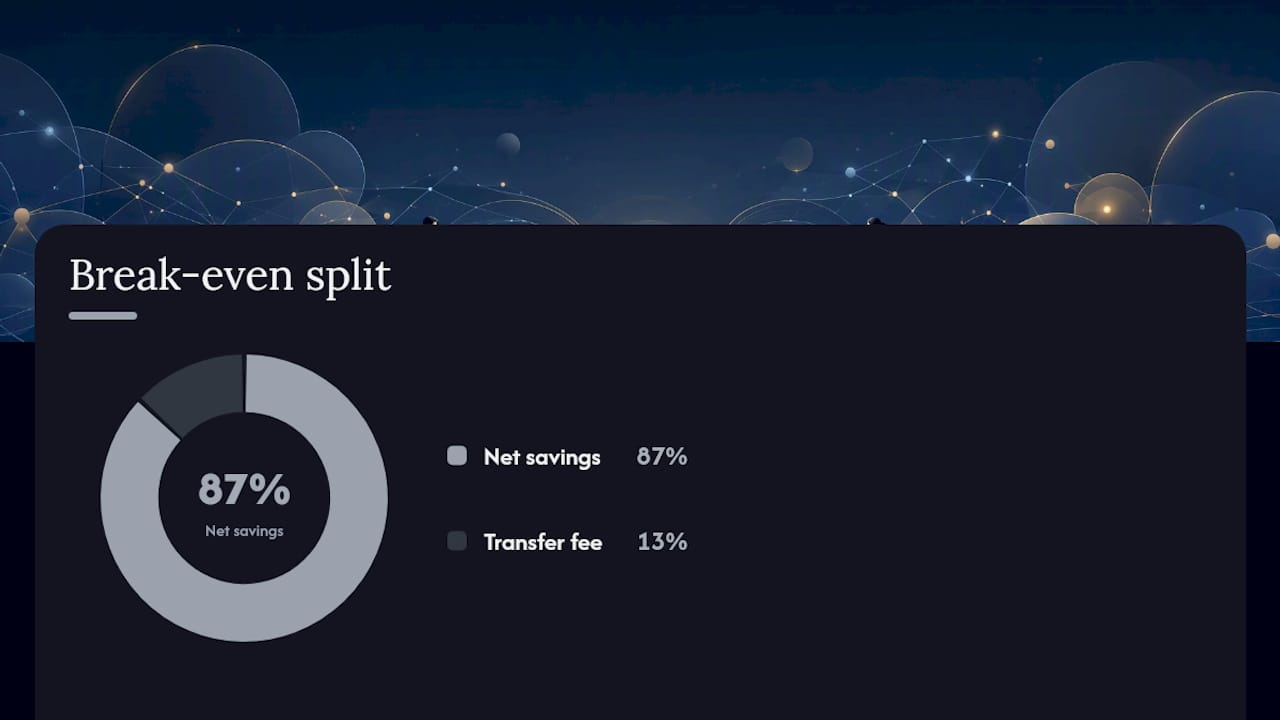
Net savings = (Current APR × Balance × Months ÷ 12) − Transfer fee
If net savings is positive, the transfer saves you money. If it's negative or near zero, stay put or look at a personal loan instead.
- Interest you'd pay staying put: $4,000 × 18% × (15/12) = $900
- Transfer fee: $4,000 × 3% = $120
- Net savings: $900 − $120 = $780
That's a clear win. Now stress-test it: if you can only pay it down in 12 months (not 15), savings drop slightly but remain positive.
| Input | What to collect |
|---|---|
| Current APR | Your card's purchase APR (check statement or issuer app) |
| Balance to transfer | Amount you plan to move |
| Intro APR | Usually 0%; confirm the exact rate |
| Intro period length | Typically 12–21 months |
| Transfer fee | 3%–5% of transferred amount |
| Monthly payment capacity | How much you can pay each month |
Balance transfers work best for consumers with good or excellent credit who can realistically pay the balance within the promo window. Run this calculation before applying.
Step-by-step checklist to start capturing interest savings
- Gather your numbers. List every card: current balance, APR, minimum payment, and credit limit.
- Check your credit score. You'll need good to excellent credit (typically 670+) to qualify for the best 0% intro offers.
- Run the break-even formula. Use the inputs above to confirm a transfer saves more than it costs.
- Choose your transfer amount and timeline. Only transfer what you can realistically pay within the promo window.
- Request the transfer or set payment sequencing. If no transfer, direct all excess payments to your highest-APR card using your issuer's payment settings.
- Call your issuer for an APR reduction. A single call asking for a lower rate works more often than most cardholders expect, especially with a good payment history.
- Set autopay for at least the minimum on every card. Payment history is 35% of your FICO Score — missing a payment erases months of interest savings instantly.
- Track monthly interest paid. Your statement shows it. Tracking this number monthly is how you confirm a tactic is working.
Pro Tip: Personal finance automation removes the behavioral gap that causes balance-matching. Finja's payment sequencing feature handles steps 5 and 8 automatically, routing excess payments to your highest-APR card and surfacing your monthly interest trend in one view.
When balance transfers and aggressive sequencing backfire
Not every situation calls for a transfer. Three scenarios where it's the wrong move:
- Your credit score is below 670 and you're unlikely to qualify for a 0% offer.
- The balance is larger than any realistic transfer limit, leaving a residual chunk still accruing interest at the original rate.
- You're adding new purchases to the card you're trying to pay down, which rebuilds the balance faster than you're clearing it.
The promo-expiry trap is the most common way a transfer win turns into a loss. If you carry a remaining balance when the intro period ends, the full go-to APR (often 18–29%) kicks in immediately on whatever's left. A $1,500 residual at 26% APR costs $390 in the first year alone — wiping out much of the original saving.
When a transfer doesn't fit, consider these paths instead. A personal loan consolidates multiple balances into one fixed monthly payment at a predictable rate, with no promo-expiry cliff. Negotiating a temporary hardship APR reduction directly with your issuer costs nothing and can cut your rate for 6–12 months. And if the issue is behavioral — spending on cleared cards — strict budgeting and automated payment rules address the root cause rather than just moving the balance. A debt payoff calculator can help you model which path clears your debt fastest given your actual monthly capacity.
The pattern that actually produces consistent wins
Most people focus on finding the right tactic and underestimate how much the execution gap costs them. The balance-matching research makes this concrete: consumers who intend to pay down high-APR debt still split payments roughly proportionally across cards because that's what feels fair or organized. The intention is right; the allocation is wrong.
The workflow that reliably closes that gap is simple: automate the sequencing, track the monthly interest number, and treat any promo window as a hard deadline with a payoff plan attached. Consumers who combine a balance transfer with automated excess-payment routing to their next-highest-APR card tend to see the largest, fastest reductions. The debt-free credit card strategy isn't complicated — it just requires removing the decisions that humans consistently get wrong under pressure.
Finja puts these tactics on autopilot for you
Knowing the right moves is half the battle. Executing them consistently, across multiple cards, every month, is where most people lose ground.
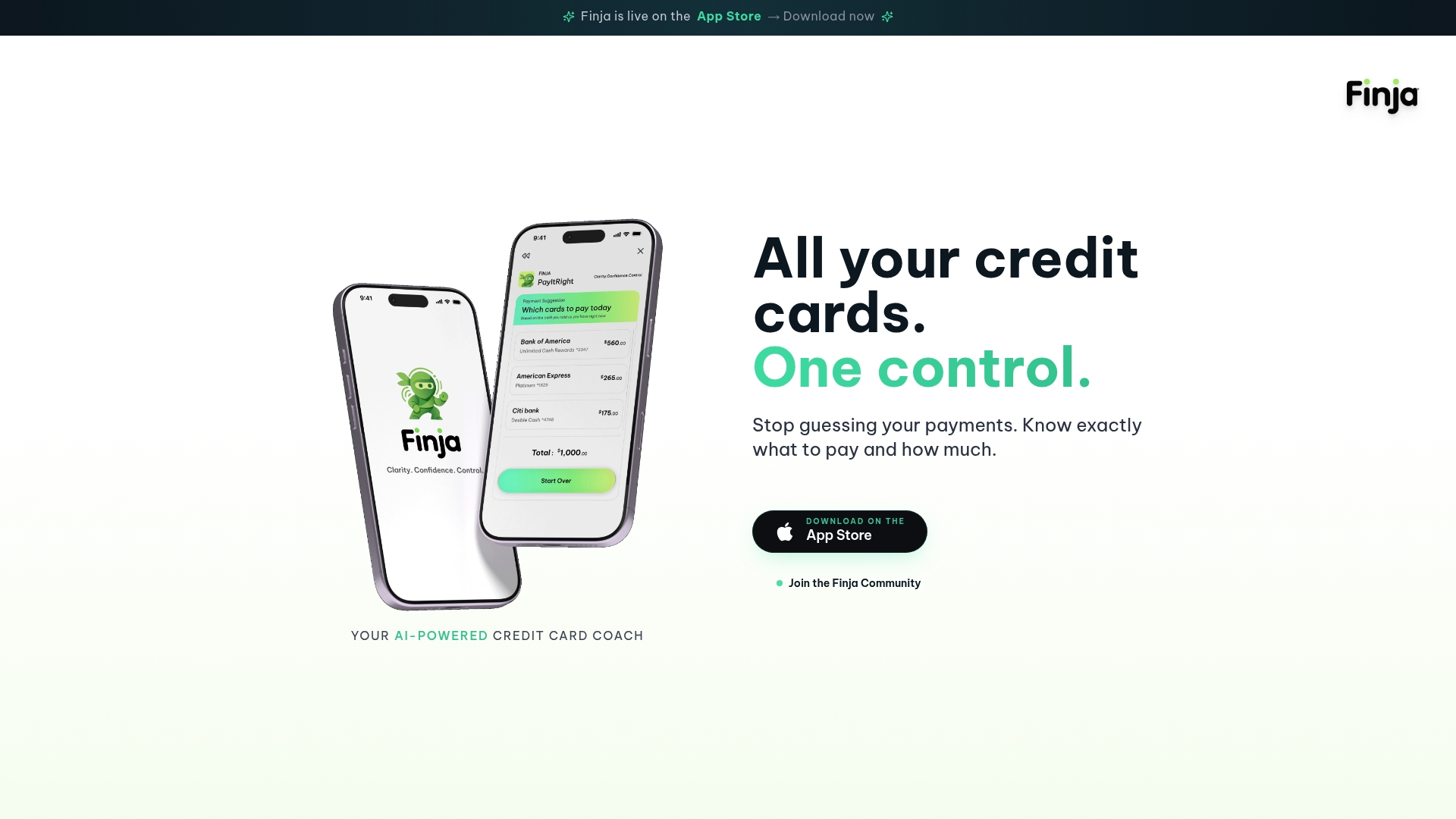
Finja is an AI-powered credit card management app built specifically for multi-card consumers. It consolidates all your balances and APRs in one view, automatically sequences your payments to target the highest-rate balance first, and tracks your monthly interest paid so you can see your wins in real dollars. When a promo window is approaching expiration, Finja alerts you before the go-to rate kicks in. The result: the avalanche method, the biweekly payment habit, and the transfer-window discipline from this article run in the background without requiring you to recalculate anything manually. Start your free trial at Finja and see how much interest you can recover this month.
Sources
- How Do Individuals Repay Their Debt? (Becker Friedman Institute working paper)
- How Your Credit Card Payments Are Applied to Your Balances | myFICO
- How Do Balance Transfers Work? | Better Money Habits (Bank of America)
- What is a balance transfer & how does it work? | Experian
- 5 ways to reduce credit card interest | NerdWallet
This article is general information, not a substitute for advice from a qualified financial advisor. Consult a qualified financial professional about your own circumstances before acting on anything here.