
Credit card interest is what you pay for borrowing money you didn't pay back by the due date, calculated daily against your unpaid balance. The single most effective move is simple: pay your full statement balance by the due date every cycle, since that's what prevents purchase interest. Everything else, APR, daily periodic rates, grace periods, matters mainly for the months you can't do that.
TL;DR:
- Paying your full statement balance on time prevents interest charges, but missing payments or carrying balances for multiple cycles can trigger higher rates or penalties.
- Interest compounds daily based on the current balance and APR, with cash advances and certain transfers accruing interest immediately without grace periods.
- Negotiating a lower rate on high-balance, high-APR cards can save more money over time than small reductions on lower balances.
- Most consumers wrongly believe paying the minimum or one late month resets the grace period, which can lead to ongoing interest charges from previous balances.
- Prioritizing paying off the highest-interest, highest-balance card yields the most significant savings versus focusing on smaller or lower-rate accounts.
Table of Contents
- What Is a Credit Card Interest Charge, and How Does It Relate to APR?
- What Are the Different Types of Credit Card Interest Rates?
- When Does a Credit Card Start Charging Interest?
- How Do Issuers Actually Calculate Your Monthly Interest Charge?
- How Can You Avoid or Reduce Credit Card Interest Charges?
- What Does Interest Actually Cost You in Real Dollars?
- What Misconceptions Trip People Up Most?
- Why Most Interest Advice Misses the Point
- Sources
What Is a Credit Card Interest Charge, and How Does It Relate to APR?
Your card's Annual Percentage Rate, or APR, is the yearly cost of carrying a balance, but issuers don't actually charge interest once a year. They convert that APR into a daily periodic rate and apply it every single day you carry a balance, which is why a 24% APR card can feel more punishing than the number suggests.
A single card often carries several APRs at once, and each applies to a different kind of transaction:
- Purchase APR, the rate on everyday spending
- Cash advance APR, almost always higher
- Balance transfer APR, sometimes promotional
- Penalty APR, triggered by a missed payment
Most cards also have variable APRs tied to the prime rate, so your rate can shift when the Federal Reserve moves. Because interest compounds daily rather than monthly, even a few extra days of carrying a balance adds up faster than most people expect.
What Are the Different Types of Credit Card Interest Rates?
Not every dollar on your card costs the same to borrow. The APR that applies depends entirely on how the charge got there.
- Purchase APR covers everyday swipes and is the only rate that benefits from a grace period when you pay in full.
- Cash advance APR is typically several points higher than your purchase rate, and interest starts accruing the moment you withdraw cash, with no grace period at all.
- Balance transfer APR may start at a promotional 0% for a set window, but transfers usually carry a fee and revert to a standard rate once the promo ends.
- Penalty APR kicks in after a late payment, sometimes exceeding 29%, and can apply to your entire balance until you make several on-time payments in a row.
Knowing which APR governs a given charge tells you exactly how much runway you have before interest starts. For more on how these rates function, see this breakdown of credit card APR and what it actually costs you.
When Does a Credit Card Start Charging Interest?
Every billing cycle ends on a statement closing date, followed by a due date roughly 21 to 25 days later. That window is your grace period, and paying your statement balance in full by the due date means you owe zero interest on those purchases.
Miss that window, even by a day, and the rules change:
- Interest begins accruing on your remaining balance from the transaction date, not the due date.
- You typically lose your grace period entirely, meaning even new purchases start racking up interest immediately.
- To regain the grace period, you generally need to pay your full statement balance for two consecutive billing cycles, according to Experian.
- Cash advances and many balance transfers skip the grace period altogether, accruing interest from day one regardless of your payment habits.
That two-cycle rule catches people off guard constantly. Paying off last month's balance doesn't automatically restore your grace period if this month's statement still shows unpaid interest from the gap. Understanding the difference between your statement balance and current balance makes this much easier to track.
How Do Issuers Actually Calculate Your Monthly Interest Charge?
Here's the math your card issuer runs behind the scenes, and it's more mechanical than most statements make it look.
First, they take your APR and divide it by 365 to get a daily periodic rate. A 24% APR becomes roughly 0.0658% per day. The CFPB confirms this is the standard method most issuers use, though a few divide by 360 instead.
Next comes your average daily balance. Issuers track what you owe on each day of the billing cycle, add those daily figures together, then divide by the number of days in the cycle.
Finally, they multiply: daily rate × average daily balance × number of days in the cycle equals your monthly finance charge.
- Daily rate: 24% APR ÷ 365 = 0.000658
- Average daily balance: $3,000
- Days in cycle: 30
- Monthly interest: 0.000658 × $3,000 × 30 = $59.22
That's not a rounding error. Investopedia walks through nearly identical math, and it's why a seemingly modest balance generates a real monthly cost. Context matters here too: the average APR on accounts assessed interest sits around 22%, and typical balances run into the thousands, so this isn't a hypothetical for most cardholders. You can check your own average daily balance calculation against your statement to confirm the issuer's math matches yours.
How Can You Avoid or Reduce Credit Card Interest Charges?
Not every tactic here carries equal weight. Start at the top of this list, because the first item does more than everything below it combined.
- Pay your full statement balance, every cycle. This is the only guaranteed way to avoid purchase interest entirely. Set autopay for the full statement balance, not the minimum, and pay a few days before the due date to build in a buffer for processing delays.
- Pay early or in multiple installments if paying in full isn't realistic. Since interest calculates on your average daily balance, a mid-cycle payment lowers that average even if you can't clear the whole thing.
- Consider a 0% balance transfer, but only with a payoff plan already mapped out. Transfers typically cost 3% to 5% upfront, and promotional windows run 12 to 21 months before the standard rate applies. Compare that against a personal loan or balance transfer to see which fits your timeline.
- Call your issuer and ask for a lower rate. This gets skipped constantly, yet issuers frequently grant temporary reductions of 1 to 3 percentage points to cardholders with a solid payment history who mention competing offers.
- Explore hardship programs or credit counseling if you're falling behind on multiple cards. These aren't a last resort, they're a structured way to get reduced rates and a fixed payoff schedule before penalty APRs make things worse.
Pro Tip: Chasing a 2-point APR cut on a small balance saves you pocket change. Chasing that same cut on a large balance you'll carry for a year can save real money, so prioritize your highest-balance, highest-APR card first.
If you're managing several cards with different due dates and rates, ten practical ways to cut your credit card bills can help you sequence which balance to attack first.
What Does Interest Actually Cost You in Real Dollars?
Numbers make this concrete. Take a $3,000 balance at 24% APR. Making only minimum payments, you'd pay well over $1,000 in interest before clearing it, stretching payoff past three years. Accelerate payments to clear it in 12 months instead, and total interest drops to roughly $380.
A $6,500 balance, close to the average balance reported for many cardholders, tells a similar story at scale. Shave that APR from 24% down to 21% through negotiation, and you cut hundreds of dollars off the total interest owed over a year of steady payments, without changing a single spending habit.
- A 1 to 3 point APR reduction compounds meaningfully on balances carried for months, not weeks.
- Multiple cards make this math harder to track manually, since each one runs its own average daily balance calculation.
- Automated tools can flag which card to pay down first based on real interest cost, not just balance size.
Interest isn't a flat fee tacked onto your bill. It's a daily calculation that rewards every dollar you pay early and punishes every day you don't.
There are AI credit card management platforms that look across every card you carry and recommend which payment reduces your total interest the most. For scenario math on how small changes ripple across a year, these dollars-and-cents examples walk through the comparison in more detail.
What Misconceptions Trip People Up Most?
The biggest one: paying the minimum keeps you "current" and out of trouble. It doesn't. Minimum payments are calculated to keep you paying interest for years, often covering barely more than that month's finance charge, so your principal barely moves.
A close second: people assume that paying off their balance one month automatically resets their grace period the next. It doesn't always. If you carried a balance the prior cycle, Experian notes you typically need two consecutive full-statement payments before the grace period fully returns, meaning a single "good" month can still leave residual interest on your bill.
Another common mistake: assuming a 0% promotional APR means zero cost.
Finally, many cardholders believe negotiating their rate is pointless or reserved for people with financial trouble. It's the opposite. Issuers respond best to cardholders with steady on-time payments who simply ask, and a brief call can shave points off your rate with no downside to trying.
Why Most Interest Advice Misses the Point
Most guides treat every dollar of interest the same, telling you to "pay more than the minimum" and calling it done. That advice isn't wrong, but it skips the part that actually matters: which balance you attack first when you're juggling several cards with different rates.
The math in this piece should make one thing obvious. A 3-point rate cut on a $500 balance barely registers. That same cut on a $6,500 balance, carried for a year, saves real money. Yet most advice treats negotiation and balance transfers as equally weighted options rather than ranking them by dollar impact.
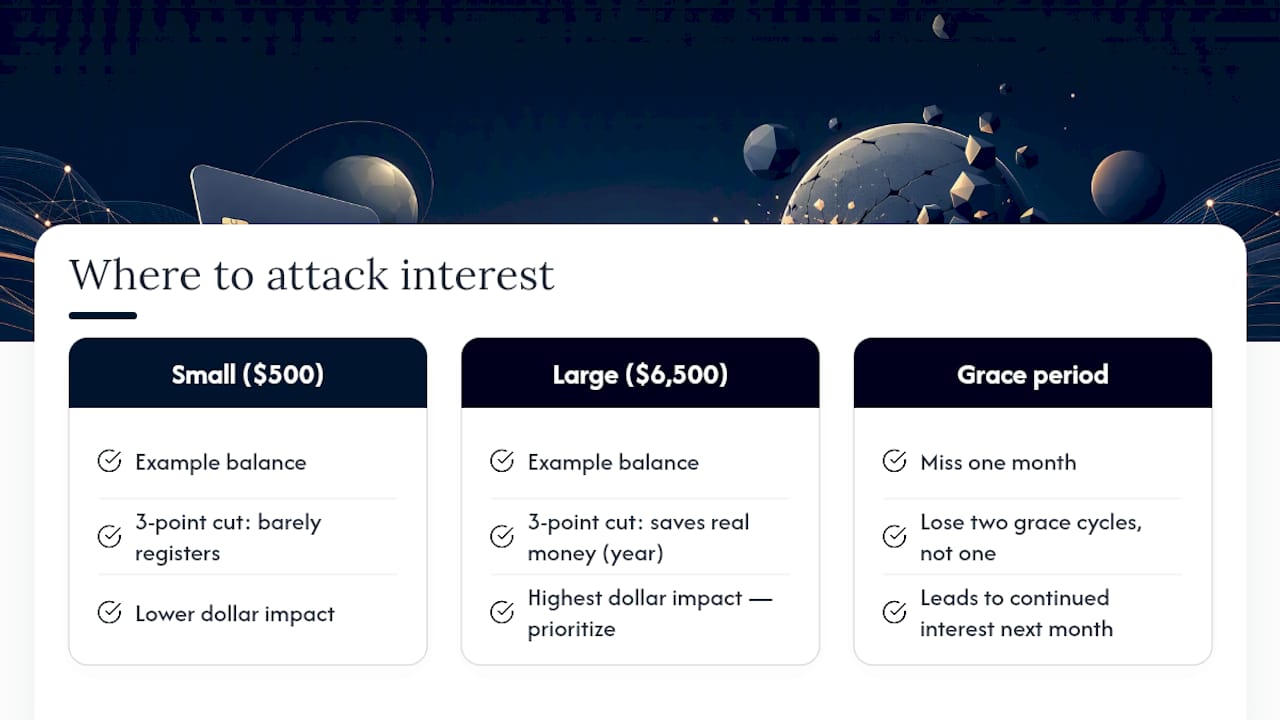
The other gap in conventional wisdom is the grace period reset rule. Almost nobody explains that a single missed month can cost you two cycles of grace period, not one. That detail alone explains why someone who "got back on track" still sees interest charges the following month.
If there's one priority to take from this: stop optimizing your lowest balance and start optimizing your highest-cost one. The rate matters less than the math behind it.
— Grace K.
This article is general information, not a substitute for advice from a qualified financial advisor. Consult a qualified financial professional about your own circumstances before acting on anything here.
Sources
- What is credit card daily periodic rate? | Experian
- How does my credit card company calculate the amount of interest I owe? | CFPB
- Tips for lowering your credit card interest rate | The New York Times
- How credit card interest works | Investopedia
- Can I negotiate a lower interest rate on my credit card? | Experian