Average daily balance is the sum of your account's end-of-day balances for a billing cycle, divided by the number of days in that cycle. It's the number most credit card issuers plug into their interest formula every month, and it's the reason two people who spend the same amount can pay different finance charges.
The fastest way to shrink that number is to pay earlier in the cycle, since every day your balance drops lowers the average for the rest of the period, according to the Consumer Financial Protection Bureau. You don't have to take an issuer's word for the math, either. A calculator or a card agreement can confirm exactly how your APR and daily balances turn into a dollar figure.
- Definition: ADB = (sum of daily balances) ÷ (days in billing cycle)
- Action: Pay early or make a mid-cycle payment to pull daily balances down before they get averaged
- Verify it: Your card agreement's "how we calculate interest" section spells out the exact method, and tools like Finja can model the effect of a payment before you make it
Key Takeaways
Average daily balance drives your interest charge, and paying earlier in the billing cycle is the single most reliable way to lower it.
| Point | Details |
|---|---|
| Formula basics | Add each day's balance, divide by billing-cycle days, then multiply by the daily periodic rate to get interest owed. |
| Timing beats amount | A payment made early in the cycle lowers the ADB for every remaining day, cutting interest more than the same payment made later. |
| Methods vary by issuer | Compounding, purchase-inclusion rules, and cycle length all change your ADB, so check your card agreement's finance charge section. |
| Grace periods matter | Paying your statement balance in full by the due date can avoid finance charges entirely, unless you carried a balance last cycle. |
| Verify with a calculator | Enter exact posting dates and APR into a tool to confirm your issuer's stated finance charge matches your own math. |
Where to Learn More
Read the CFPB's explanation of daily interest calculation, Investopedia's ADB breakdown, and Experian's guide to billing-cycle quirks. For background on how daily periodic rates get set, Rate Grove's guide to credit card interest covers the APR mechanics in plain terms. Then check your own card agreement against what you've read.
Table of Contents
- How to Calculate Average Daily Balance: The Formula
- Compounding, Purchase Timing, and Other Issuer Quirks
- How Average Daily Balance Turns Into a Finance Charge
- A Full Worked Example You Can Check Against Your Statement
- Where to Find Your Issuer's Actual Method
- Calculators and Tools That Track ADB for You
- What the Math Actually Tells You
- Sources
How to Calculate Average Daily Balance: The Formula
Getting from "balance on the statement" to "interest charge" takes three steps, and none of them require anything more advanced than long division.
- Record each day's ending balance. Every purchase, payment, or credit changes that day's balance, and it stays in effect until the next transaction posts.
- Add up every day's balance for the billing cycle. A 30-day cycle means 30 numbers get summed, even if the balance didn't change most days.
- Divide the total by the number of days in the cycle. That result is your average daily balance, per the calculation Investopedia walks through in detail.
The daily periodic rate comes from your APR. Divide the APR by 365 (some issuers use 360, so check your agreement), and you get the rate applied to each day's balance.
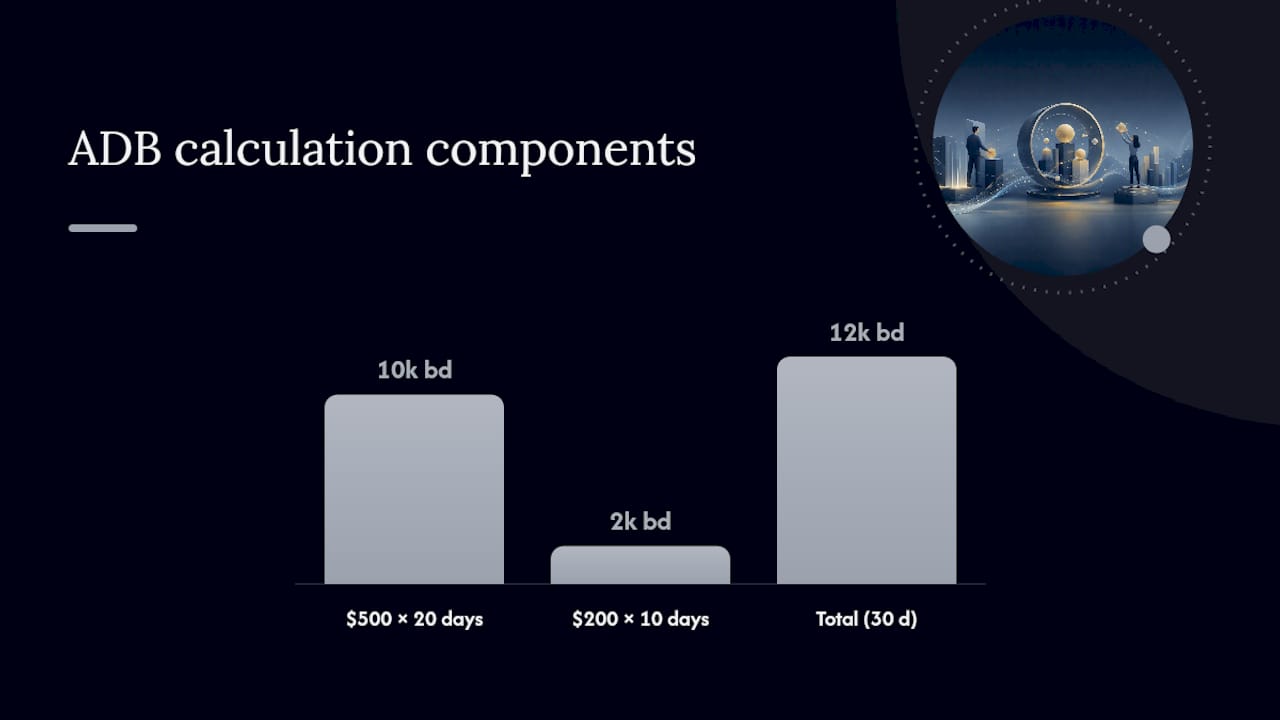
Quick example: Say your balance sits at $500 for 20 days, then drops to $200 for the remaining 10 days of a 30-day cycle. That's (500 × 20) + (200 × 10) = 12,000, divided by 30 days, for an ADB of $400.
Billing cycles aren't always the same length. Issuers commonly run cycles of 28 to 31 days, and some close the cycle on a business day rather than a calendar date, which shifts which transactions get counted, as Experian points out. That's why your ADB can swing month to month even when your spending habits don't change.
Compounding, Purchase Timing, and Other Issuer Quirks
"Average daily balance" isn't one universal formula. Issuers build in variations that change how much interest you actually owe, and the differences aren't always disclosed in plain language.
- Compounding versions add unpaid interest back into the daily balance before averaging, which raises the ADB and costs you more overtime.
- Non-compounding versions calculate interest only on principal balances, without folding prior interest into the mix.
- Purchase-inclusion rules vary too. Some issuers count new purchases in the current cycle's ADB immediately; others exclude them until the following cycle.
- Double-cycle billing, which once let issuers average balances across two cycles to calculate interest, was banned outright by the CARD Act of 2009, a protection Investopedia still cites as a baseline consumer safeguard.
The compounding question matters more than most cardholders realize. A compounding ADB method effectively charges interest on interest, which is why Investopedia's breakdown singles it out as the costlier variant.
Pro Tip: Call your issuer and ask directly: "Do you compound daily interest into the average daily balance, and do new purchases count in the current cycle?" The answer changes how aggressively you should time payments.
How Average Daily Balance Turns Into a Finance Charge
Once you have your ADB, the finance charge formula is straightforward: multiply your average daily balance by the daily periodic rate, then multiply that by the number of days in the billing cycle. Some issuers express it as ADB × (APR ÷ 365) × days in cycle, which lands on the same number.
Here's where payment timing becomes real money instead of a theoretical tip. Making a payment on day 5 of a 30-day cycle instead of day 25 means 20 extra days where your balance, and therefore your ADB, sits lower. Since issuers calculate interest daily based on that average, an earlier payment shrinks the number that gets multiplied by your rate.
- Paying $200 early in the cycle can significantly lower your ADB and reduce interest charges over the billing period
- The CFPB confirms that early payments are one of the few universally effective ways to cut interest, regardless of issuer
- Grace periods, typically 21 days or more after the statement closes, let you avoid finance charges entirely if you pay the full statement balance by the due date
That last point trips up a lot of cardholders. If you carried a balance last cycle, you may lose the grace period on new purchases until you pay the full balance for two consecutive cycles. Reading the card agreement's grace period clause before you assume you're interest-free is worth the five minutes.
A Full Worked Example You Can Check Against Your Statement
Here's a 30-day cycle with realistic activity, the kind your own statement probably resembles more than a textbook example does.
- Days 1 to 9: balance holds at $800 (starting balance)
- Day 10: a $300 purchase pushes the balance to $1,100 for days 10 to 19
- Day 20: a $500 payment drops the balance to $600 for days 20 to 30
| Period | Days | Daily Balance | Subtotal |
|---|---|---|---|
| Days 1–9 | 9 | $800 | $7,200 |
| Days 10–19 | 10 | $1,100 | $11,000 |
| Days 20–30 | 11 | $600 | $6,600 |
Add the subtotals: $7,200 + $11,000 + $6,600 = $24,800. Divide by 30 days, and the ADB comes out to $826.67.
With an APR, the daily periodic rate is the APR divided by 365. Multiply your ADB by this rate and the number of days in your billing cycle to find your finance charge.
Run the same inputs through a consumer calculator like NerdWallet's Average Daily Balance tool using your exact posting dates, and you should land within a few cents of your issuer's stated charge.
Where to Find Your Issuer's Actual Method
Don't assume your card works exactly like the example above. Somewhere in your card agreement is a section titled something close to "How We Calculate Your Balance" or "Finance Charges," and it names the method your issuer actually uses.
- Check your monthly statement for the cycle start and end dates, since those define the days in the ADB calculation
- Ask customer service directly: "Do you compound daily interest?" and "Are new purchases included in this cycle's average, or the next one?"
- Expect different rules for cash advances and promotional APR balances, which often get calculated separately from your standard purchase balance
Every issuer must disclose its method under the CARD Act's transparency requirements, so the information exists. Most cardholders just never go looking for it.
Calculators and Tools That Track ADB for You
A reliable ADB calculator needs three inputs: your exact posting dates, your APR, and a list of transactions with dates attached. Miss any of those and the output won't match your statement.
Tools built for calculation, like NerdWallet's ADB calculator, handle single-card math well, matching results closely when posting dates line up correctly. Where they fall short is juggling several cards at once and modeling what happens if you shift a payment earlier on one card versus another.
That's the gap a multi-card management app closes. Finja shows balances across every card in one view and models how an early payment on one account changes projected interest, so you're not running the math by hand for each card separately.

Pro Tip: Automation cuts down arithmetic mistakes, but always cross-check the estimate against your actual statement once it posts. Software is only as accurate as the posting dates you feed it.
What the Math Actually Tells You
Most advice about credit card interest treats "pay more" and "pay earlier" as interchangeable. They're not. A $500 payment on day 5 of your cycle does more to your average daily balance than a $500 payment on day 25, because the early payment lowers your balance for three extra weeks of averaging. Cardholders who fixate on the total amount they can afford to pay, rather than when they pay it, are leaving savings on the table every single cycle.
The bigger blind spot shows up for people juggling three or four cards. Calculators handle one account fine, but they don't tell you which card's payment timing saves the most money this month, and that's a genuinely different question than "how much interest does card A charge." The math rewards whoever pays earliest on whichever balance is largest, and that shifts month to month. A single-card mental model misses it every time.
Read your card agreement once. It's tedious, but it tells you whether your issuer compounds interest into the daily balance, which is the one variable that turns a manageable rate into a genuinely expensive one.
— Grace K.
This article is general information, not a substitute for advice from a qualified financial advisor. Consult a qualified financial professional about your own circumstances before acting on anything here.
Sources
- How does my credit card company calculate the amount of interest I owe? | Consumer Financial Protection Bureau
- Understanding the Average Daily Balance Method for Credit Card Interest | Investopedia
- How to calculate average daily balance | Experian
- Average Daily Balance Credit Card Calculator | NerdWallet