
If you can realistically pay off your balance before a card's promotional period ends, a balance transfer usually costs less. If you're carrying a larger balance or need one predictable payment for a set number of months, a personal loan usually wins. The trade-off comes down to a 0% intro APR with an upfront fee versus a fixed rate with a fixed schedule, and the CFPB warns that neither option helps if the spending habits that created the debt don't change too.
TL;DR:
- Balance transfer fees typically range from 3% to 5%, and missing a payment can trigger a higher post-promotional APR, erasing savings.
- Personal loans have fixed interest rates and predictable payments, but origination fees usually deduct from proceeds and slightly increase your total cost.
- Transfer limits might be lower than your total debt, leaving some balances unpaid, whereas loans can consolidate larger sums into a single fixed payment.
- A balance transfer can improve your credit utilization ratio quickly, but a personal loan can better diversify your credit mix and cause an immediate reduction in revolving debt.
- Carefully calculating and comparing total costs, including fees and interest over your actual payoff timeline, is crucial before choosing either consolidation method.
Table of Contents
- Balance Transfer vs Personal Loan: How Each One Actually Works
- What Does a Balance Transfer Really Cost You?
- What Does a Personal Loan Really Cost You?
- How Do These Options Affect Your Credit Score?
- When a Balance Transfer Makes More Sense
- When a Personal Loan Makes More Sense
- A Step-By-Step Checklist to Decide
- Applying and Following Through Without Losing Ground
- How Finja Fits Into This Decision
- What Happens to Your Utilization Ratio Long-Term?
- Does Either Option Affect Your Financial Flexibility?
- What Are the Penalties for Early Payoff or Missed Payments?
- Who Qualifies, and How Do You Improve Your Odds?
- Are There Tax Implications to Consider?
- Balance Transfer vs Personal Loan: Compare Costs, Choose the Simpler Payoff
- Model Your Payoff Before You Commit to Either One
- Where to Verify Rates and Rules Yourself
- Sources
Balance Transfer vs Personal Loan: How Each One Actually Works
A balance transfer moves debt from one or more credit cards onto a new card, usually one offering a 0% or low introductory APR for a set window, often 12 to 21 months. You apply, get approved for a credit limit, and the new issuer pays off your old balances directly. The catch is that your transfer amount is capped by your approved credit limit, so if you owe a large balance but get approved for a lower limit, you're stuck carrying the rest elsewhere.
A personal loan works differently. You borrow a fixed lump sum from a bank, credit union, or online lender, then repay it in equal monthly installments over a fixed term, which can vary by lender. The interest rate is locked in at approval; it doesn't jump midway through unless you have a variable-rate loan, which is less common for debt consolidation.
Here's where the two diverge on how money actually flows:
- Balance transfer: New card pays off old cards directly (or you request the transfer); you now owe the new card issuer at the promo rate.
- Personal loan: Lender deposits funds into your bank account (or pays creditors directly, depending on the lender); you manually pay off your cards, then repay the lender on a fixed schedule.
- Payment allocation: Credit card issuers apply your payment first to the balance with the highest interest rate above the minimum required, per federal card regulations. Loans apply payments per a standard amortization schedule, split between principal and interest from day one.
- Hidden costs: Balance transfer fees (typically 3% to 5% of the transferred amount) get added to your new balance immediately. Loan origination fees (often 1% to 8%) get deducted from your loan proceeds before you ever see the cash, or rolled into the loan balance.
Both products solve the same underlying problem, consolidating multiple payments into one, but the mechanics of how you get there, and what you owe if you slip, are not interchangeable.
What Does a Balance Transfer Really Cost You?
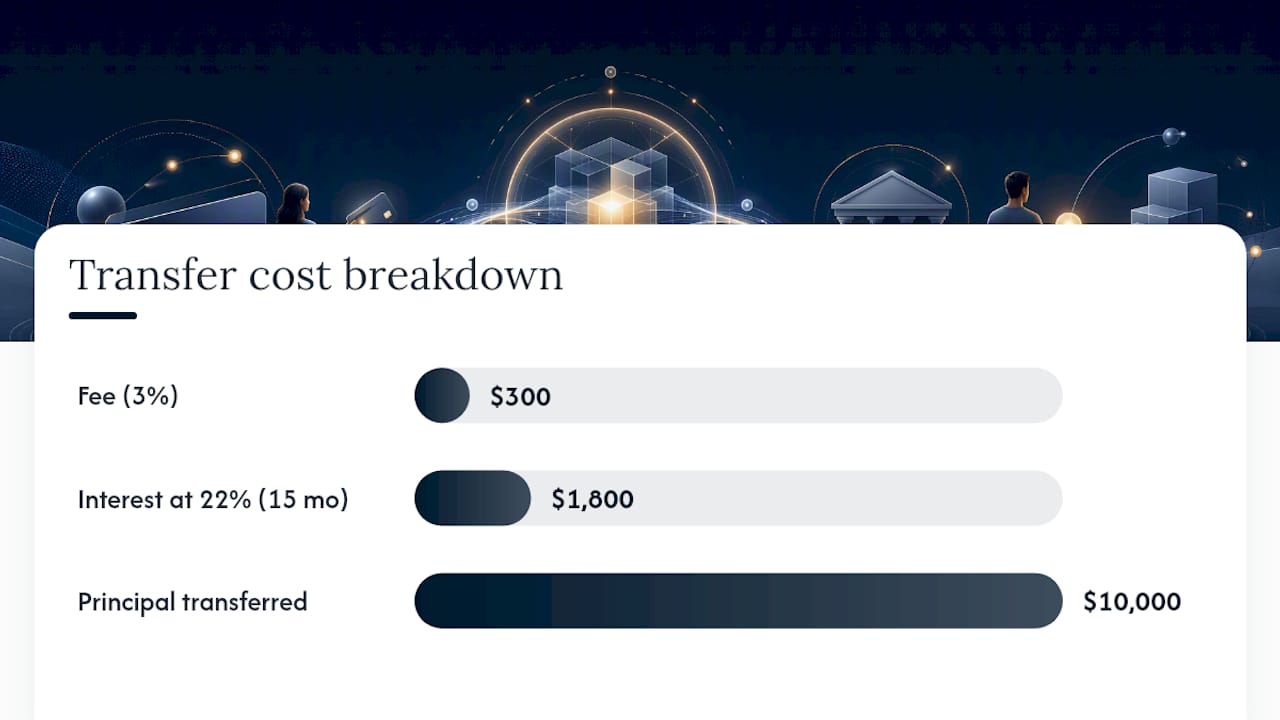
The intro APR is the headline, but it's not the whole story. Most balance transfer cards charge a one-time fee of a few percent of the amount transferred, and that fee gets added to your new balance immediately. Miss a payment during the promo period, and many issuers reserve the right to end the 0% rate immediately, kicking you to the card's standard APR, which can be significantly higher.
Here's how to size up a transfer offer in three steps:
- Calculate the fee. Transferring $10,000 at a 3% fee adds $300 to your new balance right away, so you're really financing $10,300.
- Divide by the promo months. If your card offers a promotional period at 0% APR, you need to pay enough monthly to clear your balance before the rate resets.
- Estimate the fallback cost. If you can't finish in time and the remaining balance rolls over at a post-intro rate near 24%, even a few months of that can erase your fee savings fast.
Quick math: On that $10,000 transfer with a 3% fee, paying it off in exactly 15 months costs you $300 total in fees and $0 in interest, assuming you never miss a payment. Compare that to leaving the same balance on a card at 22% APR, where interest alone could exceed $1,800 over the same period. That gap is the entire argument for transferring in the first place.
What Does a Personal Loan Really Cost You?
Personal loan APRs vary widely by credit profile, with better rates for borrowers with strong credit and higher rates for those with lower credit scores. The Federal Reserve's consumer credit data tracks how these rates shift with broader interest-rate trends, which matters because loan pricing moves with the market far more visibly than most card offers do.
Origination fees, charged by many online lenders and some banks, usually amount to a few percent of the loan amount and are typically deducted from your proceeds upfront. A $10,000 loan with a 5% origination fee means you actually receive $9,500, but you still owe interest on the full $10,000.
Run the numbers on a personal loan example using your own balance, APR, and term to estimate monthly payment, total interest paid, and total cost including any origination fees.
Quick math: That's a fixed, predictable cost you know on day one, no matter what happens to your credit or the market. A tool like Loanofficer lets you plug in your own balance, rate, and term to see the exact monthly payment and total interest before you apply.
How Do These Options Affect Your Credit Score?
Both moves touch your credit report, but in different places. A balance transfer opens a new revolving account, which can lower your average account age and trigger a hard inquiry, typically a small, temporary dip of a few points. The upside comes fast, though: once the transfer clears your old cards, your overall credit utilization often drops sharply, since you're spreading debt across a higher combined limit (assuming you don't close the old cards).
A personal loan changes your credit mix by adding an installment account. Since installment loans don't count toward revolving utilization the way credit cards do, moving $10,000 off your cards and into a loan can drop your utilization ratio to near zero, often the single biggest lever for a fast score improvement. It also diversifies your credit mix, which scoring models like FICO weigh as a minor positive.
A few practical moves matter more than people realize:
- Keep old credit card accounts open after a transfer or payoff, even at zero balance, since closing them shrinks your total available credit and can push utilization back up.
- Avoid applying for multiple cards or loans in a short window, since each hard inquiry can shave a few points off your score temporarily, and several at once compounds that effect.
- Don't run up new charges on the cards you just paid off; that's the single fastest way to undo the benefit of consolidating in the first place.
- If you're deciding between a transfer and a loan, note that a loan resolves revolving utilization immediately, while a transfer only helps once your new limit comfortably exceeds your transferred balance.
Pro Tip: Re-run a credit score simulator about 30 to 45 days after your transfer posts or your loan disburses. That's roughly when new balances, closed transactions, and inquiry effects have fully reported, giving you a realistic read instead of a snapshot mid-transition.
When a Balance Transfer Makes More Sense
Balance transfers tend to favor borrowers with good to excellent credit, a manageable debt load, and confidence they can pay off balances within the promotional period. If you owe a moderate balance and can commit a monthly payment to finish before the promotional period ends, a balance transfer often costs only the transfer fee without interest.
Watch for these red flags before you apply:
- A transfer fee above 5%, which starts eating into your projected savings fast.
- An approved credit limit that's lower than the balance you're trying to move, leaving a chunk of debt behind on the old card.
- A history of running balances back up on paid-off cards, since that pattern tends to repeat itself.
Before signing up, ask the issuer these questions:
- How long does the 0% or promotional APR actually last, in exact months?
- Is there a cap on how much I can transfer, and does it depend on my approved limit?
- What happens to the promo rate if I miss a single payment?
When a Personal Loan Makes More Sense
Loans generally fit better when your balance is larger, your timeline is longer than a typical promo window, or you simply want the certainty of one fixed payment you can budget around for years, not months. Someone consolidating $20,000 across five cards, for example, is unlikely to find a transfer offer with a limit high enough to cover it, but a loan can wrap the whole amount into a single term.
A few warning signs suggest a loan isn't the deal it looks like:
- An APR that's barely better, or worse, than your current card rates, which erases the point of consolidating.
- Very high origination fees can reduce or eliminate interest savings, especially on smaller loans.
- A term so long that total interest paid balloons even though the monthly payment looks comfortable.
To compare loan offers quickly:
- Line up the APR, not just the monthly payment, since a lower payment over a longer term often costs more overall.
- Add the origination fee to the total cost, not just the loan amount.
- Multiply the monthly payment by the number of months to see the true total repayment figure.
A Step-By-Step Checklist to Decide
Run through this before you apply for anything:
- List every card balance, APR, and minimum payment so you know your real starting number.
- Estimate total cost under both scenarios using your actual balance, a realistic transfer fee, and a loan quote if you have one.
- Prequalify where you can. Many card issuers and online lenders offer soft-pull prequalification, so you see likely rates without a hard inquiry hitting your report.
- Set a payoff target date and calculate the monthly amount needed to hit it, whether that's the end of a promo period or a loan's final installment.
- Lock in autopay immediately after approval so a missed payment never becomes the reason you lose a promo rate.
- Stop if the math doesn't work. If neither option gets your monthly payment below what you're comfortable committing to for the full term, or if a loan's APR barely beats your current cards, that's a sign to look at budget changes before consolidating.
Pro Tip: If you're on the fence between two offers, calculate the total dollar cost of each, fees included, over the exact number of months you plan to take. The lowest monthly payment isn't always the cheapest option once fees and full term length are factored in.
Applying and Following Through Without Losing Ground
For a balance transfer, apply, get your approved limit, and initiate the transfer immediately, since processing can take one to two weeks and your old card still accrues interest until the balance clears. Keep making minimum payments on the old card until you see the transfer post.
For a personal loan, once funds land in your account, pay off each card balance in full right away, rather than letting cash sit, and confirm each account shows a $0 balance before considering the job done.
From there, pick a repayment method and stick to it. The avalanche method (highest APR first) saves the most money mathematically; the snowball method (smallest balance first) tends to keep people motivated longer. Either beats no method.
- Set up autopay for at least the minimum on every account.
- Revisit your rate every six to twelve months. If your credit score has climbed, refinancing a loan or transferring again might beat your current terms.
- Track your consolidated payment plan the same way you'd track a budget line item, not an afterthought.
How Finja Fits Into This Decision
This platform helps you model both scenarios side by side, comparing projected interest costs and payoff dates before you commit to either path, then schedules optimized payments across your cards once you decide. For deeper planning, Finja's guides on reducing financial stress from credit card debt and avoiding compound interest go further. The tool doesn't issue loans or cards; it's a planning resource that works alongside whichever option you pick.
What Happens to Your Utilization Ratio Long-Term?
Your credit utilization ratio, the percentage of available revolving credit you're using, typically counts for close to a third of your FICO score, making it one of the fastest levers you can pull. A personal loan tends to help here more directly, since installment debt isn't factored into revolving utilization at all. Moving your credit card balances onto a personal loan can significantly reduce your credit utilization ratio overnight, assuming your old cards remain open with limits intact.
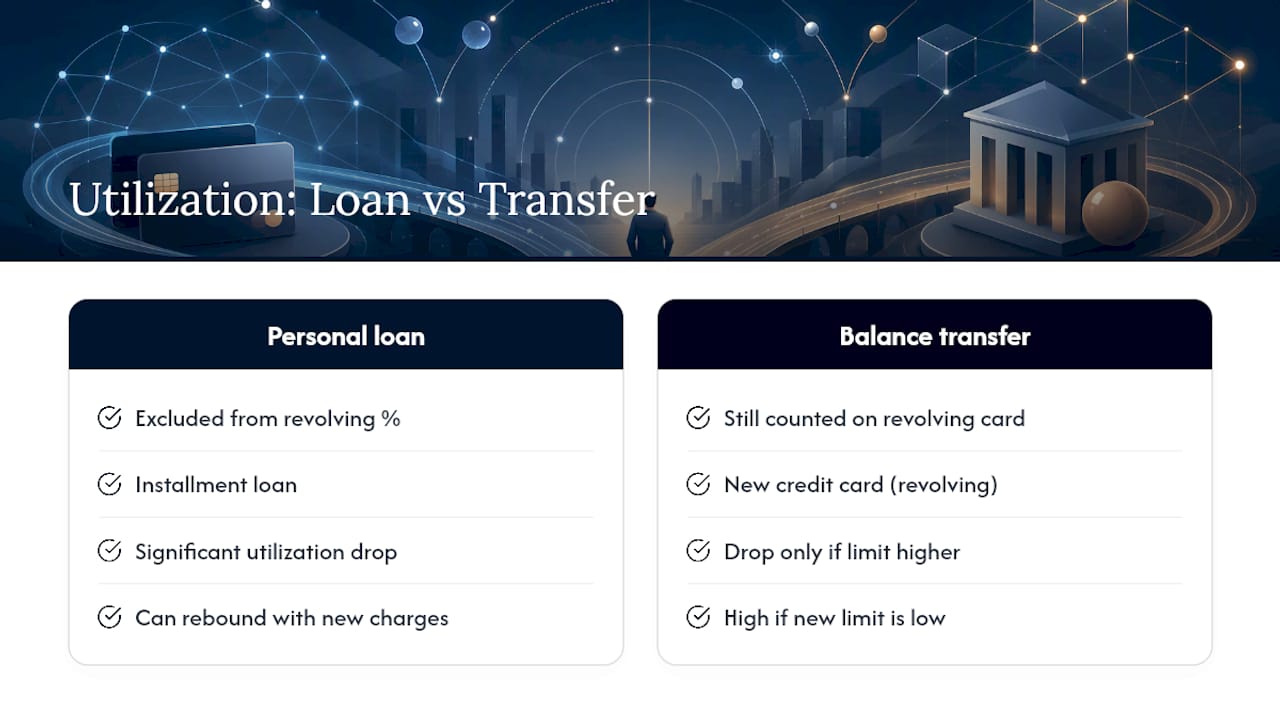
A balance transfer's effect is more conditional. If your new card's limit is only slightly higher than your transferred balance, your utilization on that single card can stay elevated, even though your total number of accounts hasn't changed.
The longer-term credit health picture depends on what you do after the balance moves. Utilization is a snapshot, recalculated each billing cycle, so a strong ratio one month doesn't lock in permanently if you run new charges back up. Lenders and scoring models also look at your payment history over time, so consistent on-time payments after consolidating tend to matter more, over a year or two, than the initial utilization drop itself. Consolidation is a reset button, not a finish line.
Does Either Option Affect Your Financial Flexibility?
A balance transfer generally preserves more flexibility in the short term, since you're not taking on a new fixed monthly obligation, just shifting an existing one to better terms. That matters if your income varies month to month, because most cards still let you pay above the minimum without penalty, giving you room to slow down in a lean month.
A personal loan trades some of that flexibility for predictability. Your payment is fixed for the full term, which is useful for budgeting but less forgiving if your income drops unexpectedly. Some lenders offer hardship deferrals, but that's not guaranteed and varies by lender.
Either option can strain your emergency fund if you're not careful. Using savings to pay down a transfer faster, or covering a loan's origination fee out of pocket, can leave you without a cushion right when you need one. A reasonable approach is to keep at least one to two months of expenses in savings untouched, even while aggressively paying down consolidated debt, since running your emergency fund to zero just to hit a payoff date faster often backfires the moment an unexpected expense hits.
What Are the Penalties for Early Payoff or Missed Payments?
Neither balance transfer cards nor most personal loans charge a prepayment penalty, so paying off either one early, if you can, generally saves you money without a hidden cost. That's worth confirming on any loan offer specifically, since a small number of lenders still include prepayment clauses buried in the fine print.
Missed payments carry real teeth on both sides, though the mechanics differ. Late fees typically follow too, often in the $30 to $40 range per occurrence.
On a personal loan, a missed payment usually triggers a late fee and gets reported to credit bureaus once it's 30 days past due, which can meaningfully dent your score. Some lenders also apply a default interest rate or accelerate the remaining balance in cases of repeated missed payments, though that's more common with severe, ongoing delinquency than a single slip.
The safest move for both products is the same: automate your minimum payment so a missed payment never happens by accident, then manually add extra toward principal whenever you have room.
Who Qualifies, and How Do You Improve Your Odds?
Approval also depends on your income and existing debt load relative to that income.
Personal loans typically have a wider eligibility range, with some lenders working with fair credit at higher APRs and others focusing on prime borrowers. Lenders typically weigh your debt-to-income ratio as heavily as your credit score, sometimes more so, since it reflects your actual capacity to make a new fixed payment.
To improve approval odds for either option: pay down existing balances before applying, since that lowers your utilization and debt-to-income simultaneously; avoid opening other new credit in the months before you apply; and check your credit report for errors, since inaccuracies are more common than most people expect. Before finalizing any loan, verify the lender is properly licensed through NMLS Consumer Access, which lets you check registration status and any disciplinary history.
Are There Tax Implications to Consider?
For most consumers, neither a balance transfer nor a personal loan used to pay off credit card debt creates a taxable event. You're not receiving income, you're restructuring existing debt, so the IRS generally doesn't treat the transferred amount or loan proceeds as taxable.
Interest paid on both products is typically not tax-deductible either, unlike mortgage interest or certain student loan interest. The exception that trips people up: if a lender or card issuer ever forgives or settles a portion of your debt for less than you owe, that forgiven amount can count as taxable income, reported to you and the IRS on a 1099-C. That scenario applies to debt settlement, not to a standard transfer or loan payoff, but it's worth knowing the line between the two. If you're unsure how a specific settlement or forgiveness might affect your taxes, a tax professional familiar with cancellation-of-debt rules is the right resource, not a general guide like this one.
Balance Transfer vs Personal Loan: Compare Costs, Choose the Simpler Payoff
The math in this comparison keeps landing on the same point: fees and rates matter less in isolation than they do against your actual timeline. Extend that same balance past the promo period, even by a few months, and the loan often wins outright.
Where conventional advice falls short is treating this as a pure interest-rate comparison. It isn't. It's a bet on your own follow-through. A Debt makes a similar point: transfers reward borrowers who can finish fast, while loans suit those who need structure more than speed. The CFPB's warning about consolidating without fixing the root spending habit is the part most comparison articles bury, and it shouldn't be. A cheaper interest rate on either product doesn't fix a spending pattern that reopens the same hole six months later.
If you take one thing from this: run the actual numbers with your real balance and real offers before deciding, not the industry-average examples every article, including this one, uses to illustrate the math.
— Grace K.
Model Your Payoff Before You Commit to Either One
Running the math by hand on multiple cards, transfer fees, and loan quotes gets tedious fast, and small errors there cost real money. This type of app gives you a consolidated view of every card balance, rate, and due date in one place, then models what a transfer or loan would actually save you before you apply for anything.
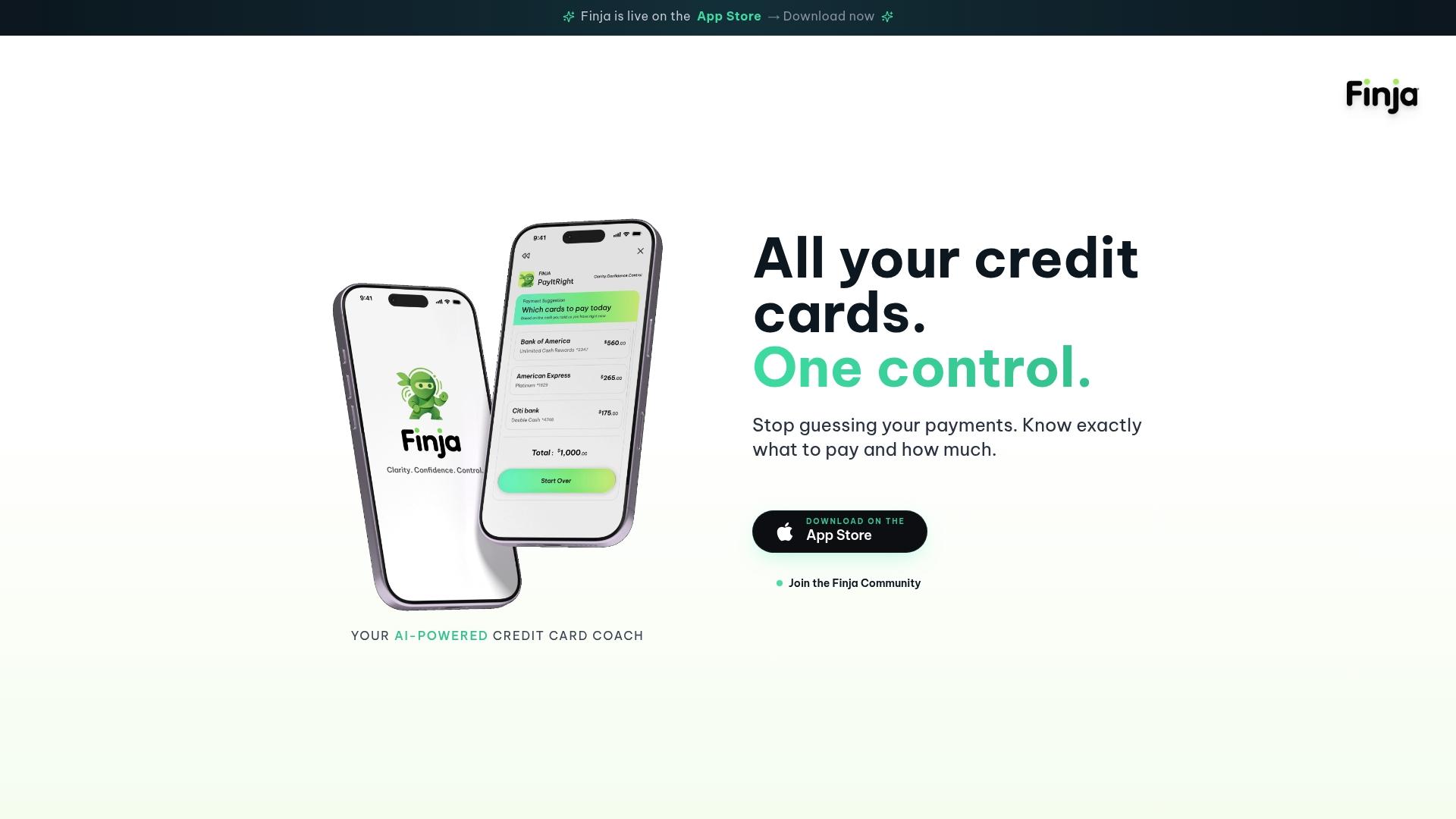
That's the specific gap this service fills: not another card or loan, but the modeling layer that tells you which option actually pays off faster for your numbers. It's built for people juggling several cards who want ongoing payment optimization, not just a one-time consolidation move. If you're managing multiple balances and want a clearer read on where your money should go each month, try Finja and run your own scenario before you apply for a transfer or a loan.
Where to Verify Rates and Rules Yourself
The CFPB's consolidation guidance covers what to check before combining debt. The Federal Reserve's G.19 release tracks current consumer credit trends. The FDIC offers general guidance on comparing lender terms, and LoanOfficer.ai's calculator lets you run your own payoff numbers directly.
This article is general information, not a substitute for advice from a qualified financial advisor. Consult a qualified financial professional about your own circumstances before acting on anything here.
Sources
- CFPB: What do I need to know if I'm thinking about consolidating my credit card debt?
- Federal Reserve: Consumer Credit (G.19)
- FDIC
- Loanofficer