
The difference between those two products is one of the most expensive misunderstandings in consumer credit.
Here are the four things to do right now:
- Check your promo end date on your current statement or in your online account — it's usually listed under "Promotional Balance" or "Special Financing."
- Confirm your remaining promotional balance — this is the exact dollar amount that will start accruing interest if unpaid.
- Schedule a payment large enough to clear that balance before the end date, or set up a payment plan that gets you there.
- Call your issuer if you can't pay in full — ask about rate reductions, payment allocation options, or whether a hardship program applies.
The daily periodic rate (your APR divided by 365) starts compounding the moment the promo window closes. Every day you wait after that date costs real money.
Key Takeaways
When an interest-free promotional period ends, your card's standard APR applies to any unpaid balance immediately — and deferred-interest offers can charge retroactive interest all the way back to the original purchase date if you haven't paid in full.
| Point | Details |
|---|---|
| Standard APR applies at end | Your card's regular rate kicks in on unpaid balances the moment the promo closes. |
| Deferred interest is different | "No interest if paid in full" means retroactive interest hits if any balance remains at the deadline. |
| Late payments can void promos early | Missing a minimum payment by 60+ days on a deferred plan can trigger full retroactive interest before the end date. |
| Balance transfers often win on larger balances | A 3% transfer fee on $2,000 costs $60 upfront versus roughly $480 in annual interest at 24% APR. |
| Finja tracks and optimizes your payoff | Finja flags expiring promos, simulates transfer tradeoffs, and recommends payment order to cut total interest. |
Table of Contents
- Why does the interest-free period end, and what changes when it does?
- Deferred interest vs. true 0% APR: which one do you have?
- What can void your promotional rate before the end date?
- What are your options when the promo ends?
- A step-by-step checklist for the last 60 days before your promo ends
- How much does carrying a leftover balance actually cost?
- Should you keep or close the card after the promo ends?
- What most people get wrong when a promo ends
- How Finja helps you stay ahead of expiring promos
- Sources
Why does the interest-free period end, and what changes when it does?
The promotional rate on your card was always temporary. Chase's issuer guidance states plainly that the promotional rate switches to the card's standard rate at the scheduled end date — and that planning payments before that date is the only reliable way to avoid the switch costing you money.
What "standard APR" actually means for your balance: The annual percentage rate (APR) is the yearly cost of carrying a balance, expressed as a percentage. Your daily periodic rate is that APR divided by 365. That rate applies to your average daily balance each billing cycle, and the resulting interest is added to what you owe — which then earns interest itself. That compounding is why a balance that feels manageable in month one can feel much heavier by month six.
NerdWallet's analysis confirms that after a true 0% intro APR ends, the card's ongoing APR applies to any remaining balance and typically to new purchases going forward. The grace period — the window between your statement closing date and your payment due date during which no interest accrues on new purchases — usually only applies when you carry no balance. Once you're carrying a promotional balance that converts to standard interest, the grace period on new purchases can disappear too, meaning new charges start accruing interest immediately.
Which balances are affected depends on your specific offer. Intro purchase APRs cover purchases made during the promo window. Balance-transfer promos cover transferred balances. Cash advances almost never qualify for promotional rates and typically carry a separate, higher APR from day one. Some offers cover only one category — so a balance-transfer promo may not protect new purchases you make during the same period. Issuer terms vary: always verify which transaction types fall under your promotional bucket.
Pro Tip: Your statement's "Account Summary" or "Promotional Balance" section lists the promo end date and the exact promotional balance. On most major issuers, you can also find this in the app under "Manage Account" or "Balance Details." Screenshot it — that date is your deadline.
Statistic to know: Credit card APRs have climbed significantly in recent years. Tracking what your specific post-promo rate will be — not just the national average — is the only number that matters for your payoff math. You can find your card's go-to rate in the Schumer Box on your original card agreement or in the current terms on your issuer's website.
Deferred interest vs. true 0% APR: which one do you have?
This distinction can cost you hundreds of dollars, and most cardholders don't catch it until the bill arrives.
When the promo ends, interest begins only on whatever balance remains at that point. If you had $2,000 and paid it down to $300 before the end date, only the $300 starts accruing interest.
A deferred-interest offer — common with retail store cards and "no interest if paid in full" financing — works very differently. Interest accrues behind the scenes the entire time. If you haven't paid the full original balance by the deadline, the issuer charges you all of that accumulated interest retroactively, back to the original purchase date.
The CFPB warns explicitly that deferred-interest offers use the word "if" — as in "no interest if paid in full within 12 months" — and that consumers must read the contract carefully because retroactive interest can be a significant surprise.
| Feature | True 0% Intro APR | Deferred-Interest Offer |
|---|---|---|
| Interest during promo | None | Accrues silently |
| If balance remains at end | Interest starts on remaining amount only | Retroactive interest charged from purchase date |
| Late payment impact | May void promo, standard APR applies going forward | Can trigger full retroactive interest immediately |
| Common source | Bank-issued credit cards | Retail store cards, "same as cash" financing |
| Key contract language | "0% APR for X months" | "No interest if paid in full" |
Worked example — deferred interest: You finance a $1,500 appliance at a retail store with "no interest if paid in full in 18 months." You make minimum payments and have $200 left when the deadline hits. That retroactive interest bill could easily exceed $600 — on a balance you thought you'd nearly cleared.
The CFPB's consumer guidance also notes that being more than 60 days late on a minimum payment before a deferred-interest period ends can void the promotional benefit entirely and trigger that same retroactive interest charge — even if you had every intention of paying the balance before the deadline.
What can void your promotional rate before the end date?
Promos don't always run their full course. Several account events can terminate yours early, and the triggers are buried in the fine print most people skip.
- Late or missed minimum payments: Most issuers define "late" as 30 days past due for standard promos. For deferred-interest plans, the CFPB notes that significant late payments can void the benefit entirely and trigger retroactive interest.
- Returned payments: A payment that bounces — whether from insufficient funds or a closed account — is treated similarly to a missed payment and can trigger penalty terms.
- Exceeding your credit limit: Going over your credit limit during the promo period can violate the offer's terms, particularly on older card agreements.
- Penalty APR activation: If a late payment triggers your card's penalty APR (often 29.99% or higher), that rate can replace both your standard and promotional rates. Penalty APRs can apply to existing balances in some cases, though the CARD Act of 2009 limits when issuers can apply them retroactively to existing balances.
- Performing transactions outside the promo's scope: Making a cash advance on a card where only purchases qualify for the promo doesn't void the promo, but the cash advance itself accrues interest immediately at a separate, higher rate — and minimum payments may be applied to the lower-rate balance first, leaving the cash advance to compound.
- Issuer-specific triggers: Some promos include terms like "must remain in good standing" or "no returned payments during the promotional period." Read the offer's terms document, not just the marketing summary.
Watch your statements in the 60 days before your promo ends. Any notice labeled "Important Changes to Your Account," "Rate Change Notice," or "Default Rate Applied" is a red flag that your promo may already be at risk.
What are your options when the promo ends?
You have more choices than most cardholders realize — and each one has a real cost attached to it.
Pay off the balance in full. The cleanest option. If you can pull from savings, you avoid all post-promo interest. The math is simple: any savings account earning less than your card's post-promo APR is costing you money by sitting there while the balance accrues interest.

Accelerate payments during the promo. If you have weeks left, divide the remaining balance by the number of days until the end date and pay that amount daily or weekly. Even partial paydown reduces the balance that starts accruing interest.
Transfer the balance to a new 0% offer. CNBC Select's analysis shows that balance-transfer fees versus ongoing APR costs need to be compared for each balance size and timeline. Carrying that same $2,000 at a high APR for a year costs several hundred dollars in interest — so the transfer wins, but only if you actually pay off the new card before its promo ends too.
Request a rate reduction or payment allocation change. Issuers won't advertise this, but calling to ask whether extra payments can be applied specifically to the promotional balance — or whether a temporary rate reduction is available — is worth 15 minutes of your time. It's not guaranteed, but it costs nothing to ask.
Keep the card open but stop new purchases. If none of the above is feasible, at minimum stop using the card for new spending once the promo ends. New purchases on a card carrying a balance typically lose their grace period and accrue interest immediately.
If your score is strong and the interest savings are significant, it may be worth it — but factor in the application timing (approvals aren't instant) and the balance-transfer fee before committing.
A step-by-step checklist for the last 60 days before your promo ends
Work through this in the final two billing cycles. Skipping steps two and three is where most people lose money.
- Confirm the exact promo end date. Log into your account or check your paper statement. The date on the marketing email and the date in your actual account terms can differ — use the account terms.
- Find your remaining promotional balance. This is listed separately from your total balance on most statements. Write it down.
- Calculate the monthly payment needed to clear it. Divide the promotional balance by the number of billing cycles remaining. If you have two cycles left and owe $1,200, you need $600 per cycle minimum.
- Schedule those payments now. Don't rely on remembering. Set up scheduled payments in your issuer's app or website for the specific amounts and dates.
- Set up autopay for at least the minimum payment. This protects your promo from a late-payment void even if your larger payment fails for any reason. Use due-date management to align payment dates with your paycheck schedule.
- Prepare your phone script before calling the issuer. Have your account number, the promo end date, and the promotional balance ready. Ask specifically: "Can you apply my extra payment to the promotional balance first?" and "Is a temporary rate reduction available after the promo ends?"
- Double-check your statement after the promo end date. Confirm that interest posted correctly — at the standard rate, not a penalty rate — and that your payments were applied as requested.
Quick timing note: Interest typically posts at the end of the billing cycle in which the promo expires, not on the exact calendar end date. If your promo ends March 15 and your billing cycle closes March 28, interest for the period March 15–28 will appear on that statement.
How much does carrying a leftover balance actually cost?
The numbers make the urgency concrete. NerdWallet's guidance on post-promo APR assumptions informed these calculations.
For the $500 balance, the math still favors a transfer — but barely, and only if you clear the new card within its promo window. For $8,000, the savings are substantial enough that a transfer is almost always the right call if you qualify. See high-interest cost scenarios for additional real-dollar breakdowns.
The compounding effect matters too. Interest on a credit card isn't calculated once a year — it compounds daily. Over a full year, the actual cost is closer to $537 when compounded daily. Understanding how to avoid compound interest traps is one of the fastest ways to cut your real cost of carrying a balance.

Pro Tip: If you have multiple cards with expiring promos, list them by end date and remaining balance. Pay the one with the nearest end date first, regardless of balance size. A $300 balance expiring next month costs more in urgency than a $1,500 balance expiring in four months.
Should you keep or close the card after the promo ends?
The answer depends on three things: whether the card charges an annual fee, what it does to your credit utilization, and whether you'll actually use it responsibly going forward.
Reasons to keep it open:
- A longer credit history generally helps your credit score. Closing an older account shortens your average account age.
- Available credit on an open card lowers your overall credit utilization ratio — assuming you've paid the balance elsewhere. Lower utilization typically supports a stronger score.
- No annual fee means keeping it open costs nothing.
Reasons to close it:
- An annual fee you can't justify with rewards or use makes the card a net cost.
- A high ongoing APR combined with a tendency to carry a balance is a financial risk, not just an inconvenience.
- Simplifying your accounts is a legitimate reason, especially if managing multiple cards is causing you to miss payments.
Three quick questions to guide your decision:
- Does the card charge an annual fee? If yes and you won't use it enough to offset the fee, closing is worth considering.
- Is this your oldest card or one of your oldest? If yes, keeping it open (even unused) protects your credit history length.
- Will you be tempted to carry a balance at the post-promo APR? If yes, keeping the card active is a risk — consider keeping it open but cutting up the physical card.
Closing a card reduces your total available credit, which can raise your utilization ratio if you carry balances on other cards. A debt-free credit card strategy can help you map out the right sequence for paying down and eventually closing cards without hurting your score.
What most people get wrong when a promo ends
The mistake I see repeated most often isn't missing the end date — it's misreading the offer type in the first place. They pay down $900 of a $1,200 balance and feel fine about the remaining $300.
The lesson isn't just "read the fine print." It's that the phrase "no interest if paid in full" is doing a lot of work in that sentence, and the if is the operative word. The CFPB has flagged this exact language pattern as a consistent source of consumer confusion. That one check can save you hundreds.
How Finja helps you stay ahead of expiring promos
Keeping track of multiple promo end dates, remaining promotional balances, and optimal payment sequences is exactly the kind of problem that gets expensive when managed manually. Finja's AI-powered credit card management platform consolidates all your card balances in one view, flags upcoming promo expirations before they hit, and calculates the payment order that minimizes your total interest across every card you hold.
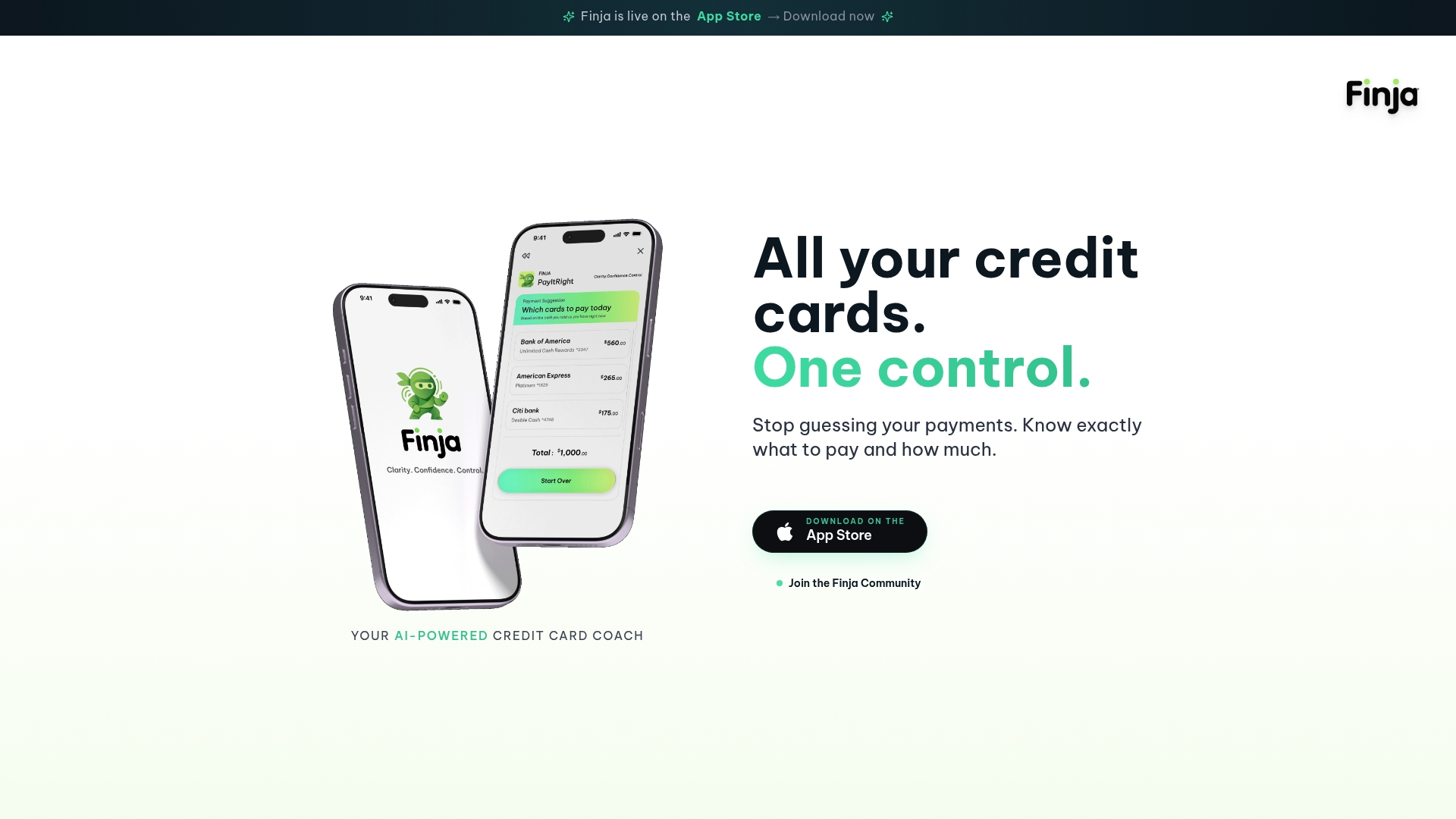
Where Finja earns its keep is in the tradeoff math: it simulates whether a balance transfer makes sense for your specific balance, fee, and timeline — so you're not guessing. Payment-priority recommendations tell you exactly which card to pay first and how much, updated as your balances change. For cardholders managing two or more cards with overlapping promos, that kind of precision is the difference between paying $60 in transfer fees and paying $480 in interest.
If you're heading into the post-promo window on any card right now, start with Finja to map your payoff schedule and see exactly what the next 12 months cost under each scenario.
Sources
The sources below are the most reliable places to understand promotional financing mechanics and to verify your own card's terms.
- How to understand special promotional financing offers on credit cards | Consumer Financial Protection Bureau
- What Happens When Your Credit Card's 0% Intro APR Ends? - NerdWallet
- What Happens When Your Intro APR Period Ends? | Chase
- What Happens When My 0% APR Period Ends? - CNBC Select
Where to find your promo end date on your statement: Look for a section labeled "Promotional Balance," "Special Financing," or "Deferred Interest Balance" in the account summary portion of your statement. The end date appears next to the promotional balance amount. In your issuer's app, check "Manage Account," "Balance Details," or "Promotions." If you can't locate it, call the number on the back of your card and ask the representative to read you the promotional end date and remaining promotional balance — both are in your account record.
This article provides general financial information for educational purposes. It is not a substitute for advice from a qualified financial professional. Confirm your specific card terms with your issuer before making payment decisions.