
The math almost always favors people who use the promo period to attack principal, not just dodge interest for a while.
Three things ground that verdict. The Philadelphia Fed found that roughly a quarter of card debt in its sample carried some kind of introductory promotional offer, with an average promo length around nine months and post-promo rates jumping sharply once the window closes. The CFPB draws a hard line between true 0% APR and "deferred interest" offers, a distinction that changes what you owe if you slip.
- It helps most if you're consolidating high-interest debt with a firm monthly payoff number in mind.
- It helps least if you're relying on it to finance ongoing spending you'd otherwise avoid.
- The main risk to watch: deferred-interest terms that apply interest retroactively to the full original balance if you don't pay it off completely by the deadline.
If you're carrying balances on one or more cards right now, keep reading. A rewards card is likely the better fit in that case, since the value of 0% APR comes almost entirely from not paying interest on money you'd otherwise be financing.
Key Takeaways
| Point | Details |
|---|---|
| Confirm true 0% vs deferred interest | Look for "if paid in full" language, which signals retroactive interest risk if you don't finish on time. |
| Calculate the real required payment | Required monthly payment equals (balance plus fees) divided by promo months. Set autopay for that amount, not the minimum. |
| Factor in every fee | Balance-transfer fees of 3% to 5% get added to your balance and must be included in any savings calculation. |
| Rerun the worked examples | Swap your own balance, fee, and promo length into the scenarios above to see your actual net savings or cost. |
| Automate to remove behavioral risk | Finja consolidates promotional balances, schedules payoff-amount autopay, and alerts you before a promo expires. |
Table of Contents
- Why Zero APR Offers Strategically Valuable Terms Get Confused With Deferred Interest
- What Types of 0% APR Offers Will You See?
- How Does the 0% Promo Period Actually Work?
- Why Do Banks and Retailers Offer 0% APR in the First Place?
- When Is a 0% APR Offer Actually Worth Taking?
- How Do You Compare Offers and Calculate the Real Savings?
- What Traps Turn a 0% Deal Into an Expensive Mistake?
- What's the Safest Way to Use a 0% Offer Step by Step?
- What Does the Research Say About Why These Promos Work the Way They Do?
- Two Quick Scenarios You Can Rerun With Your Own Numbers
- An Editorial Take: When a 0% Offer Is Actually Worth Taking
- How a Credit-Management App Can Improve Your Odds With 0% Offers
- Sources
Why Zero APR Offers Strategically Valuable Terms Get Confused With Deferred Interest
Interest simply doesn't build during that period, and if you pay the balance off before the promo ends, you owe nothing beyond what you originally charged.
Deferred interest is a different animal wearing similar language. These offers, common on store cards and big-ticket retail financing, promise "no interest if paid in full within 12 months" or similar. The catch is that interest accrues silently in the background the entire time. If you pay the balance down to zero before the deadline, you never see that interest. But if even a small amount is left on the day the promo expires, the card issuer charges you interest retroactively, calculated from the original purchase date, not from whenever the balance stopped shrinking.
Here's what that looks like in practice. Depending on the terms, you could owe interest on the full $1,200 for the entire year, not just on the $80 left unpaid. That single detail is why the CFPB flags deferred interest as one of the most misunderstood terms in consumer credit.
| Feature | True 0% APR | Deferred Interest |
|---|---|---|
| Interest during promo | Never accrues | Accrues silently, unseen |
| If balance remains at deadline | Interest starts going forward only | Interest charged retroactively to purchase date |
| Common on | Credit cards (purchases, transfers) | Store cards, retail/medical financing |
| Risk level | Lower, predictable | Higher, can spike bill unexpectedly |
What Types of 0% APR Offers Will You See?
- Credit card intro APR on purchases. New cardholders often get 0% on purchases for a set window, useful for financing a specific expense without touching savings.
- 0% on balance transfers. You move existing high-interest debt onto a new card that charges no interest for a promotional period, usually with a transfer fee attached.
- Dealer or manufacturer auto financing. Auto lenders sometimes offer 0% financing on new vehicles, though it often comes paired with reduced cash-back incentives, meaning the "discount" you give up may cost more than the interest you save.
- Store card promos. Furniture, electronics, and medical financing frequently use deferred interest rather than true 0% APR, which is exactly why this category deserves the most scrutiny.
Promo lengths vary widely by type. Balance-transfer offers commonly run 12 to 21 months. Purchase-APR promos tend to sit shorter, often 6 to 15 months. Auto financing promos are typically fixed at 36 to 72 months tied to the loan term itself, not a revolving credit cycle.
Run both scenarios before assuming the interest-free option automatically wins.
How Does the 0% Promo Period Actually Work?
The mechanics follow a predictable timeline. You open an account or complete a balance transfer, and the promotional clock starts immediately, sometimes from the date of approval rather than the date you actually use the card. During the promo window, your statement shows no interest charges on the covered balance, assuming you meet the terms.
Payment allocation matters more than most people realize. If you have both a transferred balance and new purchases on the same card, issuers typically apply your payment to the balance with the highest interest rate first, once any promotional balance stops being interest-free. But during the promo period itself, minimum payments usually go straight to reducing that promotional balance since there's no interest competing for the payment. The problem is that the minimum payment is calculated to be small, often a flat percentage of the balance, which means it's usually not enough to clear the balance before the promo ends. Making only minimum payments during a promotional window is one of the most common reasons the strategy fails, according to Experian.
When the promo period ends, whatever balance remains starts accruing interest at the card's standard purchase or transfer APR, which is often in the high teens to mid-20s depending on your creditworthiness.
Why Do Banks and Retailers Offer 0% APR in the First Place?
Card issuers aren't doing you a favor — the fees and terms are carefully structured to cover issuer economics, as explained on the Prominence Bank credit card features page.
- Interchange fees on purchases. Every swipe generates a small fee paid by the merchant, and issuers collect that regardless of whether you're paying interest.
- Balance-transfer fees. The balance transfer fee charged upfront is revenue for the issuer, collected at the moment you transfer, regardless of interest outcomes.
- Post-promo interest. Once the window closes, the standard APR applies to whatever balance remains, and that's where issuers recover most of their subsidized cost.
- Cross-selling. New cardholders often get pitched other products, savings accounts, additional cards, or insurance add-ons, over the life of the relationship.
There's a behavioral angle here too. Federal Reserve research through the Philadelphia Fed found that promotional pricing can be explained partly by "time-inconsistent" borrowing, meaning consumers tend to overvalue the immediate benefit of paying no interest now and undervalue how likely they are to still be carrying a balance when the rate resets. That same research documented significant "card flipping," where balances move from card to card chasing promos, and noted that transaction fees alone often don't cover the losses issuers take on borrowers who default during the interest-free period. Issuers accept that risk because the reset rate, and the borrowers who never fully pay off, make up the difference. A breakdown of why card rates vary so widely across issuers explains more about how that pricing gets set individually.
Competition plays a role too. When one major issuer extends its balance-transfer window to 21 months, competitors often follow within a cycle or two, which is part of why promo lengths have crept upward over the past several years even as post-promo rates have climbed alongside them.
When Is a 0% APR Offer Actually Worth Taking?
- Consolidating high-interest card debt with a firm payoff plan. This is the clearest win. Moving a balance from a 22% card to a 0% promo, even after a transfer fee, can save real money if you have a realistic monthly payment mapped out before you transfer a dollar.
- Financing a planned large purchase with a fixed timeline. Furniture, a laptop, home repairs, anything with a known price and a payoff date you're confident you can hit. The key condition is knowing exactly how much you need to pay each month, not hoping it works out.
- Bridging short-term cash flow when repayment is nearly certain. A bonus coming in six weeks, a tax refund, a predictable paycheck bump. This works only when the "certain" money is genuinely certain.
- Not recommended: impulse purchases or ongoing recurring expenses. Using 0% financing to cover groceries, subscriptions, or discretionary spending you can't otherwise afford tends to just delay a problem instead of solving it.
Each of these depends on three conditions holding true: you have enough available credit limit to cover the transfer or purchase, your income is stable enough to guarantee the monthly payment, and you're paying more than the minimum every single cycle. Without all three, the math falls apart fast. This kind of consolidation move pairs well with a broader debt-free credit card strategy rather than standing alone as a one-time fix.
That's your required minimum monthly payment to hit zero before the rate resets. If that number feels unrealistic against your actual budget, the offer isn't strategically valuable for you right now, no matter how good the headline rate looks.*
How Do You Compare Offers and Calculate the Real Savings?
The formula is simple, and running it before you apply saves you from a guessing game later: required monthly payment equals (balance plus any transfer or setup fee) divided by the number of promo months. Compare that total cost, fee included, against what you'd pay in interest under your current card or a personal loan over the same period.
| Comparison Point | What to Check |
|---|---|
| Promo length | How many months of 0% you actually get, not just the advertised headline number |
| Applies to | Purchases only, balance transfers only, or both |
| Balance-transfer or setup fee | Usually 3% to 5% of the transferred amount, charged upfront |
| Post-promotional APR | The standard rate that kicks in once the promo ends, often high teens to mid-20s |
| Minimum-payment allocation | Which balance your payment reduces first, and whether that changes after the promo period |
| Deferred interest vs true 0% | Whether unpaid balances trigger retroactive interest at expiry |
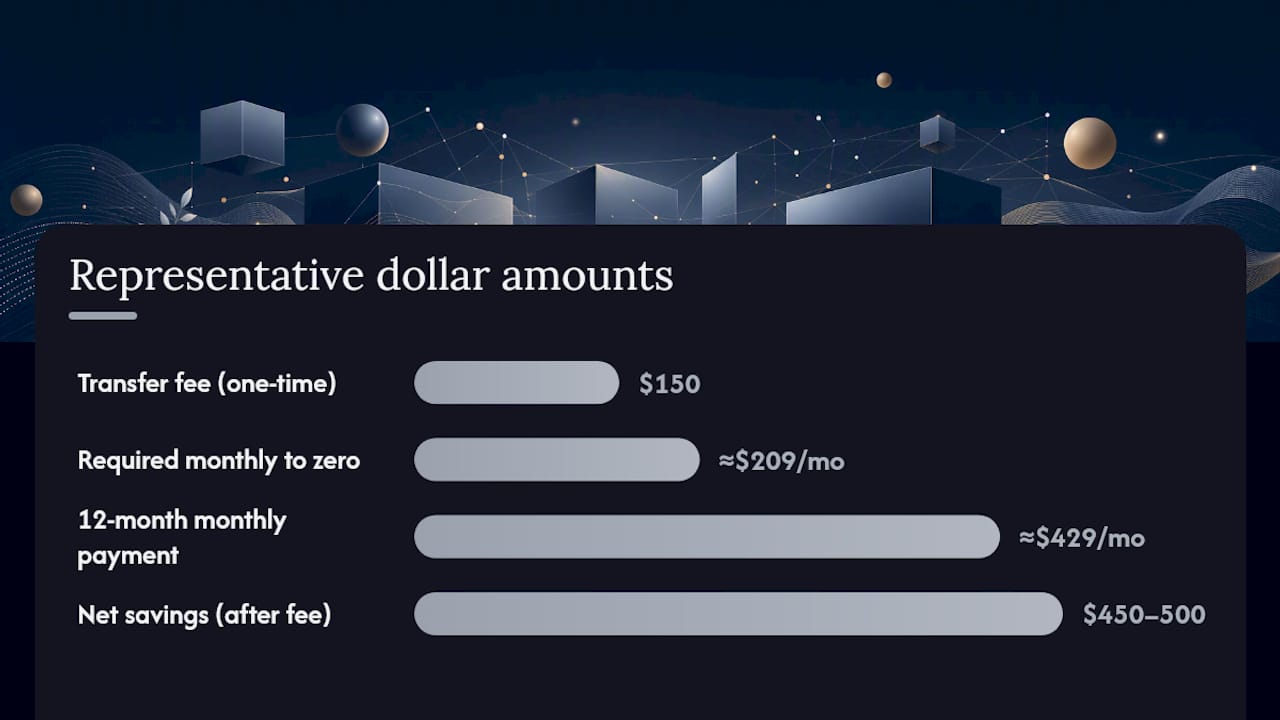
Two quick examples make this concrete.
The fee adds $150 to your balance, for a total of $5,150 to pay off in 12 months, which works out to about $429 a month. Net savings from the transfer: roughly $450 to $500, even after the fee.
Required monthly payment to hit zero by the deadline: about $209. Compare that against your current card's effective APR reduction strategy if you're deciding between several open balances at once.
What Traps Turn a 0% Deal Into an Expensive Mistake?
The savings above evaporate fast if you trip over any of these.
- Deferred-interest retroactive charges. Confirm in writing whether the offer is true 0% or deferred interest before you sign. If the phrase "if paid in full" appears anywhere, treat the whole balance as at risk until it's actually gone.
- Balance-transfer fees that eat the savings. Run the math with the fee included, not as an afterthought, before deciding a transfer is worth it.
- Post-promo APR spikes. Know your exact reset rate in advance and set a calendar reminder at least one billing cycle before the promo ends.
- Penalty APRs from late payments. A single missed payment can void the entire promotional rate on some cards. Autopay for at least the minimum eliminates this risk almost entirely.
- Retailer price markups. Some 0% financing deals on furniture or electronics are priced higher than the cash price elsewhere, so the "free" financing isn't actually free.
- Card flipping habits. Chasing promo to promo without ever paying down principal just resets the clock on debt you never actually reduce.
One more thing worth knowing: opening a new card or moving a large balance can temporarily lower your available credit and bump your utilization ratio, which may dip your credit score for a billing cycle or two before it recovers as you pay the balance down.
What's the Safest Way to Use a 0% Offer Step by Step?
- Capture the exact offer terms. Promo length, what it applies to, any fees, and the post-promo APR, all in writing.
- Compute your required monthly payoff. Balance plus fees, divided by promo months, gives you the number you actually need to hit.
- Check fees and payment-allocation rules. Know how your payment gets applied if you're carrying more than one balance on the card.
- Confirm your credit limit covers the transfer or purchase. A limit that's too tight can leave part of your balance stranded at a non-promotional rate.
- Set autopay for the payoff amount, not the minimum. This single step removes most of the behavioral risk that trips people up.
- Monitor the promo end date and build a contingency. Know what happens if life gets in the way of the plan.
For the calculator step, plug in four numbers: current balance, promo months remaining, any balance-transfer or setup fee, and the post-promo APR you'd face if any balance is left. That's the entire input list.
One billing cycle before the promo ends, take stock. If you're on track to hit zero, stay the course. If you're not, look at whether a second balance transfer, a personal loan, or simply accelerating payments for the final stretch gets you across the line without ever touching the post-promo rate. A tactic like the compound interest avoidance approach can help structure that final push if the numbers are tight.

What Does the Research Say About Why These Promos Work the Way They Do?
The most useful research here doesn't come from marketing departments. It comes from regulators and central bank economists studying how these offers actually play out.
Philadelphia Fed prevalence data: roughly a quarter of card debt in the study sample was tied to some kind of introductory promotional offer, with an average promo length of about nine months. Post-promo APRs rose sharply once the window closed, often by double-digit percentage points, a pattern the researchers linked partly to time-inconsistent borrowing behavior: people accept the deal because the present benefit (no interest now) outweighs, in the moment, a future cost (a much higher rate later) that feels abstract until it arrives.
CFPB consumer guidance: the agency's core warning is structural, not anecdotal. The CFPB specifically flags "if paid in full" language as the signal to watch for.
The most actionable remedy from this research is automation. If time-inconsistency is the core behavioral risk, meaning your future self is less disciplined than your present self assumes, then pre-committing to a payoff plan through autopay removes the decision point entirely. You're not relying on willpower to make the right payment every month; you've already made the decision once and let the system execute it. Tools built around this kind of financial stress reduction tend to lean heavily on exactly this principle.
Two Quick Scenarios You Can Rerun With Your Own Numbers
Take these two examples and swap in your actual balance, fee, and rate to see where you land.
- Scenario A: Balance transfer. A $6,000 balance at 22% APR gets transferred to a 12-month 0% card with a 3% transfer fee. Fee adds $180, bringing the total to $6,180, or $515 a month to hit zero. Staying on the original card and paying it off over 12 months at 22% would cost roughly $750 to $800 in interest. Net savings from the transfer: approximately $570 to $620. What flips the decision: if the transfer fee were 5% instead of 3%, savings shrink to closer to $450, still worthwhile, but noticeably less.
- Scenario B: Purchase financing. A $2,500 purchase financed at 0% for 12 months, no fee, requires about $209 a month to pay off in full. A personal loan at 10% APR for the same amount over the same term runs about $220 a month with roughly $135 in total interest. Net savings using the 0% card: about $135. What flips the decision: a shorter promo period, say 6 months instead of 12, pushes the required payment to over $415 a month, which may not fit your budget even though the interest math still favors 0%.
The consistent thread across both: the promo length and the fee are the two levers that matter most, and a longer promo with a smaller fee almost always beats a shorter one with a bigger fee, even when the headline rate is identical.
An Editorial Take: When a 0% Offer Is Actually Worth Taking
That's incomplete advice, and it leads people into offers they aren't equipped to use well. It has no value if you don't already have a plan to use that window, and it can actively hurt you if you mistake it for permission to spend more.
What gets underestimated is how much the fee-and-term math matters more than the headline rate. Most people compare offers by promo length alone and miss that the fee structure often decides the winner.
My recommendation criteria are simple: take the offer only if you can write down, before applying, the exact dollar amount you'll pay every month, and only if that number is comfortably inside your existing budget, not a stretch goal. If the offer uses deferred-interest language anywhere in its terms, walk away regardless of how good the headline sounds. It's whether they automate the payment the day the account opens instead of deciding fresh every month.
How a Credit-Management App Can Improve Your Odds With 0% Offers
Running the math in this article once is useful. Running it automatically every month, across every card you hold, is where it actually changes your outcome. Finja gives you a consolidated view of every promotional balance you're carrying, so you're not tracking expiration dates in your head or across five different card apps.
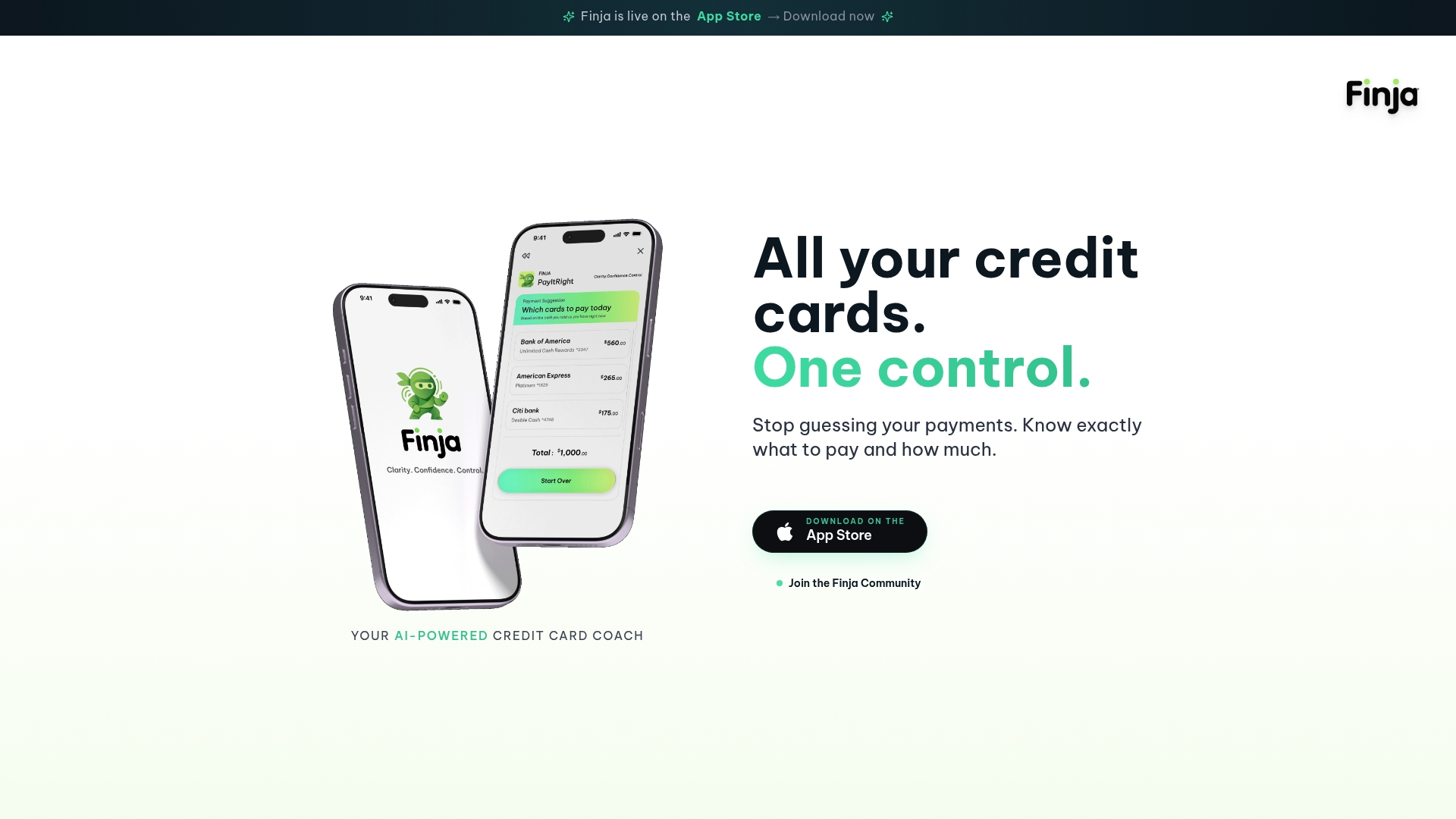
Specifically, Finja helps you schedule autopay at the exact payoff amount your promo requires, not just the minimum, and it simulates your payoff timeline so you can see, in real numbers, whether you're on track months before the rate resets. It also sends alerts ahead of promo expiration, giving you time to adjust if life throws off the plan. Get a clearer view of your cards and payoff timeline at Myfinja.
Sources
- Are Zero or Low Annual Percentage Rate (APR) Credit Promotions Beneficial to Credit Card Companies and Their Customers? (Philadelphia Fed, WP 23-06)
- How to understand special promotional financing offers on credit cards (CFPB)
- How do 0% APR credit cards work? (Experian)
This article is general information, not a substitute for advice from a qualified financial advisor. Consult a qualified financial professional about your own circumstances before acting on anything here.