
Yes, you can make a credit card payment on a Saturday or Sunday, and in most cases it counts for the day you submit it, as long as you beat your issuer's cutoff time. What changes on a weekend is when the payment appears on your account. The date that protects you from a late fee (the credited date) and the date your balance visibly drops (the posted date) can be two different days.
This guide explains how that split works, which cutoff times apply, what happens when your due date lands on a weekend or holiday, and a simple routine that keeps weekend payments from costing you money.
TL;DR
- Weekend payments are accepted by major issuers. Timeliness depends on the credited date, not the day your balance updates.
- For due-date payments, federal rules generally bar a cutoff earlier than 5 p.m. for mail, electronic and phone payments. Many issuers set their own online cutoff, so check yours.
- If your due date falls on a weekend or holiday, don't count on extra time for online or phone payments. Pay by the Friday before.
- A payment made after the cutoff is usually credited the next business day, which can mean a late payment if it was the due date.
- Your balance and available credit may lag by a day or more after the payment is credited. That delay is normal.
Table of Contents
- Credited date vs. posted date
- The 5 p.m. rule and issuer cutoffs
- When your due date falls on a weekend or holiday
- Does the payment method matter?
- What weekend processing means for interest and late fees
- Why your balance doesn't update after a weekend payment
- A weekend payment routine that works
- Managing several cards makes weekends harder
- See every card and due date in one place
- FAQ
- Sources
Credited date vs. posted date
Two terms explain nearly every weekend payment question.
The credited date is the effective date of your payment. It decides whether you were on time and how much interest you owe. The posted date is when the transaction shows in your online account and is applied to your balance. Chase draws this exact line: the credited date is the effective date for timeliness and interest, while the posted date is when the payment appears online.
The legal baseline comes from Regulation Z. Under the Federal Reserve's rule, a creditor must credit a card payment as of the date it is received, unless a permitted exception applies. The most common exception is a cutoff time. The OCC explains that payments received after an issuer's established cutoff are generally credited as of the next business day.
So a Saturday payment made before the cutoff is typically credited Saturday. It may not show on your balance until Monday, because banks and the Federal Reserve's payment systems mostly move money on business days. If you want a deeper look at that gap, our guide to posting date vs. transaction date covers what changes on your card and when.

The 5 p.m. rule and issuer cutoffs
The cutoff is where weekend payments go wrong. Here is what the rules say.
- For mail, electronic, telephone and most other payment methods, a cutoff on the due date generally may not be earlier than 5 p.m. at the location the creditor specifies.
- The CFPB tells consumers that a due-date payment should be received by 5 p.m. in the time zone of your billing statement. It also notes that issuers may set a reasonable online cutoff.
- In-person payments at a branch count as received that day if made before the branch closes. The issuer can use an earlier cutoff only when the branch closes before 5 p.m.
In practice, individual issuers publish their own schedules. A few examples from U.S. issuers' own pages:
| Issuer | What it says about weekends and cutoffs |
|---|---|
| U.S. Bank | You can pay on weekends and holidays. To show as on time and dated for the day submitted, the minimum payment must arrive before 6 p.m. local time from a U.S. Bank deposit account or 7 p.m. Central Time from another bank. |
| Fidelity Visa Signature | Payments made on weekends, holidays or after 7 p.m. Central Time are processed the next business day. A due-date payment submitted before 7 p.m. Central can still be scheduled as timely when the due date is a weekend or holiday. |
| Chase | Online payments are credited the same day, but the posting day depends on the time and day of the week, with Saturday and Friday late-evening payments following their own schedule. |
| Barclays US | Saturday payments are credited the same day, while available credit and the posted transaction update Monday. |
The lesson: the cutoff on your card's payment page is the one that counts, and it can differ by issuer, by payment channel and even by where the money comes from. Find it once and write it down.
If you also run a side business and weigh which payment method to use for your own invoices, this comparison of ACH versus card payments shows how timing differs by rail, which is the same idea behind issuer cutoffs.
When your due date falls on a weekend or holiday
This is the situation most people searching this topic are in. The rules are less generous than many assume.
The Truth in Lending Act requires your due date to be the same day each month, whether that is a specific date or the last day of the month. The OCC notes this is why your due date can land on a holiday or weekend. Issuers cannot simply move it.
What protects you depends on the payment method:
- Mailed payments. If the due date is a weekend or federal holiday when the issuer does not accept or receive mail, a mailed payment received before the cutoff on the next business day is generally timely. The CFPB says the same: when the due date is a Sunday or a holiday with no mail receipt, you generally have until 5 p.m. on the next business day.
- Online and phone payments. If the issuer accepts electronic or telephone payments on the due date, those methods generally still must meet the due-date cutoff. There is no automatic extension to Monday.
That second point catches people. If your due date is Sunday, you can pay online on Sunday, but you need to beat that day's cutoff. Waiting until Monday afternoon because "the bank is closed Sunday" is a gamble. Paying by Friday, or at the latest early Saturday, removes the question.
The due date and the statement closing date are different things, which matters if you are trying to time payments for interest or your credit score. Our credit card due date management guide walks through how to track both across several cards.
Does the payment method matter?
Yes. Regulation Z lets creditors set reasonable payment requirements, including different cutoff times for mail, electronic, telephone and in-person payments. A few practical points follow.
Mail is the slowest and the riskiest. The CFPB stresses that a payment must be received by the due date. Mailing it on the due date does not by itself make it timely. Weekends add days with no postal delivery to many payment centers, so allow extra time.
Online payments from the issuer's site or app are the most predictable. The cutoff is published, the confirmation is immediate and the credited date is clear.
Payments through your own bank's bill pay can be slower. Some bill pay services send a check or a delayed electronic transfer, so the issuer may receive it days after you press submit. Treat it like mail unless your bank promises a delivery date.
Phone payments follow their own cutoff, which may differ from the online one. Ask the representative for the credited date and write down the confirmation number.
Where your money comes from also matters. As the U.S. Bank cutoffs above show, paying from an account at the same bank can earn a later cutoff than paying from an outside account.
What weekend processing means for interest and late fees
A weekend payment can affect three things: whether you are late, how much interest accrues, and whether you keep your grace period.
Late fees. If the payment is credited on or before the due date, it is on time, even if your balance does not update until Monday or Tuesday. If you miss the cutoff on the due date, it is credited the next business day and counts as late. The CFPB's page on when a card payment is considered late is the plain-language reference.
Interest. Interest is calculated on the credited date, not the posted date. A Saturday payment credited Saturday stops interest from building on that amount as of Saturday, while a payment that misses the cutoff may cost you one more day. On a large balance that is small but real. Cards compound interest daily, which is why some cardholders split payments across the month. We explain the mechanics in how to cut daily credit card interest with mid-cycle payments.
Grace period. If you pay your statement balance in full by the due date, you avoid interest on purchases. A grace period, when you have one, is a minimum of 21 days is not what Fidelity states, so we will not rely on it here; instead see the issuer's cardmember agreement for your exact terms. What matters for weekends is simple: a payment that is credited late can cost you the grace period on the next cycle, so a Sunday due date is not the day to cut it close.
If a delay was not your fault. Regulation Z includes a safeguard. If delayed crediting causes finance or other charges, the creditor must adjust the account so those charges are credited during the next billing cycle. Also, if a creditor accepts a payment that does not follow its stated requirements, it generally must credit it within five days of receipt, and a method the creditor itself promotes is treated as conforming. If you were charged a fee after paying correctly, call the issuer, cite your confirmation number and ask for a reversal.

Why your balance doesn't update after a weekend payment
You paid Saturday morning, and on Sunday your balance looks unchanged. Nothing is wrong. Three separate things update on separate schedules:
- Credited date: the day the issuer treats the payment as received.
- Posted date: the day it appears in your transaction list and reduces the balance.
- Available credit: the day your spending room increases.
Barclays' schedule shows how these split. A Friday payment after 7 p.m. Eastern is credited that day, with available credit on Saturday and posting on Monday. It also warns that payments on certain major holidays may be credited on the date received but post and update available credit later, and available-credit updates can be delayed while funds are confirmed.
U.S. Bank says funds are typically available one to two business days after payment. For payments on non-business days through digital banking, its published table generally shows availability two business days later, with cutoffs varying by account source and channel.
The practical consequence: if you pay down a card to free up room for a purchase on Monday, pay by Thursday or Friday, not on the weekend. Our explainer on how long credit card payment posting takes and why goes deeper on the timelines.
A weekend payment routine that works
You do not need to memorize every issuer's rules. Build a short routine.
- Look up the cutoff for each card. Find it on the issuer's payment page or help center and note the time zone. Use the earliest cutoff if you pay from different accounts.
- Pay at least one business day before a weekend or holiday due date. Friday is the safest day. This avoids every cutoff and posting question.
- If you must pay on the weekend, pay in the morning from the issuer's own site or app. Screenshot the confirmation showing the date and amount.
- Check the credited date, not just the balance. Many issuers show "payment received" or "pending" status before posting.
- Set a reminder for Monday. Confirm the payment posted and the balance and available credit updated. If not, contact the issuer with your confirmation.
- Keep autopay as a safety net, not a plan. Autopay of the minimum protects against a missed payment, but you still choose the larger amount yourself to limit interest.
If weekend due dates keep tripping you up, ask your issuer whether you can move the date. Many issuers allow it, and our guide to changing your card due date to match paychecks explains how it typically plays out over one or two cycles. For a broader view of timing choices, see when to pay your credit card for fees, interest or score.
Managing several cards makes weekends harder
With one card, a weekend due date is a nuisance. With four or five, each with its own due date, cutoff and posting schedule, it becomes a real risk. Two cards due on the same Sunday, paid from different accounts with different cutoffs, is exactly where a payment slips past a deadline.
The fix is a single calendar view of every due date, with the weekend and holiday ones flagged and a pay-by date set a business day earlier. Our guide on optimizing card payments with timing and Regulation Z shows how to build that view by hand.
Our perspective
We built Finja around a simple observation: most people with several credit cards do not lose money because they lack discipline. They lose it because the timing rules are scattered. One card's cutoff is 6 p.m. local time, another's is 7 p.m. Central, a third has a due date that always lands on a Sunday. Nobody keeps all of that in their head.
That is why we focus on reducing interest costs and improving credit health, rather than chasing rewards. When you see every card in one place, the weekend problem mostly disappears, because you can decide what to pay, how much and by when, before the weekend arrives.
Our approach is a dedicated credit card coach, not a general budgeting tool. The AI-powered guidance is designed to help with payment timing and amounts across your cards, so a Sunday due date is something you handle on Thursday rather than something you discover on Sunday.
Grace K.
See every card and due date in one place
If you juggle multiple cards, Finja is an AI-powered credit card coach that shows all your cards in one view and offers guidance on payment timing and amounts, with the goal of reducing interest costs and improving credit health.
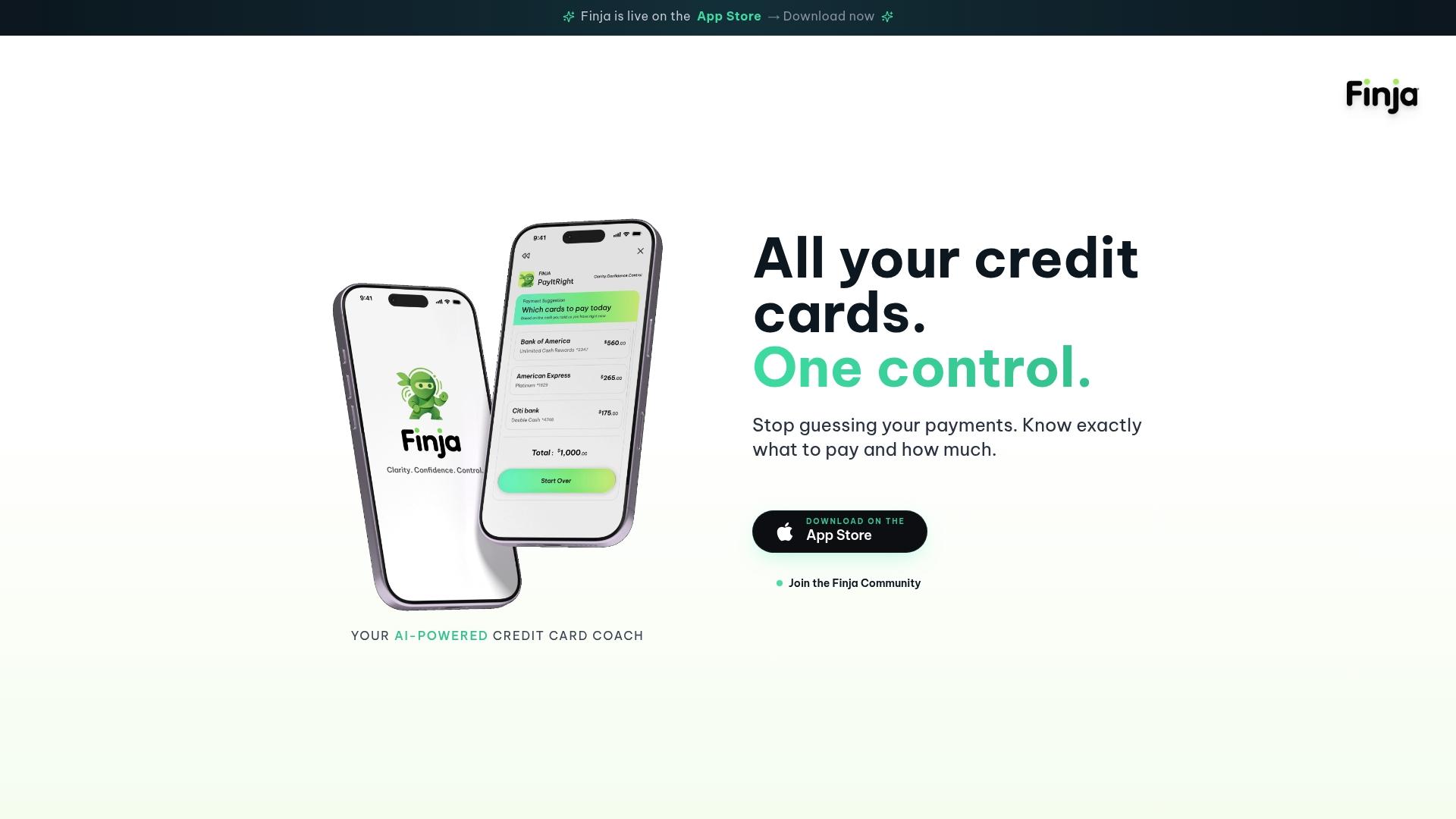
It is built for people with multiple cards, not for single-card reminders. If weekend due dates and different cutoffs are costing you attention, try Finja and put the schedule in one place.
FAQ
Can credit card payments go through on the weekend?
Yes. Major issuers accept payments online and by phone on weekends and holidays. U.S. Bank, for example, says you can pay on weekends and holidays and that the payment shows as on time and dated for the day you submit it if it arrives before the cutoff. Payments made after the cutoff are generally processed the next business day.
Do credit card payments post on weekends?
Usually the payment is credited on the day you make it, but the posting often waits for the next business day. Barclays, for instance, credits Saturday payments the same day, while the posted transaction and available credit update Monday. Your timeliness is judged on the credited date.
What if my due date is on a Sunday?
For mailed payments, you generally have until the next business day if the issuer does not receive mail on Sunday. For online and phone payments, the due-date cutoff generally still applies. The safest move is to pay by the Friday before.
What time do I need to pay for it to count that day?
Federal rules generally do not allow a due-date cutoff earlier than 5 p.m. for mail, electronic and phone payments, though issuers can set a reasonable online cutoff. Many issuers publish a later time, such as 7 p.m. Central. Check your card's payment page for the exact time and time zone.
What if I paid on time but still got a late fee?
Gather your confirmation showing the date, time and amount, then contact the issuer and ask them to review the credited date. If delayed crediting caused charges, Regulation Z requires the creditor to adjust the account in the next billing cycle. You can also file a complaint with the CFPB if the issuer will not fix it.
Sources
- Can I make my credit card payment on weekends or holidays? (U.S. Bank)
- When will the funds be available on my credit card after I pay? (U.S. Bank)
- One-Time Payments, Fidelity Visa Signature Card
- Online Payments, Credit Card (Chase)
- Credit card payment posting timeframes (Barclays US)
- Section 1026.10, Payments (Federal Reserve, Regulation Z)
- When is my credit card payment considered late? (CFPB)
- Why wasn't my online payment posted on the same day? (OCC HelpWithMyBank)
- Why is my credit card payment due on a holiday? (OCC HelpWithMyBank)
- ACH vs Credit Card for Small Businesses