
Daily credit card interest is calculated by taking your card's daily periodic rate, which is usually your APR divided by 365, and multiplying it by your average daily balance for the billing cycle. The one lever you actually control is timing: paying earlier shrinks your average daily balance and shrinks the interest with it. Regulation Z requires issuers to spell out this method on every statement, and the Consumer Financial Protection Bureau publishes the exact formula issuers use.
TL;DR:
- Paying early on your credit card reduces your average daily balance, which directly lowers the daily interest charges.
- Some issuers use a 360-day year for calculations, making your daily periodic rate slightly higher than when using 365 days.
- Making mid-cycle payments or extra payments towards high-APR cards can save you more interest than just paying the minimum at the end of the cycle.
- Interest is compounded daily, so the effect of payments made earlier compounds over time, especially on larger balances.
- Using a tool like Finja can automate payment timing recommendations, helping you minimize interest without manual tracking.
Table of Contents
- What Is the Daily Periodic Rate?
- Calculating Your Average Daily Balance
- Two Worked Examples You Can Copy
- When Does the Grace Period Actually Protect You?
- How to Actually Lower What You Pay in Daily Interest
- Where an AI Coach Fits Into the Math
- Why the Math Matters More Than the Motivation
- A Straightforward Way to Automate the Payment Timing
- Where to Verify the Numbers Yourself
- Sources
- FAQ
What Is the Daily Periodic Rate?
Your daily periodic rate (DPR) is the slice of your APR that applies to a single day. Take your APR, divide by 365, and you get the DPR. A card with a 24% APR carries a DPR of roughly 0.0658%. Multiply that against a $1,000 balance and you're looking at about $0.66 in interest for that one day, before any issuer rounding kicks in, according to the CFPB's breakdown of credit card contract terms.
That math sounds simple until you check your actual statement. A few things complicate it:
- Some issuers use a 360-day year instead of 365, which nudges the DPR slightly higher. Check your cardholder agreement or the fine print on your statement to confirm which one applies to you.
- Daily compounding means interest gets added to your balance every day, and the next day's interest is calculated on that new, slightly larger number. That's different from a flat, one-time estimate.
- Over a full billing cycle, daily compounding usually produces a marginally higher total than a simple back-of-envelope calculation, especially on larger balances or higher APRs.
The gap between "simple estimate" and "actual issuer math" is usually small on a typical monthly balance, but it grows the longer you carry debt and the higher your rate climbs.
Calculating Your Average Daily Balance
Issuers don't charge interest on your statement balance. They charge it on your average daily balance, which reflects every day's actual balance across the billing cycle. Here's the process the CFPB outlines for figuring it out yourself:
- Start with your balance at the beginning of the billing cycle.
- Add any new purchases or interest charges posted that day.
- Subtract any payments or credits posted that day.
- Record that day's ending balance, then repeat for every day in the cycle.
- Add up all the daily balances and divide by the number of days in the cycle.
That final number, not your statement balance, gets multiplied by the DPR and the number of days to produce your interest charge. Complicating matters further, purchases, cash advances, and promotional balances often carry different APRs, so issuers frequently run this calculation separately for each category, then add the results together.
Pro Tip: Pull up your last statement and find the section labeled "Interest Charge Calculation" or "Balance Computation Method." Regulation Z requires issuers to disclose exactly how they got your number, and that disclosure requirement is your best tool for reverse-engineering your own bill.
Two Worked Examples You Can Copy
Numbers make this concrete faster than any explanation. Try these two scenarios against your own statement.
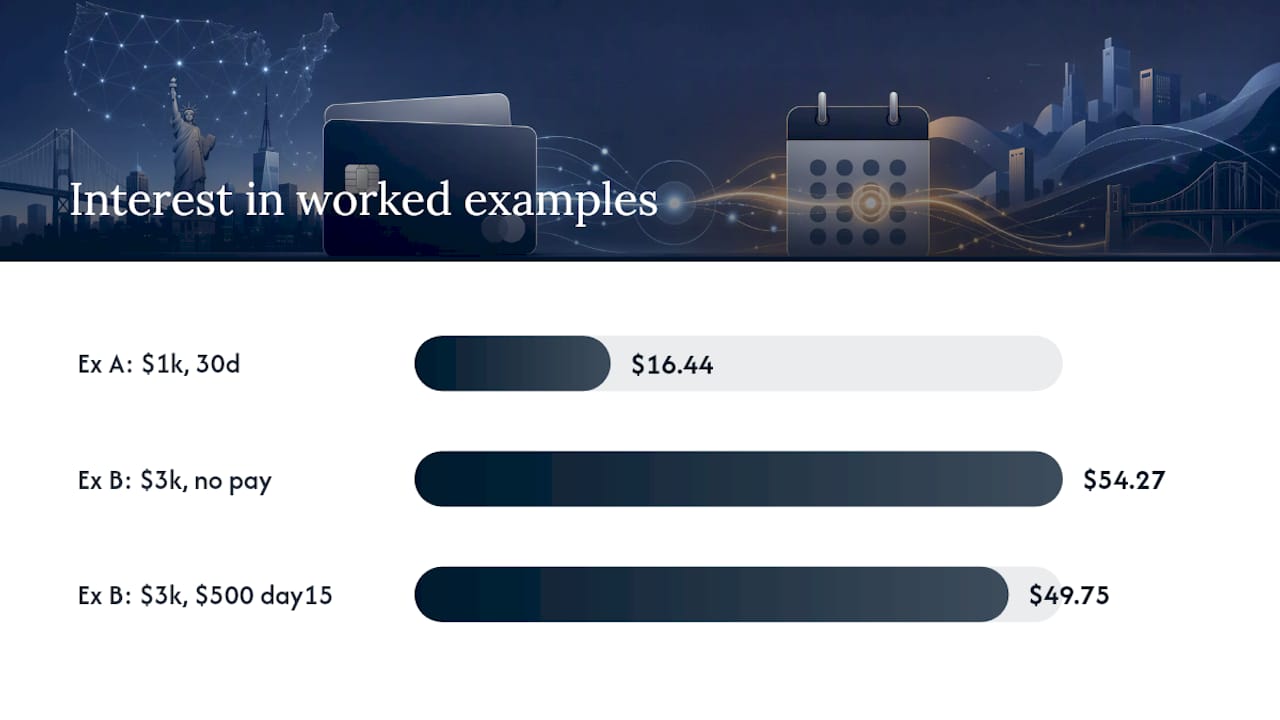
Example A: A $1,000 balance sitting at 19.99% APR gives you a DPR of about 0.0548%. Over a 30-day cycle with no new charges or payments, that works out to roughly $16.44 in interest, using the CFPB's average daily balance formula.
Example B: A $3,000 balance at 22% APR produces a DPR near 0.0603%. Left untouched for 30 days, that's about $54.27 in interest. Now pay $500 on day 15 instead of waiting for the due date. Your average daily balance drops from $3,000 to roughly $2,750 for the cycle, and your interest falls to around $49.75, saving you close to $4.50 in that single cycle. Do that every month and the savings compound.
- The gap between a simple estimate and what your issuer actually charges usually comes down to daily compounding, which recalculates your balance (and the interest on it) every single day.
- On a $3,000 balance at 22% APR, that compounding effect typically adds only pennies over 30 days, but it grows fast on larger revolving balances carried for months.
For context, the Federal Reserve's most recent G.19 release puts the average APR across all credit card accounts at 20.94%, and 22.15% specifically among accounts that get charged interest. If your card sits above that range, you're paying more than the typical American carrying a balance.
When Does the Grace Period Actually Protect You?
A grace period is the window between your statement closing date and your due date, and it's the only thing standing between you and interest on new purchases. Pay your full statement balance by the due date, every cycle, and you avoid interest on those purchases entirely.
That protection has real limits, though:
- Cash advances almost never get a grace period. Interest usually starts accruing the day you take the cash.
- Balance transfers typically start accruing interest immediately too, unless your card explicitly promises otherwise.
- Promotional 0% APR balances follow their own rules, and once that window closes, any remaining balance often starts accruing interest at the standard rate, sometimes retroactively depending on the offer's terms.
- If you're already carrying a revolving balance from a previous cycle, new purchases usually don't get a grace period until you pay that balance down to zero.
Miss a full payment even once, and many issuers will pull your grace period on new purchases entirely, meaning interest starts accruing the moment you swipe. That's a bigger hidden cost than most people appreciate.
How to Actually Lower What You Pay in Daily Interest
Because interest accrues daily, when you pay matters almost as much as how much you pay. A payment made on day 10 of a cycle stops interest from accumulating on that amount for the remaining 20 days, while the same payment made on day 25 barely moves the needle, a distinction the CFPB points to directly when explaining daily accrual.
If you carry balances on more than one card, allocation matters just as much as timing. Paying above the minimum toward your highest-APR balance first, rather than splitting extra payments evenly across cards, typically saves you the most in total interest. Comparing the marginal interest avoided per dollar paid across your cards, rather than treating every balance the same, is the more useful mental model for multi-card holders.
A short checklist to work from:
- Make a mid-cycle payment instead of waiting for the due date, even if it's not the full balance.
- If you have a large payment coming, split it: some early in the cycle, the rest closer to the due date, rather than dumping it all at once on day 30.
- Direct any extra money above the minimum toward whichever card carries the highest APR, not the highest balance.
- Track promotional APR end dates closely. A balance that was interest-free can start accruing at a standard rate the day the promotion expires, sometimes without much warning.
Pro Tip: Set a calendar reminder for the midpoint of each billing cycle, not just the due date. A single mid-cycle payment on a revolving balance often does more to cut your annual interest than an extra $50 tacked onto your minimum payment at the end.
Where an AI Coach Fits Into the Math
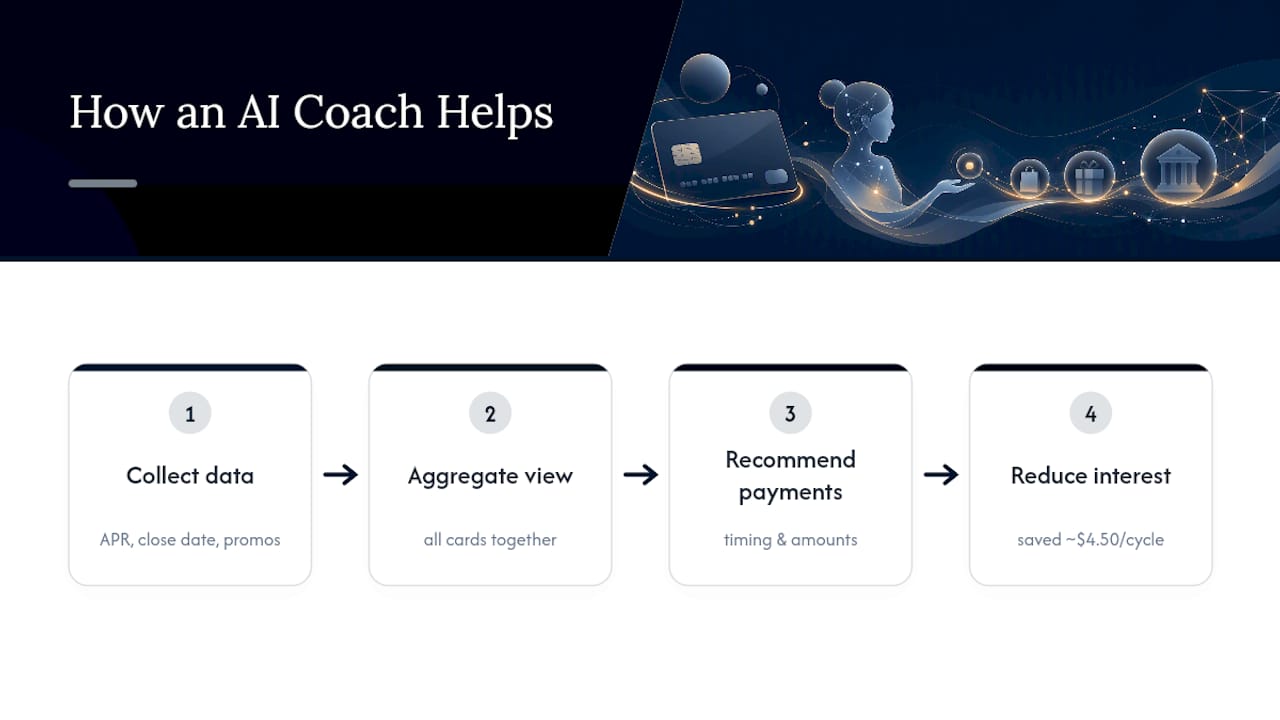
Running this calculation by hand across two or three cards, each with different APRs, closing dates, and promotional terms, gets tedious fast. An AI credit card coach can pull every card into one view and recommend payment timing and amounts aimed at cutting interest rather than maximizing rewards. If you want a deeper walk-through of the average daily balance method or want to see real dollar examples of high-interest scenarios, those breakdowns cover the same math from a few different angles. Shifting a $500 payment two weeks earlier, as shown in Example B above, saved close to $4.50 in a single cycle. Multiply that kind of adjustment across several cards and cycles, and the savings stop being trivial.
Why the Math Matters More Than the Motivation
Most advice about credit card debt focuses on willpower: pay more, spend less, try harder. That's not wrong, but it skips the part that actually moves the number on your statement. Run the DPR math on your own accounts. Check whether your issuer uses 365 or 360 days. You'll probably find that the timing of a single payment matters more than you expected, and that's a lever you can pull this month, not a habit you have to build over a year. Automating that timing, rather than tracking it in your head across multiple cards, is where a tool like Finja earns its keep.
— Grace K.
A Straightforward Way to Automate the Payment Timing
Everything above works with a calculator, a spreadsheet, and some discipline about your due dates. Finja exists for the days you don't have time for any of that. It pulls your cards into one consolidated view and tells you when and how much to pay to cut down on interest, rather than chasing rewards points that don't move your balance.
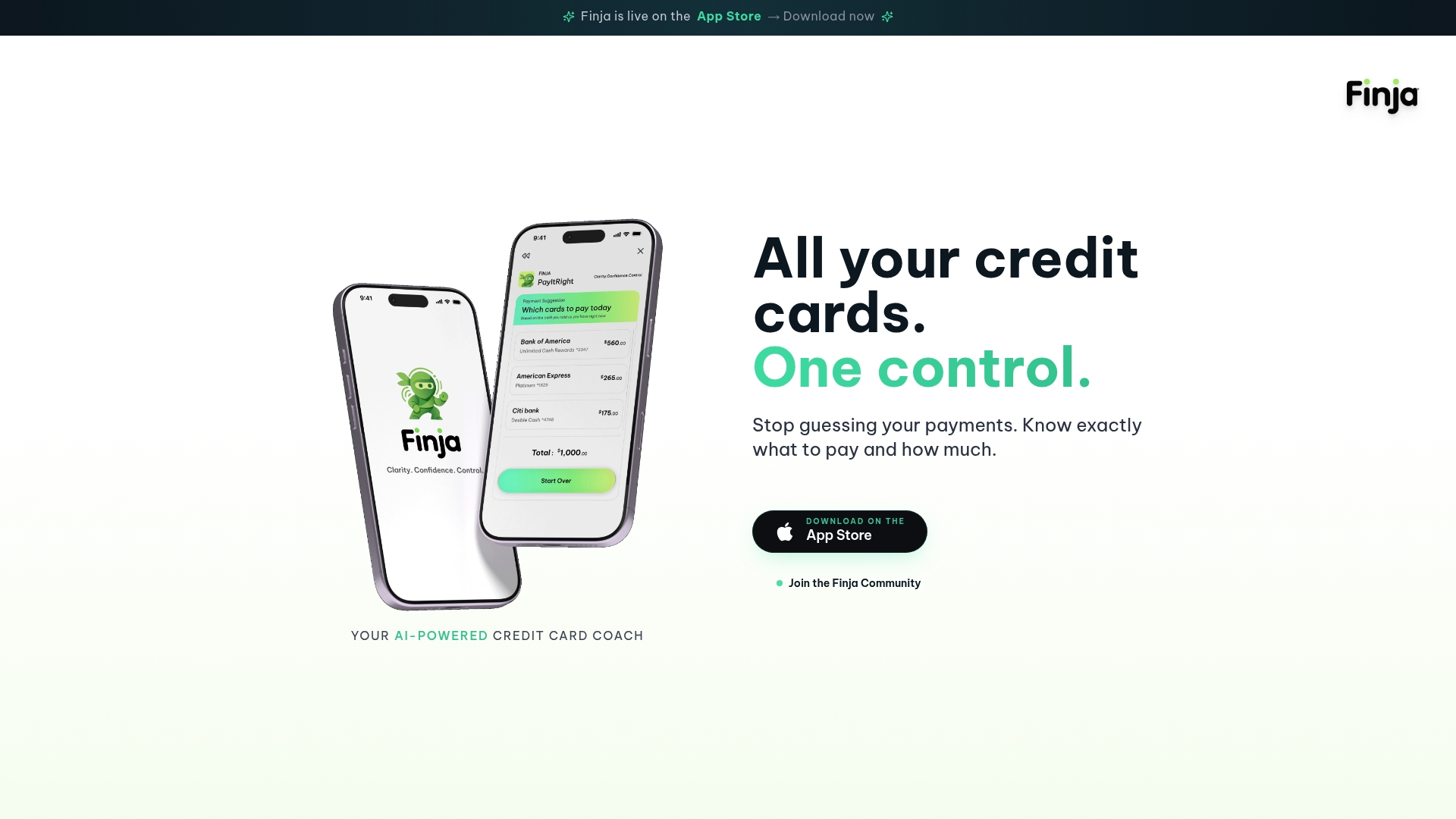
If you're juggling more than one card with different APRs and closing dates, that consolidated view replaces the manual tracking this article just walked you through. The app is designed specifically as a credit card coach, not a general budgeting app, so the recommendations stay focused on interest reduction and credit health. Check out Finja's AI-powered coach to see how it applies these same calculations to your actual accounts.
Where to Verify the Numbers Yourself
For the exact language issuers must use, read the CFPB's credit card contract definitions and the eCFR's Regulation Z periodic statement rules. For current national rate averages, the Federal Reserve's G.19 release is updated regularly.
This article is general information, not a substitute for advice from a qualified financial advisor. Consult a qualified financial professional about your own circumstances before acting on anything here.
Sources
- Credit card contract definitions | Consumer Financial Protection Bureau
- Federal Reserve G.19 — Consumer credit
FAQ
How Much Interest Will I Pay on a $10,000 Credit Card Balance?
At 22.15%, the average APR among accounts assessed interest according to the Federal Reserve, the daily periodic rate is about the APR divided by 365, and interest depends on your balance and number of days. Your actual charge depends on your specific APR and how much your balance moves during the cycle.
How Much Interest Will I Pay on $3,000 at 22% APR?
Using the DPR formula (22% ÷ 365), a $3,000 balance accrues roughly $54.27 in interest over a 30-day cycle if left untouched, based on the CFPB's calculation method. Making an early payment mid-cycle lowers your average daily balance and cuts that number, as shown in the $500-payment example above.
Is 20% Interest on a Credit Card High?
Not by current standards. The average APR across all credit card accounts sits at 20.94%, and 22.15% among accounts actually charged interest, per the Federal Reserve's G.19 data. A 20% rate is close to typical, though anything meaningfully above that range costs you more than the average cardholder pays.
How Do I Calculate the Daily Interest Charge on My Own Card?
Divide your APR by 365 to get your daily periodic rate, then multiply that by your average daily balance for the billing cycle, following the CFPB's step-by-step method. Your statement's balance computation disclosure, required under Regulation Z, shows exactly which version of this formula your issuer uses.
Can Finja Tell Me Exactly How Much Daily Interest I'm Paying?
Finja consolidates your cards into one view and applies payment timing recommendations aimed at reducing the interest calculated by each issuer's method. Pricing and specific features are available directly on the Finja product page.