
Yes, most card issuers let you change your due date, usually through your online account or by phone. The catch is timing: your new date typically takes one to two billing cycles to kick in, so keep paying your current due date until the switch actually shows up on your statement. Changing the date won't move your credit score on its own, but it can make on-time payments a lot easier to hit.
TL;DR:
- Changing your credit card due date can help align payments with your paycheck, reducing the risk of overdrafts and missed payments.
- Most issuers take one to two billing cycles to process a due-date change, so maintain payments on the old date until the new one appears on your statement.
- Due-date requests are often limited to once every 30 to 90 days, and recent late payments can disqualify you from changing your date.
- If your request is denied, enroll in autopay, pay your statement balance immediately, or consider hardship options to manage cash flow.
- Scheduling due dates roughly a week apart and tied to paydays supports better multi-card management and prevents overlapping payment burdens.
Table of Contents
- How to Change Your Credit Card Due Date Online or by Phone
- Why Moving Your Due Date Actually Helps Your Budget
- Steps to Request a New Credit Card Due Date
- When the Change Actually Takes Effect
- Why Some Due-Date Requests Get Denied
- What to Do If Your Issuer Won't Move the Date
- What Happens If You Pay Late
- Managing Due Dates Across Multiple Cards
- A Quick Closing Take From Grace K.
- Where to Verify These Rules Yourself
- Sources
- FAQ
How to Change Your Credit Card Due Date Online or by Phone
Most major issuers build a due-date option directly into their online account settings or mobile app, though the exact label varies by bank. You're generally looking for something under "payment settings," "card services," or a direct "change due date" menu item, and issuers commonly allow dates anywhere from the 1st through the 28th of the month.
If you can't find the option online, calling works just as well. Use the number printed on the back of your card, not a number you found through a search engine, and ask specifically for a due-date change.
Here's how the request paths usually break down:
- Log in to your account portal and check payment or billing preferences first.
- Try the issuer's mobile app if the desktop site doesn't show the option.
- Call customer service using the number on your card if there's no self-service option.
- Ask the representative to confirm the new date in writing or by email.
Chase's own guidance reflects this pattern: some changes happen instantly in the system, but the actual billing impact lags behind by a cycle or two. That gap trips up a lot of people who assume the change is live the moment they submit it.
Why Moving Your Due Date Actually Helps Your Budget
Lining your due date up with payday is the whole point. If your paycheck lands on the 1st and 15th, a due date of the 5th means the money is already sitting in your account instead of getting spent on other things first. That timing gap is where overdrafts and missed payments quietly happen.
Staggering due dates across multiple cards also matters. Piling three payments into the same week creates a cash crunch even when your total monthly income covers everything fine.
- Set due dates a few days after payday, not right before.
- Spread multiple card due dates across different weeks of the month.
- Treat this as a budgeting tool, not a rescue plan for a payment you can't make right now.
Pro Tip: If you're already short on cash this month, a due-date change won't help you in time. Call your issuer about hardship options instead, as financial experts recommend — the change itself takes weeks to process.
Steps to Request a New Credit Card Due Date
Before you change anything, check your current statement closing date and grace period. That tells you how much runway you actually have between when a purchase posts and when payment is due.
- Pull up your most recent statement and note the closing date and current due date.
- Pick a new date that reliably lands a few days after a paycheck and falls within your issuer's allowed range, commonly the 1st through the 28th.
- Log in to your account or app and navigate to payment settings, or call the number on the back of your card.
- Write down the date you made the request, who you spoke with, and what they confirmed.
- Keep paying on your original due date every cycle until the new date visibly appears on a statement.
That last step is the one people skip, and it's the one that causes late fees. Issuers don't always flip the switch as fast as the phone rep implies.
When the Change Actually Takes Effect
Expect the new due date to show up in your next billing cycle, or sometimes the one after that. Most issuer guidance points to a one to two billing cycle lag between the request and the date actually moving.
Until you see the new date printed on a statement, pay on the old one. Paying "early" based on a date that hasn't kicked in yet is safer than assuming it has. And if your new due date lands on a weekend or holiday, most issuers push the payment cutoff to the next business day, so you're not penalized for a calendar quirk.
Why Some Due-Date Requests Get Denied
Issuers cap how often you can change your due date, often once every 30 to 90 days or a limited number of times per year. This stops people from gaming billing cycles and keeps issuer systems from getting overloaded with constant edits.
Accounts with recent late payments or a default in the last several months often aren't eligible for a change at all. Some issuers also block certain dates near the end of the month for processing reasons.
- Recent late payments or a past-due balance often disqualify a request outright.
- Frequency limits, often once every 30 to 90 days, apply even on accounts in good standing.
- Certain days near month-end may be off-limits due to billing-cycle processing.
What to Do If Your Issuer Won't Move the Date
A denied request isn't the end of the road. You still have a few ways to manage the mismatch between when bills hit and when money's actually in your account.
- Enroll in autopay for at least the minimum payment so nothing slips through by accident.
- Pay your statement balance as soon as it posts instead of waiting for the due date, sometimes called paying on receipt.
- Ask if your issuer allows split or multiple payments across the month rather than one lump sum.
Pro Tip: Autopay for the minimum only protects you from late fees, not from interest. Pay more than the minimum whenever you can, even on autopay.
What Happens If You Pay Late
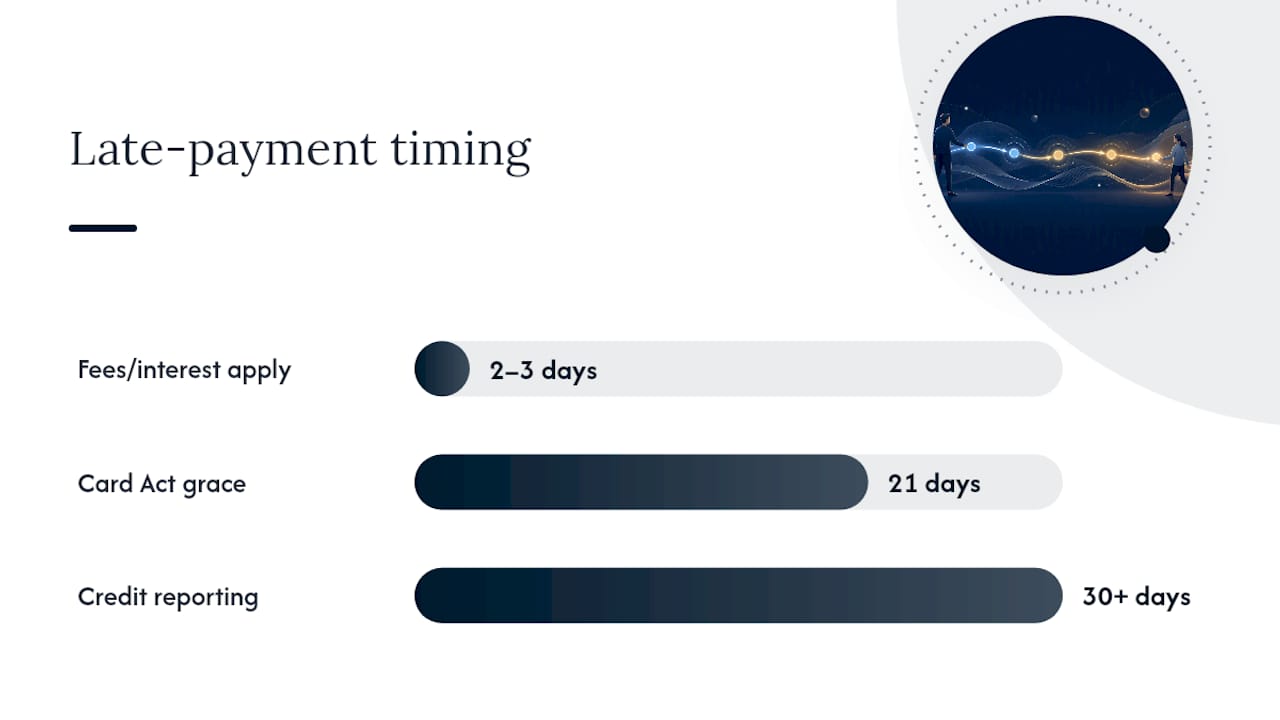
Credit bureaus generally start seeing reports once a payment is 30 or more days past due, but late fees and interest can hit within days of missing your due date. A payment that's just two or three days late usually won't show up on your credit report, but it can still cost you money right away.
Federal law backs up some of the timing you're working with here. The Card Act requires at least a 21-day grace period between your statement closing date and your due date, giving you a guaranteed window to pay before interest applies to new purchases.
- Late fees and interest can apply within days, well before any 30-day reporting threshold.
- The 21-day grace period is a federal floor, not a courtesy some issuers offer and others don't.
- If you're facing a short-term cash crunch, call your issuer about hardship programs rather than banking on a due-date change to save you this month.
If a short late payment already hit your report, there are ways to dispute or remove a late payment depending on your history with that issuer.
Managing Due Dates Across Multiple Cards
Once you're juggling three or four cards, due-date changes stop being a one-time fix and start being an ongoing coordination problem. Looking at all your cards' closing dates and due dates side by side, rather than one at a time, is usually what reveals which card to move first.
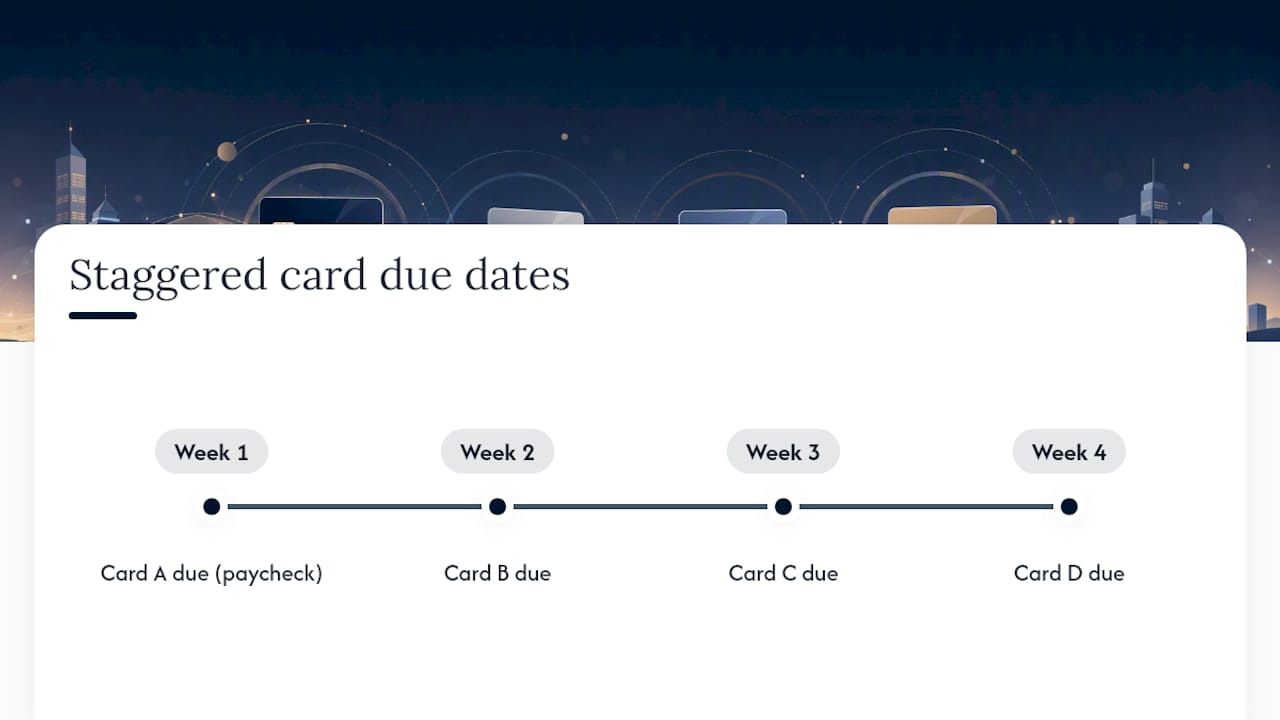
A useful approach: stagger due dates roughly a week apart, and keep at least one card's due date tied to each paycheck. For deeper coordination strategies, see guides on credit card due date management that walk through aligning closing dates against due dates so you're never caught paying two statements in the same week.
A Quick Closing Take From Grace K.
Pull your statement, pick a date a few days after payday, request the change, and set autopay while you wait for it to process. That's the whole job, and most people overthink it. The part worth taking seriously is the waiting period. If you manage several cards, a tool like Finja, an AI-powered credit card coach, can help you see which card to shift first instead of guessing.
— Grace K.
Where to Verify These Rules Yourself
Check the CFPB's consumer guidance for federal protections, then confirm specifics with your own issuer's help center, since policies on frequency limits and blackout dates vary by bank.
Sources
- How to Change Your Credit Card Due Date — Experian
- How to change your credit card payment due date — Chase
- Changing the due date on your credit card bills — Bankrate
- Consumerfinance
FAQ
Does Changing Your Credit Card Due Date Affect Your Credit Score?
Not directly. Changing your due date has no direct effect on your credit score, but picking a date that's easier for you to hit on time helps protect the payment history portion of your score over time.
Can I Change the Payment Due Date on My Credit Card?
Yes, most issuers allow it through your online account, mobile app, or by calling the number on the back of your card. The new date usually takes one to two billing cycles to take effect, so keep paying your current due date until it's confirmed.
Will a Two-Day Late Payment Hurt My Credit Score?
Usually not directly, since credit bureaus typically only receive reports once a payment is 30 or more days late. That said, a two-day late payment can still trigger a late fee and interest charges well before the 30-day mark.
What Is the 21-Day Grace Period Rule for Credit Cards?
Federal law under the Card Act requires issuers to give you at least 21 days between your statement closing date and your payment due date before interest applies to new purchases. This grace period is a minimum standard, so some issuers offer more, but none can legally offer less.