A large payment hold means one of two things. Either a merchant has reserved part of your credit line for a purchase that has not finished processing, or your card issuer is delaying a payment you made until it is sure the money will not bounce. Both are usually temporary. Both can leave you with less spendable credit than you expected. This guide explains which kind you have, how long it usually lasts, what it does to your balance and interest, and what to do if it does not clear.
TL;DR
- A hold on a purchase (an authorization hold) cuts your available credit right away but generally does not add to your balance or accrue interest until the charge posts, according to Capital One.
- A hold on a payment you made is different: the issuer is checking that the payment will not be returned. Unusual payment amounts, a new bank account or a typo in the account number can trigger it.
- Most pending purchases clear in a few days. Hotel and rental-car blocks can run much longer, up to 15 days in some cases.
- Ask the business about the block before you pay, use the same card for the final bill, and keep an eye on your available credit near the limit.
- You generally cannot dispute an authorized pending charge until it posts. An unauthorized one should be reported to your issuer right away.
Table of Contents
- Two different things people call a payment hold
- Why a large amount gets held
- How long a hold lasts
- What a hold does to your credit and your interest
- What to do about a large hold, step by step
- How to avoid payment holds
- Our perspective on holds
- Keep every card's holds and payments in view
- FAQ
- Sources
Two different things people call a payment hold
The phrase gets used loosely, so start by sorting out which situation you are in.
1. A hold on a purchase. A merchant asks your issuer to authorize an amount. The issuer approves it and sets that amount aside. Experian explains that an authorization hold reserves part of your available credit until the purchase or reservation is approved and processed, and that it normally shows as a pending transaction. This is the one that most often hits you with a large amount: a hotel stay, a rental car, a cruise, a big repair deposit.
2. A hold on a payment to your card. You send money to pay your bill, and the issuer holds back the credit for it. Capital One's help center says a payment hold can delay when your payment becomes available while the issuer confirms it will not be returned. This one tends to show up when you pay a large amount, especially if it is out of pattern for you.
There is also a third, less common case: an administrative hold. Chase separates these from authorization holds and notes that issuers may restrict credit for suspected fraud, going over the limit or repeated missed payments. If your whole card is restricted rather than one amount, that is the situation to look at, and our guide to what your credit card account status means can help you read the signs.

Why a large amount gets held
When you buy something
Businesses that do not know the final bill in advance reserve an estimate. The FTC says hotels, rental-car companies and other businesses may place a block for the estimated bill, which lowers the credit available for other purchases until the block clears. The bigger the estimate, the bigger the bite out of your limit.
Common situations:
- Hotel stays, where the block often covers the room plus an allowance for extras
- Rental cars, where the block covers the expected rental and a cushion
- Cruises and lodging, which Experian says can hold for up to 31 days
- Gas pumps, restaurants with tips and similar pay-after-service merchants
- Deposits for contractors, event venues or large online orders
When you pay your bill
According to Capital One, a payment may be held while the company confirms it will not be returned. The triggers it lists are:
- A previously returned payment
- A change in your normal spending or payment behavior
- A newly added bank account
- A mistyped bank account number
A large payment can trip the "change in behavior" signal simply because it is bigger than what you normally send. If you usually pay $200 a month and suddenly send $4,000 from a brand-new checking account, you have hit two of those triggers at once. That does not mean anything is wrong with your account. It means the issuer is protecting itself from a payment that could fail.
This is also why a returned payment is costly twice. You may face a fee, and later payments can be scrutinized. If that has happened to you, see our guide on returned payment fees and how to challenge them.
How long a hold lasts
There is no single answer. It depends on the type of hold, the merchant and the issuer. Here is what the checked sources say.
| Situation | Typical length | Source |
|---|---|---|
| Pending purchase, general | Usually within 72 hours, sometimes up to five days | Capital One |
| Pending purchase, general | Most finalize within five days; depends on merchant and issuer | NerdWallet |
| Authorization hold | A few days to a week | Chase |
| Authorization hold | Minutes to seven days for most; up to 31 days for cruise, lodging or vehicle rentals | Experian |
| Hotel or rental-car block, final bill paid with the same card | Most likely replaced in one or two days | FTC |
| Hotel or rental-car block, final bill paid another way | Up to 15 days | FTC |
| Available credit after you make a payment | Generally one to two days, longer in some cases | Capital One |
The FTC's explanation for the 15-day case is worth remembering. If you pay the hotel with cash, a check or a different card, your original issuer does not know the bill was settled, so the first block sits there. Paying with the same card you used at check-in is the simplest way to shorten it.
If your concern is a payment you made rather than a purchase, our explainer on how long credit card payments take to post covers the timing in more detail. And if you are confused about why dates on your statement do not match, posting date versus transaction date explains it.

What a hold does to your credit and your interest
The key point: a hold affects what you can spend, not (yet) what you owe.
Capital One says a pending transaction reduces your available credit immediately, so it can limit further spending or cause a decline when you are near your limit. It generally does not enter your account balance until the merchant finalizes the charge, and pending charges do not accrue interest before they post. Experian's explanation shows why this feels confusing: the hold restricts available credit but does not change the account balance until approval and processing.
A simple worked example
These numbers are made up to show the arithmetic.
- Credit limit: $6,000
- Current balance: $2,500
- Available credit: $3,500
- A hotel places a $1,800 block at check-in
Your balance is still $2,500, but your available credit drops to $1,700. If you then try a $2,000 purchase, it may be declined, even though you have not technically spent the $1,800. When the hotel posts the real bill of, say, $1,350, the block is replaced and your available credit rises to $2,150 (the limit minus $2,500 minus $1,350).
Notice what did not happen: no interest accrued on the $1,800 block, and your balance never showed $1,800. The only cost was a few days of squeezed spending power.
That squeeze matters more if you carry balances on several cards and are close to limits. It can also interact with a lowered limit. If an issuer cut your limit and a hold pushes you near it, see our 72-hour plan after a credit limit cut.
Note what happens when the payment itself is held. Your payment may not show as available credit right away, so you can believe you paid down a card yet still get a decline at the register. In that case, check your available credit rather than the balance, and wait for the one-to-two-day update window before assuming something has failed.
What to do about a large hold, step by step
Before the hold happens
- Ask the business. The FTC advises asking whether the business will place a block, how much it will be, how it chose that amount and how long it will last.
- Use one card for the whole stay or rental. Pay the final bill with the same card used for the reservation when you can.
- Warn your issuer. The FTC recommends monitoring your account and notifying your issuer before travel or a large or unusual purchase. It also notes that a block or a fraud-related decline can still occur, so carry a backup way to pay.
- Leave headroom. If you know a $1,500 block is coming, make sure the card has more than that available.
While a purchase hold is pending
- Check the amount against what you agreed to. A block can legitimately be larger than your final bill. A charge you do not recognize is a different matter.
- Give it the normal window. Three to five days is typical for ordinary pending items, per the sources above. Travel merchants can take longer.
- Contact the merchant first if the final bill was paid and the block is still there past the expected window. Ask them to release or reverse the authorization. Then contact your issuer if that does not work.
If the charge looks wrong
Capital One says an authorized transaction that is problematic generally must post before a consumer can dispute it, while an unauthorized charge should be reported right away through the fraud process. In practice:
- You do not recognize it: call the number on the back of your card and report it as unauthorized now. Do not wait for it to post.
- You authorized it but the amount is wrong or it is duplicated: wait for it to post, then dispute. Our guide to duplicate card charges and the 60-day window walks through the timing.
- You were refunded but the money has not come back: see credit card refund timelines for when to escalate.
- You are seeing fees or items you cannot explain: real statement examples of hidden charges can help you identify them.
If your payment is the thing on hold
- Confirm the bank account number you entered is correct.
- Check that the account has enough money to cover the payment.
- Wait the standard one-to-two-day window for available credit to update.
- If it persists, contact your issuer and ask why the hold was applied and when it will release.
- Do not send a second payment out of panic without checking your bank account first. You risk paying twice and tying up cash.
If you are trying to settle a balance fully and worry about leftover interest, our guide to stopping trailing interest with payoff checks shows how to plan the final payment.
How to avoid payment holds
You cannot prevent every hold. Merchants decide their own blocks. But on the payment side, Capital One recommends using the same bank account consistently, paying on time and making sure you have sufficient funds. Those habits keep your pattern predictable, which is exactly what the issuer's checks look for.
A few more practical habits:
- Add a new bank account early. Link it and make a small payment first, rather than sending a large one on the due date.
- Break up your timing, not your obligation. If you need to make an unusually big payment, do it several days before the due date so a hold does not push you late. Never rely on the last day.
- Verify account numbers twice. A mistyped digit is one of the listed triggers.
- Track available credit, not just balance. Holds show up in the former.
- Know your freeze or lock settings. A card you locked yourself behaves differently from a held one. Our comparison of freeze versus lock on a credit card shows what still goes through on each.
Our perspective on holds
We built Finja around a simple observation: most people with several credit cards do not get hurt by one big mistake. They get hurt by small timing gaps they cannot see. A hold is a perfect example. The balance looks fine, the available credit is lower than you think, a payment is in limbo, and each card tells a different story in a different app.
Our view is that the answer is clarity before reaction. When you can see every card in one place, you can spot that a $1,800 block is eating the headroom on one card while another has plenty of room, and you can decide which card should take the next purchase. You can also see whether a payment has actually made it through before you decide to send more money.
We focus on reducing interest costs and protecting credit health, not on chasing rewards. A hold does not cost interest by itself, but the panic around it often does: late payments, duplicate payments, or putting a spending need on the card with the highest rate. Good guidance on payment timing and amounts keeps small friction from becoming expensive.
One rule we would give any cardholder: when a large payment or charge is pending, do nothing rushed. Check the amount, check the date, then act once.
— Grace K.
Keep every card's holds and payments in view
If you juggle multiple cards, a hold on one can quietly throw off your plans for the rest. Finja is an AI-powered credit card coach that shows all your cards in one place and gives guidance on when and how much to pay, so you can keep interest down and your credit health on track. You can learn more on the Finja site.
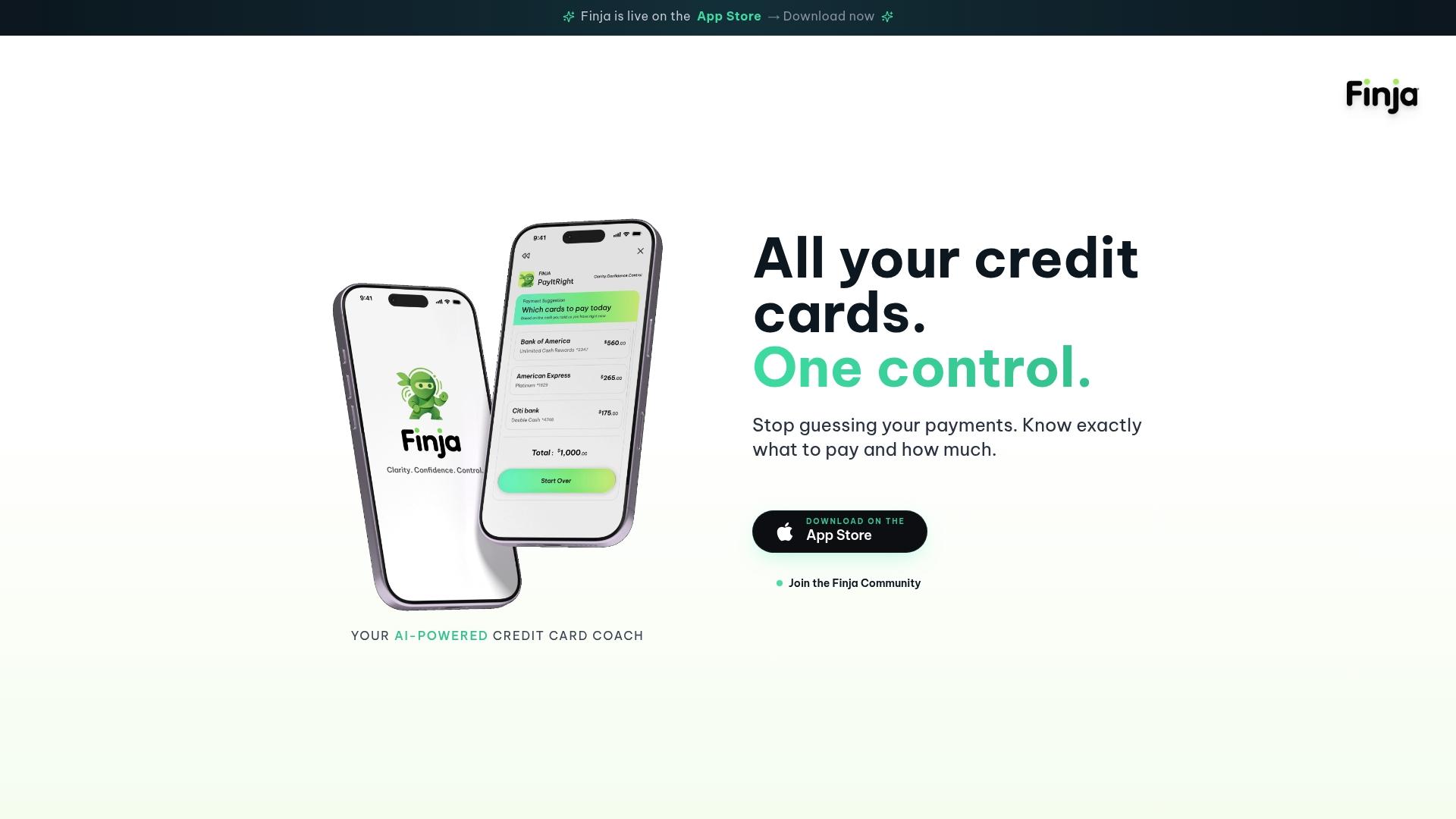
It is built for people with several cards, not for single-card reminders, and it is meant to be simple from the first use.
FAQ
What does a hold on my card mean?
It means a merchant or your issuer has temporarily frozen part or all of your available credit. It may appear as a pending charge, but that credit is not usable until the hold is released, usually after the charge processes or the account issue is resolved, per Chase.
Does a hold on my credit card cost me interest?
Generally no. Capital One says pending charges do not accrue interest before they post, and a hold usually does not enter your balance until the merchant finalizes the charge. Interest starts to matter only once the real charge posts and you carry a balance.
Why was my large credit card payment put on hold?
The issuer may be confirming that the payment will not be returned. Capital One lists a past returned payment, a change in your usual spending or payment behavior, a newly added bank account and a mistyped account number as possible triggers. Check the account details and funds, then contact your issuer if it does not clear.
Can I dispute a pending hold?
If you did not authorize it, report it to your issuer immediately through the fraud process. If you authorized it but the amount is a problem, Capital One says it generally has to post before you can dispute it. Keep records of the agreed amount in the meantime.
How long will a hotel or rental-car hold stay on my card?
The FTC says it will most likely be replaced within one or two days if you pay the final bill with the same card. If you pay with another card, cash or a check, the original block may last up to 15 days. Ask the business how long its block runs before you commit.
Sources
- Pending credit card transactions | Capital One Help Center
- Understanding a payment hold | Capital One Help Center
- Troubleshooting declined transactions | Capital One Help Center
- When a Company Declines Your Credit or Debit Card | FTC Consumer Advice
- What Is a Credit Card Hold? | Experian
- What Is a Credit Card Hold & How Does It Work? | Chase
- How Long Do Pending Transactions on a Credit Card Take? | NerdWallet