
Your score most likely fell because of one of six things: a late payment reported to the bureaus, a spike in credit utilization tied to your statement closing date, a new hard inquiry, an account closure or paid off loan, a collection or charge off, or an error or identity theft. The size of the drop usually tells you which one happened. Pull your credit reports and compare your last two statement balances before you do anything else.
TL;DR:
- Most score drops are caused by high utilization reported at statement closing, not by recent payments or payoffs, and can be mitigated by paying down balances before closing dates.
- Late payments are the most damaging event, especially after 30 days past due, with higher initial scores experiencing larger point losses that can take years to recover.
- Multiple credit inquiries for different types of loans or new credit cards in a short period can significantly lower your score, while shopping for the same loan type within 14 to 45 days is usually treated as a single inquiry.
- Closing old accounts or having issuer-initiated limit cuts can reduce available credit and shorten your credit history, potentially causing score declines even if your spending stays stable.
- The largest single drops are caused by collections, charge-offs, or fraud, and quick recovery depends on the cause, with utilization spikes bouncing back faster than late payments or collections.
Table of Contents
- Quick Checklist: Likely Causes and Typical Point Impact
- Late and Missed Payments: The One That Hurts Most
- Credit Utilization and the Statement Closing Date Trap
- New Credit Applications and Hard Inquiries
- Closed Accounts, Paid Off Loans, and Shifts in Credit Mix
- Collections, Charge-Offs, Errors, and Identity Theft
- How to Check Your Reports and Pinpoint the Cause
- How to Recover: Matching the Fix to the Cause
- Catching Utilization Drops Before They Happen
- Reading the Size of the Drop
- Where to Go for Reports, Disputes, and Fraud Help
- Sources
- FAQ
Quick Checklist: Likely Causes and Typical Point Impact
Match your situation to this list before digging into the details below.
- Late payment (30+ days): the most damaging single event, often 60 to 110+ points depending on your starting score
- High utilization at statement close: typically causes a moderate drop, and it usually bounces back within a billing cycle or two
- New hard inquiry: generally causes a small drop, fading within 12 months
- Closed account or paid off loan: usually 5 to 30 points from shorter history or lost available credit
- Collection or charge off: commonly causes a large drop, sometimes very severe
- Reporting error or identity theft: unpredictable, sometimes severe, and worth treating as urgent
Not every dip means something went wrong. Scores fluctuate a few points month to month simply because balances and reporting dates shift. According to BECU's breakdown of common causes, a lot of "unexplained" drops trace back to when your card issuer reports your balance, not when you actually paid it. If nothing on your report changed but your score did, check your statement closing date first.
Late and Missed Payments: The One That Hurts Most
Payment history makes up roughly 35% of your score in the most widely used scoring models, more than any other factor, according to Experian. That weight is exactly why a single late payment can undo months of careful management overnight.
Here is the mechanic most people miss: creditors don't report you late the day your payment is due. They report it once you're 30 days past due. Before that threshold, you might owe a late fee, but your score is untouched. Cross 30 days, though, and the damage compounds at 60 and 90 day marks, with each stage doing more harm than the last.
The higher your starting score, the further you tend to fall. Someone with a 780 score can lose more points from a first late payment than someone with a 620, simply because the model has more room to punish a "surprise."
If a late payment just hit your report, act fast:
- Bring the account current immediately, even if it means a partial payment plus a call to the lender
- Pull your statements and payment confirmations as proof of the actual payment date
- Dispute it with the bureau directly if the late was reported in error
- Call the issuer and ask for a goodwill adjustment, especially if this is a first offense on an otherwise clean account
Pro Tip: Goodwill letters work more often than people expect on accounts with years of on time history. Frame it as a one time slip, not a pattern, and reference your tenure with the lender.
If you need a structured path for disputing or negotiating a late payment off your report, Finja's guide on removing a late payment walks through the CFPB escalation process step by step.
Credit Utilization and the Statement Closing Date Trap
Utilization measures how much of your available credit you're using, both per card and across all your cards combined. Most guidance says to stay well under 30%, and the lower you go, the better your score tends to look.
Here's the part that trips up otherwise responsible cardholders: card issuers report your balance around the statement closing date, not your due date or the date you paid. A high balance reported to the bureaus at your statement closing date can increase reported utilization, even if you pay it off before the due date, according to GreenPath. Your score reacts to that snapshot, not your actual payoff habit.
Picture this: you put $4,000 on a card with a $5,000 limit to cover a car repair, and your statement closes two days later at 80% utilization. You pay it off entirely before the due date, but the bureaus already saw the 80% number. Your score drops until the next reporting cycle shows a lower balance.
Fixes that actually work:
- Pay down balances a few days before your statement closing date, not just before the due date
- Request a credit limit increase to lower your utilization ratio without changing spending
- Spread large purchases across cards instead of maxing one out
Pro Tip: If you juggle multiple cards, figure out each one's statement closing date and set a calendar reminder two days ahead. That single habit prevents most utilization-driven score surprises.
Finja's piece on tracking 30 to 45 day score changes breaks down exactly how reporting timing creates these mystery dips across multiple cards.
New Credit Applications and Hard Inquiries
A single hard inquiry usually causes a small drop that is strongest in the first six months, fading by 12 months, according to BECU. It stays on your report for about two years, but its influence on your score shrinks well before that.
Mortgage, auto loan, and student loan shopping get special treatment. Scoring models recognize that consumers rate shop, so multiple inquiries within a 14 to 45 day window (the exact window depends on the model) count as a single inquiry instead of stacking penalties.
Credit card applications don't get that courtesy. Applying for three store cards in one month hits you three separate times, which is why opening several cards in a short window tends to do more damage than shopping for a mortgage rate across five lenders.
- One inquiry: minor, usually 5 to 10 points
- Several inquiries in a short window for the same loan type: often treated as one event
- Several inquiries for different credit cards: each one counts separately
- An inquiry you don't recognize at all: treat it as a possible fraud flag, not a memory lapse
If you're not sure how long a specific inquiry will keep affecting you, Finja's guide on how long hard inquiries last lets you map out the timeline for your exact situation.
Closed Accounts, Paid Off Loans, and Shifts in Credit Mix
Closing a credit card can reduce your total available credit and average account age, which may lower your credit score even if your spending remains the same.
When you close a long-standing card, you lose that account's contribution to your average account age and its slice of your total available credit, according to Chase. Both of those losses can push your utilization ratio up even if your spending never changed, and a shorter average account age can knock down your score independent of anything else.
Paying off an installment loan can cause a small, usually temporary, score dip by changing your credit mix, even though it is beneficial long term.
Even credit limit decreases initiated by your issuer, not by you, can quietly spike your utilization since the math changes even when your balance stays the same.
Practical rules worth following:
- Keep no annual fee cards open rather than closing them, even if you rarely use them
- Time a loan payoff for after any major borrowing, like a mortgage application, rather than right before it
- Watch for issuer-initiated limit cuts, which often show up after a period of low usage
Finja breaks down the mechanics further in why canceling old cards hurts your score and in credit mix optimization strategies if you want to plan account changes without the side effects.
Collections, Charge-Offs, Errors, and Identity Theft
This is where the biggest, scariest drops come from. A collection account or a charge-off represents a serious default, and it typically produces the largest single-cycle score loss outside of outright fraud.
Recent bureau policy changes have limited the impact of many paid medical collections and raised thresholds for reporting unpaid ones, as tracked by the CFPB's consumer research. Unpaid non-medical collections and charge-offs still hit hard, and they still count.
Identity theft is the wild card. According to Experian, identity theft and fraudulent accounts can cause severe, often triple-digit, sudden credit score drops. Watch for these red flags:
- Accounts on your report you never opened
- Hard inquiries from lenders you never applied to
- An address or employer listed that isn't yours
If you spot any of that, don't wait. Document everything with screenshots and dates, dispute the entries with each bureau in writing, and place a fraud alert or a full credit freeze on your file. The CFPB's guidance on making ends meet outlines the dispute process, and it's worth following closely since errors are more common than most people assume.
How to Check Your Reports and Pinpoint the Cause
Work through this in order rather than jumping straight to a dispute.
- Pull your reports. Get free reports from AnnualCreditReport.com, the only site authorized for no cost federal reports, and check each bureau's own consumer portal for score specific details.
- Scan every trade line. Confirm balances, account status, and limits match what you expect on each card and loan.
- Check the balance at your last statement close, not just today's balance, since that's the number that got reported.
- Review the inquiries section for anything you don't recognize.
- Look for status changes, like an account marked closed, charged off, or sent to collections that you weren't expecting.
- Verify your personal information, including addresses and employers, for anything unfamiliar.
- Save evidence as you go: screenshots, dates, and billing statements, before you file any dispute.
- If you suspect identity theft, file a report at IdentityTheft.gov and consider a police report if accounts were opened fraudulently.
Pro Tip: Take screenshots the moment you notice a drop, not after you've already started disputing. Bureaus process changes fast, and the evidence you need can disappear from view within days.
How to Recover: Matching the Fix to the Cause
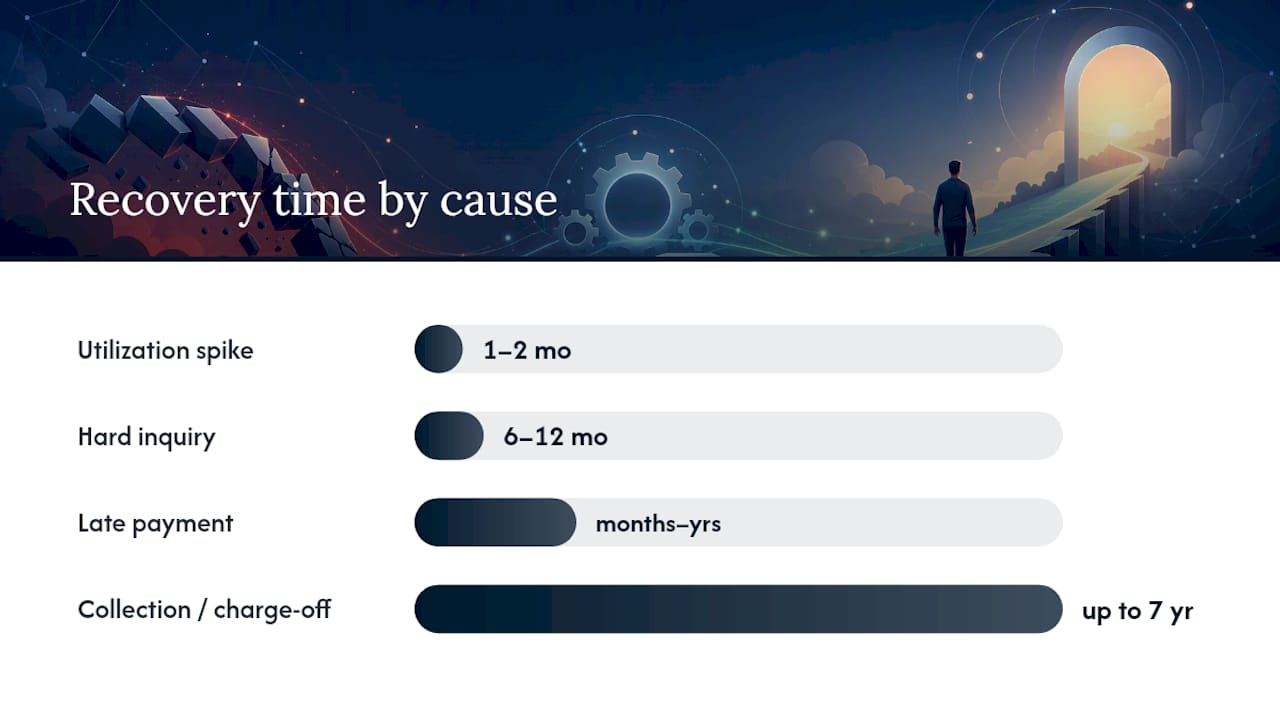
Recovery speed depends entirely on what caused the drop. Utilization spikes bounce back fastest; late payments and collections take the longest.
Fast fixes you can do this week:
- Pay down balances before your next statement closes, not just before the due date
- Dispute any inaccurate late payment notation directly with the bureau
- Request a credit limit increase on an underused card to lower your ratio instantly
For collections, some agencies will accept a pay for delete arrangement. Get any such agreement in writing before you send a dime, since verbal promises aren't enforceable. If you settle a collection, get written confirmation of the settlement terms and the updated reporting status.
Long term, consistency does the real work: on time payments, letting old accounts age instead of closing them, and monitoring your reports regularly rather than only after something feels off.
| Cause | Typical Recovery Time |
|---|---|
| Utilization spike | 30 to 60 days |
| Hard inquiry | 6 to 12 months |
| Late payment | Several months to a few years |
| Collection or charge-off | Up to 7 years on report, impact fades over time |
Finja's prioritized recovery plan and its payment history improvement guide both go deeper into sequencing these fixes if you're juggling more than one cause at once.
Catching Utilization Drops Before They Happen
Multi-card management makes statement-close timing genuinely hard to track by hand. Some AI-powered credit card coaches consolidate multiple accounts into one view and flag payment timing before a high balance gets reported at statement close, rather than after your score has already dropped.
Some credit coaching platforms focus on levers that affect score: interest cost and utilization timing. For a deeper dive on the mechanics behind timing-related dips, see Finja's 30 to 45 day score change guide.
Want a coach that tells you exactly when to pay each card? Explore Finja and see how AI-guided payment timing keeps utilization spikes from catching you off guard.
Reading the Size of the Drop
Not every score change deserves the same reaction, and treating a 5-point dip like a crisis wastes energy you should save for the drops that actually matter.
A drop under about 15 points is usually just noise: utilization variance or ordinary model recalculation. Nothing to lose sleep over. A drop in the 15 to 50 point range typically points to a utilization spike or a fresh hard inquiry, both of which resolve within a few months on their own. Once you're looking at 50 points or more, you're almost certainly dealing with a late payment, a collection, a charge-off, or fraud, and that's the range where I'd stop waiting and start pulling reports immediately.
The trigger for urgency isn't really the point count on its own. It's whether you recognize everything on your report. An account you don't remember opening or an inquiry from a lender you never contacted matters more than the raw number, even at 20 points. Most months, though, the right move is simply routine monitoring, not panic. Scores wiggle. What you're watching for is the wiggle that doesn't make sense.
— Grace K.
Where to Go for Reports, Disputes, and Fraud Help
Start with AnnualCreditReport.com for your free reports from all three bureaus, the standard entry point recommended by federal consumer resources. For disputing an error or understanding your rights, the CFPB's consumer guidance covers the process in detail, and IdentityTheft.gov handles fraud reporting specifically.
For ongoing tactical reading, Finja's blog covers payment history repair, inquiry timelines, and credit mix strategy in more depth than any single article can cover.
Sources
- Why Did My Credit Score Drop? | Experian
- Why Did My Credit Score Drop? | GreenPath
- CFPB report: Making ends meet in 2023
FAQ
Why would my credit score drop if I haven't done anything?
Your balance may have been reported at a high point during your statement closing date, or a card issuer may have cut your credit limit, both of which raise utilization without any action on your part.
What is the biggest killer of credit scores?
Collections and charge-offs typically cause the largest single drops outside of fraud, with late payments close behind since payment history makes up roughly 35% of most scoring models according to Experian.
How many Americans have a 700 credit score?
Score distribution data varies by source and year, so check current figures directly from a bureau like Experian or FICO rather than relying on a fixed number here.
What credit score do you need for a $400,000 house?
Mortgage qualification depends on loan type, lender, down payment, and debt-to-income ratio, not score alone, so speak with a lender about your specific numbers rather than relying on a single threshold.
How long does a hard inquiry affect my score?
A hard inquiry's impact is strongest in the first six months and fades substantially by 12 months, even though it remains visible on your report for about two years.