
The fastest way to improve your payment history credit standing is to stop new late marks immediately. Bring any past-due accounts current, then build a system that makes on-time payments automatic. According to myFICO, payment history is the single most important factor in your FICO Score, carrying roughly 35% of the total weight. Some VantageScore models may assign up to about 40% weight to payment history, but for most FICO Scores, 35% is the standard.
Here are five actions you can take in the next 24–72 hours:
- Pull your free credit reports at Annualcreditreport and flag every past-due or delinquent account.
- Call each creditor with a past-due balance. Have your account number, the amount owed, and a payment method ready. Ask what it takes to bring the account current today.
- Set up autopay for at least the minimum payment on every open card or loan. Even a minimum payment filed on time prevents a 30-day late mark.
- Prioritize by account type: mortgage and auto loans first, then credit cards with recent 30+ day delinquencies, then older collection accounts.
- Enable bill reminders through your bank app or phone calendar as a backup to autopay.
Bringing a past-due account current does not erase the previous late mark, but it immediately stops new ones from being added. That's the turning point. Every on-time payment from that moment forward begins to outweigh the old negative entries.
Key Takeaways
Consistent on-time payments, starting with bringing any past-due accounts current, is the single most effective action you can take to improve your payment history and raise your credit score.
| Point | Details |
|---|---|
| Payment history weight | Payment history accounts for roughly 35% of your FICO Score (and up to about 40% on some VantageScore models), making it the highest-impact factor to address. |
| Stop new damage first | Bringing past-due accounts current immediately stops new late marks from being reported to the bureaus. |
| 7-year retention rule | Late payments remain on your credit report for up to seven years, but their impact fades as recent on-time payments accumulate. |
| Automate the minimum | Setting autopay for at least the minimum payment on every account prevents 30-day late marks regardless of cash flow. |
| Finja for multi-card users | Finja's payment optimizer consolidates due dates and recommends payment sequences to protect your credit health across all cards. |
Table of Contents
- Why payment history carries so much weight on your credit score
- What to do right now if you already have missed payments
- How to prevent late payments from happening again
- How to build positive payment history when your file is thin or damaged
- How long does it take to see real improvement?
- When and how to ask for a goodwill removal
- How to dispute incorrect late payments on your credit reports
- How Finja helps you build and protect your payment history
- The habits that actually move the needle over time
- Finja makes on-time payments the default, not the goal
- Sources
Why payment history carries so much weight on your credit score
Payment history reflects one simple question lenders ask: did this person pay what they owed, when they owed it? The answer to that question drives roughly 35% of your FICO Score and up to approximately 40% on some VantageScore models. No other single factor comes close.
The Federal Reserve's consumer credit materials confirm that payment history and responsible credit use are the primary drivers of credit score behavior — not the number of cards you carry or how long you've had them.
What actually gets reported to Equifax, Experian, and TransUnion includes: on-time payments, 30/60/90+ day delinquencies, charge-offs, accounts sent to collections, public records such as bankruptcy, and closed accounts that ended in good standing. A payment is considered "on time" if it posts by the due date. Miss that date by even one day and you may face a late fee, but creditors typically don't report the late mark to the bureaus until the account is 30 days past due. That 30-day window is your safety net.
Severity matters too. A 30-day late mark hurts less than a 90-day delinquency. Recency matters even more. A missed payment from six years ago does far less damage than one from six months ago, because scoring models weight recent behavior more heavily.
What to do right now if you already have missed payments
Getting current is step one, and it's non-negotiable. To figure out exactly what you owe, call the creditor and ask for the total past-due amount including any fees. Bringing that account current stops new late marks from being reported and starts your recovery clock immediately.
Prioritize in this order
- Housing payments (mortgage or rent, if reported) — losing housing is the worst financial outcome and these carry the most scoring weight.
- Secured loans (auto, personal loans with collateral) — repossession compounds the damage.
- Credit cards with recent 30+ or 60+ day delinquencies — the more recent the delinquency, the harder it hits your score.
- Older collection accounts — these already hurt you; negotiate carefully before paying (see the goodwill section below).
Scripts that actually work
When you call a creditor, keep it short and direct:
"Hi, I have account number [X]. I'm behind and I want to bring this current today. Can you tell me the exact amount I need to pay, and can you confirm that once I pay it, no additional late marks will be reported?"
For hardship plans, add: "I've had a temporary financial setback. Do you have a hardship program or a reduced-payment arrangement I can apply for?"
After getting current, ask the representative to note your account as "paid current" and confirm the date. Then set up autopay before you hang up.
- Confirm the creditor's reporting schedule (most report monthly).
- Request written confirmation of any payment arrangement.
- Check your credit report 30–45 days later to verify the update.
Pro Tip: If you can't pay the full past-due amount at once, pay enough to push the account back under 30 days past due, which helps avoid a new late mark while arranging the rest. days past due. That single targeted payment stops a new late mark from being filed while you arrange the rest.
How to prevent late payments from happening again
The single best habit is automating at least the minimum payment on every account. A payment that posts automatically, even for the minimum, cannot become a 30-day late mark. Experian recommends autopay as the most reliable way to protect your payment record going forward.
Autopay vs. reminders vs. manual payment
| Method | Reliability | Risk | Best for |
|---|---|---|---|
| Autopay (minimum) | Highest | Overdraft if balance is low | Everyone as a baseline |
| Autopay (full balance) | High | Overdraft on large balances | Those who pay in full monthly |
| Calendar reminders | Medium | Human error, forgotten alerts | Backup to autopay only |
| Manual payment | Low | Missed due dates | Not recommended as sole method |
Set autopay for the minimum as your floor, then pay extra manually when cash flow allows. That way you never miss a due date, and you still control how much you pay above the minimum.
Due-date strategies worth knowing
Most card issuers let you move your due date by calling or adjusting it online. If you have multiple cards, stagger the due dates across the month so you're not covering several large payments at once. Paying a few days before the statement closing date (not just the due date) also lowers the balance that gets reported to the bureaus, which reduces your credit utilization ratio. That's a secondary win on top of protecting your payment record.
For a deeper look at scheduling payments across multiple cards, the credit card due date management guide covers the mechanics in detail.
Pro Tip: On cards you rarely use, set a small recurring charge like a streaming subscription and pair it with autopay. The card stays active, reports a positive payment every month, and you never have to think about it.
How to build positive payment history when your file is thin or damaged
If your credit file has few accounts or a string of negatives, you need to add new, positive payment records. The goal is to give the bureaus recent, consistent on-time data to work with.
- Secured credit cards: You deposit cash as collateral (typically $200–$500) and the card reports monthly to all three bureaus. Use it for small purchases and pay in full each month. Confirm the issuer reports to Equifax, Experian, and TransUnion before applying.
- Credit-builder loans: Offered by many credit unions and community banks, these loans hold the funds in a savings account while you make payments. Once paid off, you receive the money. The payment history gets reported throughout. Watch for origination fees that eat into the benefit.
- Rent and utility reporting: Services like Experian RentBureau or third-party rent-reporting tools can add your monthly rent payments to your Experian file. Some services report to all three bureaus; others report to only one. Verify coverage before signing up.
- Experian Boost: This free tool from Experian lets you add utility, phone, and streaming payment history directly to your Experian credit file. It only affects your Experian report and scores that pull from it, not Equifax or TransUnion. Still, for a thin-file consumer, even a single bureau improvement can matter.
Experian's guidance and the CFPB's rebuild-your-credit resource both emphasize that any product you use must report to the national bureaus to count. A credit-builder product that only reports internally does nothing for your FICO Score.
Thin-file users (few or no accounts): start with a secured card plus Experian Boost. Add a credit-builder loan after three to six months.
Damaged-file users (negatives present): get current first, then add a secured card. Don't open multiple new accounts at once; each application triggers a hard inquiry.
How long does it take to see real improvement?
The short answer: you can see meaningful score movement within months for recent on-time payments and lower utilization. But a 30-day delinquency stays on your report for up to seven years, and a 90-day delinquency causes a larger initial drop that takes longer to recover from.
Late payments remain on your credit report for up to seven years from the original delinquency date. Their impact on your score fades steadily as you build a longer streak of on-time payments behind them.
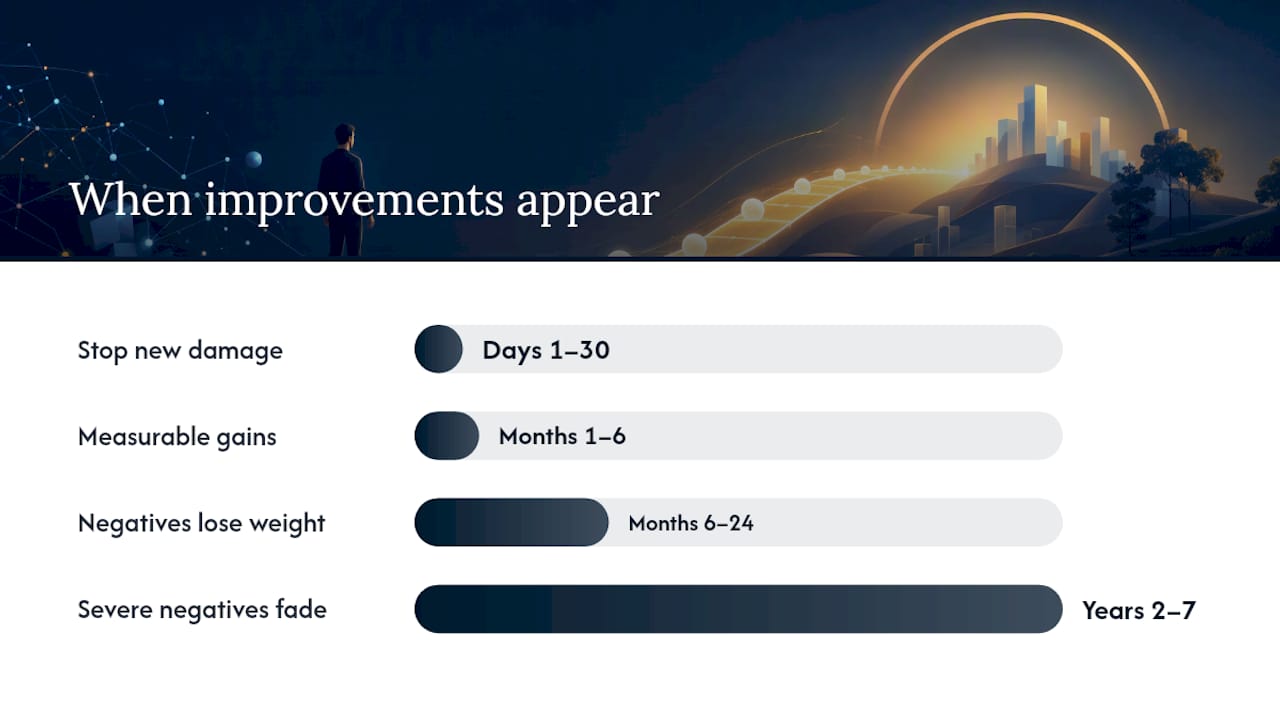
Here's a realistic timeline:
- Days 1–30: Stop new damage. Get current, set up autopay, dispute any errors. No score change yet, but the bleeding stops.
- Months 1–6: On-time payments begin stacking. Utilization drops if you're paying down balances. Consistent on-time payments and reduced utilization can produce measurable score gains within this window.
- Months 6–24: Older negatives lose weight as recent positive history grows. A 30-day late mark from 18 months ago matters far less than one from last month.
- Years 2–7: Severe negatives (charge-offs, collections, 90-day delinquencies) continue to fade. By year four or five, most consumers with otherwise clean recent history see scores that no longer reflect the old damage heavily.
The Federal Reserve's credit score guidance reinforces this: there's no fast fix for a damaged history, but consistent behavior compounds over time. Track your progress monthly using free credit monitoring so you can see the trend moving in the right direction.
When and how to ask for a goodwill removal
A goodwill removal is a request to a creditor asking them to delete a reported late payment as a courtesy. It's not guaranteed, and creditors have no legal obligation to agree. But for an isolated late payment on an otherwise clean account, it's worth asking.
Goodwill removals work best when you have a long, positive history with the creditor, the late payment was a one-time event (illness, job loss, travel), and you've been current ever since.
Sample goodwill letter framework
"Dear [Creditor Name] Customer Service Team,
I'm writing to request a goodwill adjustment to my account [number]. I have been a customer since [year] and have maintained a strong payment record with the exception of a late payment in [month/year], which occurred due to [brief, honest reason]. I have since brought my account current and have not missed a payment since. I respectfully ask that you consider removing this late mark as a goodwill gesture. I value my relationship with [Creditor] and am committed to maintaining it going forward.
Thank you for your consideration."
Keep it under 200 words. Be specific about the date and reason. Don't threaten to close the account or imply legal action.
Dos and don'ts:
- Do send the letter by certified mail and follow up by phone.
- Do document the reason honestly (vague requests get ignored).
- Don't expect removal as a right. Most creditors will decline, and that's their prerogative.
- Don't pay a collection account expecting automatic deletion unless you have a written pay-for-delete agreement first.
Pay-for-delete applies specifically to collection accounts. Some collectors will agree in writing to remove the entry upon payment. Get that agreement in writing before you pay a single dollar. Not all collectors honor these agreements, and the original creditor's entry may remain even if the collector's entry is removed. For more on credit card payment plans and negotiation, including hardship arrangements, that resource covers the full process.
How to dispute incorrect late payments on your credit reports
Errors on credit reports are more common than most people expect. A payment you made on time can appear as late due to a processing delay, a creditor's reporting error, or even identity mix-ups. You have the legal right to dispute any inaccurate entry.
The FTC's consumer credit resources confirm your right to dispute inaccurate information and explain what creditors and bureaus are required to do during the investigation process.
Step-by-step dispute workflow
- Get your reports from all three bureaus at AnnualCreditReport.com.
- Identify the suspect entry: note the creditor name, account number, reported date, and the specific error.
- Gather evidence: bank statements showing the payment cleared, payment confirmation emails, or screenshots from your bank's transaction history.
- File a dispute with the bureau that shows the error (or all three if it appears on multiple reports). You can dispute online, by mail, or by phone.
- Also contact the original creditor (the "furnisher") directly. Disputing with both the bureau and the furnisher simultaneously strengthens your case.
- The bureau has 30 days to investigate and respond. If the entry is verified as accurate, it stays. If it can't be verified, it must be removed.
For understanding how account statuses appear on your report, that guide explains the terminology you'll encounter during this process.
Official dispute resources
| Bureau | Dispute Portal | What it covers |
|---|---|---|
| Experian | experian.com/disputes | Experian credit file errors |
| Equifax | equifax.com/personal/credit-report-services | Equifax credit file errors |
| TransUnion | transunion.com/credit-disputes | TransUnion credit file errors |
| CFPB | consumerfinance.gov/complaint | Complaints against creditors or bureaus |
| FTC | Ftc | Consumer rights and fraud resources |
How Finja helps you build and protect your payment history
Managing payments across multiple credit cards is where most people slip up. One card's due date falls on a Friday, another on the 28th, a third has a variable minimum that changes each month. That complexity is exactly where Finja operates.
Finja's AI-powered platform consolidates all your card accounts into a single payment calendar, so you see every due date, minimum payment, and statement closing date in one place. The optimizer recommends which card to pay first and how much, based on your balances, due dates, and utilization levels. That means you're not just paying on time; you're paying in a sequence that protects your credit health most efficiently.
- Consolidated payment calendar: see all due dates and minimums at a glance.
- Payment sequencing recommendations: Finja flags which accounts are closest to triggering a 30-day late mark and prioritizes them.
- Low-balance alerts: get notified before a linked account dips below a safe threshold for autopay.
- Utilization tracking: see how your statement-close balances affect your reported utilization before the bureaus see them.
For a multi-card user, the difference between paying randomly and paying in an optimized sequence can mean the difference between a 30-day delinquency and a clean month. Finja's system is designed to make the right payment at the right time the default, not the exception.
Pro Tip: Connect all your cards to Finja's dashboard and enable the minimum-payment protection feature. Even if you can't pay more than the minimum on a given month, the system flags it and schedules it before the due date, so no card slips into late-reporting territory.
The habits that actually move the needle over time
Most people who struggle with late payments aren't irresponsible. They're disorganized. The accounts pile up, the due dates blur together, and one card gets missed because it wasn't in the mental rotation.
Three micro-habits consistently separate people who rebuild their credit from those who stay stuck:
Pay before the statement closing date, not just the due date. The balance reported to the bureaus is the one on your statement at closing, not at the due date. Paying down a card before it closes lowers your reported utilization, which is a secondary score factor that can move quickly.
Schedule autopay for minimums on every account, no exceptions. This is the floor. You can always pay more manually. But the minimum autopay means you never accidentally let a card go 30 days past due because you forgot.
Do a monthly five-minute account review. Log in, confirm every payment posted, check for any new charges you didn't recognize, and verify your balances are trending in the right direction. Five minutes once a month catches errors before they become disputes.
The mistake most people make is treating payment management as a reactive task. Something goes wrong, they fix it, then go back to ignoring it. The credit score improvement checklist is a useful companion for building this into a regular routine rather than a crisis response.
Finja makes on-time payments the default, not the goal
Knowing what to do and actually doing it consistently are two different problems. Most people reading this guide already understand that on-time payments matter. The gap is in execution, especially across multiple cards with different due dates, minimums, and statement cycles.
Finja closes that gap. As an AI-powered credit card management platform, it gives you a consolidated view of every card, recommends the optimal payment sequence to protect your credit health, and sends alerts before any account gets close to a late-reporting threshold. You connect your cards, set your payment preferences, and Finja handles the scheduling logic that most people try to track in their heads or a spreadsheet.
Getting started takes a few minutes: download the app, connect your credit card accounts, and enable payment optimization. Finja's subscription includes a trial period so you can see the payment calendar and recommendations before committing. Your data is protected with bank-level encryption, and Finja does not make payments on your behalf without your explicit authorization.
Start managing your cards with Finja and put your payment history on autopilot.
Sources
The guidance in this article draws from the most authoritative sources on U.S. credit scoring and consumer rights. Use these directly to verify rules, file disputes, and pull your free reports.
Every source listed here is a primary institution or federally recognized consumer resource. If you read something about credit scoring elsewhere that contradicts these sources, the sources below win.
- How Payment History Impacts Your Credit Score | myFICO
- How to rebuild your credit | Consumer Financial Protection Bureau
- Usa
- How to Improve Your Payment History | Experian
- Credit score tips | Federal Reserve
- What Is Payment History and How Does It Impact Your Credit? | Intuit Credit Karma
- Ftc
Pull your reports from AnnualCreditReport.com first. Everything else in this guide flows from knowing exactly what's on your file.
This article is general information, not a substitute for advice from a qualified financial advisor. Consult a qualified financial professional about your own circumstances before acting on anything here.