
Canceling an old credit card will often lower your credit score, sometimes by more than you'd expect. The two main reasons: your credit utilization ratio jumps when you lose that card's available credit, and your average account age can drop if the closed card was one of your older accounts. Before you cancel anything, check your current utilization percentage, confirm whether the card is your oldest account, and run a score simulator.
Here's what to do right now:
- Check your total available revolving credit across all cards, then calculate what your utilization would be without this card's limit.
- Identify whether this is your oldest account. If it is, closing it will eventually shorten your average account age.
- Run a score simulator (more on the right tools below) before you make the call.
- Check your rewards balance so nothing gets forfeited at closure.
Pro Tip: Even a card you haven't touched in two years is doing quiet work for your score by holding down your utilization and keeping your account age intact. Don't close it on impulse.
According to the CFPB, closing a card can hurt your score, but the degree depends heavily on your full credit profile. FICO, the scoring model used in the vast majority of U.S. lending decisions, weighs utilization and length of credit history as two of its most influential factors. That's exactly why closing an old card tends to sting.
Key Takeaways
Canceling an old card almost always raises your credit utilization immediately, and the age effect follows gradually as the closed account eventually ages off your report.
| Point | Details |
|---|---|
| Utilization spikes first | Losing a card's limit raises your utilization ratio, the biggest immediate risk to your score. |
| Age effects are gradual | Closed accounts in good standing stay on your report for about 10 years, so the age damage is slow. |
| Thin files face the most risk | Consumers with few accounts or high existing balances will see the largest drops after closure. |
| Alternatives usually exist | Downgrading to a no-fee card or freezing the account preserves your credit limit and account age. |
| Finja models the exact impact | Finja's AI simulator shows your utilization change and recommends whether to close, downgrade, or pay down first. |
Table of Contents
- Why canceling old cards hurts your score: the FICO factors explained
- How the utilization math actually changes after you close a card
- What actually shows up on your credit report after you close an account
- Who is most likely to see a meaningful score drop?
- Safer alternatives to permanently closing an old card
- How to estimate the score impact before you act
- Step-by-step checklist to close a card safely
- The short-term score dip versus the long-term financial picture
- Finja helps you model the impact before you close a card
- Sources
Why canceling old cards hurts your score: the FICO factors explained
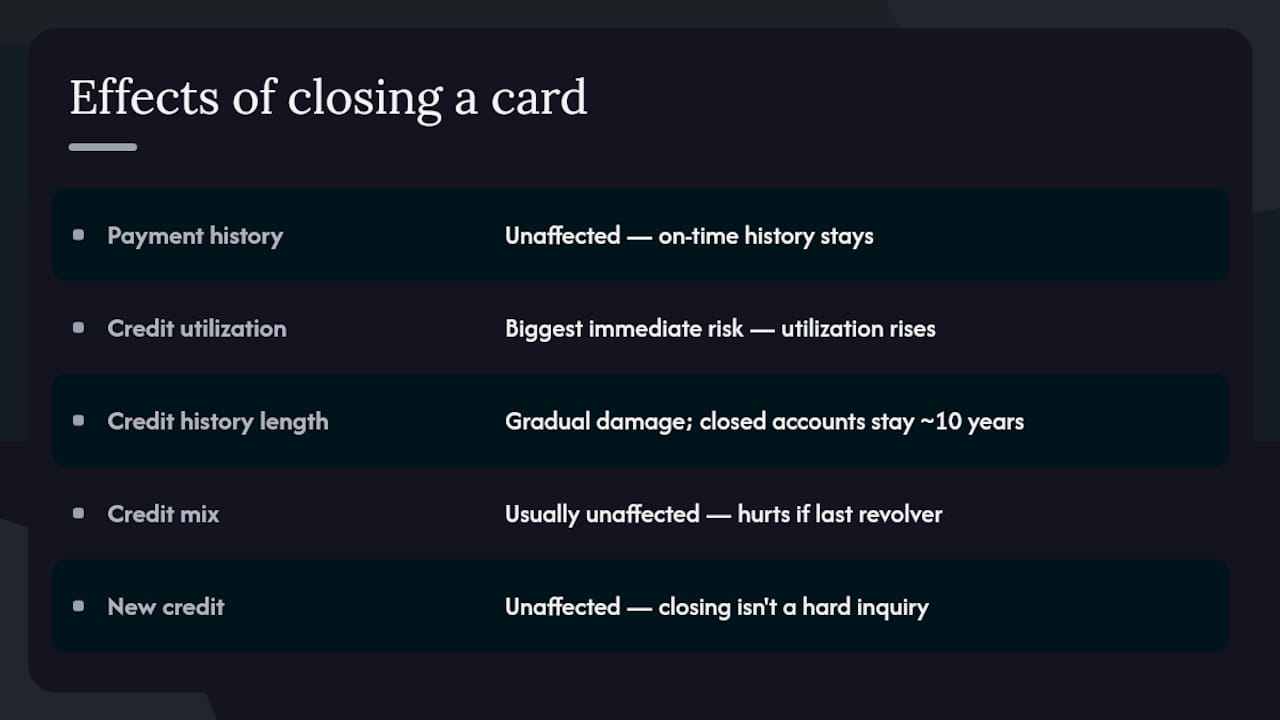
FICO scores are built from five weighted categories. Closing a card touches at least two of them directly, and sometimes three.
Credit utilization (a significant portion of your FICO score)
This is the biggest immediate risk. Closing a card removes that card's credit limit from your total available revolving credit. If you're carrying any balances on other cards, your utilization ratio rises the moment that limit disappears. Utilization is calculated both per card and across all revolving accounts combined, so a spike on either dimension can move your score.
Utilization threshold to know: Experian recommends keeping utilization well below 30%, and ideally below 10%, for the strongest scores. Cross that 30% line after a closure and you'll likely feel it.
Length of credit history (a meaningful portion of your FICO score)
This factor covers three things: the age of your oldest account, the age of your newest account, and the average age of all accounts. Closing your oldest card doesn't immediately wipe that history. Accounts closed in good standing typically remain on your credit report for about 10 years and continue counting toward your average age while they're there. The damage is gradual: once that account eventually falls off the report, your average age can drop noticeably.
Credit mix measures the variety of account types you carry: revolving accounts (credit cards, lines of credit) versus installment accounts (auto loans, mortgages, student loans). Closing a card only hurts this factor when it eliminates your last revolving account or meaningfully reduces the variety in a thin file. For someone with several cards and a mortgage, losing one revolving account rarely moves this needle.
Payment history and new credit
Two things worth clarifying: closing a card in good standing does not erase your on-time payment history from that account. Those positive marks stay on your report. And closing a card is not a hard inquiry, so it won't add a new-credit ding to your score.
How the utilization math actually changes after you close a card
Abstract percentages are easier to understand with real numbers. Here are two scenarios.

Scenario A: Low-balance situation
You have three cards with a combined limit of $15,000. You carry a $1,500 balance total. You close one card with a $3,000 limit and a zero balance.
Scenario B: Higher-balance situation
Same three cards, same $15,000 combined limit. This time you carry a $4,500 balance. You close the same $3,000 zero-balance card.
In Scenario A, the jump is modest. The card you're closing carries no balance in either case. That's the counterintuitive part: closing a card you don't even use can still raise your utilization because you lose its available credit.
Pro Tip: Before running any simulator, pull your most recent statement balances, not your current real-time balances. Issuers report to the bureaus on your statement close date, so that's the number that actually feeds your score. Using the wrong balance figure will give you an inaccurate forecast.
For a deeper look at credit card financial modeling and how to build a realistic picture of your score before making any card decisions, that guide walks through the inputs that matter most.
What actually shows up on your credit report after you close an account
Closing a card doesn't make it vanish from your report. The account stays, labeled "closed," and continues to influence your score for years.
Here's the timeline to understand:
- Utilization effect is immediate. Once the issuer reports the account as closed, that limit drops from your available credit. This typically hits your report within one billing cycle.
- Age effects are slow-moving. Because closed accounts in good standing remain on your report for roughly 10 years, the average-age damage is gradual. You won't feel a sudden age collapse the day you close the account.
- Adverse accounts follow a different rule. Accounts with negative marks (late payments, collections) typically fall off after about 7 years, per CFPB guidelines.
- Score changes appear in the next reporting cycle, usually within 30–45 days of closure.
Post-closure monitoring checklist:
- Pull your credit reports from AnnualCreditReport.com at 30, 60, and 90 days after closing.
- Confirm the account shows "closed by consumer" and "in good standing," not "closed by issuer" or with any derogatory notation.
- Watch your utilization on remaining cards for the first two cycles.
- Check that your positive payment history on the closed account is still visible.
Who is most likely to see a meaningful score drop?
TransUnion makes the point clearly: the impact of closing a card is highly personalized. The same closure can be a non-event for one person and a 30-point drop for another. Here's how to figure out which side you're on.
Higher risk of a meaningful drop:
- You have a thin credit file, meaning fewer than five total accounts or a short overall history.
- The card you're closing represents a large share of your total available credit (say, 30% or more of your combined limit).
- You're already carrying balances that put you near or above 30% utilization.
- The card being closed is your oldest account, and your next-oldest account is significantly younger.
- You have no installment accounts (no auto loan, mortgage, or student loan), making your revolving accounts your only credit mix.
Lower risk:
- You have many open accounts with long histories and low balances.
- The card you're closing has a small limit relative to your total available credit.
- Your overall utilization stays well below 30% even after removing this card's limit.
- You have other old accounts that will continue anchoring your average age.
For context: CNBC Select reported a published simulation where a well-established cardholder saw only a 1-point score drop after closing an account, with scores rebounding quickly as long as payments stayed current. That's a realistic outcome for someone with a thick file and low utilization. It's not the typical outcome for someone with two cards and a $4,000 balance.
Understanding how credit mix optimization works can help you assess whether your file is thick enough to absorb a closure without meaningful damage.
Safer alternatives to permanently closing an old card
Closing a card is permanent. Most of the problems people want to solve by closing a card can be solved another way.
- Downgrade or product-change the card. Call your issuer and ask to switch to a no-annual-fee version of the same card. You keep the account age, you keep the credit limit, and you eliminate the fee. This is almost always the right first move when the annual fee is the issue.
- Put the card in a drawer and use it occasionally. A small recurring charge (a streaming subscription, a gas fill-up once a month) keeps the account active and prevents the issuer from closing it on their end. Set the card to autopay so you never miss a payment.
- Freeze or cut the physical card. If overspending is the concern, you can destroy the physical card or freeze it through your issuer's app without closing the account. The credit line stays intact.
- Request a credit limit reallocation. Some issuers let you move credit from one card to another. If you want to consolidate, you can shift the limit to a card you use more often before closing the lower-limit card, preserving your total available credit.
- Pay down balances before closing. If you've decided closure is the right call, reducing your balances on other cards first softens the utilization spike.
Pro Tip: If the annual fee is your reason for closing, call the retention line before you do anything else. Issuers routinely offer statement credits, bonus points, or a fee waiver for one year to keep you from canceling. It takes five minutes and often works.
For more on managing multiple credit cards without letting any one card become a liability, that guide covers the practical side of keeping a multi-card setup organized.
How to estimate the score impact before you act
Running a simulation before you close a card takes about ten minutes and can save you from a surprise you didn't need.
Tools that can help:
- CreditWise from Capital One includes a score simulator that lets you model what happens if you close a card. It's free and available to anyone, not just Capital One customers.
- Issuer-provided simulators (available through some bank apps) let you model changes within your existing account data.
- Finja's AI credit-card simulator consolidates all your card data in one place and models the utilization and age effects of closing any individual card, then recommends whether paying down a balance first or downgrading is the better move for your specific profile.
Step-by-step manual model:
- List every open revolving account with its current reported balance and credit limit.
- Add up total available credit and total balances. Divide to get current utilization.
- Remove the card you're considering closing: subtract its limit from total available credit (keep the balance if it's nonzero, since you'd still owe it).
- Recalculate utilization with the new total available credit.
- Check whether the new utilization crosses 30% or 10%. If it does, that's your signal to pay down balances before closing.
- Identify whether this is your oldest account and estimate how much your average age would drop.
Simulator limitations to keep in mind: these tools use approximations. They model the most likely outcome based on your current data, but FICO's exact algorithm isn't public. The most important inputs to get right are your reported statement balances (not real-time balances) and your correct credit limits.
Pro Tip: Run the simulation twice: once with your current balances, and once after modeling a paydown of $500 or $1,000 on your highest-balance card. Seeing the difference between those two scenarios often reveals whether a small paydown before closing eliminates the utilization risk entirely.
The AI credit management tools available today can automate most of this modeling, which is especially useful when you're managing three or more cards simultaneously.
Step-by-step checklist to close a card safely
If you've run the simulation and closing is still the right call, here's how to do it without leaving loose ends.
Before you close:
- Log in and redeem every reward point, mile, or cashback dollar. Most issuers forfeit unredeemed rewards at closure.
- Pay the balance to zero, or arrange a balance transfer to another card.
- Cancel any automatic payments or subscriptions tied to this card and update them to a different card.
- Screenshot or download your last 12 months of statements for your records.
- Run your utilization simulation one final time with current balances.
When you initiate closure:
- Call the issuer directly (the number on the back of the card). Closing online or by chat sometimes leaves the process incomplete.
- Ask the representative to note the account as "closed by consumer" and confirm the account is in good standing at closure.
- Request written confirmation (email or letter) of the closure and the effective date.
- Ask whether any pending transactions or interest charges could post after closure.
After closure:
- Check your credit report within 30 days to confirm the account shows "closed" with a zero balance and no derogatory marks.
- Monitor your utilization on remaining cards for the next two billing cycles.
- Verify your positive payment history on the closed account is still visible on the report.
- If the report shows anything inaccurate (wrong balance, wrong closure reason, missing payment history), dispute it directly with the bureau.
Investopedia's guide on canceling a credit card covers the issuer-contact steps in detail and is worth bookmarking before you make the call.
The short-term score dip versus the long-term financial picture
Here's the perspective most credit articles skip: a temporary score drop is not always the wrong outcome.
The CFPB is direct about this: personal financial trade-offs matter. If a card charges a $550 annual fee you're not recouping in value, or if keeping it open is enabling spending you can't sustain, the score mechanics become secondary. A 15-point dip that saves you $550 a year and removes a behavioral risk is a good trade.
Scores are also more resilient than people assume. For well-established profiles, CNBC Select's reporting shows that drops from a single closure are often small and rebound within a few months if payments stay current. The readers who genuinely need to be cautious are those with thin files or high existing utilization, and for them the alternatives covered above (downgrade, freeze, limit reallocation) almost always solve the underlying problem without the score cost.
Credit is one component of financial health, not the whole picture. Sometimes the right financial decision produces a temporary score dip. The goal is to make that decision with clear numbers in front of you, not to avoid it because the score math looks scary at first glance.
Finja helps you model the impact before you close a card
Knowing the theory is one thing. Seeing the exact numbers for your specific cards is another.
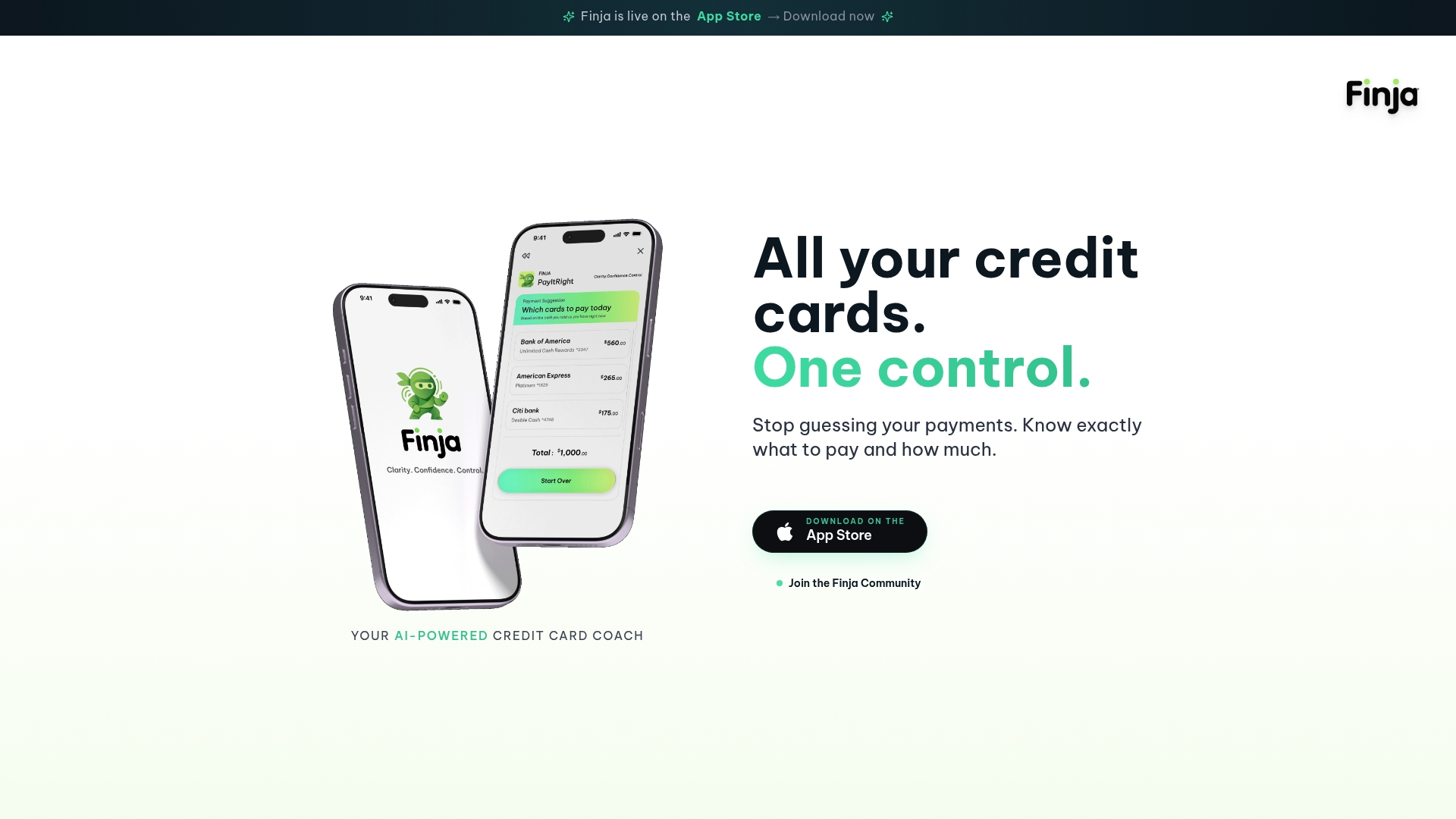
Finja is an AI-powered credit card management platform built for consumers managing multiple cards. Before you close any account, Finja's simulator shows you exactly how your utilization changes card by card, flags whether the account you're considering closing is anchoring your average age, and recommends whether paying down a specific balance first eliminates the score risk. The payment optimizer goes further: it models whether downgrading to a no-fee product or reallocating a credit limit is a better move than closing outright, so you're not guessing at trade-offs.
For cardholders carrying balances across several cards, Finja also identifies which payments reduce your interest costs fastest, so you can improve your credit score health and lower your cost of debt at the same time. Try the simulator at Myfinja before you make any card decision.
Sources
- Does it hurt my credit to close a credit card? | CFPB
- Would canceling a credit card improve my credit score? | TransUnion
- Will closing a credit card hurt your credit? | Experian
- Credit limit decrease or account closure: how it affects your FICO score | MyFICO
- Does Closing a Credit Card Hurt Your Credit Score? | Chase
This article is general information, not a substitute for advice from a qualified financial advisor. Consult a qualified financial professional about your own circumstances before acting on anything here.