
Minimum payments keep your account current, but they won't meaningfully reduce your principal. That's the short answer. The number printed on your statement is the contractual floor your issuer set, not a repayment plan, and paying only that amount can stretch a manageable balance into a decade-long debt. The NCUA and consumer-finance researchers consistently flag minimum-payment misconceptions as one of the most costly knowledge gaps in personal finance. Finja was built precisely for this problem, helping cardholders with multiple accounts see exactly what each payment actually costs them.
Table of Contents
- Common minimum payment myths you need to stop believing
- How card issuers actually calculate your minimum payment
- What paying only the minimum actually costs you
- How minimum payments affect your credit score and account standing
- How to stop relying on minimum payments
- Key Takeaways
- The real reason these myths are so hard to shake
- Useful sources and further reading
Common minimum payment myths you need to stop believing
Here are the ten most persistent myths, each followed by a one-line reality check.
-
Myth 1: Paying the minimum means you're making real progress on your debt. The minimum mostly covers interest and fees, leaving your principal nearly untouched. Fix: Pay at least double the minimum whenever your budget allows.
-
Myth 2: Minimum payments protect your credit score. They protect your payment history, but the high utilization they leave behind drags your score down. Fix: Aim to keep utilization below 30% by paying more than the minimum.
-
Myth 3: The minimum amount is set by federal law. Issuers set their own formulas; there is no federal statute mandating a specific minimum dollar amount. Fix: Read your card's terms and conditions to understand your issuer's exact method.
-
Myth 4: Missing one minimum payment is no big deal. A single missed payment can trigger a penalty APR as high as 29.99% and damage your payment history. Fix: Set up autopay for at least the minimum so you never miss.
-
Myth 5: Splitting your payment across the month isn't allowed. Most issuers accept multiple payments per cycle, and doing so reduces your average daily balance and the interest you owe. Fix: Make a mid-cycle payment whenever you have extra cash.
-
Myth 6: Minimum payments are calculated the same way on every card. Issuers use different formulas, including a flat dollar amount, a percentage of the balance, or a combination of both. Fix: Check your statement's fine print or your issuer's website.
-
Myth 7: Paying the minimum during a 0% promo period is fine. On deferred-interest promotions, unpaid balances at the end of the promo period trigger retroactive interest on the original amount. Fix: Calculate what you need to pay monthly to clear the balance before the promo ends.
-
Myth 8: Minimum payments don't affect your rewards. Carrying a balance accrues interest that can easily exceed the cash-back or points value you earned. Fix: Track your rewards against interest costs to see whether rewards are actually paying off.
-
Myth 9: Your issuer applies extra payments to your highest-rate balance first. By law, payments above the minimum go to the highest-APR balance, but the minimum itself goes to the lowest-rate balance first. Fix: Pay well above the minimum to ensure the high-rate debt gets addressed.
-
Myth 10: Minimum payments are a smart cash-flow strategy. Financial experts note that treating the minimum as a strategy creates a false sense of progress while interest compounds. Fix: Build a real payoff plan using a fixed monthly target instead.
How card issuers actually calculate your minimum payment
According to Citi's consumer guidance, issuers typically use one of three formulas:
- Percentage of balance — roughly 1%–3% of the outstanding balance, per CBS News reporting on typical ranges.
Worked example: Suppose you carry a $3,000 balance at 22% APR. Monthly interest accrues at roughly $55. If your issuer uses "1% of balance plus interest," your minimum is $30 + $55 = $85. Of that $85, only $30 reduces your principal. The rest is pure interest revenue for the issuer.
Statement timing matters too. The minimum is calculated on your statement closing balance, not your current balance. If you make a purchase after the statement closes, that amount rolls into the next cycle's calculation. Missed payments and over-limit fees get added to the next minimum, which is why a single slip can make the next bill feel unexpectedly large.
| Balance | 1% + Interest (22% APR) | 2% of Balance | Flat $35 Minimum |
|---|---|---|---|
| — | — | $10 (flat $35 applies) | $35 |
| — | — | $40 (flat $35 applies) | $40 |
| $10,000 | — | $200 | $200 |
Note: When the calculated percentage falls below the issuer's flat minimum, the flat minimum applies.
What paying only the minimum actually costs you
The numbers here are the part most people never sit down to calculate, and they're genuinely striking.
Example 1: $5,000 balance at 23% APR. Paying only the minimum (assumed at roughly 2% of balance, floored at $25) means you'll spend over 23 years paying off that balance and pay thousands in interest on top of the original $5,000. The issuer collects far more than the principal you borrowed.
Example 2: $10,000 balance at 22% APR. At a minimum payment starting around $200 and declining as the balance falls, payoff can stretch for decades, with total interest paid possibly exceeding the original balance.
The real cost of minimum-only payments: On a $5,000 balance at 23% APR, paying only the minimum can extend your payoff timeline to over two decades, costing more in interest than the original debt.
The table below shows how quickly a fixed higher payment changes the picture. Tracking your monthly interest is the first step to seeing this in real time.
| Scenario | Balance | APR | Monthly Payment | Approx. Payoff Time | Approx. Total Interest |
|---|---|---|---|---|---|
| Minimum only | $5,000 | 23% | ~$100 (declining) | 23+ years | — |
| — | $5,000 | 23% | — | ~4 years | — |
| — | $5,000 | 23% | — | ~2 years | — |
| Minimum only | $10,000 | 22% | ~$200 (declining) | 30+ years | $10,000+ |
| Fixed $300/month | $10,000 | 22% | $300 | — | — |
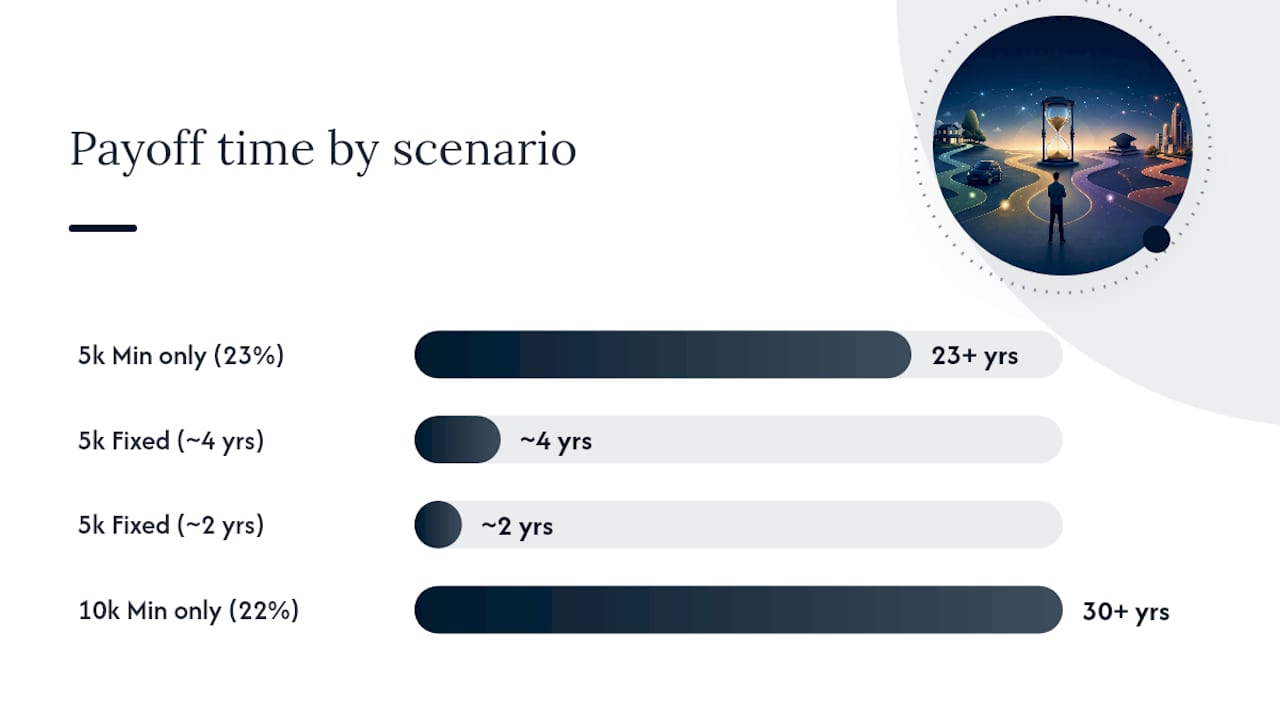
Figures are illustrative estimates based on standard amortization at the stated APR.
Deferred-interest promotions deserve a separate warning. A 0% deferred-interest offer is not the same as a true 0% APR. If you carry any balance past the promotional end date, the issuer charges interest retroactively on the full original amount, often at a rate above 26%. Paying only the minimum during that period almost guarantees you won't clear the balance in time.
How minimum payments affect your credit score and account standing
Payment history and credit utilization are the two biggest factors in most credit-score models, and minimum payments affect both in opposite directions.
On the positive side, making at least the minimum on time every month protects your payment history, which typically carries the most weight in scoring models. A single missed payment can stay on your credit report for seven years.
The problem is utilization. Paying only the minimum leaves your balance high relative to your credit limit, which keeps your utilization ratio elevated. Research from the FinHealth Network shows that disparities in credit scores and credit-history length compound over time, meaning consumers who rely on minimum payments for years face steeper barriers to affordable credit. Kansas City Fed research reinforces that traditional credit-score models can make these gaps harder to close.
Beyond the score itself, account-level consequences stack up fast:
- A missed minimum triggers a late fee (typically $30–$40) and can activate a penalty APR.
- Penalty APRs, sometimes above 29%, apply to your existing balance and all new purchases.
- A promotional 0% APR is usually voided the moment you miss a minimum payment.
- High utilization raises your debt-to-income ratio, which mortgage and auto lenders scrutinize directly.
Pro Tip: If you're planning to apply for a mortgage or auto loan within the next six months, pay your balances down aggressively now. Even dropping utilization from 60% to 25% can move your score meaningfully before the lender pulls your report.
The Genisys Credit Union's myth-debunking guide puts it plainly: minimum payments generally don't make a meaningful dent in principal, which means utilization stays high and the score benefit of on-time payments gets partially offset.
How to stop relying on minimum payments
The minimum payment trap is easy to fall into and takes deliberate effort to exit. Here's a prioritized sequence that actually works.
-
Calculate your real payoff number. Use your issuer's online payoff calculator or a free amortization tool to find the fixed monthly payment that clears your balance in 24–36 months. That number, not the minimum, is your new target.
-
Choose a payoff method and stick to it. The avalanche method (highest APR first) saves the most interest. The snowball method (smallest balance first) builds momentum faster. Either beats paying minimums across all cards simultaneously.
-
Explore a balance transfer. Moving high-APR debt to a card with a 0% introductory APR can pause interest accrual for 12–21 months. Read the credit card payment plans guide before transferring to understand fees and promotional terms.
-
Negotiate your APR. Call your issuer and ask directly. Cardholders with good payment history often get a rate reduction of a few percentage points, which meaningfully shortens payoff time.
-
Make biweekly payments. Splitting your monthly payment in half and paying every two weeks results in one extra full payment per year and reduces your average daily balance, cutting interest accrual between statements.
-
Use the 10 ways to reduce credit card bills framework for additional tactics, including negotiating fees and automating savings.
-
Ask your issuer these three questions: How is my minimum calculated? How are payments above the minimum allocated? What triggers a penalty APR on my account?
Pro Tip: Automate an extra $25–$50 on top of your minimum every month. Set it and forget it. Over a year, that adds $300–$600 in principal reduction without requiring any willpower.
Pro Tip: Round your payment up to the nearest $50. If your minimum is $67, pay $100. The habit costs almost nothing to maintain and compounds significantly over 12–18 months.

Key Takeaways
Paying only the minimum keeps your account current but leaves your principal nearly untouched, costing you years of compounding interest and keeping your credit utilization high.
| Point | Details |
|---|---|
| Minimums don't reduce principal | Most of each minimum payment covers interest, leaving the balance largely unchanged month to month. |
| Payoff timelines are extreme | A $5,000 balance at 23% APR paid at the minimum can take over 23 years to clear. |
| Utilization stays high | Minimum-only payments keep your credit utilization elevated, which offsets the benefit of on-time payment history. |
| Deferred interest is a trap | Paying only the minimum during a promotional period almost guarantees retroactive interest charges when the promo ends. |
| Finja optimizes extra payments | Finja's AI models where extra dollars reduce the most interest across multiple cards, turning good intentions into a repeatable plan. |
The real reason these myths are so hard to shake
The anchoring effect is the core of the problem. When a statement shows a $47 minimum on a $2,300 balance, the brain registers $47 as the relevant number, not $2,300. That's not a character flaw; it's a documented cognitive bias that card issuers understand well. The minimum is prominently displayed because it's the number that keeps accounts current and interest flowing.
What makes this worse is that consumer knowledge about credit scoring has declined steadily over the past decade, according to Consumer Federation research. Fewer people understand how utilization is calculated, how penalty APRs work, or what deferred interest actually means. The myths fill that knowledge gap, and they're reinforced every month when the minimum payment keeps the account green and the late-fee notice never arrives.
The practical implication: knowing the myth isn't enough. You need a system that makes paying more than the minimum the default, not the exception. Small, automated top-ups, a clear payoff target, and a consolidated view of all your cards are what convert understanding into actual debt reduction. The financial stress that comes from managing multiple cards drops sharply once you have a plan with real numbers attached to it, not just a vague intention to pay more.
Useful sources and further reading
These are the primary sources used throughout this article, each worth bookmarking for ongoing reference.
- What is the minimum payment trap (and how does it affect your finances)? - CBS News
- 3 common credit card debt myths that could be impacting your finances now - CBS News
- How Credit Card Minimum Payments Work | Citi.com
- Debunking Eight Big Credit Card Myths | Discover
- Debunking 7 Common Credit Card Myths
- ncua.gov
- finhealthnetwork.org
- kansascityfed.org
This article is general financial information, not professional advice. Confirm current rates, terms, and rules with your card issuer or a qualified financial advisor before making changes to your payment strategy.