
The fastest way to cut carrying costs across multiple credit cards is an AI-driven payment optimizer that allocates payments to minimize interest, times them to lower your average daily balance, and flags your best negotiation targets. That's the core of cash back optimization best practices as it applies to multi-card holders: reduce effective APR and reported utilization first. Rewards second.
Start here, right now:
- Pull your last statement for every card (balance, APR, minimum, due date, statement close date, credit limit)
- Identify the card with the highest APR or any card above 50% utilization
- Schedule one payment before your next statement closing date on that card
Ten minutes is enough to do all three. If you'd rather automate the allocation, connect your accounts to Finja and let the AI run the simulation. If you're not ready to connect accounts, a manual payoff calculator works as a starting point.
Key Takeaways
Paying before your statement closing date, targeting the highest-APR or most-utilized card first, and calling your longest-held issuer for a rate cut are the three moves that cut multi-card interest costs fastest.
| Point | Details |
|---|---|
| Build your inventory first | Collect balances, APRs, minimums, close dates, and credit limits before running any simulation. |
| Target utilization above 50% first | Any card above 50% utilization should receive extra payment before the statement closes, regardless of APR. |
| Call your longest-held issuer | Use account age and on-time payment history as leverage; ask for a temporary cut if permanent is denied. |
| Pay before statement close | A pre-close payment lowers the balance reported to bureaus, reducing utilization without extra spending. |
| Use Finja to automate the plan | Finja's AI optimizer runs payment-timing simulations and surfaces negotiation reminders across all your cards. |
Table of Contents
- What baseline data does your AI optimizer actually need?
- Which payment strategy saves the most interest?
- How do you ask your issuer for a lower APR?
- When does consolidation actually make sense?
- What payment timing and autopay habits cut interest fastest?
- How does an AI payment optimizer actually work?
- How do you track whether the plan is working?
- When should you stop DIY and get professional help?
- What the data actually shows about AI optimizers
- Finja puts this plan on autopilot for you
- Sources
What baseline data does your AI optimizer actually need?
Any simulation, AI-driven or manual, is only as good as its inputs. Before running a single calculation, collect these fields for every card you carry:
| Field | Where to find it |
|---|---|
| Issuer name | Card or online account |
| Last statement balance | Paper or digital statement |
| Current balance | Issuer app or online portal |
| APR (purchase rate) | Statement or account details page |
| Minimum payment | Statement or issuer app |
| Payment due date | Statement header |
| Statement close date | Statement header or issuer app |
| Credit limit | Statement or account details page |
The statement close date is the one most people miss. It's the date your issuer snapshots your balance and reports it to the credit bureaus. A payment that lands two days before close lowers the balance that gets reported, which directly reduces your utilization ratio. Your due date and your close date are rarely the same.

Pro Tip: Log into your issuer's app and search "statement closing date" or "billing cycle end." Some issuers let you shift it by a few days. If yours does, move it to give yourself a longer window between payday and close.
Once your inventory table is complete, run the numbers through a payoff calculator to get a baseline interest cost. That number is your benchmark. Everything you do from here should move it down. Paying only the minimum keeps accounts current but drastically slows debt reduction, so your baseline will show you exactly how expensive that habit is.
Which payment strategy saves the most interest?
Avalanche saves the most money. Snowball moves fastest emotionally. A hybrid approach often wins for multi-card holders with mixed goals.
| Strategy | Interest saved | Speed to first payoff | Utilization effect | Best for |
|---|---|---|---|---|
| Avalanche (highest APR first) | Maximum | Slower | Targets high-rate cards | Minimizing total interest paid |
| Snowball (smallest balance first) | Less than avalanche | Fastest | Clears cards quickly | Motivation, freeing minimum payments |
| Hybrid (utilization or APR threshold) | Near-maximum | Moderate | Targets maxed cards first | Mixed goals, credit-score improvement |
Paying down balances improves credit scores quickly because utilization is a major scoring factor, and paying before the reporting date accelerates score gains. That's why the hybrid approach often outperforms pure avalanche for multi-card holders: it clears a nearly maxed card first, drops utilization fast, and then pivots to the highest-APR balance.
Decision checklist:
- Any card above 50% utilization: pay that one down first, regardless of APR
- APR on one card is 3+ points higher than the next: go avalanche after utilization is under control
- You've missed payments before or need a quick win: snowball one small balance to zero, then switch to avalanche
- Mixed goals (score + interest): hybrid, using the 50% utilization threshold as the trigger
Once both conditions clear, default to avalanche. This single rule handles most multi-card scenarios without constant recalculation.*
For a deeper look at high-interest card prioritization, the math on sequencing payments across several accounts is worth reviewing before you finalize your order.
How do you ask your issuer for a lower APR?
Call the number on the back of your card and ask for the retention department. Experian recommends prioritizing the card you've held longest, using a record of on-time payments as your primary leverage. If a permanent reduction is denied, ask explicitly for a temporary cut of a few percentage points for about a year.
What to say, in order:
- "I'd like to speak with someone in the retention department about my interest rate."
- "I've been a customer for [X years] and have made on-time payments consistently."
- "My credit score has improved since I opened this account. I'd like to request a rate reduction."
- "I've received offers from other issuers at lower rates. I'd prefer to stay with you."
- "If a permanent reduction isn't possible, can you offer a temporary reduction for the next 12 months?"
- Document the representative's name, date, and any offer made.
Leverage points that move the needle: account age, payment history, improved credit score, and competing offers. The current rate environment makes issuers more willing to negotiate than they were two years ago, so the call is worth making even if you've been turned down before.
FTC warning: You can negotiate directly with creditors for free. For-profit debt-relief companies can charge fees and should generally be a last resort. Nonprofit credit counseling is a better first step if direct negotiation fails.
When does consolidation actually make sense?
Consolidation saves interest when the transferred or loan rate plus fees is lower than your current weighted interest rate, and you have a concrete plan to pay before any promotional period ends. Experts at CBS News note that balance transfers, personal loans, and lower-rate cards each carry trade-offs worth modeling before you commit.
The math you must run before transferring:
| Input | What to calculate |
|---|---|
| Transfer amount | Total balance moving |
| Transfer fee (typically 3–5%) | Fee in dollars added to new balance |
| Intro APR length (months) | Required monthly payment to clear balance before promo ends |
| Ongoing APR after promo | Cost if you don't pay off in time |
| Break-even months | Months until fee is recovered through interest savings |
Pro Tip: Prefer a personal loan over a balance transfer when your payoff timeline exceeds the intro window, your credit limit on the new card is too low to absorb the full balance, or you're at risk of adding new charges to the transfer card. A fixed-rate loan removes the promo-expiry risk entirely.
What payment timing and autopay habits cut interest fastest?
Make at least one extra payment before your statement closing date and set autopay to avoid missed payments and penalty APRs. NerdWallet explains that most issuers calculate interest on an average daily balance, so earlier and more frequent payments directly reduce what you owe in interest each cycle.
Autopay setup defaults for multi-card paydown:
- Minimum autopay: Set this on every card as a safety net, no exceptions
- Statement-balance autopay: Use on cards you're not actively paying down to avoid interest
- Full-balance autopay: Use only when you can consistently cover the full amount
Steps to time a pre-close payment:
- Find the statement close date for each card (issuer app or statement header)
- Schedule a payment 2–3 days before that date
- Confirm the payment posts before close, not just that it's scheduled
Pro Tip: Pay when you get paid. If you're on a biweekly paycheck, split your extra payment across two pay periods rather than making one large payment at month-end. Smaller, more frequent payments reduce your average daily balance throughout the cycle, not just at the end.
For more tactics on reducing credit card bills, the timing angle alone can shave meaningful interest without changing how much you pay total.
How does an AI payment optimizer actually work?
An AI optimizer runs payment-timing and allocation simulations across multiple scenarios to minimize interest and manage utilization, while respecting your autopay settings and any reward constraints you flag. Here's what it needs as inputs and what it delivers:
| Input | Output |
|---|---|
| Inventory table (balances, APRs, limits, dates) | Ranked payment allocation by card |
| Recurring income schedule | Optimal payment dates per cycle |
| Minimum payment amounts | Projected interest saved vs. baseline |
| User goals (score, payoff speed, interest) | Utilization forecast by reporting date |
On privacy: A well-built AI optimizer requests read-only account access through a tokenized aggregation service. It should never store your credentials directly. Before connecting any account, confirm the app uses read-only permissions and a recognized aggregation layer.
Pro Tip: Validate any AI recommendation manually on your highest-APR card first. Calculate the average daily balance for one month using the suggested payment date and amount, then compare the projected interest to your last statement's interest charge. If the numbers align within a few dollars, the model is working correctly.
Finja's optimizer combines payment-timing simulations with negotiation coaching and pre-close payment scheduling, which covers the three levers that matter most for multi-card holders.
How do you track whether the plan is working?
Track three KPIs every month: total interest paid, overall utilization, and highest single-card utilization.
Key formulas:
- Utilization %: Current balance divided by credit limit, per card and across all cards
- Interest saved: Baseline monthly interest (from Month 1) minus actual interest charged each subsequent month
- Payoff ETA: Remaining balance divided by average monthly principal payment
Pro Tip: At the end of 12 months, multiply your average monthly interest saved by 12. That's your annualized savings from the optimizer's recommendations. Compare it to any subscription cost to confirm the math works in your favor.
Multiple credit card management gets significantly easier once you have a single tracking template rather than logging into five different apps to piece together the picture.
When should you stop DIY and get professional help?
Seek help if you miss payments on more than one card, can't cover minimums, or receive repeated collector calls. Those three signals together mean the math has outpaced what optimization alone can fix.
Red flags that mean it's time to call a nonprofit counselor:
- Missed payments on more than one card in the past 90 days
- Minimum payments consuming more than 20% of take-home pay
- Receiving calls from collectors or third-party debt buyers
- Offers arriving from for-profit relief companies requiring upfront fees
FTC consumer protection summary: The FTC advises that consumers can negotiate directly with creditors at no cost. For-profit debt-settlement companies often charge significant fees, may damage your credit further, and are not a substitute for nonprofit credit counseling. Also note: debt forgiven through settlement may be treated as taxable income by the IRS.
Nonprofit credit counseling agencies, accessible through the National Foundation for Credit Counseling (NFCC), offer free or low-cost debt management plans without the risks tied to for-profit settlement firms.
What the data actually shows about AI optimizers
Most multi-card holders underestimate how much the timing of payments matters relative to the amount. AI optimizers catch that gap automatically. Manual planners miss it because they're focused on the due date, not the close date.
The other thing people get wrong: they treat negotiation as a one-time call. Experian's guidance is clear that repeated requests after continued on-time payments can succeed even when the first call fails. An optimizer that surfaces negotiation reminders alongside payment schedules is doing something a spreadsheet can't.
Finja puts this plan on autopilot for you
Carrying multiple cards and manually tracking close dates, APRs, and negotiation windows is a full-time job. Finja automates the inventory, runs the payment-timing simulations, and delivers scheduled recommendations so you're not doing the math from scratch every month.
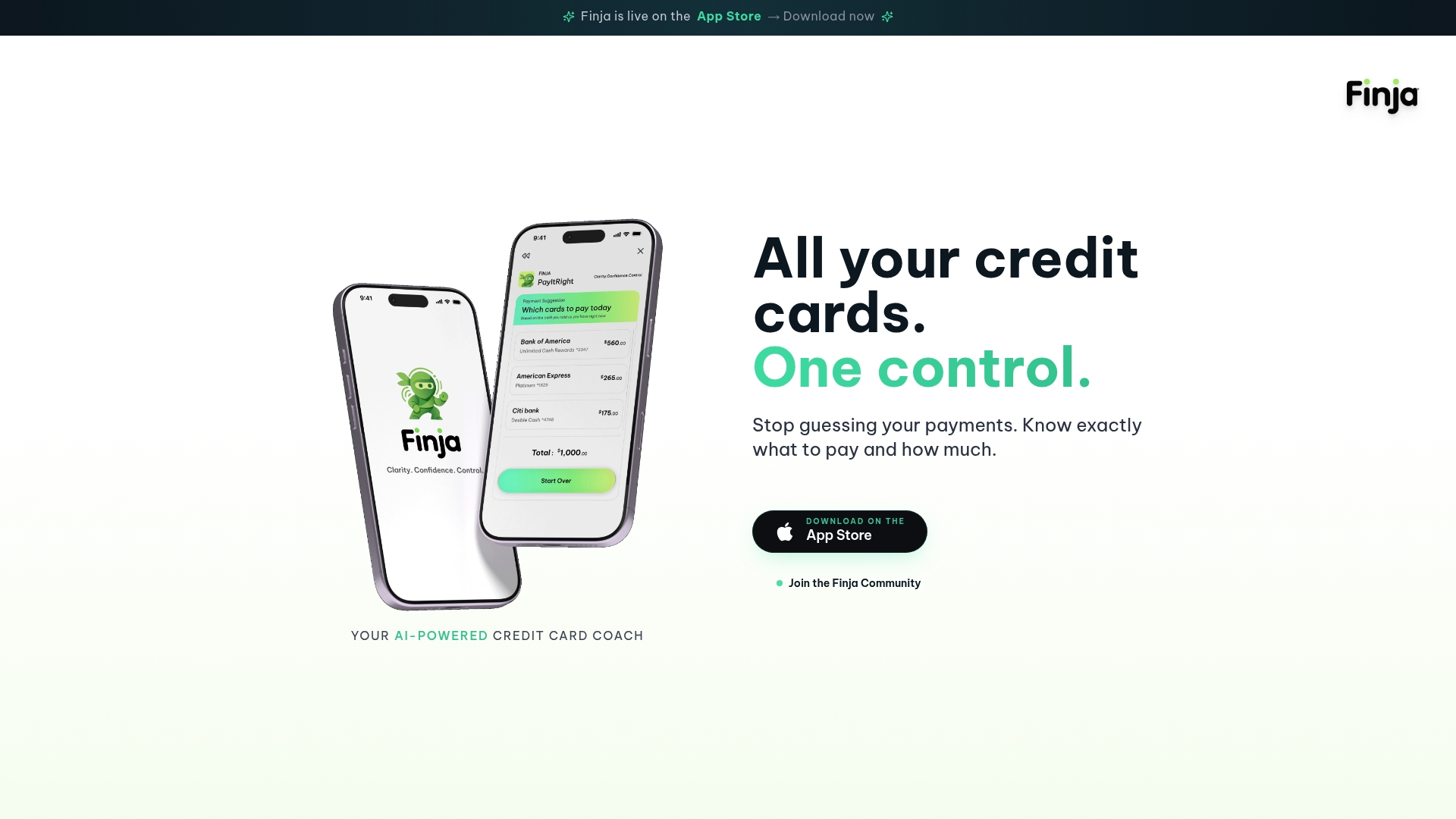
The platform covers AI payment allocation, negotiation coaching templates, credit-health monitoring dashboards, and utilization alerts before your statement closes. Connections use read-only account access through tokenized aggregation, so your credentials never sit on Finja's servers.
If you carry more than two cards and want to stop guessing which one to pay first, start with Finja and let the optimizer run your first simulation.
Sources
- How to get out of debt - Federal Trade Commission (FTC)
- How to pay off credit card debt fast - Better Money Habits (Bank of America)
- 5 ways to reduce credit card interest - NerdWallet
- Best ways to lower credit card rates, what experts think - CBS News