
AI credit card payment decisions are no longer a background process most people think about. They're the reason a transaction clears in under a second, why a fraud alert fires before you even notice the charge, and why your credit limit just went up without you asking. At the core of this shift is a set of machine learning systems that evaluate risk, route payments, and personalize offers in real time, all without a human reviewer touching the file.
Here's what that looks like in practice:
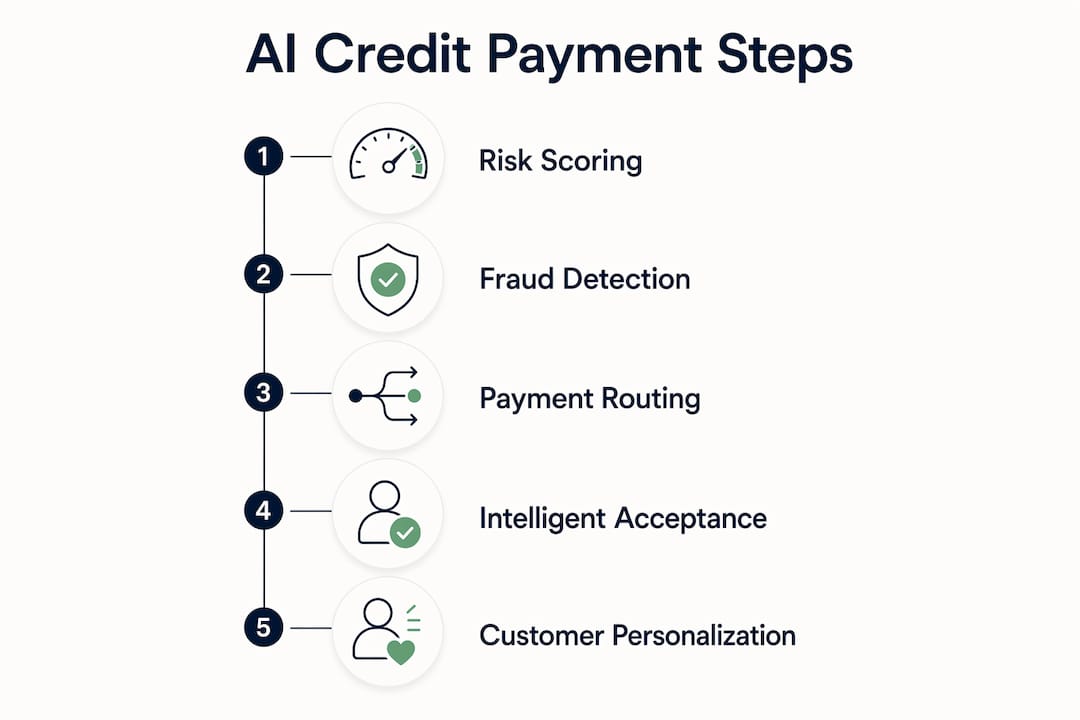
- Risk scoring: Calibrated probabilistic models estimate the likelihood of default, then apply profit-optimized thresholds to approve or decline applications, rather than relying on simple accuracy metrics.
- Payment optimization: AI dynamically adapts transaction data to match issuer preferences, increasing first-attempt authorization rates and cutting costly retries.
- Fraud detection: Models trained on hundreds of real-time attributes flag suspicious activity in milliseconds, adapting continuously to new fraud patterns.
- Customer engagement: AI chatbots, retention offer engines, and personalized credit recommendations run on behavioral data gathered across every interaction.
- Ethical governance: Regulatory frameworks and fairness constraints are now built directly into model design, because bias in credit algorithms has real legal and financial consequences.
Each of these functions is examined in detail below, with a focus on what they mean for financial professionals managing portfolios and for consumers trying to make better decisions with the cards in their wallets.
How AI optimizes credit card payment processing
The clearest win AI delivers in payment processing is what the industry calls Intelligent Acceptance: the ability to dynamically adapt transactions to match individual issuer preferences in real time. Instead of sending a static authorization request and hoping it clears, AI reads the issuer's historical approval patterns and adjusts the transaction data accordingly before the request goes out.

Network tokens play a central role here. By replacing raw card numbers with issuer-specific tokens, AI-powered systems can route each transaction through the path most likely to succeed, based on live data about which channels are performing well at that moment. The result is a higher first-attempt success rate and a meaningful reduction in the retry loops that add cost and friction to every failed authorization.

The business case is straightforward. Every declined transaction that could have been approved represents lost revenue and a frustrated cardholder. AI payment processing shifts the economics by treating authorization as an optimization problem, not a binary pass/fail gate.
Pro Tip: Build calibration and drift monitoring into any AI payment optimization deployment from day one. Transaction data distributions shift with seasonal spending, economic changes, and new fraud patterns. A model that isn't monitored will quietly degrade, and you'll see it first in a creeping decline in authorization rates before any alert fires.
The operational efficiency gains extend beyond authorization. AI systems also handle compliance checks, credit decision support, and customer service routing, compressing timelines that once took days into seconds. For financial professionals managing large card portfolios, AI credit management at this layer means fewer manual interventions and more consistent outcomes across millions of transactions.
- AI reads issuer-specific approval patterns before sending authorization requests.
- Network tokens enable dynamic routing through the highest-performing payment paths.
- Reduced retry loops lower operational costs and improve cardholder experience.
- Compliance and credit checks run in parallel, not sequentially, cutting decision time.
How AI fraud detection protects credit card transactions
Fraud detection is where AI's advantage over rules-based systems is most obvious. Older models worked by matching transactions against fixed patterns: a purchase in an unusual location, a charge above a certain threshold. Generative AI and machine learning have replaced that static logic with adaptive models that learn continuously from new data.
Marqeta's AI-powered risk score illustrates the current state of the art. The system analyzes 300+ transaction attributes at the point of authorization, comparing each transaction against historical behavioral patterns specific to that cardholder, with millisecond-level response times. The model adapts automatically to new fraud techniques rather than waiting for a human analyst to update the rules.
The scale of the problem makes this capability urgent. Global payment fraud is projected to rise by 153% between 2025 and 2030, driven by increasingly sophisticated attacks that outpace manual detection. AI fraud detection models that continuously retrain on emerging patterns are the only realistic defense at that scale.
Statistic: Global payment fraud is expected to rise by 153% between 2025 and 2030, according to Marqeta's analysis of payment fraud trends.
One underappreciated benefit of better fraud models is the reduction in false declines. A legitimate transaction flagged as fraud doesn't just annoy the cardholder; it costs the issuer the revenue from that purchase and risks losing the customer entirely. AI systems that reduce false positives while catching actual fraud deliver a double improvement in both security and customer retention.
- Machine learning models evaluate hundreds of real-time attributes per transaction.
- Adaptive training means the model responds to new fraud techniques without manual rule updates.
- Reduced false declines improve cardholder experience alongside security outcomes.
- AI risk scores integrate directly into the authorization decision, not as a post-hoc review.
How AI personalizes credit card marketing and customer service
Credit card issuers have used AI in customer-facing applications for years, but the scope has expanded considerably. The most visible example is the intelligent virtual agent: Synchrony's Sydney, for instance, handled around 20 million customer conversations in a single year and resolved 80% of issues without escalating to a human agent. That's not a chatbot answering FAQs. That's a system handling disputes, spending inquiries, and account changes at scale.
On the marketing side, AI analyzes spending patterns and credit profiles to generate targeted offers for both prospective and existing cardholders. If a customer shows signs of churning, an AI retention engine can identify that risk and trigger a personalized offer before the customer ever contacts the issuer. Visa's research on generative AI in payments highlights how these systems can now formulate tailored loyalty programs and personalized credit offers by synthesizing behavioral data across multiple touchpoints.
The next phase is agentic AI: systems that don't just recommend actions but take them autonomously on the cardholder's behalf, with consent. Visa frames this as the shift from AI that responds to human prompts to AI that initiates transactions, adapts to new information, and optimizes outcomes within predefined guardrails. For consumers, that could mean an AI agent that automatically pays the right card at the right time to minimize interest. For issuers, it means a new layer of customer interaction that requires strong authentication and privacy standards.
- AI chatbots handle millions of service interactions, resolving most without human escalation.
- Behavioral models generate retention offers before a customer signals intent to leave.
- Generative AI personalizes loyalty programs and credit limit recommendations at the individual level.
- Agentic AI will shift from recommendation to autonomous action, requiring new consent frameworks.
Challenges, ethics, and regulation in AI credit decisioning
The technical performance of AI credit models is genuinely impressive. The harder problem is what those models do to people who were already disadvantaged by the financial system before AI entered the picture.
Bias in credit algorithms doesn't appear from nowhere. It reflects the historical data the model was trained on, and that data carries the imprint of decades of unequal access to credit. As Professor Cristián Bravo of Western University has noted, fixing algorithmic bias requires political and regulatory action, not just technical adjustments. Algorithms can be designed around a legally defined standard of fair credit access, but that standard has to exist first. The 2019 investigation by the New York State Department of Financial Services into Apple's co-branded credit card, following complaints about gender-based credit limit disparities, is a concrete example of what happens when that standard is absent.
Regulatory compliance in the US adds another layer of complexity. The Fair Credit Reporting Act and the Equal Credit Opportunity Act both apply to automated credit decisions, and the FTC has published guidance on adverse action notices that issuers must provide when AI-driven decisions go against a consumer. Explainability isn't optional in this environment. A model that can't produce a human-readable reason for a denial creates legal exposure.
The Calibrated Credit Intelligence framework addresses some of these technical challenges directly. By combining a Bayesian neural risk scorer with a fairness-constrained gradient boosting model, CCI achieves an AUC-ROC of 0.912 while reducing demographic parity gaps and maintaining calibration stability under data drift. That's a meaningful step toward models that are both accurate and auditable.
Pro Tip: Subgroup fairness assessment should run on every model update cycle, not just at initial deployment. Data drift affects demographic groups unevenly, and a model that was fair at launch can develop disparities over time without any deliberate change in design.
- AI bias in credit decisions reflects historical data inequalities, not just model errors.
- Regulatory frameworks like FCRA and ECOA require explainability and adverse action notices.
- Technical solutions like fairness-constrained models reduce but don't eliminate the need for policy intervention.
- Continuous monitoring for demographic parity gaps is a compliance requirement, not just best practice.
AI-powered credit card payment management for consumers in 2026
For consumers carrying multiple credit cards, the most practical application of AI credit card payment decisions is in platforms that translate complex risk models into clear, personalized guidance. These tools don't just show you your balance. They analyze your payment history, credit utilization, and due dates to recommend which card to pay first, how much to pay, and when, calibrated to your specific credit profile.
The underlying technology mirrors what issuers use on their end. Production-style credit decision systems separate risk estimation from decision policy, which means the same model can support different strategies depending on your financial goals: aggressive debt reduction, credit score improvement, or minimizing interest costs. Consumers benefit from this separation when an AI platform explains not just what to do but why, using SHAP-style feature explanations that show which factors are driving the recommendation.
Consumer-facing AI dashboards are also getting better at proactive alerts. Rather than waiting for a missed payment to affect your credit score, an AI system can flag a due date conflict two weeks out, identify a card approaching a utilization threshold that will hurt your score, and suggest a reallocation before the damage is done. For consumers managing three or more cards, that kind of proactive financial monitoring is genuinely difficult to replicate manually.
Pro Tip: Use AI-powered payment coaching to sequence your card payments by interest rate and utilization impact simultaneously. Paying the minimum on a low-rate card while eliminating a high-utilization card first often produces better credit score outcomes than a pure avalanche or snowball approach.
- AI platforms calibrate payment recommendations to individual credit profiles and financial goals.
- Explainability features show consumers which factors drive each recommendation.
- Proactive alerts flag due date conflicts and utilization risks before they affect credit scores.
- Separating risk estimation from decision policy lets the same AI engine support multiple consumer strategies.
For a deeper look at how these tools fit into a broader financial plan, Finja's guide to credit card payment plans covers the mechanics of structuring payments across multiple cards with AI assistance.
Finja gives you an AI credit coach built for your cards
Most people managing multiple credit cards are doing it manually: checking balances, guessing at payment order, and hoping the interest math works out. Finja changes that by putting an AI credit coach in your corner that actually understands how credit card payment decisions work and applies that logic to your specific accounts.
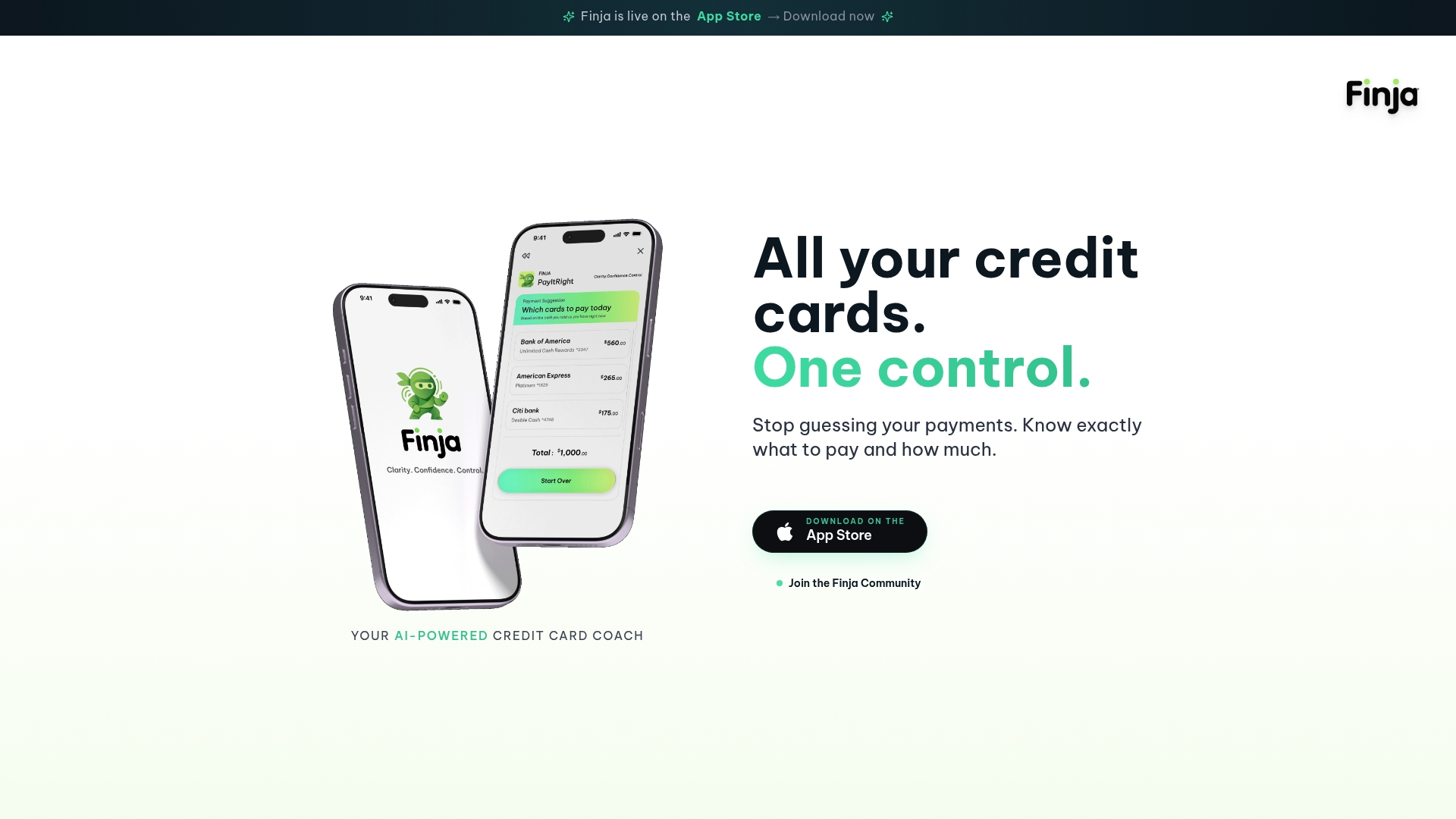
Where generic budgeting apps show you what you spent, Finja tells you what to pay, in what order, and why, based on your real credit profile, interest rates, and utilization ratios. The platform monitors your cards continuously, flags risks before they become penalties, and adjusts recommendations as your financial situation changes. No spreadsheets, no guesswork, no missed due dates that quietly cost you points on your credit score.
Finja is built specifically for consumers who want the kind of data-driven payment strategy that financial professionals use, without needing to understand the underlying models. If you're carrying balances across multiple cards and want to reduce interest costs while improving your credit health, start with Finja today.
Key Takeaways
AI credit card payment decisions combine real-time risk scoring, fraud detection, and payment routing into a single automated system that operates faster and more accurately than any manual process.
| Point | Details |
|---|---|
| AI fraud detection is adaptive | Models analyze 300+ transaction attributes per authorization, continuously retraining to catch new fraud patterns. |
| Payment optimization increases approvals | Intelligent Acceptance dynamically matches transaction data to issuer preferences, reducing failed first-attempt authorizations. |
| Bias requires regulatory solutions | Algorithmic fairness in credit decisions depends on legally defined standards, not technical fixes alone. |
| Calibrated models outperform accuracy-only metrics | The CCI framework achieves an AUC-ROC of 0.912 while reducing demographic parity gaps under real-world data drift. |
| Finja applies AI to consumer payment decisions | Finja translates credit risk modeling into personalized payment guidance, helping consumers reduce interest costs and improve credit health. |