
AI credit management is the use of machine learning and predictive analytics to automate credit decisions, monitor payment behavior, and personalize financial strategies in real time. The core AI credit management benefits include faster risk detection, reduced interest costs, and credit score improvements that manual tracking simply cannot match. Platforms like Finja apply these advantages directly to consumers managing multiple credit cards, turning scattered payment data into a clear, automated action plan. Research confirms that AI reduces credit decision cycles from days to minutes, and that operational efficiency gains reach 40–60% compared to manual processes. These are not incremental improvements. They represent a fundamental shift in how individuals can manage credit health.
1. AI credit management benefits start with operational efficiency
AI cuts the manual work out of credit management by processing thousands of data points simultaneously. Manual effort drops by 40–60% when AI handles routine tasks like payment scheduling, balance tracking, and due date alerts. That time goes back to you for decisions that actually require judgment.
The speed gain is equally significant. AI reduces decision cycles from days to minutes by pulling real-time data from your accounts, transaction history, and credit reports at once. A manual review of three credit cards with different billing cycles, interest rates, and minimum payments takes real time. AI does it instantly.
- Payment scheduling: AI identifies the optimal date and amount for each card payment to minimize interest accrual.
- Balance monitoring: Automated alerts flag when a card approaches its credit utilization threshold.
- Due date tracking: AI consolidates multiple billing cycles into a single, prioritized action list.
- Spending categorization: Transactions are sorted automatically, giving you a clear picture of where money goes.
Pro Tip: Connect all your credit card accounts to an AI platform like Finja at the start of each month. Let it generate a payment priority list before you make a single manual transfer. You will spend less time on logistics and more time on strategy.
2. Early risk detection prevents credit damage before it happens

AI monitors your spending patterns and payment habits continuously, not just at month end. Proactive AI monitoring detects shifts in spending behavior early, reducing delinquency risks before they translate into late fees or credit score drops. That early warning is worth more than any reactive fix.
The mechanism is straightforward. AI establishes a baseline of your normal financial behavior, then flags deviations. If your grocery spending spikes in a week where your checking account balance is low, the system alerts you before a payment fails. Traditional credit management catches this problem after the fact, on your next statement.
- Spending spike detection: AI flags unusual category increases that may strain your payment capacity.
- Low balance warnings: The system cross-references your available funds against upcoming due dates.
- Utilization creep alerts: AI notifies you when a card's balance is trending toward the 30% utilization threshold that affects credit scores.
- Missed payment prediction: Behavioral patterns that historically precede late payments trigger proactive reminders.
- Interest rate exposure tracking: AI calculates how a missed payment on a high-APR card compounds your total debt faster than on a low-APR card.
Pro Tip: Set your AI platform's alert threshold lower than you think you need. A warning at 25% utilization gives you time to pay down a balance before it reports to the credit bureaus at month end. Waiting for a 29% alert leaves almost no margin.
3. Personalized credit strategies built from your actual data
Generic credit advice tells everyone the same thing: pay on time, keep utilization low, avoid new accounts. AI does something fundamentally different. It analyzes your transaction history, behavioral data, and external factors to build a credit strategy specific to your financial profile. The result is advice that fits your situation, not a textbook scenario.
AI changes credit management from static reviews to dynamic, predictive models that adjust as your behavior changes. If you pay off a card in full one month and carry a balance the next, the AI recalibrates its recommendations immediately. A static spreadsheet cannot do that.
The personalization extends to repayment planning. AI calculates which debt to pay first based on your specific interest rates, balances, and cash flow, not a one-size-fits-all rule. A debt-free credit card strategy built on your actual numbers outperforms any generic payoff method.
- Dynamic credit scoring: Your risk profile updates in real time as new transactions occur.
- Tailored repayment sequencing: AI ranks your cards by the order that minimizes total interest paid given your current balances.
- Credit limit recommendations: The system identifies when requesting a limit increase would improve your utilization ratio without triggering a hard inquiry.
- Behavioral pattern recognition: AI learns your income timing and adjusts payment suggestions to match your actual cash flow cycle.
4. How AI improves credit health through automated monitoring
AI-enabled credit monitoring does two things that manual checking cannot. First, it catches errors on your credit report faster. Second, it automates repayment strategies that gradually improve your score. AI-enabled credit monitoring improves error detection and automates repayment strategies to help improve credit scores over time. Errors on credit reports are more common than most people realize, and each one costs you points until it is corrected.
The cost savings from automated payment optimization are direct and measurable. AI identifies the exact payment amount that minimizes interest on each card without leaving you short on cash for other expenses. It also flags balance transfer opportunities when a lower-rate card has available capacity. These are the kinds of calculations that take an hour to do manually and seconds for AI.
| Factor | Manual management | AI-enhanced management |
|---|---|---|
| Payment timing | Based on due date reminders | Optimized to minimize interest accrual |
| Error detection | Periodic manual review | Continuous automated scanning |
| Debt prioritization | General rules (avalanche/snowball) | Personalized to your exact rates and balances |
| Utilization tracking | Monthly statement review | Real-time alerts before reporting date |
| Cost outcome | Higher interest from suboptimal timing | Reduced fees through precise scheduling |
Reducing credit card bills through smarter payment timing is one of the most direct ways to reduce credit costs available to any cardholder. AI makes that precision automatic rather than effortful.
5. Transparency in AI recommendations builds real trust
One of the most underrated advantages of AI in credit management is explainability. Explainable AI (XAI) enhances transparency by showing users why specific credit recommendations are generated. That transparency matters because blind trust in any financial tool is a risk.
When an AI platform tells you to pay Card A before Card B this month, you should be able to see the calculation behind that recommendation. Interest rate differential, current balance, days until reporting date, and your available cash all feed into that decision. Platforms that surface this reasoning give you the ability to override when your personal circumstances warrant it.
Explainable AI is key to building consumer trust in AI-driven credit advice. Trust is not automatic. It is earned through consistent, transparent performance over time. The more you understand why the AI recommends what it does, the more confidently you can act on those recommendations.
6. AI executes next-best-actions, not just suggestions
Most financial apps display data. Top AI credit management systems go further. AI automates next-best-actions such as optimal payment timing and debt sequencing, removing the gap between knowing what to do and actually doing it. That execution layer is what separates a useful tool from a genuinely effective one.
The practical difference shows up in outcomes. A system that tells you "pay your high-APR card first" requires you to remember, calculate, and act. A system that schedules the payment, confirms the amount, and alerts you to confirm requires almost nothing from you beyond a single tap. AI tools for financial management that automate execution consistently outperform those that only advise.
This is where Finja's approach stands out. Finja does not just surface your credit data. It generates a prioritized payment plan based on your specific cards, balances, and financial behavior, then walks you through executing it.
7. Personalized communication improves your relationship with credit
Credit management is not purely mathematical. Behavior, motivation, and habit all affect whether you follow through on a payment plan. AI-powered solutions personalize communications and repayment approaches by analyzing your data, improving both effectiveness and your overall experience. A reminder timed to your actual pay cycle lands differently than a generic monthly alert.
Personalized outreach from an AI platform also reduces the friction that causes people to ignore financial alerts. When a notification reflects your specific situation, you pay attention. When it reads like a mass message, you dismiss it. That behavioral difference has a direct impact on whether you make the payment that protects your credit score.
Managing multiple credit cards becomes significantly less stressful when your AI platform communicates in a way that matches your financial rhythm rather than a generic billing schedule.
Key takeaways
AI credit management delivers the most value when it combines real-time monitoring, automated execution, and personalized recommendations built from your actual financial data.
| Point | Details |
|---|---|
| Efficiency gains are substantial | AI reduces manual credit management effort by 40–60%, freeing time for higher-value decisions. |
| Early detection prevents damage | Continuous monitoring catches spending shifts before they become late payments or score drops. |
| Personalization beats generic advice | AI builds repayment plans from your specific rates, balances, and cash flow, not general rules. |
| Execution matters more than advice | Platforms that automate next-best-actions outperform those that only display recommendations. |
| Transparency builds trust | Explainable AI shows the reasoning behind each recommendation, letting you override when needed. |
What I've learned about AI and credit management after years of watching people use it
Most people approach AI credit tools the same way they approach a fitness app. They set it up, feel good about it for a week, and then stop engaging. The tool does not fail them. They fail the tool.
The real advantage of AI in credit management is not that it does everything for you. It is that it gives you a 24/7 monitor that catches what you would miss. But that only works if you act on the alerts. I have seen people ignore a utilization warning three months in a row and then wonder why their score dropped. The AI flagged it every time.
The other misconception I see constantly is that AI recommendations are infallible. They are not. AI tools require quality data and human oversight to avoid "set-and-forget" pitfalls. If your income changes, your spending category shifts, or you take on a new card, you need to update your platform's inputs. Garbage in, garbage out applies to AI just as much as it does to a spreadsheet.
The people who get the most out of AI credit management treat it as a co-pilot, not an autopilot. They check the recommendations, understand the reasoning, and make the final call themselves. That combination of machine precision and human judgment is where the real credit health improvements happen.
— Grace K.
Finja's AI credit card coach puts these benefits to work
Finja is built specifically for people managing multiple credit cards who want to stop guessing about payment order and start acting on data. The platform pulls your card data together, analyzes your balances and interest rates, and generates a personalized payment plan that minimizes what you owe in interest each month.
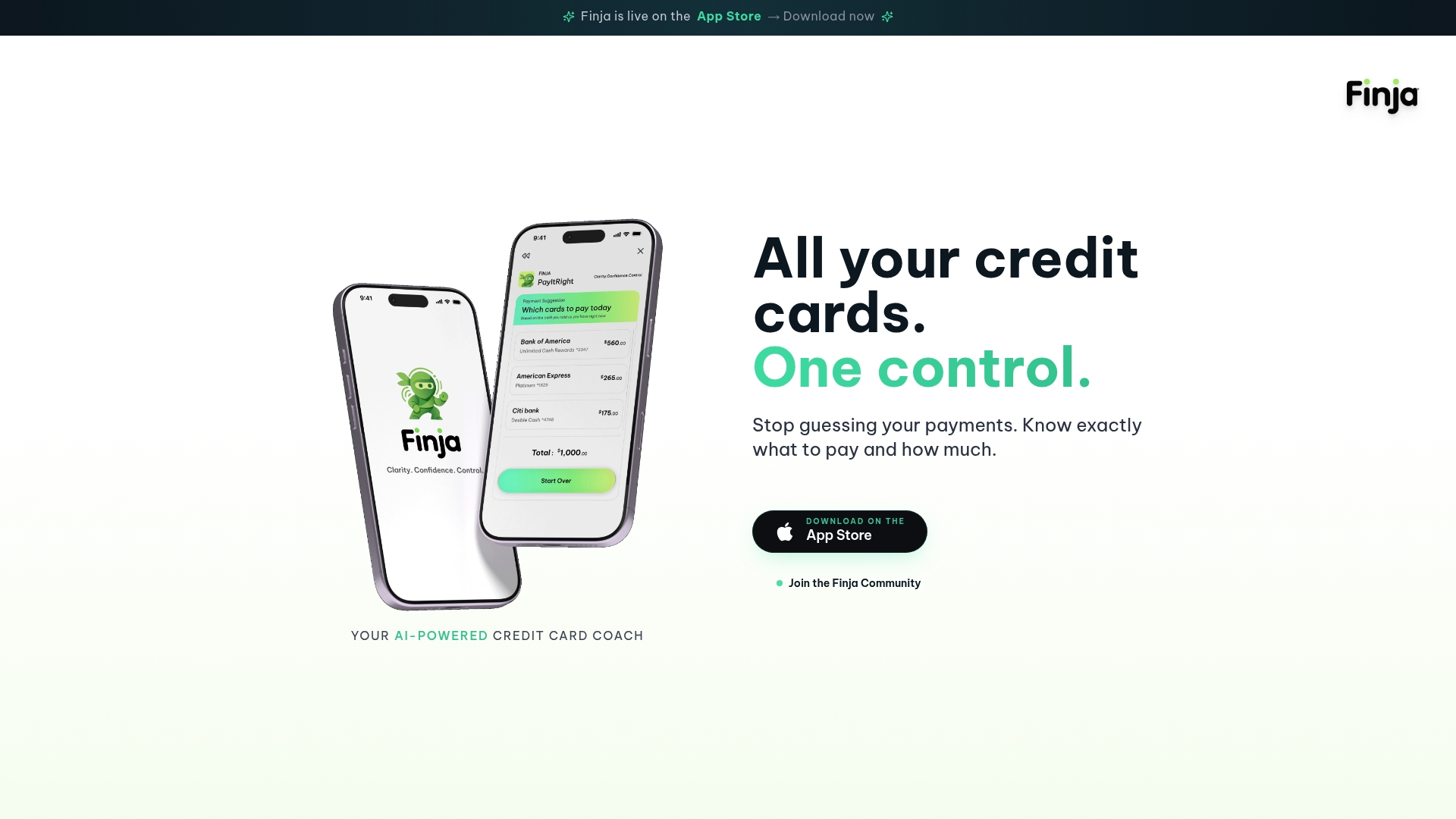
Finja's AI credit card coach monitors your utilization in real time, alerts you before balances hit score-damaging thresholds, and schedules payments to match your cash flow. You get the full picture of your credit card payment plans in one place, with clear reasoning behind every recommendation. If you carry balances across two or more cards and want to reduce what you pay in interest while building a stronger credit profile, Finja's AI platform is built for exactly that situation.
FAQ
What are the main AI credit management benefits?
AI credit management reduces manual effort by 40–60%, accelerates credit decisions from days to minutes, and enables real-time monitoring that catches risks before they damage your credit score.
How does AI credit risk assessment work for individuals?
AI analyzes your transaction history, payment behavior, and account balances continuously, then flags deviations from your normal patterns that signal potential payment problems before they occur.
Can AI actually improve my credit score?
AI-enabled credit monitoring improves error detection on credit reports and automates repayment strategies timed to minimize interest and utilization, both of which directly support credit score improvement over time.
What is explainable AI in credit management?
Explainable AI surfaces the reasoning behind each credit recommendation, showing you which data points drove the suggestion so you can evaluate and act on it with confidence rather than blind trust.
Is AI credit management safe to use without human oversight?
AI tools require quality financial data and ongoing human review to remain accurate. Treating AI as a co-pilot rather than an autopilot produces the most reliable credit outcomes.