
Every credit-card charge in a zero-based budget needs a job the moment you spend it: either pull the full amount from that category's cash immediately or divide a larger purchase into monthly installments budgeted from the same category so the balance is covered by the due date. Paying the statement in full protects your grace period and keeps interest off the table. Tools like Finja help people juggling several cards see all their due dates and balances in one place, and the Consumer Financial Protection Bureau backs the grace-period math behind this rule.
TL;DR:
- Using credit cards in a zero-based budget requires immediately assigning each charge to either a spot purchase or a planned installment to avoid interest and budget discrepancies.
- Paying the full statement balance on time preserves your grace period, while mid-cycle payments can significantly reduce daily interest charges.
- Managing multiple credit cards effectively involves syncing due dates with paychecks, tracking sub-allocations, and prioritizing higher-APR balances for extra payments.
- Missing to categorize charges or not adhering to planned payment timing can cause unanticipated interest costs and budget breakdowns.
- Tools like Finja can streamline tracking due dates and balances across cards, helping to minimize missed payments and interest payments.
Table of Contents
- How Zero-Based Budgeting Handles Credit Card Purchases
- What's the Monthly Routine for Budgeting Credit Cards?
- How Do Grace Periods and Payment Timing Affect Your Budget?
- Managing More Than One Card Without Losing the Zero
- Where Zero-Based Budgets Go Wrong With Credit Cards
- Why This Approach Actually Reduces Financial Stress
- Let Finja Handle the Payment Timing for You
- Sources
- FAQ
How Zero-Based Budgeting Handles Credit Card Purchases
A zero-based budget only works if every dollar of income is assigned a job before the month starts, and that includes dollars you have not technically spent yet because they are sitting on a card. Grow Financial frames this as income minus planned spending equaling zero, and credit purchases fit inside that math the same as cash does. The trick is knowing which of two buckets a charge belongs to.
A spot purchase is anything you can pay off in full on the next statement. Groceries, gas, a dinner out. You deduct the full amount from that category's balance the instant you swipe the card, exactly as if you had paid cash.

A planned installment is a bigger purchase you've decided to spread across a few paychecks on purpose, like a $300 appliance you're paying over several months. You budget a portion from that category each month rather than yanking the whole $300 out at once.
Here's the difference in practice:
- Pay in full: $300 purchase, $300 deducted from the category immediately, card balance cleared next statement, zero interest.
- Planned installment: $300 purchase, $100 budgeted from the category for three straight months, card balance cleared by month three, zero interest if each installment actually gets paid.
Both paths keep your budget at zero. What breaks it is a third option nobody plans for: charging something and forgetting to assign it to either bucket. That's how a $300 purchase quietly becomes a $340 problem once interest lands on it.
What's the Monthly Routine for Budgeting Credit Cards?
Treat this like a checklist you run every time you get paid, not a once-a-month chore.
- List income and fixed obligations first. Rent, utilities, minimum card payments, and any full-pay targets you've committed to for cards you're clearing entirely.
- Build categories for spending and for installments. Groceries and gas get normal categories. That new laptop you're paying off over four months gets its own line, sometimes called a sinking fund.
- Deduct as you spend. The second a charge hits, subtract the full amount or the monthly installment share from its category, so your budget total never drifts from zero.
- Time transfers to paydays. Move money into a card-payment holding spot right after each paycheck lands, and set a reminder for any payment due mid-cycle between paychecks.
A simple calendar makes this concrete: if you're paid on the 1st and 15th, and your card statement closes on the 20th with payment due the 15th of the next month, your second paycheck of the month should already have that payment carved out before you touch it for anything else.
Pro Tip: Set your due date reminder for three days before the actual deadline, not the day of. Bank transfers and issuer processing can take a business day or two, and a "paid on time" that posts late still dings you.
How Do Grace Periods and Payment Timing Affect Your Budget?
A grace period is the window, typically the time between your statement closing and the payment due date, during which you owe no interest on new purchases as long as you paid last month's statement balance in full. Miss that condition once and the CFPB explains you typically lose the grace period entirely, meaning new purchases can start accruing interest from the transaction date until you restore full payment in a later cycle.
Most issuers calculate interest using an average daily balance and a daily periodic rate. That means interest compounds daily against whatever balance you're carrying, so a payment made on day 10 of a 30-day cycle reduces your average balance, and your interest charge, more than the same payment made on day 25. The CFPB's own breakdown of this math is worth reading once so the mechanics stop feeling abstract.
The Federal Reserve's G.19 release tracks average APRs on credit card accounts nationally, and rates on accounts assessed interest routinely sit in double digits. That's real money at stake once a balance starts carrying month to month.
Three tactics keep your budget insulated from this:
- Make a mid-cycle payment if you've charged more than usual early in the cycle, rather than waiting for the due date.
- Pay the full statement balance whenever cash flow allows it, not just the minimum.
- If you're already carrying a balance, target the current balance shown online rather than the older statement figure, since that captures charges made since the statement closed.
Our guide on cutting daily interest with mid-cycle payments walks through the exact math with a real billing cycle example.
Managing More Than One Card Without Losing the Zero
More cards means more due dates, and more chances for one payment to slip through a gap in your calendar. Three approaches work, and most people end up combining two of them.
- Sync every due date to a payday. Call your issuers and request due-date changes so every card lines up with a paycheck you know is coming.
- Run one "card payments" category with labeled sub-allocations. Instead of five separate budget lines, keep one pool and tag how much inside it belongs to each card.
- Route payments back to the original purchase category when you can. If a grocery charge sits on Card A, the grocery category, not a generic "debt" line, covers that payment.
For balances you're carrying rather than paying off monthly, send anything above the minimum toward the highest-APR balance first. Issuers are required to apply extra payments that way in most cases, so it's the fastest route to shrinking what actually costs you money.
Pro Tip: If you're tracking three or more cards by hand, a consolidated view stops being optional. This is precisely the gap Finja is built to close, pulling every balance and due date into one dashboard with payment-timing suggestions attached. Our post on budgeting with credit cards by syncing to paychecks goes deeper on the sub-allocation method above.
Where Zero-Based Budgets Go Wrong With Credit Cards
Four mistakes account for most blown budgets, and each has a quick fix.
- Carrying an unplanned balance kills your grace period. Build a small buffer into your card category and aim for at least one full-pay month whenever a balance creeps in.
- Missing an annual bill, like insurance or a subscription renewal, shows up as a surprise charge. A sinking fund inside your budget absorbs it before it lands.
- Confusing the statement balance with the current balance leads to underpayment. Check both before you pay, and budget for whichever figure actually stops interest.
- Chasing rewards without budgeting the purchase first turns "free points" into real debt. Treat every reward-driven purchase like any other planned expense.
Why This Approach Actually Reduces Financial Stress
Assigning every credit-card charge a home the moment it happens is the difference between a budget that looks tidy on paper and one that survives contact with real spending. The people who struggle with cards inside a zero-based system usually aren't undisciplined. They just never built a rule for the gap between swiping and paying, so charges pile up invisibly until a statement delivers bad news.
The paycheck-aligned method here, matching due dates to income and deducting as you spend, closes that gap without asking anyone to give up credit cards altogether. For readers juggling more than two cards, pairing this system with a consolidated tool for payment timing removes the mental math that causes most missed payments. Our posts on protecting your grace period and when to pay for fees, interest, or credit score cover the mechanics in more depth than a single article can.
— Grace K.
Let Finja Handle the Payment Timing for You
Once you're running multiple cards inside one budget, the hard part stops being the math and starts being the tracking. Some tools are built specifically for that gap: they pull every card into one view, flag which balance to pay first, and suggest payment timing designed to cut interest rather than chase rewards points. That's a different job than a general budgeting app tries to do.
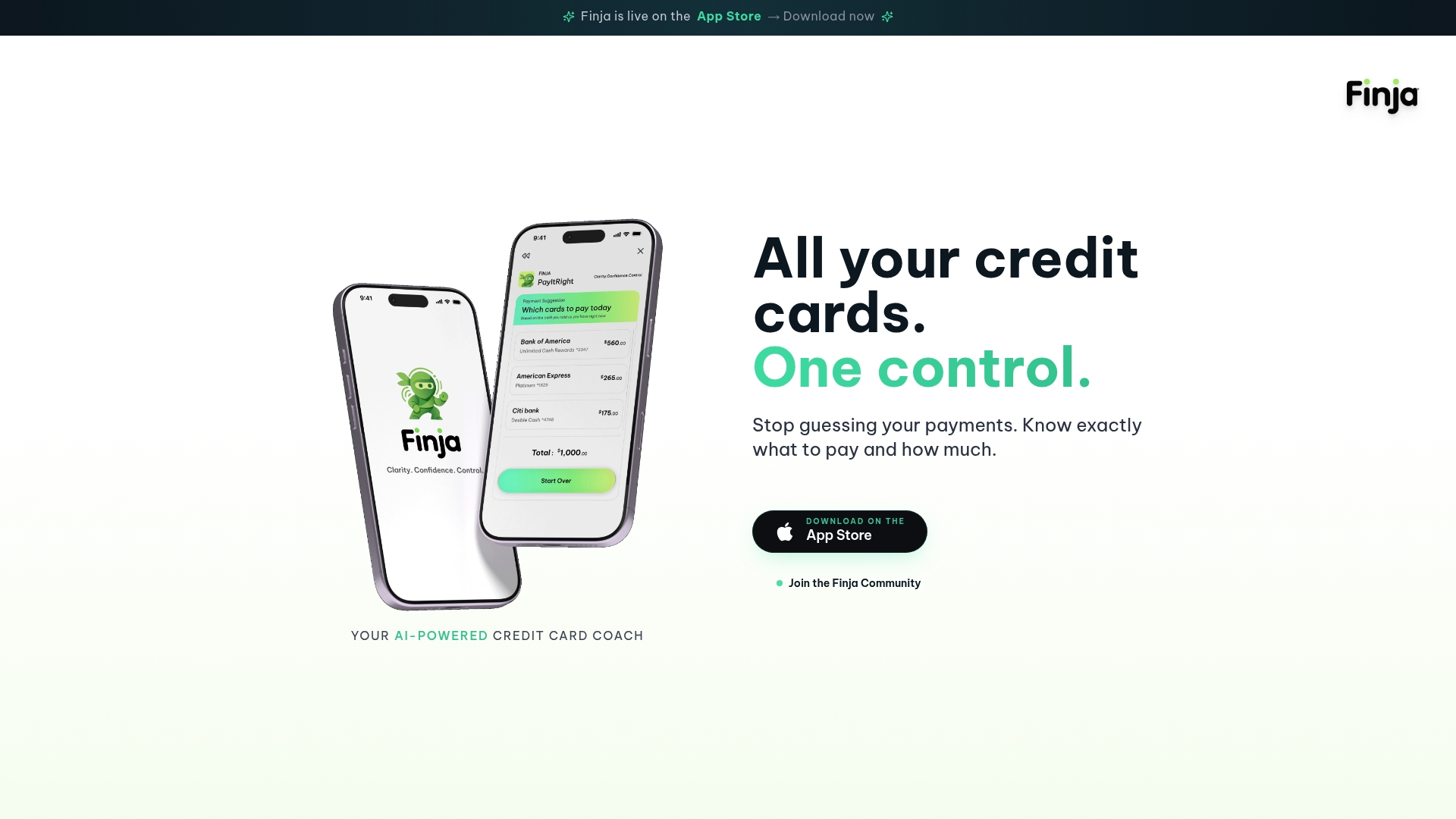
If you're the kind of budgeter who assigns every dollar a job but still loses track of which card is due when, some consolidated dashboards with AI-driven payment guidance are built around exactly that gap. Check out Finja's credit card coach and see whether a consolidated view fits the way you already budget.
Sources
- What is a grace period for a credit card? | Consumer Financial Protection Bureau
- Consumer credit - G.19 | Federal Reserve
- Create a Zero-Based Budget | Grow Financial
FAQ
What Are the Pros and Cons of a Zero-Based Budget?
The main advantage is control: every dollar, including credit-card charges, gets assigned a job, so surprise balances become rare. The downside is upkeep, since it demands more frequent tracking than a simple percentage-based budget, especially once multiple cards are involved.
What Is the 7-Year Rule on Credit Cards?
This generally refers to negative information, like late payments or collections, staying on your credit report for about seven years under standard reporting practices. It's a reason to avoid unplanned balances in the first place, since a single missed payment cycle can echo on your credit report far longer than the debt itself lasted.
Why Does Some Budgeting Advice Say to Avoid Credit Cards Entirely?
Advice against credit card use usually centers on the risk of overspending past what a budget accounts for, since swiping a card doesn't feel like spending cash does. Inside a strict zero-based system, that risk shrinks considerably because every charge gets deducted from a category the moment it happens, not at the end of the month.
How Do I Pick a 0% APR Credit Card Right Now?
Available promotional APR offers and terms shift constantly and vary by issuer and applicant, so check current listings directly with issuers rather than relying on any fixed recommendation. Whatever card you choose, confirm the length of the 0% window and what the APR reverts to afterward before you plan installments around it.
Does Finja Help With Zero-Based Budgeting Across Multiple Cards?
Finja is built as an AI credit-card coach that consolidates multiple cards into one view and offers payment-timing suggestions to reduce interest and support credit health, rather than a general budgeting app. Pricing details are available directly on Finja's site.