
The main transaction-level credit card fraud alerts are: suspicious charge, high-value transaction, card decline, foreign transaction, merchant-category, velocity (rapid successive charges), subscription/recurring, card-not-present (online/phone), and geo-based. These are real-time or near-real-time notifications generated by your card issuer or payment network — Visa, Mastercard, Amex, Discover — and delivered via in-app push, SMS, email, or third-party aggregator apps like Finja. If you carry multiple cards, knowing exactly which alert type just fired is the difference between stopping fraud quickly and discovering it on your statement much later.
The U.S. Payments Forum classifies transaction alerts as issuer-based controls triggered by authorization activity, account changes, threshold breaches, merchant-category triggers, velocity patterns, and geolocation anomalies — and treats them as a first line of awareness, not a complete defense.
The nine alert types above cover the full range of what issuers currently surface. Here is what triggers each one and exactly what to do when it arrives.
Table of Contents
- What triggers each type of credit card fraud alert?
- Where do alerts come from, and how do they reach you?
- What should you do the moment a fraud alert arrives?
- How do you configure alerts across multiple cards without losing your mind?
- Why do alerts sometimes fire on legitimate charges?
- What do real alert messages look like?
- How do alerts fit into a broader fraud-prevention strategy?
- Key Takeaways
- Why consolidated alerting changes the game for multi-card users
- Finja gives you one place to see and act on every card alert
- Useful sources and further reading
What triggers each type of credit card fraud alert?
Every alert fires at authorization time, not when the charge posts. That matters because the amount you see in the alert may differ from the final posted charge — a restaurant pre-auth, for example, won't include the tip you add later. Some transactions that skip the authorization step entirely, like certain small recurring charges, may never trigger a push or SMS notification at all.
| Alert Type | Typical Trigger | What It Signals |
|---|---|---|
| Suspicious charge | ML anomaly: merchant, amount, or timing breaks your spending pattern | Possible unauthorized use; verify immediately |
| High-value transaction | Single purchase exceeds your preset dollar threshold | Could be fraud or a large legitimate purchase |
| Card decline | Authorization rejected by issuer | Fraud attempt, credit limit, or issuer hold |
| Foreign transaction | Merchant country code differs from your home country | Legitimate travel or card-skimming abroad |
| Merchant-category (MCC) | Charge at a blocked or flagged category (e.g., gambling, wire transfer) | High-risk category use; confirm intent |
| Velocity / rapid transactions | Multiple authorizations within a short window | Card testing or stolen-card rapid spending |
| Subscription / recurring | New or changed recurring charge detected | Unwanted enrollment or changed billing amount |
| Card-not-present (CNP) | Online or phone purchase with no physical card tap | Common fraud vector; confirm you initiated it |
| Geo-based | Charge location conflicts with your device's known location | Possible card cloning or account takeover |
AI and machine-learning models now sit alongside rule-based thresholds in most major issuer systems. A simple rule flags any charge over $500; an ML model flags a $12 charge at a merchant you've never visited, made 90 seconds after a charge at a merchant two states away. Both matter. The ML layer catches what rigid rules miss, especially velocity sequences and subtle merchant-pattern anomalies.
Where do alerts come from, and how do they reach you?
Alert origin and delivery channel are separate questions. Origin determines how much detail you get; channel determines how fast you get it.
- Automated voice calls — reserved for high-risk fraud flags; issuers like Amex and Discover use these for suspected account takeovers.
One critical detail: if your contact information is out of date at the issuer, none of these channels work. An old phone number means no SMS. An old email means no email alert. Enrollment alone is not enough.
Pro Tip: Enable in-app push as your primary channel for every card, SMS as a backup, and skip email as a real-time fraud signal. Then route all issuer notifications into Finja so you see one prioritized feed instead of four separate app badges.
What should you do the moment a fraud alert arrives?
Speed matters. Visa notes that reporting suspicious charges quickly is what allows issuers to investigate and apply zero-liability protections. Waiting even a few hours can complicate a dispute.
- Open your card app and verify the transaction — check merchant name, amount, timestamp, and location against your own activity.
- Check with any authorized users — a household member or employee may have made the charge legitimately.
- Lock the card immediately if you cannot confirm the charge — most issuer apps and Finja offer a one-tap card lock that stops new authorizations without canceling the card.
- Call your issuer's fraud line if the charge is unrecognized — have the alert details ready. Do not use a phone number from the alert text itself; use the number on the back of your card.
- Request a replacement card and dispute the charge — your issuer will guide you through the dispute process and issue a new card number.
- Monitor your other cards — fraudsters who have one card number often have more.
How do you configure alerts across multiple cards without losing your mind?
Managing four cards through four separate apps is how alerts get missed. The goal is one consolidated, prioritized feed with sensible thresholds per card. Here is a practical setup checklist:
- Verify contact info at every issuer — log into each issuer portal and confirm your current mobile number and email address are on file. Outdated contact details are the single most common reason alerts fail to arrive.
- Enable push notifications for every card — go into each issuer app's notification settings and turn on at minimum: suspicious activity, card decline, CNP purchase, and foreign transaction.
- Set amount thresholds that match each card's role — a travel card warrants a lower high-value threshold than a business card you use for large vendor payments. Tune per card, not uniformly.
- Turn on velocity and subscription alerts for all cards — these two types catch the most common fraud patterns (card testing and unauthorized recurring charges) and generate relatively few false positives.
- Connect all cards to Finja — route issuer notifications into a single prioritized feed so you see the highest-risk alert first, regardless of which card it came from. Finja's multi-card management approach is built for exactly this scenario.
For card-behavior profiles: an everyday spending card benefits from low thresholds and CNP alerts on; a travel card needs geo-based alerts off during trips (or paused and re-enabled); a business card may need MCC-specific alerts for categories outside your vendor list.
Pro Tip: Keep a simple change log — a note in your phone is fine — recording every time you add a card, remove one, or update a phone number. Alert gaps almost always trace back to a setup change that was never propagated to the issuer portal.

Why do alerts sometimes fire on legitimate charges?
The FTC advises that declines are often the result of legitimate issuer holds — hotel incidentals, rental car deposits, or approaching credit limits — not fraud. The same logic applies to alerts that fire on valid charges.
Common false-positive causes:
- Merchant name mismatch — a charge from "SQ *COFFEE SHOP LLC" instead of the café name you recognize
- Pre-authorizations — gas stations, hotels, and restaurants often pre-auth for more than the final amount
- Aggregated charges — a rideshare or delivery app may batch multiple small charges into one authorization
- Recurring micro-transactions — small monthly charges from streaming services can look like card-testing activity to a velocity rule
Before canceling a card, check the merchant name and timestamp carefully. Some issuers include a decline reason code in the notification. If the decline reason points to a credit-limit hold or incidental deposit rather than a fraud flag, a quick call to the issuer resolves it without a card replacement.
What do real alert messages look like?
| Sample Alert Text | Likely Cause | Immediate Action |
|---|---|---|
| "Purchase of $847.00 at ELECTRONICS STORE — was this you?" | High-value transaction alert | Verify in app; lock card if unrecognized |
| "Your card was declined at GAS STATION" | Credit limit, hold, or issuer risk flag | Check issuer app for decline reason |
| "Suspicious activity detected on your card — verify now" | ML anomaly or pattern break | Open issuer app directly; do not click SMS link |
| "International transaction: $212.00 in Mexico" | Foreign transaction alert | Confirm if traveling; call issuer if not |
| "Card-not-present purchase: $39.99 at STREAMING SERVICE" | CNP / online purchase alert | Confirm subscription; dispute if unrecognized |
| "3 transactions in 4 minutes — possible card testing" | Velocity alert | Lock card immediately; call fraud line |
| "New recurring charge: $14.99 at APP STORE" | Subscription alert | Verify enrollment; dispute if unauthorized |
| "Purchase at WIRE TRANSFER SERVICE — $500.00" | MCC-flagged merchant category | Call issuer; this category is high-risk |
Alerts fire at authorization time, so the amount in the message may not match the final posted charge. A restaurant alert for $60 may post as $72 after the tip. That discrepancy is normal — it is not a second fraudulent charge.
How do alerts fit into a broader fraud-prevention strategy?
Alerts are an awareness and rapid-response tool, not a complete defense. The U.S. Payments Forum frames them as one layer in a defense-in-depth approach — they tell you something happened, but they cannot prevent a charge that already cleared authorization.
Complementary controls that fill the gaps:
- Two-factor authentication on every issuer account and your card management app
- Merchant and MCC blocks — many issuers let you block entire merchant categories (gambling, cash advances) at the card level
- Spending limits — per-transaction and daily caps that reject charges above a set amount automatically
- Virtual card numbers — single-use or merchant-locked numbers for online purchases so your real card number is never exposed
- Weekly manual statement reviews — not every transaction triggers an alert; small recurring charges and transactions that skip authorization may never generate a notification
AI-driven monitoring adds another layer by spotting anomalous sequences that rule-based systems miss. But even the best automated system benefits from a human check. A 10-minute weekly review of your statements across all cards catches what automation misses.
Key Takeaways
Real-time transaction alerts are your fastest signal that something is wrong — but only if they're configured correctly, routed to the right channel, and acted on immediately.
| Point | Details |
|---|---|
| Enable the right alert types | Turn on suspicious activity, decline, CNP, foreign transaction, and velocity alerts for every card you carry. |
| Act fast when an alert fires | Lock the card, verify in-app, and call your issuer's fraud line — do not click links in SMS alerts. |
| Keep contact info current | Outdated mobile numbers or email addresses at the issuer will silently block every alert from reaching you. |
| Expect false positives | Pre-authorizations, merchant name mismatches, and aggregated charges routinely trigger alerts on legitimate activity. |
| Use Finja for multi-card consolidation | Finja surfaces the highest-risk alert first across all your cards so nothing gets buried in separate app feeds. |
Why consolidated alerting changes the game for multi-card users
The real problem with managing fraud alerts across multiple cards is not the alerts themselves — it is the noise. Four cards across four issuer apps means four separate notification streams, each with its own threshold logic and delivery timing. A high-risk alert on card three gets buried under a payment-due reminder from card one.
Finja addresses this by pulling issuer alerts into a single prioritized feed, ranking them by risk level, and surfacing the one that needs your attention right now. In a scenario where two alerts fire simultaneously — a velocity flag on your travel card and a CNP alert on your everyday card — Finja identifies the velocity flag as higher risk and puts it at the top. From there, you can lock the card directly in the app without switching to the issuer's platform.
That consolidation also makes credit card financial health tracking more accurate, because Finja sees the full picture across all your cards rather than one card at a time. For deeper reading on how AI prioritization works in practice, the AI credit management benefits guide covers the mechanics in detail.
Finja gives you one place to see and act on every card alert
Most multi-card users don't have a fraud problem — they have a visibility problem. Alerts are firing, but they're scattered across apps, arriving at different speeds, and competing with low-priority notifications. Finja fixes that by consolidating every issuer's alerts into one feed, scoring each one by risk, and letting you lock a card, flag a charge, or contact your issuer without leaving the app.
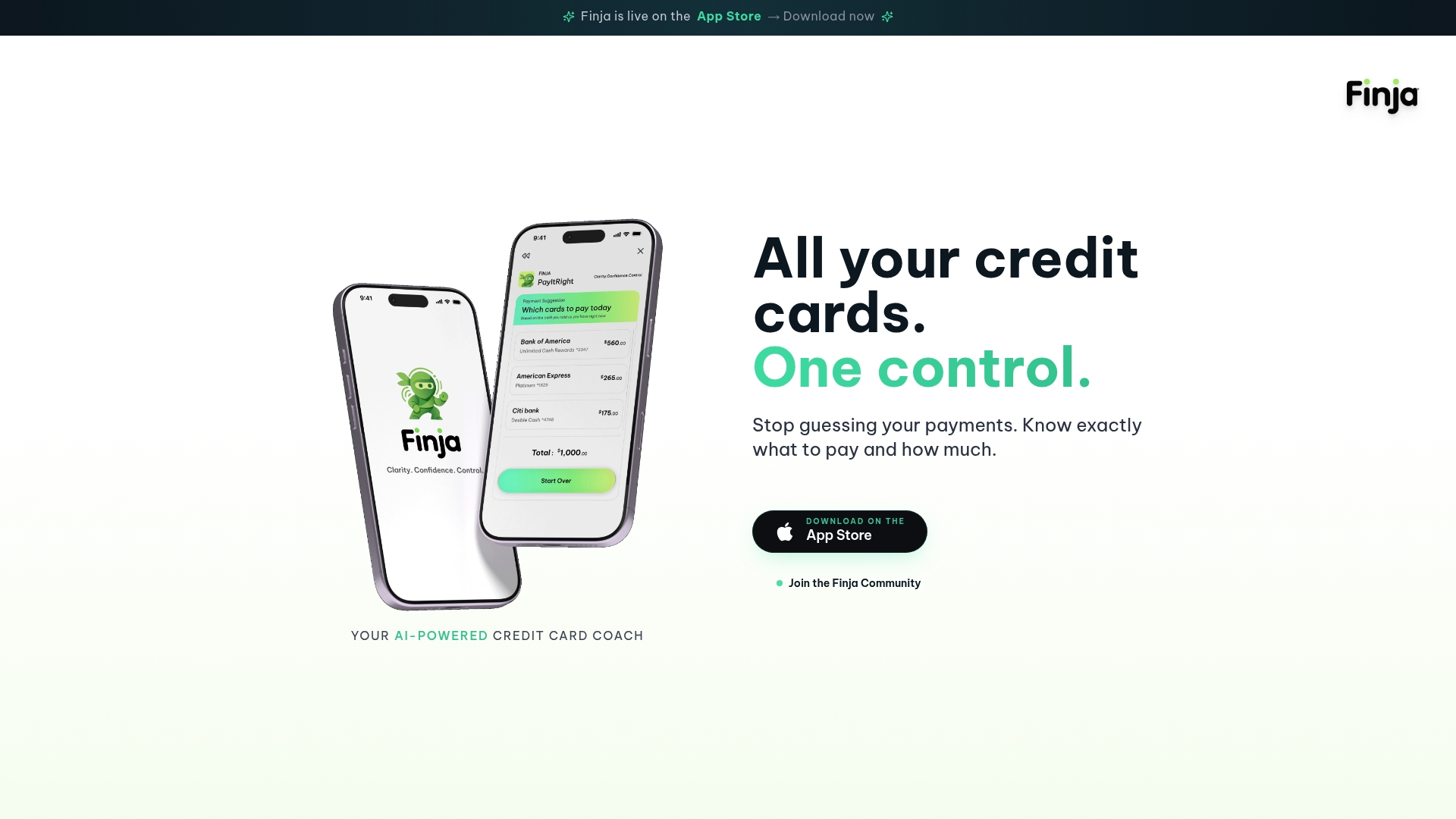
Setup takes minutes: connect your card issuers, confirm your contact details are current at each one, enable push notifications, and set your priority rules. Finja handles the rest — surfacing what matters, filtering what doesn't, and keeping your full card portfolio visible in one place. If you're managing more than two cards and want faster response times when something looks wrong, start with Finja and see the difference a consolidated alert feed makes.
This article is general information, not financial or legal advice. Confirm current issuer policies, dispute windows, and zero-liability terms directly with your card issuer or a qualified financial professional.
Useful sources and further reading
- U.S. Payments Forum — Transaction Alerts, Controls, and Notification Services: the industry standard reference for how transaction alerts are triggered, delivered, and classified.
- FTC — When a Company Declines Your Credit or Debit Card: authoritative consumer guidance on why declines happen for legitimate reasons and how to verify before assuming fraud.
- Experian — How to Set Up Credit Card Alerts: step-by-step setup guidance with a focus on keeping contact information current across issuers.
- Bitecode — How AI Enhances Transaction Monitoring and Fraud Prevention: technical overview of how ML models complement rule-based systems to catch anomalous patterns.