
Credit card category bonuses fall into six main types: fixed, rotating, customizable, merchant-specific (MCC-driven), tiered/accelerator, and limited-time promotional categories. Each rewards a different kind of spender, and picking the wrong one for your habits is how people leave money on the table every month.
- Convenience seekers do best with fixed categories or a flat-rate card that never requires tracking.
- Rewards maximizers and flexible spenders get more value from rotating or customizable categories, but only if they actually activate and monitor them.
- Business spenders tend to benefit most from tiered or accelerator structures tied to volume.
The trade-off underneath all of it: higher earn rates almost always come with more caps, more activation steps, or more mental overhead. The rest of this guide breaks down exactly how each type works so you can match it to how you actually spend.
Key Takeaways
Category bonuses reward specific spending types at elevated rates, but realizing that value depends on matching the category's structure—fixed, rotating, customizable, MCC-driven, tiered, or promotional—to how you actually spend.
| Point | Details |
|---|---|
| Match structure to habits | Fixed categories suit convenience seekers; rotating and customizable categories suit active trackers. |
| Watch caps closely | Rotating categories often cap around $1,500 per quarter before dropping to the base rate. |
| MCCs decide eligibility | Issuers use Merchant Category Codes to classify purchases, and interpretations vary between issuers. |
| Pair, don't chase one card | A flat-rate card plus one or two category cards outperforms searching for a single do-everything card. |
| Automate the tracking | Finja consolidates account views and flags caps, activations, and merchant coding issues across your cards. |
Table of Contents
- The Main Types of Credit Card Category Bonuses
- What Are the Core Types of Category Bonuses?
- How Do Issuers Decide What Qualifies for a Category Bonus?
- Which Everyday Spending Categories Earn the Most?
- How Should You Choose and Use Category Cards?
- What Are the Most Common Category Bonus Mistakes?
- Why Pairing Cards Beats Chasing a Single Perfect Card
- What We Found Testing These Strategies in Practice
- How Finja Helps You Capture Every Category Bonus
- Frequently Asked Questions
- Sources
The Main Types of Credit Card Category Bonuses
A bonus category is any spending type where your card pays an elevated rewards rate above its base earn rate. If your card earns 1 point per dollar on everything but 3 points per dollar on dining, dining is the bonus category. It sounds simple, but the mechanics behind it determine whether you actually collect that higher rate or quietly miss it every billing cycle.
Typical bonus category rates run from 2 to 5 points or miles per dollar, or 2% to 6% cash back, compared with a standard 1x or 1% base rate. Cards express this in different currencies. Cash back cards state it as a percentage. Travel and points cards state it as a multiplier. Here's how the ranges typically shake out:
| Category Structure | Typical Earn Range | Format |
|---|---|---|
| Fixed categories | 2x–4x points or 2%–4% cash back | Points, miles, or cash back |
| Rotating categories | 5% cash back (common ceiling) | Cash back, usually with a quarterly cap |
| Customizable categories | 3x points or 3% cash back | Points or cash back on chosen categories |
| Tiered/accelerator | Varies by spend tier, often 1.5x–4x | Points or cash back, scales with volume |
It helps to separate category bonuses from welcome bonuses, because people conflate them constantly. A welcome bonus is a one-time reward for hitting a spending threshold in your first few months with a new card, and it's often the single largest infusion of points or cash back you'll ever get from that card. A category bonus is different: it's a permanent (or semi-permanent) feature of the card that pays out every time you spend in that category, for as long as you own the card.
Bonus categories work because issuers assign an elevated rate to a defined type of spending, most commonly travel, dining, groceries, and gas, and that rate applies automatically or after a simple activation step, depending on the card's structure.
Here's the mechanism most people never think about until something goes wrong: issuers don't know what you bought. They know the Merchant Category Code (MCC) the merchant used to register with the payment network. That four-digit code is what actually triggers your bonus rate, not the receipt in your hand. We'll unpack exactly how that works and where it breaks down in a later section, but keep it in mind as you read through the six category types below. It explains almost every "why didn't this earn bonus points" mystery you'll ever run into.
What Are the Core Types of Category Bonuses?
Each category structure trades earning potential against effort in a different way. Knowing which trade-off you're signing up for is the whole game.
Fixed categories
Fixed categories never change. The card picks a category, or a short list of categories, and pays that rate indefinitely. The Chase Freedom Flex pairs its rotating categories with fixed bonus categories on things like dining and drugstores, while cards like the American Express Gold Card lock in an elevated rate on restaurants and U.S. supermarkets every single month, no activation required.
Fixed categories suit convenience seekers best. You spend, you earn, you never touch a settings menu. The downside is flexibility: if your spending habits shift away from the card's fixed category, that higher rate becomes irrelevant.
Rotating categories
Rotating categories change every quarter, and they're the highest-maintenance structure on this list. Discover it Cash Back built its whole identity around this model: 5% cash back in categories like gas stations, grocery stores, or Amazon.com, rotating every three months, typically capped around $1,500 in combined purchases per quarter. Spend past that cap and you drop to the base rate.

You typically need to activate the category, usually through the issuer's app or website, before the quarter starts. Miss that step and you earn nothing extra even if you spend heavily in that category. Second, the categories aren't announced far in advance, so planning your spending around them takes real attention. Issuers themselves frame rotating cards as a higher-effort, higher-reward product built for people willing to track and opt in every quarter, not a set-it-and-forget-it tool.
Pro Tip: Set a recurring calendar reminder for the first week of every quarter to activate your rotating category. Missing one activation window can cost you $60 to $75 in lost cash back if you're spending near the cap.
Customizable categories
Customizable categories let you choose which spending type earns the bonus rate, usually from a short menu. Citi Custom Cash and cards in the Citi Dividend and ThankYou families often let cardholders select a top category (gas, groceries, dining, travel, and similar options) each billing cycle, automatically applying the bonus to whichever eligible category you spent the most in.
This structure fits flexible spenders whose top expense shifts month to month. It's less rigid than fixed categories and less demanding than rotating ones, since many customizable cards apply the bonus automatically to your highest category rather than requiring manual selection. The trade-off is usually a spending cap on the bonus, often a few thousand dollars per cycle, after which you revert to the base rate.
Merchant-specific and MCC-driven categories
This isn't really a fourth structure so much as the invisible layer running underneath all three of the above. Every category bonus, whatever its shape, ultimately depends on how the merchant is coded. A purchase at a hotel gift shop, a restaurant inside a casino, or a grocery delivery service can all get classified differently than you'd expect, and that classification is what determines your rate.
A classic example: dining at a restaurant physically located inside a hotel sometimes codes as "lodging" rather than "restaurants," which means it misses your dining bonus entirely. We cover the mechanics of this in detail in the next section.
Tiered and accelerator categories
Tiered categories reward volume. Instead of a flat bonus rate, you unlock a higher rate once your spending in a category (or overall) crosses a threshold. This shows up most often on business cards and premium travel cards, where a card might pay a modest rate on the first tier of spend and a meaningfully higher rate once you cross an annual or quarterly benchmark.
Capital One Venture cards, for instance, use a simpler flat structure for everyday spend but layer in accelerated multipliers for purchases made through their travel portal, functionally creating a tier between "everyday spending" and "travel booked our way." Business spenders with predictable high-volume categories, like shipping, advertising, or fuel for a fleet, tend to get the most value out of accelerator structures because they can plan spending to consistently clear the threshold.
Limited-time and introductory category boosts
Some cards run promotional categories for a defined window, often three to twelve months after account opening, paying an elevated rate on a category the card doesn't normally boost. These are marketing tools designed to change your spending behavior early in the account relationship.
The trap here is treating a temporary boost like a permanent feature of the card. Before you shift your grocery or gas spending onto a card because of a promotional rate, check the exact expiration date. A category that pays 5% for six months and then drops to 1% needs a plan for what happens after month six, or you'll keep swiping out of habit long after the bonus disappears.
How Do Issuers Decide What Qualifies for a Category Bonus?
Issuers rely on Merchant Category Codes, a four-digit standard the payment networks use to classify what kind of business a merchant runs. When a merchant sets up card processing, they select (or are assigned) an MCC like 5411 for grocery stores or 5812 for restaurants. Your card issuer reads that code at the point of sale and decides, in real time, whether the purchase qualifies for a bonus rate.
The catch is that issuers interpret and map MCCs differently from one another. One issuer's "travel" category might include cruise lines, vacation rentals, and parking garages. Another issuer's travel category might restrict the bonus strictly to airfare and hotels. That's why the same Airbnb purchase can earn a travel bonus on one card and nothing extra on another. It has nothing to do with the merchant and everything to do with how your specific issuer built its category rules.
A few edge cases catch people off guard constantly:
- In-hotel restaurants frequently code under lodging rather than dining, so a bonus meant for restaurants doesn't apply.
- Marketplaces and aggregators (think Amazon, Walmart.com, or delivery apps) sometimes code as general merchandise rather than the specific product category you bought, like groceries.
- Digital wallets and prepaid reloads can post under a generic services code that doesn't match any bonus category at all.
- Merchant reclassification after an acquisition or rebrand can shift a store from one MCC to another without any notice to cardholders, sometimes changing your earn rate overnight.
Some issuers, including American Express, disclose in their terms that certain categories, like U.S. supermarkets, only apply to purchases made domestically, adding a geographic layer on top of the merchant-code layer.
If a purchase doesn't earn the rate you expected, start by checking the transaction description in your issuer's app; it often shows the MCC-derived category label the issuer assigned. From there, most issuers publish category exclusion lists on their help pages. If the description looks wrong and you believe it should qualify, calling the issuer directly and asking them to review the merchant coding is a legitimate next step, not an overreaction.
Pro Tip: If you're unsure whether a new merchant will code correctly for your bonus category, make a small test purchase first. Check how it posts within a day or two before you route your full monthly spend through that merchant.
Which Everyday Spending Categories Earn the Most?
Groceries, gas, dining, travel, and streaming subscriptions make up the categories most U.S. cardholders actually chase, and each one comes with its own quirks and exclusions worth knowing before you commit your spending to a single card.
- Groceries: Often 3x points or 3%–6% cash back, but almost every issuer excludes wholesale clubs like Costco and Sam's Club, and some exclude Walmart and Target because of how those retailers code their transactions.
- Gas: Typically 2x–5x points or up to 5% cash back on standalone gas stations; purchases at a gas station attached to a grocery store or convenience mart can sometimes code differently and miss the bonus.
- Dining: Commonly 3x–4x points or 3%–4% cash back, generally including takeout and delivery apps, though in-hotel and in-casino restaurants are the frequent exception.
- Travel: Ranges widely, often 2x–5x points, with the scope varying by issuer between narrow (airfare and hotels only) and broad (also including tolls, parking, rideshare, and cruises).
- Streaming and subscriptions: Usually 3x–6x points on services like Netflix, Spotify, and Hulu, though bundled cable or satellite packages sometimes fall outside the definition.
- Transit and rideshare: Often 2x–3x points, generally covering Uber, Lyft, subways, and tolls, though rental cars are frequently classified separately.
- Drugstores: Typically 2x–3x points, generally limited to standalone pharmacy chains rather than the pharmacy counter inside a big-box store.
- Online retail: A newer bonus category on several cards, often 2x–3x points, but definitions vary on whether it covers marketplace sellers or only direct retailer sites.
Caps change the real value of all of this more than most people account for. A card advertising 6% cash back on groceries sounds dramatic until you notice the fine print: often capped around $6,000 in annual grocery spending, after which the rate drops to 1%. If your household spends $700 a month on groceries, you'll hit that cap around month nine, and the remaining three months of the year earn the base rate instead. Quarterly caps on rotating categories compress this timeline even further, frequently topping out around $1,500 in combined purchases per quarter, which works out to roughly $500 a month before you're back to earning 1%.
The practical lesson: don't evaluate a category bonus by its advertised rate alone. Divide your actual monthly spending in that category against the cap, and you'll get a realistic sense of how much of the year you'll spend earning the bonus rate versus the fallback rate.
How Should You Choose and Use Category Cards?
The fastest way to lose rewards value isn't picking the wrong card. It's using the right card inconsistently. Here's a simple process to fix that.
- Identify your top three spending categories from the last three months of statements. Most rewards strategies fail because people optimize for categories they wish they spent more in, not the ones they actually do.
- Check caps and activation requirements for any card tied to those categories. A 5% rotating card with an unmet activation step earns the same as a card with no bonus at all.
- Confirm the merchant's MCC classification for your specific recurring purchases, especially any that seem borderline (hotel dining, marketplace groceries, transit apps).
- Pair one flat-rate card with one or two category cards. Experts consistently recommend this pairing because a flat-rate card, typically earning 1.5x–2x on everything, catches every purchase that doesn't fit a bonus category, while your category cards handle groceries, gas, or dining specifically.
- Build a simple decision rule and stick to it. If a rotating category is active and you're under the cap, use that card. If the category isn't active, or you've hit the cap, default to your flat-rate card. If you're at a merchant with uncertain MCC classification, default to the flat-rate card rather than risk earning nothing extra on a card with no fallback bonus.
That fifth step is where most people's systems break down in practice, not because the logic is hard, but because remembering which card is "on" this month requires actual mental bandwidth. A rewards maximization checklist can help you formalize the rules once instead of re-deciding them every time you're at checkout.
For monitoring, three habits do most of the work: set calendar reminders tied to quarterly activation windows, review your statement monthly for any category spending that posted at the base rate unexpectedly, and revisit your card lineup once or twice a year as your spending shifts. A portfolio rebalancing review once or twice annually catches the drift that happens when your life changes but your cards don't, like a move that eliminates your commute-heavy gas spending or a new streaming habit that outgrows your current bonus lineup.
What Are the Most Common Category Bonus Mistakes?
Four mistakes account for most of the lost rewards people report, and every one of them is avoidable with a five-minute check.
- Forgetting to activate a rotating category. This is the single most common failure point, since activation windows aren't always well advertised and often open weeks before the quarter starts.
- Blowing past the spending cap without noticing. Once you're over the cap, every additional dollar earns the base rate, and most issuers don't send a warning when you cross it.
- Assuming a merchant qualifies based on what you bought, not how it's coded. Buying groceries at a marketplace or superstore doesn't guarantee grocery-category coding.
- Treating a limited-time promotional rate as permanent and continuing to route spending to that card long after the boosted rate expired.
When a purchase doesn't earn what you expected, check the transaction's category label in your issuer's app first; it usually reflects the MCC the merchant used. If that looks wrong, check the issuer's published exclusion list for that category before assuming it's an error. If you still believe the transaction should qualify, call the issuer and ask them to review the merchant's coding directly, since front-line reps can sometimes escalate a miscoded transaction.
If you plan to dispute a transaction's category classification, document it as you go: note the date and amount, screenshot the receipt or order confirmation, and contact the issuer within the window stated in your cardmember agreement, typically 60 days from the statement date. Waiting past that window usually forecloses your ability to dispute it at all.

Why Pairing Cards Beats Chasing a Single Perfect Card
No single card covers every category well, and research into card pairing strategy backs up what experienced rewards users already know: a flat-rate card plus one or two targeted category cards consistently outperforms hunting for one card that does everything. The flat-rate card acts as your safety net, catching miscellaneous spending and anything with uncertain MCC classification, while your category cards do the heavy lifting on your biggest recurring expenses.
Welcome bonuses and category bonuses serve different purposes in this system. A welcome bonus is a sprint, often worth hundreds of dollars in value if you clear the spending requirement in the first few months. Category bonuses are the marathon: smaller individual payouts, but compounding every month for as long as you hold the card. The strongest rewards strategies capture both, front-loading welcome offers on new accounts while leaning on established category cards for ongoing spend.
The practical challenge isn't understanding these structures. It's remembering, transaction by transaction, which card earns the most right now, especially once you're carrying three or four cards each with different active categories and caps.
This is exactly the friction a card management approach is built to remove; instead of you tracking five sets of rules in your head, a consolidated view surfaces which card to use before you tap or swipe.
Pro Tip: Before paying for any subscription-based management tool, add up how much you've left unclaimed in the last twelve months from missed activations, capped-out categories, or misfired MCC assumptions. If that number clears the subscription cost, the tool pays for itself.
What We Found Testing These Strategies in Practice
Running these pairing and tracking strategies against real spending for a few months surfaces something most guides skip over: the strategy itself isn't hard, but the follow-through is where value actually leaks out. Knowing that rotating categories need quarterly activation is easy. Remembering it on the first of April, every April, is the part that fails.
What consistently worked was treating category tracking like a system rather than a memory exercise: fixed calendar checkpoints, a clear default card for anything uncertain, and a monthly statement review to catch anything that posted at the wrong rate. Readers applying this framework should expect the biggest gains not from finding a "better" card, but from closing the gap between what their current cards could earn and what they actually collect.
How Finja Helps You Capture Every Category Bonus
Everything in this guide comes down to one uncomfortable truth: knowing the rules isn't the same as applying them at checkout, every time, across every card in your wallet. Finja closes that gap by watching your accounts for you instead of asking you to memorize activation dates and caps across four different issuer apps.
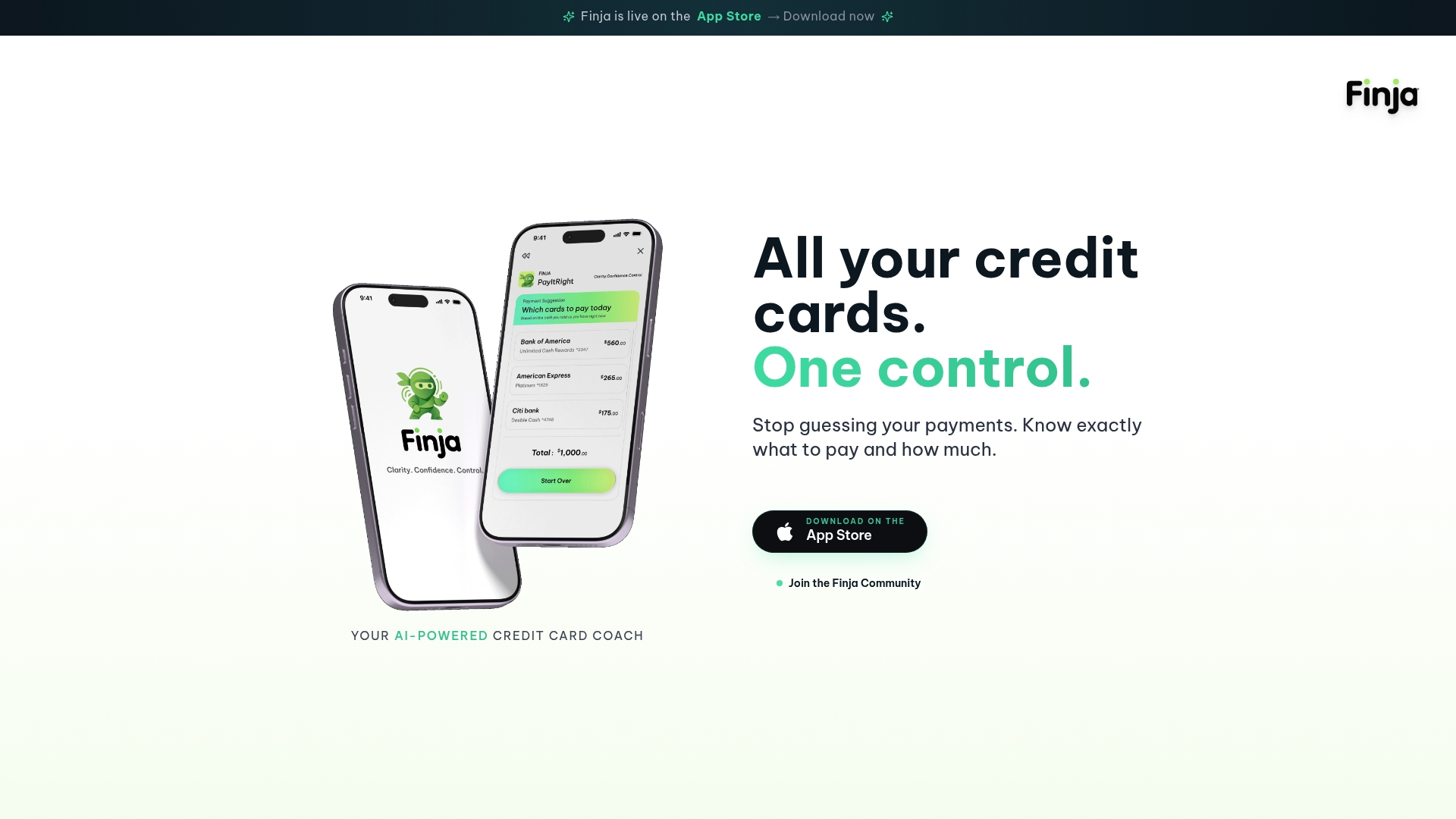
Finja gives you a consolidated view of every card's active categories, so you're not logging into separate apps to check whether this quarter's rotating bonus is live. It flags when you're approaching a spending cap before you cross it and lose the elevated rate for the rest of the period. It surfaces merchant classification issues so you can catch a miscoded transaction early instead of discovering it three statements later. And when you're standing at checkout deciding which card to use, it recommends the card that actually earns the most for that specific purchase, based on your real card lineup rather than a generic rule of thumb.
If you're managing more than two or three cards and trying to keep their category rules straight in your head, that's exactly the situation Finja was built for. Check your accounts and see your consolidated category view at Myfinja.
Frequently Asked Questions
What are the main types of credit card category bonuses? The core types are fixed, rotating, customizable, merchant-specific (MCC-driven), tiered/accelerator, and limited-time promotional categories. Each pays an elevated rate on specific spending, but they differ in how much tracking and activation they require.
How is a category bonus different from a welcome bonus? A category bonus pays an ongoing elevated rate every time you spend in that category. A welcome bonus is a one-time reward for hitting a spending threshold within the first few months of opening the account, and it's often the largest single reward you'll get from a card.
Do I need to activate every bonus category? Rotating categories almost always require activation each quarter, typically through the issuer's app or website. Fixed and customizable categories usually apply automatically, though some customizable cards require you to select your top category manually.
Why didn't my purchase earn the bonus rate I expected? The most common reason is merchant coding. The card issuer bases your bonus on the merchant's Merchant Category Code, not the actual items you bought, so a purchase that seems obviously "grocery" or "dining" can post under a different code and miss the bonus entirely.
Should I get a rotating category card or a fixed-rate card? It depends on how much tracking you're willing to do. If you'd rather not track anything, a fixed or flat-rate card delivers more consistent, if lower, returns.
Can I use more than one category card at once? Yes, and pairing cards is generally the stronger strategy. Most rewards-focused users combine a flat-rate card for general spending with one or two category cards targeting their biggest expenses, like groceries or gas.
This article is general information, not a substitute for advice from a qualified financial advisor. Consult a qualified financial professional about your own circumstances before acting on anything here.
Sources
Categories, caps, and activation rules change without much warning, so confirm details directly with primary sources before relying on them: issuer bonus-category pages (Chase, Discover, Citi, American Express), merchant category code explainers, and card pairing guides.
Always check your card's current terms and conditions before assuming a category, rate, or cap still applies as described here.
- How merchant category codes affect credit card rewards | CardRatings
- What Is a Bonus Category on a Credit Card? | The Points Guy
- What Are Rotating Bonus Category Credit Cards? | Experian
- Rotating credit card bonus categories | Chase
- The Biggest Credit Card Welcome Bonuses 2026 | Cardocrat