
Pay your highest-interest card, then the one closing soonest, before its statement cuts, and let autopay cover the minimum on everything else as a backstop. That's the whole rotation rule. It works because two things bureaus and lenders care about (interest cost and reported utilization) respond to when you pay, not just how much you pay over the month.
Start with three moves this billing cycle:
- Pull up every card's statement closing date, current balance, and APR, and rank them by interest rate first, closing date second.
- Send a manual payment to the top card 3 to 5 days before its statement closes, on top of whatever autopay already covers.
- Keep autopay set to at least the minimum on every card, so a missed manual payment never turns into a late fee.
Pro Tip: Experian notes that utilization makes up roughly 30% of your FICO score, and cardholders who get under 10% see stronger results than those who just stay under the common 30% guideline. An app like Finja can track all of this automatically instead of you juggling five due dates in your head.
Key Takeaways
Rotating payments works because it targets two separate mechanics, interest cost and reported utilization, at the exact points in the billing cycle where you have the most control.
| Point | Details |
|---|---|
| Pay before close, not just before due | The statement closing balance gets reported to bureaus, so a payment made 3 to 5 days before that date lowers reported utilization. |
| Target APR and close date first | Send extra payments to the card with the highest interest rate and the soonest statement close date each month. |
| Keep autopay as your failsafe | Set autopay to at least the minimum on every card so a missed manual payment never becomes a late mark. |
| Recalculate monthly | Balances, promotional APRs, and utilization shift, so rerun your priority ranking every cycle rather than setting it once. |
| Automate with Finja | Finja consolidates account views and schedules pre-close payments based on APR and closing date, with autopay guardrails built in. |
Table of Contents
- How Does Rotating Credit Card Payments Actually Reduce Interest?
- When Should You Pay Each Card in the Billing Cycle?
- Which Card Should Get Your Extra Payment This Month?
- What Does a Month of Rotation Actually Look Like?
- How Do You Automate Rotation Without Losing Control?
- What Are the Biggest Risks When Rotating Payments?
- What Should Your First 30 and 90 Days Look Like?
- Why Payment Timing Beats Most Debt Advice You've Heard
- Let Finja Handle the Rotation Schedule for You
- Frequently Asked Questions
- Sources
How Does Rotating Credit Card Payments Actually Reduce Interest?
Two mechanics do all the work here, and neither one requires you to pay a dollar more over the course of a month. You're just changing when the money moves.
The first is average daily balance. Most issuers calculate interest by averaging your balance across every day in the billing cycle, then applying your daily periodic rate to that average. Send a payment on day 10 instead of day 25, and the balance you're charged interest on for the back half of the cycle drops immediately. Freedom Debt Relief points out that payments above the minimum typically get applied to your highest-interest balance first, which is exactly where you want extra money landing.
The second mechanic is the statement snapshot. Your card issuer doesn't report your due-date balance to Experian, Equifax, or TransUnion. It reports whatever balance existed the moment your statement closed, and Broadview FCU confirms that closing date usually falls 21 to 25 days before your payment is actually due. Pay down the balance before that closing date, and a lower number gets reported. Pay the same amount on the due date instead, and the bureaus never see it that cycle.
| Mechanic | What triggers it | What it affects | How fast it shows up |
|---|---|---|---|
| Average daily balance | Any payment during the cycle | Interest charged this cycle | Immediate, reflected on next statement |
| Statement snapshot | Payment made before close date | Reported utilization | One billing cycle |
| Grace period | Paying the full statement balance by due date | Whether new purchases accrue interest | Next cycle onward |
CFP® Jacob Bayer, cited by BHG Financial, calls pre-statement payment timing one of the most actionable short-term moves available for improving a credit score, precisely because it can shift utilization within a single reporting cycle rather than months.
- Multiple smaller payments in one cycle lower your average daily balance more than one lump payment at the end.
- A pre-close payment can move your reported utilization even if your total spending for the month hasn't changed.
- Utilization improvements often show up on your very next statement, not three months later.
When Should You Pay Each Card in the Billing Cycle?
Think of the cycle in four stages, and you'll never wonder what to do next.
- Charges post. Purchases hit the statement as they happen. Nothing to do yet except track them.
- Mid-cycle top-up. Around the midpoint, send a payment toward your priority card if the balance has grown. This trims the average daily balance before it compounds further.
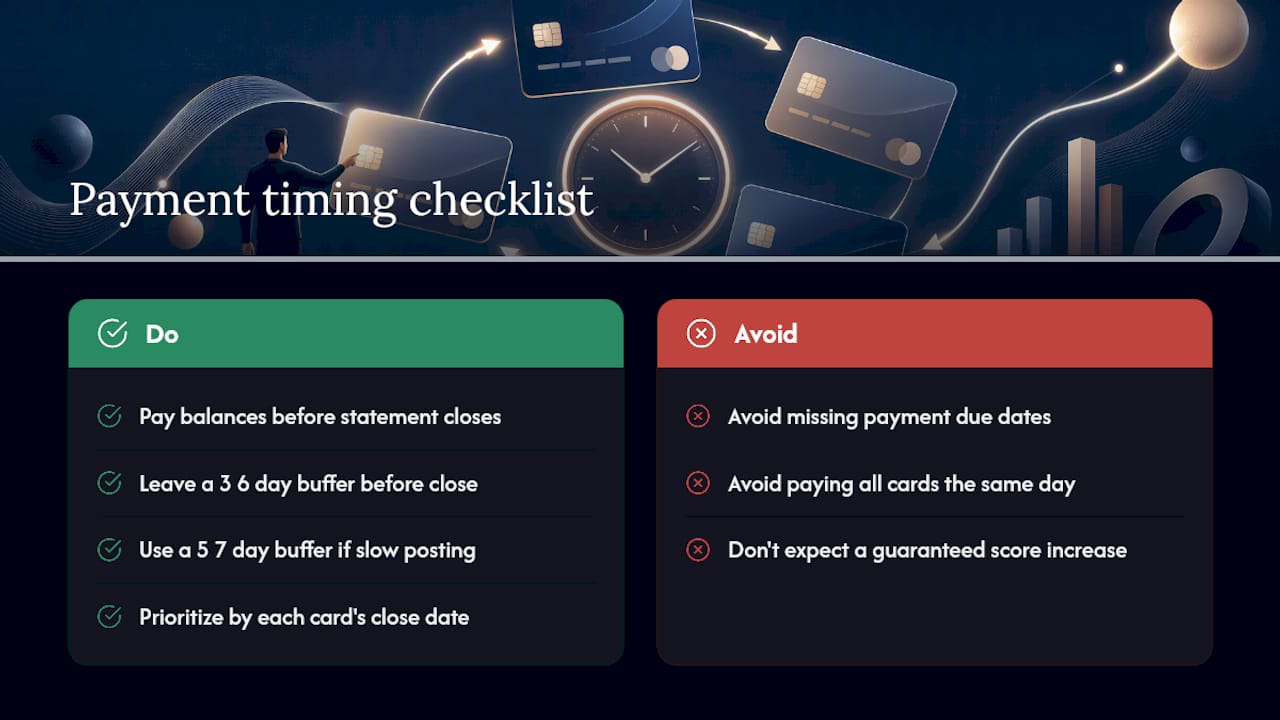
- Pre-close payment. This is the move that matters most. Pay down your priority card 3 to 5 days before its statement closing date, giving the payment time to post before the bank pulls its snapshot.
- Due-date sweep. By the actual due date, make sure every card shows a $0 balance if your budget allows it, both to protect your grace period and to avoid interest on the following cycle's purchases.
Autopay should always be set to at least the minimum payment as your safety net. Manual payments are where the strategy lives, but a forgotten manual payment should never turn into a 30-day late mark on your credit file.
If your issuers report on different days, which is common when you're juggling four or five cards, don't try to memorize a single pay day. Build a short calendar entry for each card's own close date and work backward 3 to 5 days from there. Some issuers also have a lag between when a payment posts and when it's reflected internally, so if you're paying right at the wire, push your buffer to 5 to 7 days instead of 3.
Pro Tip: If a card shows unusually slow posting two cycles in a row, treat that as your signal to shift its buffer permanently, not a one-time fluke.
Which Card Should Get Your Extra Payment This Month?
Run every card through this order of questions, and the answer becomes obvious fast.
- Which card carries the highest APR, and does its statement close soonest? That card gets priority. High rate plus a near-term close date means it's costing you the most and reporting the soonest.
- If two cards have similar APRs, which one has the highest utilization relative to its limit? Send extra payment there. A card at 60% utilization on a $2,000 limit hurts your score more than one at 15% utilization on $10,000, even with an identical balance.
- If utilization is also similar, target the smallest balance. This is the one place a snowball-style shortcut beats pure avalanche math: clearing a small balance frees up a full credit line and simplifies your rotation going forward.
A few things can flip this order mid-cycle:
- A card above 30% utilization becomes urgent regardless of its APR, since that threshold disproportionately drags down your score.
- An upcoming loan or mortgage application means every card should get pushed toward its lowest possible reported balance before applications go in.
- A short-term cash crunch means you protect the autopay minimums first and delay discretionary extra payments, full stop.
Balance transfers deserve a mention here only as a guardrail, not a default. They make sense strictly when the math favors them, which is not automatic. Experian lists limit increases and converting revolving debt to installment loans as other legitimate levers when rotation alone can't get utilization where you need it. Read more on high-interest card prioritization if you're deciding between avalanche and snowball for your specific mix.
What Does a Month of Rotation Actually Look Like?
Here's a sample month across three cards with a $600 total payment budget beyond the minimums.

Card A gets the bulk of the budget because it carries the highest APR and closes first. Skip the rotation entirely and pay $600 as one lump sum on the shared due date instead, and none of that money reduces the average daily balance on the two highest-rate cards during the weeks before their statements close.
To copy this for your own cards, build a simple table with these columns: card name, current balance, APR, credit limit, statement close date, recommended pre-close amount, and monthly priority rank. Update it every time a statement posts. If your cards close on staggered dates across the month, which is typical, just work through your priority list in close-date order rather than trying to pay everything on one calendar day. For more worked math on payoff sequencing, see compound interest avoidance strategy.
How Do You Automate Rotation Without Losing Control?
The manual version of this works, but it's tedious across four or five cards with different close dates, different APRs, and different limits. A workable automation flow looks like this:
- Import every card into one consolidated view instead of five separate bank logins.
- Set priority rules based on APR and statement close date so the system knows which card to fund first.
- Schedule pre-close payments automatically, timed to each card's individual cycle.
- Keep autopay minimums running underneath everything as the failsafe layer.
Once that's running, monitor a short list of things weekly:
- Reported utilization per card, not just the total across all cards combined.
- Upcoming statement close dates, especially any that shift due to a billing cycle change.
- Missed or delayed payment postings, particularly right after a bank holiday.
- Balance-transfer promotional APR expiration dates, if you're using one.
- Grace period status, meaning whether you're still avoiding interest on new purchases.
Finja is built around exactly this workflow: a consolidated view of every card, payment priority recommendations based on APR and closing date, pre-close scheduling, and guardrail rules that keep autopay minimums running as a backstop. It's the kind of tool designed for someone managing this across multiple cards rather than one.
Pro Tip: Before trusting automation fully, verify your bank's posting window and hold times for at least one full cycle. Some banks post payments same-day; others take two to three business days, and that gap matters when you're paying five days before a statement closes.
What Are the Biggest Risks When Rotating Payments?
Rotation backfires when a few common mistakes creep in.
- Losing your grace period. If you carry any balance past the due date, new purchases may start accruing interest immediately with no grace period, even if you're rotating payments perfectly elsewhere.
- Balance-transfer fees outweighing the savings. A 3% to 5% transfer fee on a $5,000 balance costs $150 to $250 upfront; that only pays off if the interest saved over the promotional period clearly exceeds the fee.
- Double-counting payments. Scheduling a manual payment on top of autopay without checking whether autopay already pulled the full statement balance can overpay a card or trigger a return item.
- Posting delays. A payment submitted the night before close might not post until the next business day, missing the snapshot entirely.
- Mistaken autopay settings. Autopay set to "statement balance" instead of "minimum payment" can conflict with manual pre-close payments in ways that confuse your own tracking.
Watch for red flags too: a sudden credit-limit decrease, a reporting date that shifted without notice, repeated late postings on the same card, or a string of hard inquiries from applying for limit increases too often. Experian's guidance on utilization levers is worth revisiting if any of these show up, since they change which strategy actually helps.
What Should Your First 30 and 90 Days Look Like?
- Days 1 to 7: Map every card, listing balance, APR, limit, and statement close date in one place.
- Days 7 to 14: Set autopay to at least the minimum on each card as your failsafe.
- Days 14 to 21: Schedule your first round of pre-close payments based on the priority rules above.
- Days 21 to 30: Turn on utilization monitoring or alerts so you can see the impact on your next statement.
Once you're past the first month:
- Review tracked utilization changes at the 60-day mark and confirm the pre-close payments actually lowered your reported numbers.
- Re-run the priority decision tree as balances shift; the card that led last month might not lead this month.
- Consider requesting a credit limit increase only if it meaningfully lowers utilization without triggering a hard inquiry you don't need.
A one-line weekly review works well as a habit: check each card's current balance against its statement close date, confirm autopay is active, and note whether any priority ranking needs to change. For more structure on staying consistent, see reducing financial stress from credit cards.
Why Payment Timing Beats Most Debt Advice You've Heard
Most credit advice focuses on total debt paid down over months or years. That's real, but it misses something more immediate: your reported utilization resets every single billing cycle, and you have direct control over that number regardless of your long-term payoff timeline. I think this is the most underused lever in personal finance, because it costs nothing extra and produces results within weeks rather than months.
Where people get this wrong is treating rotation as a one-time setup instead of an ongoing habit that shifts with their balances. The card that deserved priority in January might not deserve it in April once a balance drops or a promotional APR expires. Automation solves the tedium of tracking that, but it should never replace understanding why the underlying rule works. That's the gap Finja is built to close, pairing the consolidated tracking with the reasoning behind each recommendation rather than just a black-box "pay this now" alert. You can browse more of this thinking on the Finja blog.
Let Finja Handle the Rotation Schedule for You
Manually tracking five statement close dates, five APRs, and five payment buffers is exactly the kind of task that quietly falls apart during a busy month. Finja replaces that spreadsheet with a consolidated view of every card, then applies the same priority logic covered above automatically: highest APR paired with the soonest close date gets funded first, pre-close payments get scheduled without you remembering the date, and autopay minimums stay active underneath as a guardrail.
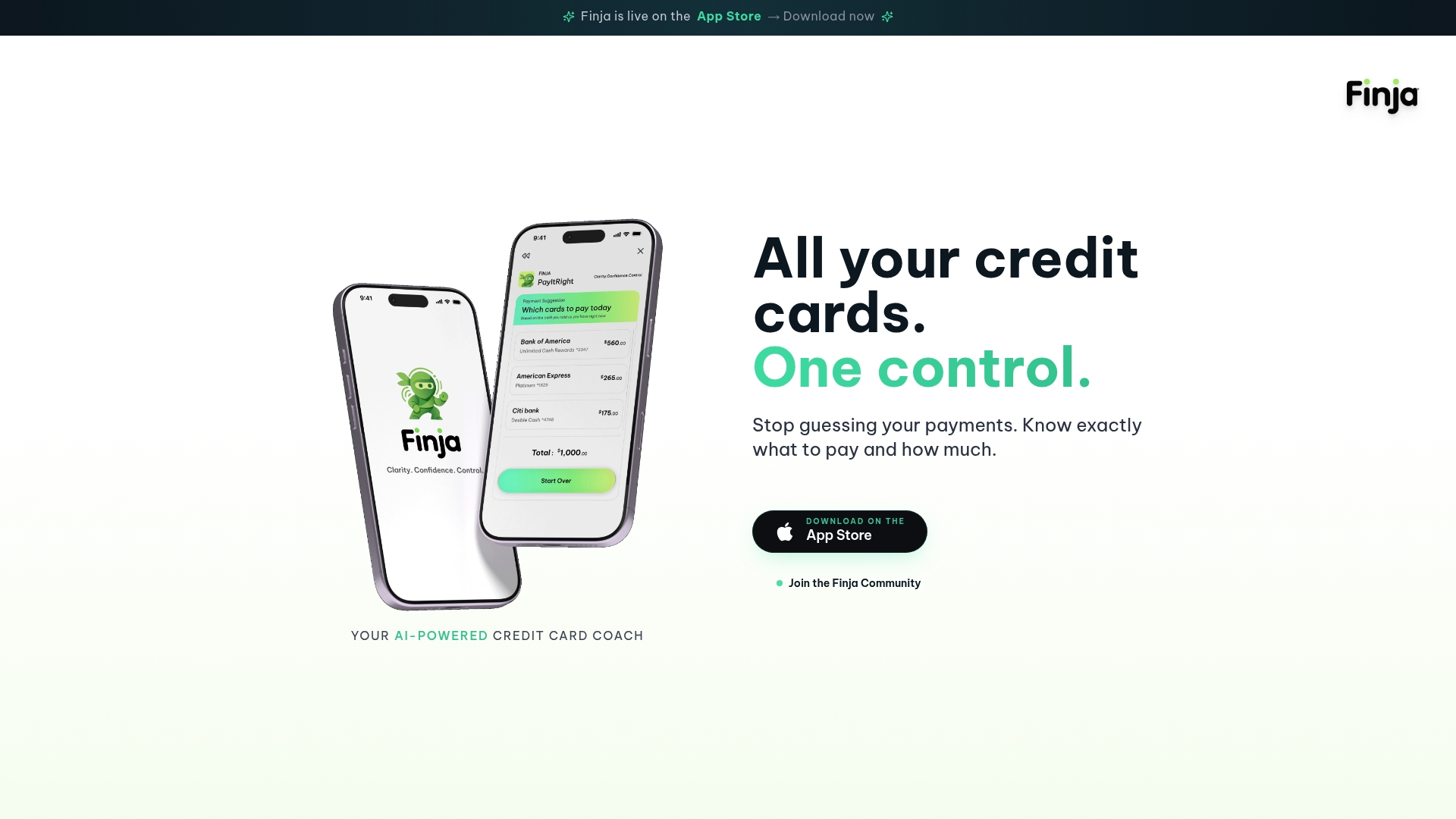
Using an account-consolidating tool like this typically means less time spent checking five separate banking apps and fewer missed pre-close windows, which is where most manual rotation plans quietly fail. It doesn't promise a guaranteed score jump; utilization and interest respond to the math, and the math depends on your own balances and budget. What it does is remove the guesswork of when to pay, and it lets you keep autopay minimums running as your safety net while you test manual pre-close payments alongside it. Head to Finja to set up your accounts and see your first rotation schedule generated automatically.
Frequently Asked Questions
Does rotating credit card payments hurt my credit score? No. Paying down balances before a statement closes generally helps your score by lowering reported utilization, as long as you're not missing due dates or triggering late fees elsewhere.
How many days before my statement closes should I pay? A 3 to 5 day buffer works for most issuers. If a card has shown slow posting before, push that buffer to 5 to 7 days.
Can I rotate payments across cards with different issuers and different reporting dates? Yes. Build your priority list by each card's own statement close date rather than trying to pay everything on the same calendar day.
Will Finja guarantee my credit score goes up? No tool can guarantee a specific score outcome, since scores depend on your full credit profile. Finja focuses on automating the payment-timing rules that commonly improve reported utilization and reduce interest.
This article is general information, not a substitute for advice from a qualified financial advisor. Consult a qualified financial professional about your own circumstances before acting on anything here.
Sources
- Credit card billing cycle explained / Broadview FCU
- When is the best time to pay my credit card bill? / Experian
- When to pay credit card bill to increase credit score / BHG Financial (CFP® Jacob Bayer)