
Credit card fraud protection makes a meaningful, practical difference for most consumers because it puts the issuer's money on the line first, not yours. Under the Fair Credit Billing Act (FCBA), your maximum liability for unauthorized credit card charges is $50, and most major networks like Visa go further with $0 liability policies. The Federal Trade Commission (FTC) and Experian both track fraud rates and confirm that credit cards remain the most targeted, yet also the most protected, payment method available to U.S. consumers. If you use a debit card instead and fraud hits, the money leaves your checking account immediately while you wait for a resolution that may take days or weeks.
The practical takeaways right now:
- Use a credit card for online purchases and unfamiliar merchants whenever possible.
- Report suspicious charges to your issuer within 30 days to preserve zero-liability protection.
- Monitor accounts daily, not just when a statement arrives.
- Consider a card-management tool like Finja to consolidate alerts across multiple cards and catch unusual patterns faster.
Table of Contents
- Why credit card fraud protection matters for your finances
- How credit card fraud typically happens today
- How do credit cards and debit cards compare on fraud protection?
- What protections do card issuers and networks actually provide?
- Practical steps you can take right now to lower your fraud risk
- What to do immediately after spotting unauthorized charges
- What to expect: timelines, provisional credits, and out-of-pocket costs
- Common myths about card fraud protection, corrected
- What experts say about proactive monitoring
- Key Takeaways
- The part most guides skip
- Finja helps you monitor all your cards in one place
- Useful sources
Why credit card fraud protection matters for your finances
The most underappreciated aspect of credit card security is the firewall effect. When a fraudster charges your credit card, they are spending the issuer's money, not yours. Your rent, utilities, and grocery budget stay untouched while the investigation runs. With a debit card, that same fraudulent charge pulls directly from your checking account, and you may not recover those funds before a bill comes due.
The credit score dimension is less obvious but just as real. Fraud that goes undetected long enough can push your credit utilization up, trigger late payments if fraudulent charges inflate a balance you don't pay, or in severe identity theft cases, open new accounts in your name that damage your payment history. Catching fraud early limits how far that damage spreads.
By the numbers: Close to 450,000 reports of credit card fraud were filed with the FTC in 2024, making it the single most common form of identity theft reported that year.
The stress and time cost matter too. Disputing fraudulent charges, replacing cards, updating stored payment methods across subscriptions, and monitoring for follow-on identity theft can consume hours. Strong protections and fast reporting compress that window considerably.
Key reasons the protections matter day-to-day:
- Cash flow stays intact while the issuer investigates, so essential payments don't bounce.
- Credit report damage is limited when fraud is caught and disputed quickly.
- Legal frameworks exist specifically to protect you: the FCBA for credit cards, the Electronic Fund Transfer Act (EFTA) for debit.
- Issuers bear financial incentive to resolve disputes in your favor because they absorb the loss, not you.
How credit card fraud typically happens today
Understanding the attack types helps you prioritize which defenses actually matter. Most fraud falls into a handful of recognizable patterns.
- Card-present skimming and shimming. A device attached to an ATM or gas pump reader captures your card data as you swipe or insert. Shimming targets chip cards specifically by sitting inside the card slot.
- Card-not-present (CNP) fraud. A thief uses your card number, expiration date, and CVV to make online purchases without ever holding the physical card. CNP fraud has grown as e-commerce expanded.
- Data breaches. A retailer, healthcare provider, or payment processor is compromised, and millions of card numbers are exposed at once. You may not know your data was stolen for months.
- Phishing and social engineering. A convincing fake email, text, or phone call tricks you into handing over card details voluntarily. No technical exploit needed.
- Account takeover. A fraudster uses stolen credentials (often from a separate breach) to log into your card account, change contact details, and redirect statements or new cards.
- Credential stuffing. Automated tools test username/password combinations from leaked databases across hundreds of sites simultaneously, looking for reuse.
- Merchant compromise. Malware on a retailer's payment system captures card data at the point of sale, often affecting thousands of customers before detection.
The trend worth watching is the continued growth of CNP fraud. As EMV chips made in-person card cloning harder, fraudsters shifted online, where a physical card is never required. That shift is why virtual card numbers and tokenization have become genuinely useful defenses, not just marketing features.
How do credit cards and debit cards compare on fraud protection?

The differences are not subtle. They affect how quickly you lose money, how long you wait to get it back, and what legal tools you have.
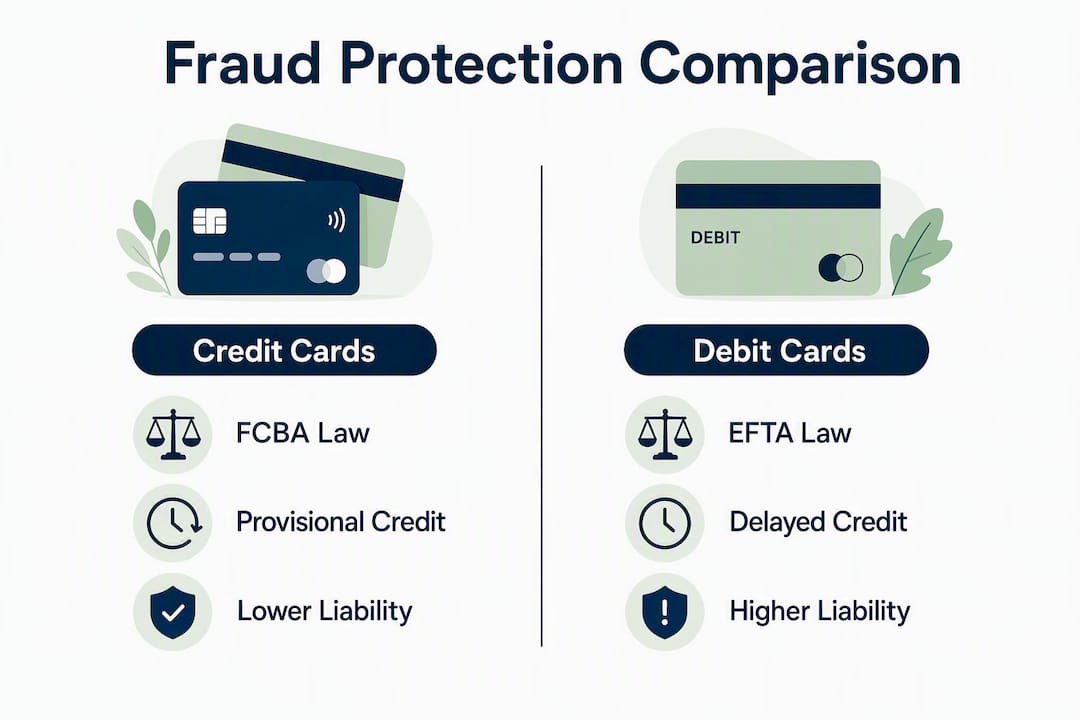
| Protection dimension | Credit card | Debit card |
|---|---|---|
| Governing law | Fair Credit Billing Act (FCBA) | Electronic Fund Transfer Act (EFTA) |
| Max liability (reported promptly) | $50 (often $0 via network policy) | $50 if reported within 2 business days |
| Max liability (delayed reporting) | $50 regardless of delay | Up to $500 if reported 3–60 days late; unlimited if over 60 days |
| Immediate impact on your cash | None — issuer's funds are used | Immediate drain from your checking account |
| Provisional credit availability | Common; typically issued quickly | Less consistent; varies by bank |
| Dispute resolution speed | Generally faster | Can be slower; funds already gone |
| Zero-liability policy | Standard across major networks | Available at many banks but not universal |
The EFTA's tiered liability schedule is the detail most consumers miss. Report a debit card compromise within two business days and your liability caps at $50. Wait 3–60 days and that ceiling jumps to $500. Wait longer than 60 days and you could be responsible for the full amount. The FCBA carries no such escalating penalty for credit cards.
Pro Tip: Use a credit card for hotel reservations, car rentals, and large online orders. Hotels and rental agencies place temporary holds that can freeze hundreds of dollars in a debit account for days, even after you check out. A credit card hold ties up your credit line, not your cash.
A few practical implications of the comparison:
- If your debit card is compromised on a Friday night, you may spend the weekend unable to pay for groceries while the bank investigates.
- Debit card fraud can immediately affect your cash availability; credit cards create a buffer that preserves your financial stability during the dispute window.
- Zero-liability on debit cards is a bank policy, not a federal mandate, so it varies by institution.
What protections do card issuers and networks actually provide?
The defenses operating behind every transaction are more layered than most cardholders realize.
Issuer-level tools
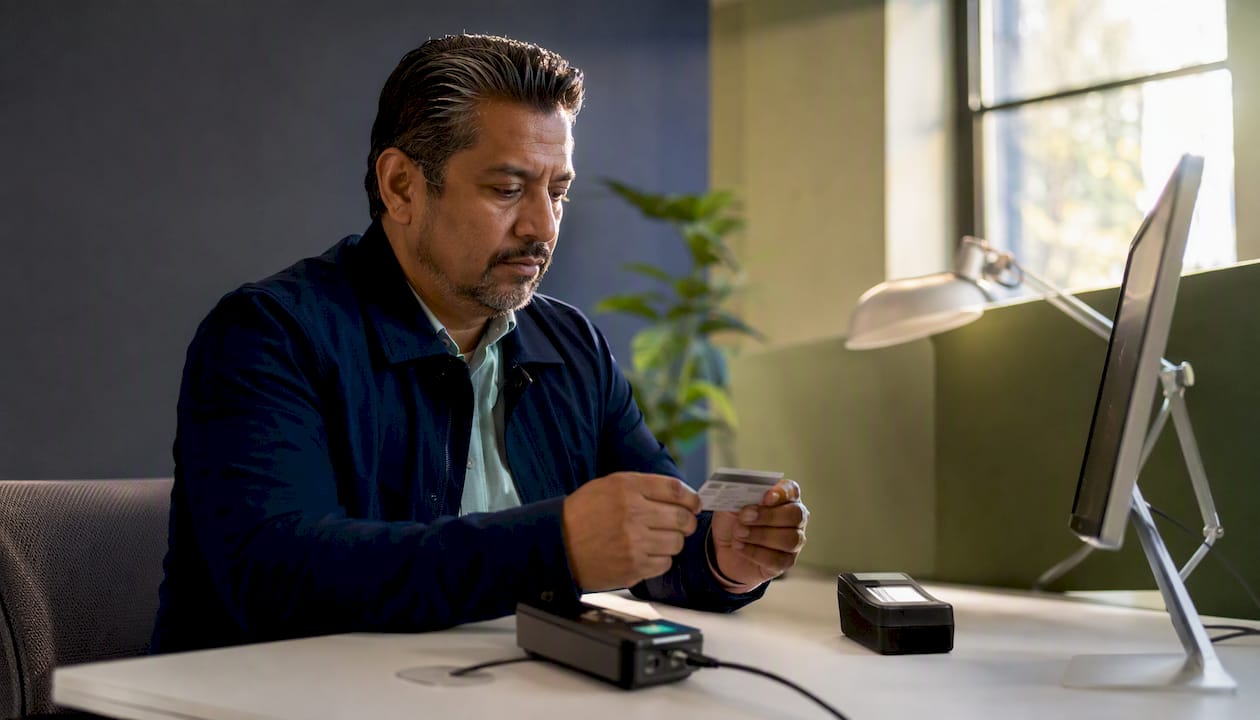
Card issuers run transaction monitoring around the clock, flagging purchases that deviate from your normal spending patterns. When something looks off, many issuers send an instant text or push notification asking you to confirm the charge. If you don't respond or deny it, the card can be blocked automatically.
Beyond monitoring, issuers offer:
- Card freeze and lock features. Most major issuers let you disable your card instantly through their app, stopping new charges without canceling the account.
- Provisional credits. For credit cards, issuers commonly apply a temporary credit to your account while investigating, so you're not paying interest on a fraudulent charge.
- Instant card reissue. Many issuers can push a new virtual card number to your digital wallet within minutes of a compromise, so you don't lose access to your account.
- Dispute management. Dedicated fraud teams handle the chargeback process with the merchant, which you don't have to manage yourself.
Network-level protections
Visa, Mastercard, American Express, and Discover all provide zero-liability protections and network-level fraud systems that analyze transactions in real time. The technology stack includes:
- EMV chips. The chip generates a unique transaction code for every purchase, making cloned cards useless at chip-enabled terminals.
- Tokenization. When you pay with a digital wallet like Apple Pay or Google Pay, your actual card number is replaced with a token. The merchant never sees your real account number.
- 3-D Secure / EMV 3-D Secure. An authentication layer for online purchases that prompts additional verification (a one-time code, biometric, or app confirmation) before completing a transaction.
- Machine learning risk scoring. Networks use machine learning to produce a risk score for every transaction, approving or flagging it in milliseconds based on hundreds of behavioral signals.
Where these protections fall short: social engineering. If a fraudster convinces you to read your card number aloud over the phone, or a phishing email gets you to enter credentials on a fake site, no amount of AI monitoring prevents the fraud. The technical defenses are strong; the human vector remains the most exploitable gap.
Practical steps you can take right now to lower your fraud risk
The most effective fraud prevention combines issuer tools with your own habits. Neither alone is sufficient.
Everyday actions
- Enable transaction alerts. Set up push notifications or texts for every purchase, not just large ones. A $1 test charge is often how fraudsters verify a stolen card number before a larger hit.
- Use strong, unique passwords and multi-factor authentication (MFA) on every card account and email address linked to financial accounts.
- Prefer contactless or digital wallet payments over swiping, especially at gas stations and standalone ATMs where skimmers are most common.
- Review your statement weekly, not just at billing time. Fraudulent charges are easier to dispute when caught within the first 30 days.
- Lock cards you rarely use. Most issuers let you freeze a card in their app without closing the account.
Stronger defenses worth adopting
- Monitor your credit reports — at AnnualCreditReport.com. New accounts you didn't open are an early sign of identity theft, not just card fraud.
Pro Tip: Combine your issuer's transaction alerts with a consolidated card-management tool like Finja to get a single view across multiple cards. Finja's multiple credit card management features surface unusual patterns across your full card portfolio, which individual issuer apps miss because they only see one card at a time.
What to do immediately after spotting unauthorized charges
Speed matters more than anything else here. The faster you act, the stronger your legal protections and the more likely you are to receive provisional credit quickly.
- Lock or freeze the card immediately. Do this through your issuer's app before you even call. It stops additional charges in seconds.
- Call your card issuer's fraud line. The number is on the back of your card. Say clearly: "I'm calling to report unauthorized charges on my account. I'd like to dispute the charge of $[amount] dated [date] and request that my account be reviewed for fraud." Ask explicitly about provisional credit.
- Request a new card number. Don't just report the fraud; ask for a replacement card with a new number so the compromised number can't be used again.
- Change your password and security questions for the card account and any email address associated with it.
- Check your other accounts. A compromised card number often comes from a broader data exposure. Log into your other financial accounts and look for anything unusual.
- File a report at IdentityTheft.gov. The FTC's site generates a personalized recovery plan and creates an official record. For losses over a few hundred dollars, file a local police report as well — some issuers and insurance policies require it.
- Consider a credit freeze if you believe your Social Security number or personal information was also exposed.
Reporting windows that affect your liability:
- Credit cards: report promptly to preserve zero-liability; the FCBA caps liability at $50 regardless, but issuer policies often require timely reporting for $0 liability.
- Debit cards: zero liability is common but often requires timely reporting per issuer terms; EFTA liability escalates significantly after 60 days.
What to expect: timelines, provisional credits, and out-of-pocket costs
Knowing the typical timeline prevents the frustration of not knowing where your dispute stands.
| Stage | Credit card | Debit card |
|---|---|---|
| Issuer acknowledgment | Within 30 days of written notice (FCBA) | Typically within 10 business days |
| Provisional credit issued | Often within 1–5 business days | Less consistent; may take 10 business days or longer |
| Investigation period | Up to 30 days (FCBA maximum) | Up to 2 business days (EFTA maximum) |
| Final resolution | Charge removed or upheld; you're notified | Funds restored or denial issued |
| Potential out-of-pocket exposure | $0–$50 depending on issuer policy | $0–$500+ depending on reporting speed |
The provisional credit distinction is where credit cards pull ahead in practice. Most major credit card issuers apply a temporary credit quickly, meaning you're not paying interest on a fraudulent charge while the investigation runs. Debit card provisional credits are less consistent and less required by law, so you may genuinely be short on cash for days or weeks.
One scenario where costs can surprise consumers: if the investigation concludes in the merchant's favor (for example, you authorized a charge but dispute the amount), the provisional credit may be reversed. Keep documentation of every disputed charge, including screenshots, emails, and your call records with the issuer.
Common myths about card fraud protection, corrected
Myth: Zero liability means I don't need to monitor my accounts. Zero-liability policies require reasonable care and prompt reporting. Ignoring alerts or waiting months to report a charge can void the protection entirely.
Myth: Closing the account immediately fixes everything. Closing a card stops new charges but doesn't resolve existing fraudulent ones. You still need to dispute those charges separately, and closing an account can temporarily affect your credit score by reducing available credit.
Myth: Debit cards are just as safe as credit cards. Legally and practically, they are not. The EFTA's escalating liability schedule and the immediate drain on your checking account make debit cards materially riskier for fraud exposure, particularly for online purchases.
Myth: Fraud only affects my card, not my credit report. Undetected fraud that inflates balances, triggers late payments, or opens new accounts in your name can damage your credit score. Monitoring your credit report is part of fraud recovery, not a separate concern.
Myth: The bank's fraud detection will catch everything. Phishing and credential stuffing enable fraud even when technical protections exist. Automated systems catch a lot, but social engineering bypasses most technical controls by exploiting you directly, not the system.
Myth: I only need to worry about fraud on cards I use frequently. Cards you rarely use are often the last ones you'd notice a fraudulent charge on. Locking dormant cards and checking their statements periodically is a simple habit that closes a real gap.
What experts say about proactive monitoring
The technology is impressive. It's still not enough on its own.
That advice reflects a broader reality: issuers and card networks absorb much of the financial liability for fraud, which is exactly why they invest heavily in AI-powered transaction authentication, EMV chips, and tokenization. Their financial incentive and yours are aligned. But their systems are built to catch patterns across millions of transactions; they can't know that you never shop at 3 AM or that you've never made a purchase in a state you're not currently visiting. You know your own behavior better than any algorithm does.
Practical monitoring habits that complement automated detection:
- Set alerts for every transaction, not just those above a threshold.
- Check your credit report monthly, not just annually. All three bureaus offer free weekly reports at AnnualCreditReport.com.
- Review credit card financial health indicators regularly, including utilization and payment history, which can signal fraud before a specific charge is identified.
- Use a centralized tool to monitor multiple cards simultaneously. When you have three or four cards, checking each issuer's app separately creates blind spots.
The AI payment trends shaping fraud detection are real and improving, but individual vigilance shortens detection time in ways that automated systems can't replicate. A fraudster who makes one small test charge and then waits 10 days before a larger hit may not trigger an automated alert. You checking your account on day three does.
Key Takeaways
Credit cards offer materially stronger fraud protections than debit cards because federal law, issuer policies, and network standards combine to cap your liability and preserve your cash while disputes are resolved.
| Point | Details |
|---|---|
| Credit cards protect your cash | Fraudulent charges use the issuer's funds, not your checking account, during the investigation. |
| FCBA vs. EFTA liability gap | Debit card liability can reach $500 or more if you report fraud after 2 business days; credit card liability caps at $50. |
| Report promptly | Zero-liability protection on both card types requires timely reporting; delays can increase your out-of-pocket exposure. |
| Proactive monitoring beats alerts alone | Checking accounts and credit reports regularly catches fraud that automated notifications miss. |
| Finja centralizes multi-card monitoring | Finja's app consolidates alerts and patterns across multiple cards, reducing the blind spots that come with managing each issuer separately. |
The part most guides skip
The dispute system works. That's the honest, underappreciated truth. Consumers who act quickly, document clearly, and follow the process almost always recover their money. What I've seen trip people up isn't the system itself; it's the panic that leads to skipping steps or waiting too long because the situation feels overwhelming.
The better mindset is procedural: lock the card, call the issuer, file the FTC report, change the passwords. In that order, without detours. The protections built into the FCBA and zero-liability policies exist precisely because Congress and the card industry recognized that fraud is not the cardholder's fault. The process is designed to make you whole, not to interrogate you.
One thing worth saying plainly: guilt and self-blame are common after fraud, especially after phishing. Sophisticated social engineering fools people who are careful and informed. The right response is not shame; it's the checklist above, executed quickly.
Finja helps you monitor all your cards in one place
If you carry two, three, or four credit cards, the biggest practical gap in fraud protection isn't the issuer's technology. It's the cognitive load of monitoring each card separately, across different apps, with different alert settings. A charge on a card you haven't used in six weeks is easy to miss when you're not actively checking that issuer's app.
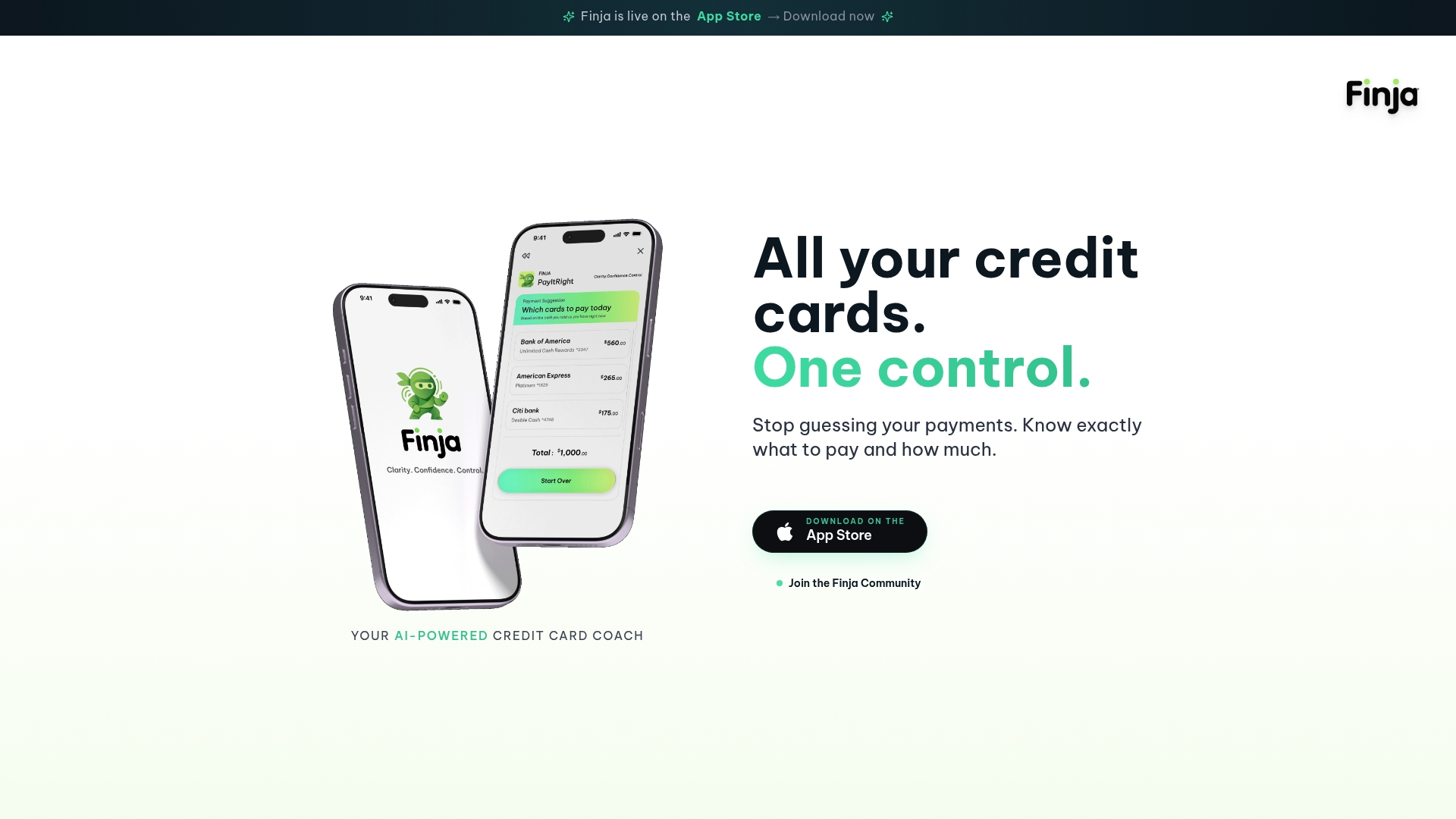
Finja consolidates your cards into a single view, surfaces unusual spending patterns, and helps you act on the protection steps covered in this article, from tracking utilization changes that might signal fraud to flagging payment timing so a disputed charge doesn't accidentally become a late payment. It's a complement to your issuer's fraud reporting, not a replacement. If you spot fraud, you still call your issuer directly. Finja just makes sure you spot it faster.
Not a substitute for reporting fraud to your card issuer.
Start managing your cards with Finja and reduce the blind spots that come with juggling multiple accounts.
Useful sources
- Credit Card and Debit Card Fraud | OCC — The Office of the Comptroller of the Currency's overview of how card fraud occurs and what consumers should do; a primary federal regulatory source.
- How common is credit card fraud? | Experian — Experian's analysis of FTC fraud data, including the close-to-450,000 reports filed in 2024; useful for understanding scale and trends.
- Are credit cards safer than debit cards? | Experian — Side-by-side comparison of FCBA and EFTA protections with practical guidance on when each card type is riskier.
- How major credit card networks protect customers against fraud | Bankrate — Explains EMV chips, tokenization, zero-liability policies, and AI risk scoring across Visa, Mastercard, AmEx, and Discover.
- 10 tips to prevent credit card fraud and keep your card safe | Fidelity — Practical prevention checklist including Stefan Ross's recommendation for proactive monitoring over reliance on automated alerts.
- Credit card fraud: what to do if you are a victim | Experian — Step-by-step recovery guide covering dispute processes, reporting timelines, and how to preserve zero-liability protections.
- How to protect your credit card from hackers | SoFi — Covers virtual card numbers, tokenization, RFID-blocking, and CVV masking as layered defenses for online and physical card security.
- IdentityTheft.gov | FTC — The FTC's official recovery portal; generates a personalized action plan and creates an official record of your fraud report.
- Finja | AI credit card management app — Finja's app for consumers managing multiple credit cards; consolidates alerts, tracks financial health, and helps implement the monitoring habits described in this article.