
Choose a fixed APR when you want predictable payments for the life of the loan, and consider a variable APR, usually structured as an adjustable-rate mortgage, only if you plan to sell or refinance within the ARM's low-rate window and you've already stress-tested the worst-case payment. Before signing anything, pull your Loan Estimate and check how the CFPB explains your specific terms.
TL;DR:
- Fixed APR guarantees steady payments for the entire loan term, while variable APRs often have lower initial rates but uncertain future adjustments.
- Two ARMs with similar starting APRs can have vastly different worst-case payments depending on their caps and margins, making comparison complex.
- Borrowers planning to sell or refinance within the fixed-rate period may benefit from ARMs' lower initial payments, but long-term holders should prefer fixed rates for predictability.
- Fully indexed rates after the initial period depend on the lender’s fixed margin, which varies and is as important as the initial rate for future cost estimates.
- Comparing loan offers requires analyzing projected payments and caps, not just initial rates or APR, to accurately understand potential payment volatility.
Table of Contents
- What fixed APR and variable APR actually mean
- When fixed wins and when variable earns a look
- How ARM rates are calculated and disclosed
- How to compare fixed and variable offers step by step
- A worked example: 5/1 ARM vs 30-year fixed
- A fast decision framework for fixed vs variable
- What borrowers get wrong about ARMs
- Managing variable-rate exposure across your cards
- FAQ
- Sources
What fixed APR and variable APR actually mean
A fixed APR locks in your rate and payment for the entire loan term. The CFPB explains that a fixed APR does not fluctuate with an index, while a variable APR can rise or fall as its underlying index moves. That said, "fixed" doesn't mean untouchable: some agreements still allow contractual changes under specific conditions, so read the fine print rather than assuming the label guarantees total stability.
APR itself bundles more than the interest rate. It typically folds in points, lender fees, and mortgage insurance where applicable, giving you a rough sense of the loan's total yearly cost. For a fixed-rate loan, that APR figure is a reasonably stable yardstick.

For an adjustable-rate mortgage, APR gets murkier. The rate you see at closing is often an introductory rate that expires after a set period, usually three, five, seven, or ten years. After that, your rate resets based on a market index plus a margin set by your lender. Because that future rate is unknown at signing, the APR disclosed upfront is really an estimate built on assumptions, not a guarantee of lifetime cost.
This is why headline APR can mislead you when comparing an ARM to a fixed loan:
- Fixed APR reflects the actual rate you'll pay for the full term, assuming no refinance.
- ARM APR reflects a blended estimate based on the introductory rate and projected future adjustments.
- Two ARMs with similar initial APRs can have very different worst-case payments depending on their caps and margins.
Instead of anchoring on the headline number, look at projected payment tables, which show what you'd actually owe under different rate scenarios.
When fixed wins and when variable earns a look
The right choice depends less on current rate levels and more on how long you'll hold the loan and how much payment variability your budget can absorb.
- Fixed-rate advantages: payments stay flat for the full term, making budgeting simple and protecting you from rate spikes.
- Fixed-rate drawback: the initial rate is usually higher than an ARM's introductory rate, so you pay a premium for certainty.
- Variable-rate advantages: a lower starting rate can mean real savings if you sell or refinance before the first adjustment.
- Variable-rate drawback: once the fixed period ends, payments can jump substantially, and some ARMs carry extra risk features like high margins, narrow caps, interest-only periods, or negative amortization that lets your balance grow instead of shrink.
Pro Tip: Ask specifically whether your ARM allows negative amortization. If a lender hesitates to answer clearly, treat that as a warning sign.
Borrowers with long time horizons, thin cash cushions, or low tolerance for payment surprises generally do better with fixed loans. Borrowers who are confident about a near-term sale or refinance, and who can comfortably afford the maximum possible payment, are the ones for whom an ARM can be a defensible trade.
How ARM rates are calculated and disclosed
Once an ARM's introductory period ends, the new rate is calculated as index plus margin, known as the fully indexed rate. The CFPB notes that margins vary among lenders and stay fixed after closing, which makes margin just as important to compare as the initial rate.
ARMs are usually labeled with two numbers, like 5/1 or 7/1. The first number is how many years the initial rate holds; the second is how often it adjusts afterward, usually annually. Each ARM also carries caps: a first-change cap limiting the size of the initial adjustment, a periodic cap limiting later adjustments, and a lifetime cap limiting how high the rate can ever climb.
Your Loan Estimate is where this all gets disclosed in writing. Key sections include:
- The "Can this amount increase after closing?" field, which flags rate or payment volatility directly.
- Projected Payments tables showing what you'd owe at different points in the loan.
- Adjustable Interest Rate (AIR) and Adjustable Payment (AP) tables that model first-change amounts and maximum payments.
A recommended check: the Loan Estimate explainer advises reading the "Can this amount increase after closing?" column alongside the AP/AIR tables to see your actual cash-flow exposure under the loan's caps, rather than relying on the APR alone.
How to compare fixed and variable offers step by step
Comparing two Loan Estimates side by side only works if you're comparing like with like.
- Match loan amount and term across both offers so the comparison isn't distorted by different sizes or lengths.
- Compare projected-payment tables, not just the initial rate, since that's where the real cost difference shows up.
- Calculate the fully indexed rate by adding the index value to the margin for any ARM offer.
- Check all three caps: first adjustment, subsequent periodic, and lifetime.
- Model the worst-case payment and compare it directly against your monthly budget.
- Review APR, total interest percentage (TIP), and cash to close on both offers.
Pro Tip: When you call a lender, ask directly for the index name, the margin, all applicable caps, whether the loan allows conversion to fixed, and whether a prepayment penalty applies.
Walking through these steps on paper, before you fall in love with a lower initial payment, is what prevents expensive surprises later.
A worked example: 5/1 ARM vs 30-year fixed
Here's a simplified comparison using illustrative numbers, not quoted rates from any lender. Say you're borrowing $350,000 for a home.
| Loan feature | 30-year fixed | 5/1 ARM |
|---|---|---|
| Initial rate | a certain percentage | a lower initial percentage |
| Initial monthly payment (principal and interest) | a fixed amount typical for the loan | a lower initial payment typical for an ARM |
| Margin (ARM only) | not applicable | a lender-set fixed margin |
| First-change cap | not applicable | a specified limit on the initial adjustment |
| Lifetime cap | not applicable | a specified limit above the initial rate |
| Worst-case rate after caps | the original fixed rate | a higher capped rate after adjustments |
| Worst-case monthly payment | the consistent fixed monthly payment | a potentially much higher payment at cap |
This is an illustrative scenario, not a market quote. In it, the ARM saves you about $228 a month for the first five years. But if the index rises enough to push the rate to its lifetime cap, that same loan could cost nearly $920 more per month than the fixed option once adjustments hit.
To replicate this with your own numbers:
- Pull the initial rate, margin, and caps straight from your Loan Estimate's AIR and AP tables.
- Run the numbers through a mortgage calculator, such as the free mortgage calculator from PsyFi, to see your own projected and worst-case payments.
- Compare the result against your actual monthly budget, not just against the initial payment.
A fast decision framework for fixed vs variable
- Plan to stay long-term or need payment certainty: choose fixed.
- Plan to sell or refinance before the ARM's first adjustment and can afford the maximum payment: variable may be defensible.
- Next steps either way: request a Loan Estimate, confirm the index and margin in writing, calculate your worst-case payment, and think through whether refinancing before adjustment is realistic given refinance costs and feasibility.
What borrowers get wrong about ARMs
The most common mistake I see is chasing the lowest introductory rate without ever checking the margin or the caps, which is exactly where the real risk hides. A less obvious tip: pull up historical index values and simulate what your first adjustment would have looked like in a rising-rate year, then add estimated refinance costs into your stress test so you're not caught short if refinancing turns out to cost more than expected.
— Grace K.
Managing variable-rate exposure across your cards
If an ARM makes you nervous about rate exposure, it's worth knowing that similar unpredictability shows up in credit card APRs too, and juggling several variable-rate cards can quietly erode your budget the same way a mortgage adjustment can. We designed an app to give you one consolidated view of every card, along with payment-optimization guidance that targets interest reduction over rewards chasing.
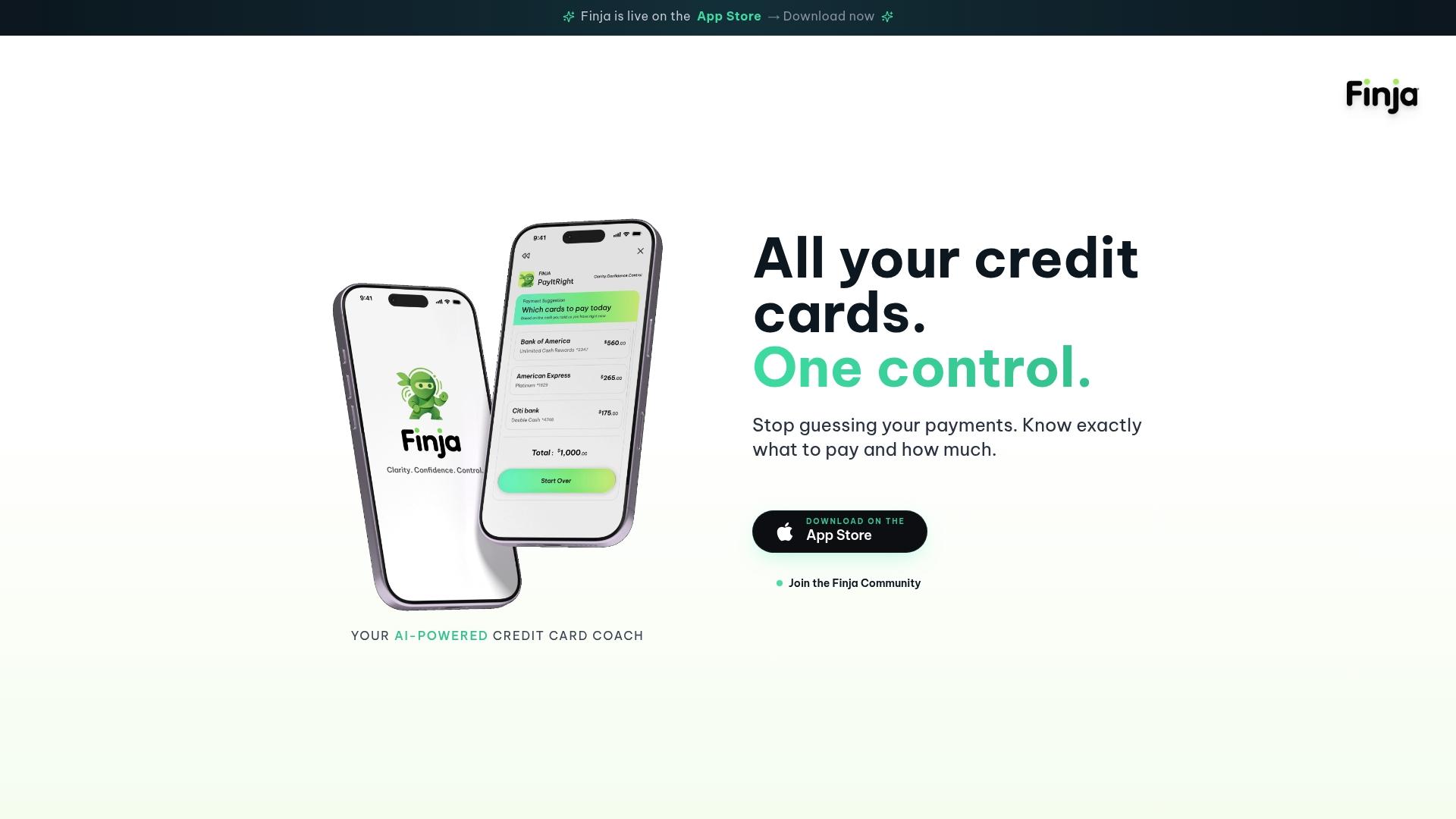
Finja fits naturally if you're managing multiple cards with variable APRs and want a clearer read on where your interest costs are coming from, plus practical tactics for lowering effective APR across your whole wallet.
- Consolidated view of all your cards in one place.
- Payment-timing and amount guidance aimed at cutting interest.
- Scenario testing to see how rate changes affect your monthly cost.
See how it works at Finja.
This article is general information, not a substitute for advice from a qualified financial advisor. Consult a qualified financial professional about your own circumstances before acting on anything here.
FAQ
Is it better to have a fixed or variable APR?
It depends on how long you'll hold the loan and how much payment flexibility your budget allows. A CFPB guide on ARM fine print frames the decision around your ability to afford future increases and your intended holding period, rather than current rate levels alone.
Is 28.99% variable APR good?
That figure is well above typical mortgage rates and sits in territory more commonly seen on credit cards, where variable APRs can legally adjust based on an index under rules that differ from mortgage ARMs. Whether it's "good" depends entirely on the product type and your alternatives, so compare it against other offers for the same credit type before judging it.
What's a good variable APR?
There's no single benchmark, since a reasonable variable APR depends on the product, the current index value, and your lender's margin. For an ARM, focus less on the starting number and more on the fully indexed rate and the caps that limit how high it can climb, as explained in CFPB guidance on index and margin.
Is 20% APR too high?
For revolving credit like credit cards, variable APRs in that range are common, and federal rules treat credit-card APR changes differently from mortgage adjustments, so the two shouldn't be judged by the same standard.