
The credit card collections process is the sequence of steps creditors and collectors take to recover unpaid credit card debt. It begins the moment you miss a payment and can escalate through internal recovery efforts, charge-off, third-party collection agencies, debt buyers, and civil litigation. The Fair Debt Collection Practices Act (FDCPA) and federal banking guidelines govern every stage. Knowing where you stand in this process gives you real leverage. This guide explains each phase and your rights at every step.
What are the stages of the credit card collections process?
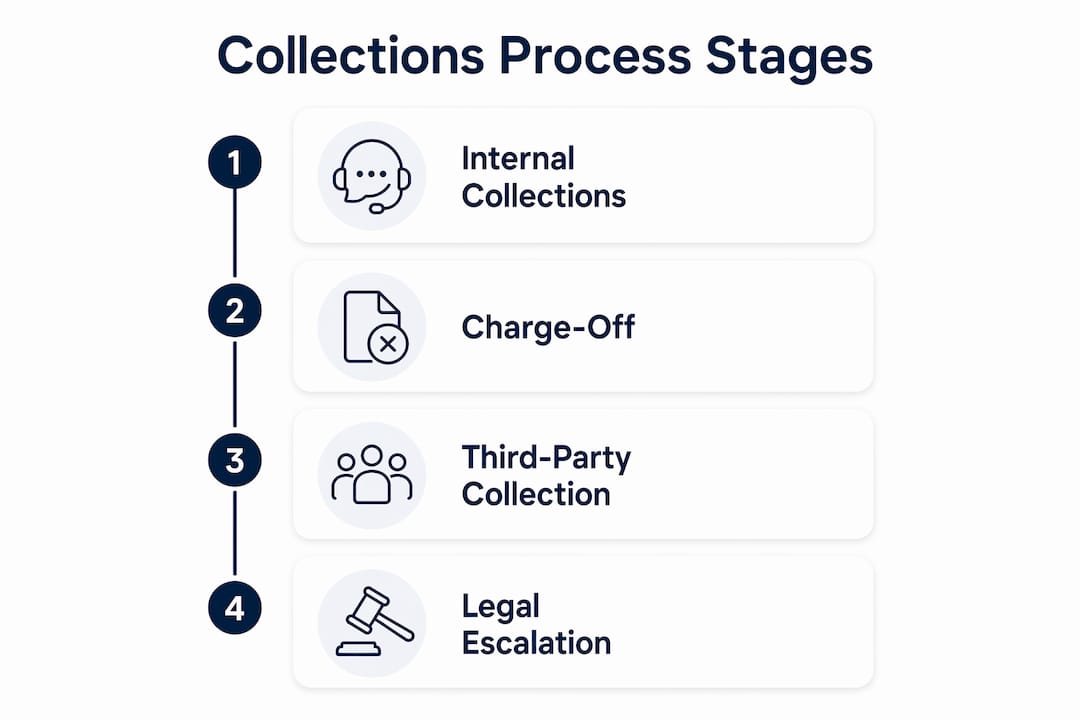
The credit card collections process follows a predictable timeline, and recognizing each stage helps you respond before options narrow.
Stage 1: Internal collections (days 1–90)
Your credit card issuer handles early recovery in-house. After one to three missed payments, the bank's internal collections team contacts you by phone, email, and mail. The goal at this stage is payment or a hardship arrangement. Issuers often offer temporary interest rate reductions or modified payment plans during this window. This is the easiest stage to resolve because you are still dealing with the original creditor, who has the most flexibility.

Stage 2: The charge-off
Charge-off occurs at 180 days past due. Banks are required by federal accounting rules to reclassify the debt as a loss on their books at that point. This is a critical fact: charge-off is an accounting step, not debt forgiveness. The debt remains legally owed in full. Many people misread a charge-off notice as a clean slate, which is a costly mistake.
Stage 3: Third-party collection
After charge-off, the original creditor either assigns the account to a collection agency or sells it outright to a debt buyer. Charge-off at 180 days is the standard trigger for this handoff. Once a third party takes over, the FDCPA requires them to send you a validation notice within five days of first contact. That notice must include the debt amount, the creditor's name, and your dispute rights.
Stage 4: Legal escalation
If the debt remains unresolved, the collector or debt buyer may file a civil lawsuit. Courts can issue wage garnishments or bank levies if a judgment is entered against you. Ignoring a lawsuit risks a default judgment even if the statute of limitations might otherwise protect you. You must actively appear and raise any legal defense.
Pro Tip: Request a payment history statement from your original creditor before the account reaches charge-off. This document becomes your baseline for disputing inflated balances later.
What rights do you have during credit card debt collection?
The FDCPA gives you specific, enforceable rights the moment a third-party collector contacts you. These are not suggestions. They are federal law.
- Validation notice: Collectors must send a written validation notice within five days of first contact. You have 30 days to dispute the debt in writing. During that window, the collector must pause collection activity until they verify the debt.
- Communication limits: The FDCPA caps collector calls at no more than 7 calls per seven-day period per debt. Calls before 8:00 AM or after 9:00 PM local time are prohibited.
- Prohibition on abuse: Collectors cannot threaten violence, use profane language, publish your name as a debtor, or make false statements about the debt's legal status.
- Right to verification: You can request the name and address of the original creditor in writing. The collector must provide this before continuing collection efforts.
- Cease communication: You can send a written letter demanding that the collector stop contacting you. After receiving it, they may only contact you to confirm they will stop or to notify you of a specific action like a lawsuit.
- Lawsuit defense: If sued on a debt that may be past the statute of limitations, you must raise that defense in court. Silence equals a default judgment.
Pro Tip: Send all dispute letters and cease-communication requests by certified mail with return receipt. This creates a timestamped legal record that protects you if the collector violates the FDCPA.
Ignoring collection attempts does not make the debt disappear. It removes your ability to negotiate and opens the door to legal action. Early engagement consistently produces better outcomes than avoidance.
How do debt buyers and collection agencies operate?
Understanding who holds your debt changes how you negotiate. Two distinct types of third parties handle charged-off credit card accounts, and they operate very differently.
Collection agencies typically work on contingency. They represent the original creditor or a debt buyer and earn a commission on what they collect. Agency commissions range from 20% to 50% of the amount recovered, with higher rates for older or harder-to-collect accounts. Because the agency does not own the debt, their settlement authority may be limited by the creditor's policies.
Debt buyers are different. They purchase portfolios of charged-off accounts outright, typically paying 4 to 12 cents on the dollar. That low purchase price creates real room for negotiation. A debt buyer who paid $0.08 on the dollar for your $5,000 balance paid roughly $400. A settlement at 40 cents on the dollar still generates a significant profit for them.
Account sales also create documentation gaps. When a debt changes hands multiple times, original account statements and signed agreements may not transfer with it. This matters because you have the right to request verification of the debt. If the current holder cannot produce adequate documentation, your dispute has more weight.
Both collection agencies and debt buyers must follow the FDCPA. Their obligations do not change based on how they acquired the account. The CFPB and FTC actively enforce these rules, and collector contact limits apply equally to both types of entities.
What are your practical options for responding to collections?
You have more choices than most people realize once an account enters collections. The right move depends on how far along the process is and who currently holds the debt.
- Negotiate a settlement: Debt buyers who paid pennies on the dollar have room to accept less than the full balance. Settlements at 40%–60% of the owed amount are common, though not guaranteed. Always get the settlement agreement in writing before sending any payment. A verbal agreement is not enforceable.
- Request debt validation first: Before negotiating, send a written validation request within the 30-day window. If the collector cannot verify the debt, you may not owe it to that entity. This step costs nothing and can eliminate inflated or misattributed balances.
- Engage early to avoid litigation: Addressing collections early preserves your negotiating leverage and reduces the risk of a lawsuit. Once a judgment is entered, your options shrink significantly.
- Understand the credit report impact: A collection account stays on your credit report for up to seven years from the original delinquency date. Newer credit scoring models may exclude paid collections from score calculations entirely. Paying a collection still benefits your credit profile because lenders view resolved delinquencies more favorably than open ones.
- Consider professional help: If the debt is large, if you are facing a lawsuit, or if you believe the collector has violated the FDCPA, consult a consumer law attorney. Many work on contingency for FDCPA violations, meaning no upfront cost to you.
- Avoid restarting the clock: Making a partial payment or acknowledging the debt in writing can restart the statute of limitations in some states. Know your state's rules before making any payment on very old debt.
Managing multiple credit cards while one account heads toward collections creates compounding stress. A debt-free credit card strategy can help you prioritize which balances to address first and prevent other accounts from following the same path.
Key Takeaways
The credit card collections process moves through defined stages, and knowing your rights at each one is the most effective tool you have for managing the outcome.
| Point | Details |
|---|---|
| Charge-off is not forgiveness | A charge-off at 180 days is an accounting step; the debt remains legally owed in full. |
| Validation notice is your first defense | Dispute the debt in writing within 30 days of first contact to pause collection activity. |
| Debt buyers have room to negotiate | Buyers pay 4 to 12 cents on the dollar, creating real space for settlement below the full balance. |
| Paying collections helps your credit | Newer scoring models may exclude paid collections, and lenders view resolved debts more favorably. |
| Ignoring lawsuits is never safe | A default judgment can result even on time-barred debt if you fail to appear and raise a defense. |
What I've learned from watching people navigate collections
Grace K.
The single biggest mistake I see is treating a collection notice like a threat to hide from. People stop answering calls, avoid opening mail, and hope the problem resolves itself. It never does. The FDCPA gives you real power, but only if you use it. A validation request costs you a stamp and 30 days of protected time. Most people never send one.
The second mistake is negotiating without knowing who holds the debt. A collection agency working on contingency has different incentives than a debt buyer who paid $400 for your $5,000 account. Knowing that distinction changes your opening offer and your patience level.
Record-keeping is the part nobody talks about enough. Every letter, every call log, every settlement offer in writing. Collectors who violate the FDCPA can be sued for damages. That is not a hypothetical. The FTC and CFPB have both taken enforcement actions against collectors for exactly the behaviors the law prohibits. Your documentation is your leverage.
The credit report piece surprises people most. Paying a collection does not erase it, but resolving delinquencies still matters to lenders and newer scoring models. Getting to a resolved status is worth the effort, even if the entry stays visible for years.
— Grace K.
Finja can help you manage credit card debt before it reaches collections
Dealing with credit card debt across multiple accounts is genuinely difficult. Finja is an AI-powered credit card management platform built to help you make better payment decisions, reduce interest costs, and protect your credit health before accounts reach critical stages.
Finja analyzes your credit card balances, interest rates, and payment patterns to give you a clear picture of where you stand. If you are managing several cards and trying to prevent any of them from sliding toward charge-off, Finja's AI credit coaching gives you a personalized plan based on your actual numbers. You can also explore credit card management tips to build better habits starting today.
FAQ
What triggers the start of the collections process?
The credit card collections process begins after one to three missed payments, when the original creditor's internal team starts recovery efforts. Charge-off and third-party involvement typically follow at 180 days past due.
Can a debt collector contact me at any time?
No. The FDCPA prohibits calls before 8:00 AM or after 9:00 PM local time and caps contact at seven calls per seven-day period per debt.
Does paying a collection remove it from my credit report?
Paying a collection does not remove it from your credit report, which retains the entry for up to seven years. However, newer scoring models may exclude paid collections from score calculations, and lenders view resolved accounts more favorably.
What happens if I ignore a debt collection lawsuit?
Ignoring a lawsuit results in a default judgment against you, even if the debt is past the statute of limitations. You must appear in court and actively raise any legal defense to protect yourself.
How much can I negotiate a settled debt for?
Debt buyers who purchased your account for 4 to 12 cents on the dollar often accept settlements well below the full balance. Settlement amounts vary, but getting the agreement in writing before any payment is non-negotiable.