
For most U.S. consumers juggling multiple credit cards, Finja is the strongest alternative to finlywealth.com: it delivers AI-driven payment optimization, a consolidated multi-card dashboard, and transparent reward modeling in one subscription. FinlyWealth itself is a Canadian credit card recommendation tool built around spending-pattern algorithms and cash rebates to offset annual fees. U.S. users need something built for their market.
The shortlist of viable finlywealth.com alternatives:
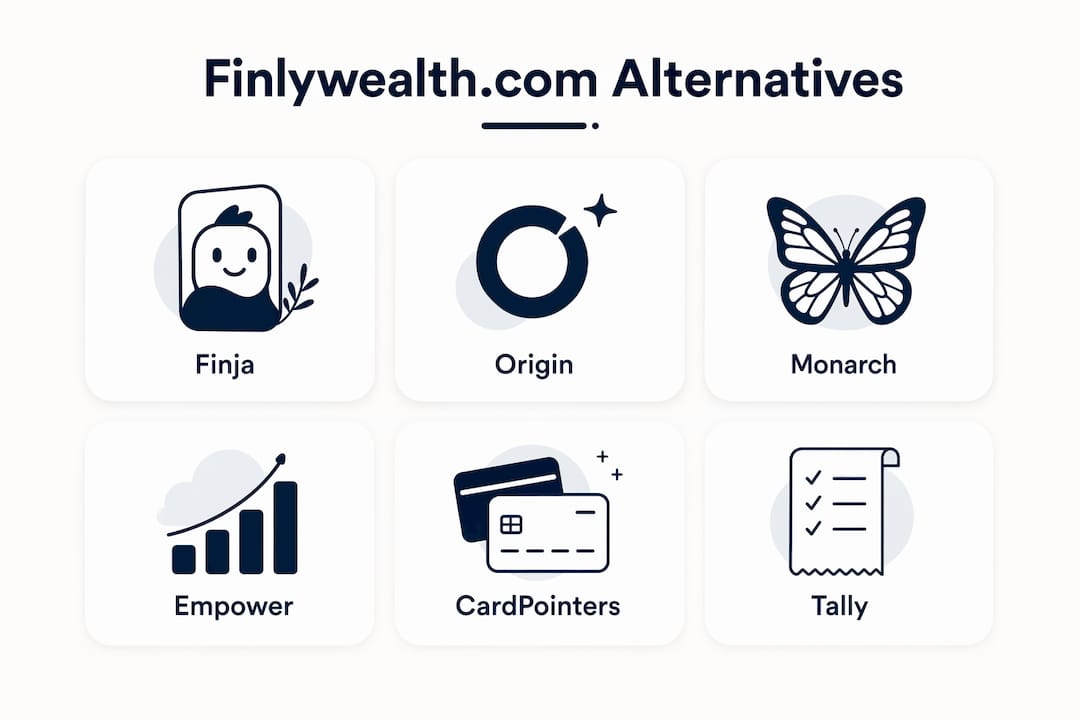
- Finja — AI payment optimization + consolidated multi-card view (recommended for most multi-card U.S. users)
- Monarch Money — budgeting-first, strong household and net-worth tracking
- Origin — all-in-one platform covering budgeting, investments, credit monitoring, and tax filing
- Empower — investment-first net-worth tracker with lighter card-level features
- CardPointers — lightweight rewards scanning and category-matching
- Tally — debt payoff and interest-minimization workflows
Table of Contents
- How do these finlywealth.com alternatives compare?
- What does each alternative actually do?
- How do you choose and switch from finlywealth.com?
- Why Finja is the right pick for most multi-card users
- Key Takeaways
- Product fit matters more than feature lists
- Finja is the direct U.S. alternative to finlywealth.com
- Key sources and references
How do these finlywealth.com alternatives compare?
The table below maps each option against the dimensions that matter most for multi-card U.S. consumers.
| Tool | Best for | Core features | AI / automation | Pricing & trial | Platform | Integrations | Security & privacy |
|---|---|---|---|---|---|---|---|
| Finja | Multi-card payment optimization | Payment optimization, consolidated dashboard, credit health, budgeting | AI payment recommendations, predictive interest modeling | Subscription (trial available) | iOS, Android, web | Major U.S. banks & card issuers | Bank-level encryption, published privacy policy |
| Monarch Money | Budgeting & household visibility | Budgeting, net worth, investment tracking, AI assistant | Plain-English AI assistant | Paid subscription | iOS, Android, web | Broad bank connections | Published privacy policy |
| Origin | All-in-one financial management | Budgeting, net worth, investments, credit monitoring, tax filing, estate planning | AI guidance | $1 first year, then subscription | iOS, Android, web | 13,000+ institutions via Plaid, MX, Finicity | Published privacy policy |
| Empower | Investment portfolio tracking | Net worth, portfolio analysis, retirement planning | Lighter automation | Free (core features) | iOS, Android, web | Major banks & brokerages | Published privacy policy |
| CardPointers | Rewards maximization | Card-offer scanning, category matching, deal alerts | Offer-matching automation | Free / low-cost | iOS, Android | Card issuers | Published privacy policy |
| Tally | Debt payoff & interest reduction | Payoff planning, consolidation, interest minimization | Automated payoff scheduling | Subscription | iOS, Android | Card issuers | Published privacy policy |
Key trade-offs worth flagging:
- Specialized vs. broad: Finja and CardPointers go deep on card-level optimization; Origin and Monarch trade that depth for all-in-one breadth.
- Rewards vs. payment optimization: CardPointers excels at matching cards to purchases; Finja focuses on reducing interest and optimizing payment sequencing across multiple cards.
- Free vs. subscription: Empower's core features are free; most tools with genuine AI modeling carry a subscription.
What does each alternative actually do?
Finja
Finja is purpose-built for the reader this article is written for: someone holding three, four, or five credit cards who wants to stop guessing which card to pay first and how much. Its AI payment recommendations analyze your balances, interest rates, and spending patterns to tell you exactly where to direct each dollar. The consolidated dashboard pulls every card into one view, and the credit-health tracking shows how your decisions move the needle on your score over time.
Standout features:
- AI-driven payment sequencing to minimize interest across multiple cards
- Consolidated multi-card dashboard with spending limit controls
- Credit-health tracking tied directly to payment behavior
Pricing: Subscription model with a trial period. Platform: iOS, Android, web.
Migration note: Export your spending history from finlywealth.com as a CSV if available, then connect your cards one at a time through Finja's bank integration. Run both tools in parallel for 30 days before changing any autopay settings.
Pros: Precise payment optimization; built for multi-card complexity; transparent AI logic. Cons: Narrower scope than all-in-one platforms; not the right pick if investment tracking is your priority.
Origin (all-in-one platforms)
"Origin covers budgeting, net worth, investments, credit monitoring, tax filing, estate planning, and AI-powered guidance in one subscription — for most people, it genuinely replaces the stack of separate apps." — Origin's 2026 analysis
Origin connects to 13,000+ financial institutions through Plaid, MX, and Finicity. The breadth is real. What it trades away is card-level payment optimization: Origin will show you your balances, but it won't tell you in what order to pay them to minimize interest.
Standout features:
- Budgeting, net worth, investments, credit monitoring, and tax filing under one subscription
- Partner access for couples without merged accounts
- AI guidance for household-level financial questions
Pricing: $1 first year, then subscription. Platform: iOS, Android, web.
Pros: Replaces multiple apps; deep integrations; strong for couples. Cons: Lighter on card-specific payment optimization; subscription cost rises after year one.

Monarch Money (budgeting-first)
Monarch is the strongest budgeting-and-net-worth alternative for users who want shared household visibility. Its AI assistant handles plain-English spending questions well. Investment tracking exists but is lighter than Origin's, and there's no tax filing or estate planning.
Standout features:
- Multi-user household plans for shared budget visibility
- Clean budgeting UI with net-worth tracking
- AI assistant for spending questions
Pricing: Paid subscription. Platform: iOS, Android, web.
Pros: Best budgeting UI in the category; solid for couples. Cons: No tax filing; rewards modeling is not a focus.
Empower (investment-first)
Empower's core net-worth and portfolio features are free, which is genuinely unusual. Detailed asset allocation breakdowns and retirement planning tools make it the strongest free option for people with meaningful investment accounts. Card-level rewards modeling is not its strength.
Pricing: Free for core features. Platform: iOS, Android, web.
Pros: Free; sophisticated investment tools. Cons: Weak on card-specific optimization and rewards modeling.
CardPointers (rewards-focused)
CardPointers scans your card portfolio and matches the right card to each purchase category in real time. Fast, lightweight, and genuinely useful for rewards maximizers. It does not offer payment optimization, credit-health tracking, or consolidated balance management.
Pricing: Free / low-cost. Platform: iOS, Android.
Pros: Quick rewards matching; deal alerts; no subscription required. Cons: No payment optimization; no credit-health features.
Tally (debt-management)
Tally focuses on one job: paying down card debt faster and at lower cost. Its payoff planning and consolidation workflows suit cardholders whose primary concern is interest reduction rather than rewards. It is not a rewards optimizer.
Pricing: Subscription. Platform: iOS, Android.
Pros: Clear interest-minimization focus; automated payoff scheduling. Cons: No rewards modeling; limited to debt-payoff use case.
Pro Tip: Before committing to any tool, check whether it connects to all your specific card issuers. A rewards calculator that can't read your actual spend is just a spreadsheet with better branding.
How do you choose and switch from finlywealth.com?
The single most important question: what is your primary job for this tool? Rewards maximization, payment optimization, or holistic wealth tracking each points to a different category. Aligning your tool choice to a clear primary goal is what separates a useful app from a subscription you forget to cancel.
Decision checklist:
- Data access: Does the tool connect to all your banks and card issuers? Confirm before signing up.
- AI modeling transparency: Can you see how reward projections are calculated? Transparent modeling is the difference between trusting a recommendation and hoping it's right.
- Cost vs. projected ROI: Use the tool's reward calculator to estimate annual value. If the subscription costs more than the projected savings, reconsider.
- Security and compliance: Look for bank-level encryption and a published privacy policy. SOC2 certification is a meaningful signal.
- Cancellation policy: Confirm you can cancel month-to-month without penalty.
- Customer support: Chat or email support matters when a bank connection breaks mid-month.
Migration steps:
- Export your finlywealth.com spending data (CSV if available) before canceling.
- Connect one card to the new tool and validate that transactions import correctly.
- Run both tools in parallel for 30 days. Compare reward projections against actual spend.
- Once projections look accurate, migrate remaining cards and update autopay settings one at a time.
- Cancel finlywealth.com only after confirming the new tool handles all your cards correctly.
Pro Tip: Run the new tool in parallel for a full 30 days before touching autopay. One billing cycle of overlap is cheap insurance against a missed payment.
Why Finja is the right pick for most multi-card users
For U.S. consumers managing multiple credit cards, Finja addresses the specific problem finlywealth.com's Canadian-market tool does not: AI-driven payment optimization across a multi-card portfolio, built for U.S. banks and card issuers. The AI credit management benefits go beyond reward matching to tell you which balance to pay, in what order, and why.
Core strengths:
- AI payment recommendations that reduce interest across multiple cards simultaneously
- Consolidated dashboard giving a single view of all card balances, limits, and credit health
- Transparent reward and payment modeling so you can verify the math
- Bank-level encryption and a published privacy policy
- Subscription model with a trial period so you can validate ROI before committing
When to choose something else: If investment portfolio tracking is your primary need, Empower's free tools are hard to beat. If you want to replace four separate apps with one subscription, Origin's breadth makes more sense. If your only goal is matching the right card to each purchase, CardPointers is faster and cheaper.
Key Takeaways
For multi-card U.S. consumers, Finja's AI payment optimization and consolidated dashboard make it the most direct alternative to finlywealth.com's Canadian-market reward calculator.
| Point | Details |
|---|---|
| Match tool to primary goal | Rewards maximization, payment optimization, and wealth tracking each require a different category of tool. |
| Run a 30-day parallel test | Validate reward projections against actual spend before switching autopay or canceling your current tool. |
| Check integrations first | Confirm the tool connects to all your specific card issuers before committing to a subscription. |
| Prioritize modeling transparency | A tool that shows its math on reward and interest projections is worth more than one that just shows a number. |
| Finja for multi-card optimization | Finja's AI payment recommendations and consolidated dashboard are built specifically for U.S. multi-card users. |
Product fit matters more than feature lists
The conventional wisdom in personal finance app reviews is to count features: the more boxes checked, the better the tool. That logic breaks down fast when you're managing four credit cards and the "all-in-one" app you chose gives you a beautiful net-worth chart but no guidance on which card to pay first.
The real differentiator in this category is not breadth. It's whether the tool's primary job matches yours. Specialized tools built around payment optimization or rewards modeling will outperform general platforms on those specific tasks, every time. All-in-one apps reduce fragmentation, but they do it by averaging across use cases. If your use case is precise, a specialized tool wins.
The second thing most reviews underweight is modeling transparency. An AI that tells you to pay Card A before Card B is only useful if you can verify the logic. Tools that publish their methodology and show the underlying math earn trust that black-box recommendations never will. Before you switch anything, ask the tool to show you its work.
Finja is the direct U.S. alternative to finlywealth.com
If you're a multi-card U.S. consumer who wants AI-driven payment optimization rather than a Canadian rewards calculator, Finja is the clearest next step. Connect one card, run the financial dashboard for 30 days alongside your current setup, and use the reward projection calculator to put a dollar figure on the switch before you commit.
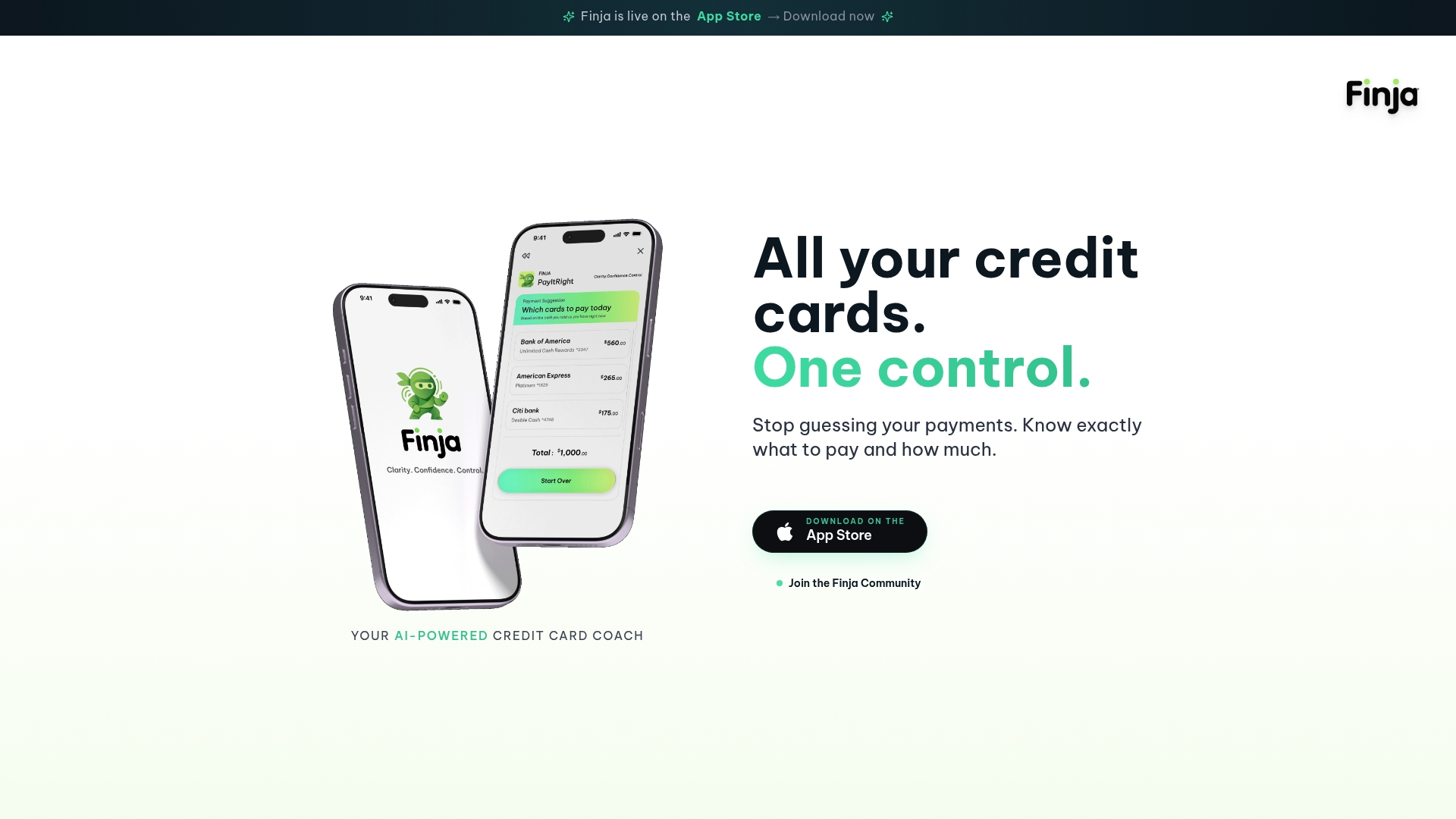
Finja's subscription includes a trial period, so the risk of testing it is low. Start at myfinja.com, connect your first card, and let the AI show you exactly where your interest costs are going and how to cut them.
Key sources and references
| Source | What it covers | Why it's useful |
|---|---|---|
| The Best All-in-One Money Management Apps in 2026 | Origin, Monarch, Empower feature analysis and trade-off comparison | Benchmark for all-in-one alternatives and integration depth |
| Best Credit Card Comparison Tools | Expert guidance on aligning tool choice to primary financial goal | Decision criteria and methodology transparency |
| Intro to FinlyWealth (Pinance) | FinlyWealth's cash rebate model and AI reward calculator approach | Baseline comparison for what finlywealth.com offers |
| AI in Fintech: A 2026 Strategy Guide | Broader AI trends in fintech and why modeling matters | Context for AI-driven payment optimization tools |