
A credit limit increase can trigger a hard pull, but it does not always. When you ask for the increase yourself, the issuer may run a hard inquiry. When the issuer raises your limit on its own after reviewing your account, it generally uses a soft inquiry, which does not touch your score. Policies differ by issuer, so the safest move is to find out which one you have before you click "request."
Below: how to tell hard from soft, what a hard pull actually costs, when a higher limit is worth that cost, and how to shift credit between your own cards without a new application.
TL;DR
- Requested increases may trigger a hard inquiry. Automatic, issuer-initiated increases generally use a soft one.
- A single hard inquiry usually takes fewer than five points off a FICO score, and the effect can last up to a year.
- A higher limit can lower your credit utilization, which can help your score if your spending stays the same.
- Some issuers let you move available credit between your own cards, and at least one says this creates no credit inquiry.
- Ask the issuer before you request, and compare cards side by side so you know which one actually needs the extra room.
Table of Contents
- Hard pull or soft pull: what is the difference
- How to find out before you request
- What a hard pull really costs your score
- When a higher limit is worth a hard pull
- Ways to get more room without a hard pull
- How credit line transfers work
- A word on the question "is $20,000 a good limit"
- Our perspective
- See all your limits and balances in one place
- What to do next
- FAQ
- Sources
Hard pull or soft pull: what is the difference
A hard inquiry happens when a lender checks your credit because you applied for credit. A soft inquiry covers things like an issuer reviewing your existing account or you checking your own report. The CFPB explains that hard inquiries can affect your score, while soft inquiries do not.
Hard inquiries are visible to other lenders, and soft ones are not. Lenders may read a large number of hard inquiries as a sign of greater risk. That is why a request that looks small to you can matter when you are about to apply for something bigger.
For a limit increase, the type of pull depends on who starts the process:
| Situation | Typical inquiry | Score effect |
|---|---|---|
| You request an increase and the issuer pulls your report | Hard (varies by issuer) | Small, temporary dip |
| You request an increase and the issuer uses internal data only | Soft | None |
| The issuer raises your limit on its own | Soft | None |
| You move existing credit between your own cards | Depends on issuer; some say none | None reported by those issuers |
The second row exists because whether a request becomes a hard or soft pull varies with each issuer's internal policy. One large issuer, for example, says on its help page that it uses a soft inquiry and looks at on-time payments, account age, recent line changes, income, employment, credit score, usage of the current line and payment size.
How to find out before you request
You do not have to guess. Many issuers tell you upfront which kind of inquiry a request will use, and if the screen is unclear, you can ask. Here is a simple routine:
- Open the increase request page in your app or online account and read the disclosure text before submitting anything.
- If it does not mention the inquiry, call the number on the back of the card and ask: "If I request a higher limit, will you run a hard or a soft inquiry?"
- Ask whether you can request a review that uses a soft inquiry only, or whether the issuer reviews you automatically on a schedule.
- Write down the answer and the date, so you can compare it against your report later.
You can make the request online, by phone or at a bank branch, according to one major issuer's FAQ. The channel does not change the underlying policy, so ask first, whichever you choose.
What a hard pull really costs your score
The cost is real but modest. A single inquiry usually takes fewer than five points off your FICO score, and the impact can last for up to a year. myFICO puts it in proportion: inquiries make up 10% of the FICO calculation, while payment history and overall debt matter more.
The score effect fades faster than the record. If you want to know how long the inquiry itself stays visible and how several of them stack up, our guide to how long hard inquiries last walks through it with a planning method.
Why rate-shopping rules do not help here
FICO treats several mortgage, auto or student-loan inquiries within a short shopping window as one inquiry: 45 days for newer FICO models and 14 days for older ones. That grouping is for those loan types. Do not assume a handful of credit card limit requests will be merged the same way. Spread them out, and do not stack them just before a loan application.
When timing matters most
If a mortgage or car loan is coming in the next few months, a hard pull for a limit increase is a poor trade. Even a few points can matter near a pricing threshold. Our note on which score matters for apps versus loans explains why the model your lender uses affects how much that dip counts. For a sense of how a score translates into cost on a big purchase, see this explainer on the auto loan credit score and the rate you can expect.
When a higher limit is worth a hard pull
The upside is utilization. A higher limit could lower your credit utilization and improve your score, provided your spending stays the same and you keep paying on time. A CNBC analysis makes the same point: the inquiry's effect is typically negligible in the long run, while a larger limit may help.
Here is a worked example with made-up numbers. You carry a $3,000 balance on a card with a $5,000 limit. That is 60% utilization on that card. If the limit rises to $7,500 and the balance stays at $3,000, utilization falls to 40%. The inquiry may cost you a few points for a while. The lower ratio can more than make up for it, but only if the balance does not grow into the new room.
That last condition is the catch. Federal Reserve researchers caution that automatic increases can ease credit constraints but may also increase borrowing and indebtedness. A higher limit is not automatically beneficial. It helps the person who keeps the same spending, and it hurts the person who treats it as more to spend.
A hard pull is probably worth it when:
- Your utilization is high on a card you plan to keep.
- You have paid on time for at least six months.
- You have no major loan application in the next several months.
- Your issuer will not offer a soft-pull review.
It is probably not worth it when your recent payment history is spotty, when you already carry a balance you cannot pay down, or when a loan application is close.
Ways to get more room without a hard pull
Wait for an automatic increase
Issuers may raise your limit on their own after you have handled the current one responsibly, typically after 6 to 12 consecutive months of on-time payments. When the cardmember did not request it, issuers use a soft inquiry. Account activity such as paying more than the minimum and rising income can also feed these reviews.
This is common. A 2025 Federal Reserve staff paper finds that automatic increases affect more than 12% of accounts annually, and that most are applied automatically using lenders' proprietary models. You cannot force one, but you can make your account look the way those models like: steady on-time payments, balances paid well above the minimum, and an up-to-date income on file.
Understand what the issuer weighs
The CFPB says issuers generally assess limits using your credit history and reported income. A low limit can reflect poor credit history, high balances elsewhere, low income, or the card's own product limit. For a request, issuers may also look at your credit score, existing debt and overall utilization, per Chase's guidance. If you are going to ask, ask when those factors are at their best. Our walkthrough on requesting a limit increase in the U.S. covers the steps and how much to ask for.
Move credit between cards you already have
This answers the question many cardholders type as "combine credit limits" or "transfer a credit line." If you hold more than one card with the same issuer, you may be able to move available credit between them. The move does not raise or lower your total available credit with that issuer. It just puts the room where you use it.
How credit line transfers work
Not every bank allows it, and the details vary. Some issuers let eligible cardholders do it online or in an app, and others may require a call to customer service. Here is what the issuers' own pages and recent reports say.
| Issuer type | What is allowed | Inquiry | Key limits |
|---|---|---|---|
| Capital One and Discover cards | Eligible customers can transfer part of their available credit between cards | No credit inquiry | Not the entire line; normally immediate, some requests reviewed for up to 30 days; typically once per week |
| Chase | Self-service tool, generally between cards of the same type (personal to personal, business to business) | Not stated in the report | Minimum remaining limits vary, donor card often at least a year old, $100 increments, two or three transfers per 30 days |
| American Express | Between cards in the same online profile: personal to personal, business to business, personal to business, but not business to personal | Reported no hard or soft inquiry | Card-age and frequency limits may apply |
The Chase and American Express rows come from media reports dated June 2025 and August 2024, so confirm current terms in your account before relying on them.
The steps at Capital One
The issuer's page describes the path: select the receiving card, open "Manage your credit line," then choose "Transfer credit line between cards" if the option is available. It also notes the difference between two things people mix up. A credit-line transfer changes credit limits without changing balances. A balance transfer moves unpaid debt from other issuers' accounts onto a card.
That difference matters because you generally cannot transfer a balance between cards from the same issuer. Moving a line is the tool for same-issuer cards. Moving debt is a different product with its own application.
When a transfer beats a limit increase request
Suppose you hold two cards from one issuer. One is nearly maxed out, and the other sits at 5% use. A transfer from the idle card to the busy one can drop your utilization on the busy card without a request, a review or, at the issuers that say so, an inquiry. Check your overall and per-card utilization first. Our guide to timing tactics that cut utilization shows how the reporting date shapes what lenders see.

Do not strip a card so low that it can no longer cover its recurring charges. And before you close any card after moving its room elsewhere, read why canceling old cards hurts your score.
A word on the question "is $20,000 a good limit"
There is no universal good number. The right limit is the one where your balance stays a small share of it and you still pay in full or close to it. Issuers set limits from your history and income, so a figure that is generous for one household is tight for another. What counts is the ratio of your balance to your limit, and whether your spending is under control. If you are using a larger limit to carry more debt, it is working against you.
Our perspective
Most people who search this topic are really asking one thing: how do I get more room without damaging my score? After working with cardholders who juggle several cards, we see the same pattern. The hard pull is rarely the problem. The real cost comes from asking blindly, on the wrong card, at the wrong time, and then letting the new room fill up.

We built Finja around interest and credit health, not rewards. When you see every card in one place, the decision gets easier: which card carries the balance, which one has idle room, which one is about to report a high statement balance. Sometimes the answer is a limit request. Often it is moving a payment earlier, or shifting available credit from a card you barely use. A hard inquiry should be a deliberate choice you make with the numbers in front of you, not a reflex.
The rule we give ourselves is simple: do not raise a limit to spend more. Raise it, or reallocate it, to make the balance you already have cost less.
— Grace K.
See all your limits and balances in one place
Deciding whether to request an increase, wait for an automatic one or move credit between cards takes a clear view of every account. Finja is an AI-powered credit card coach for people with multiple cards. It shows your cards together and gives guidance on payment timing and amounts to reduce interest and support your credit health.
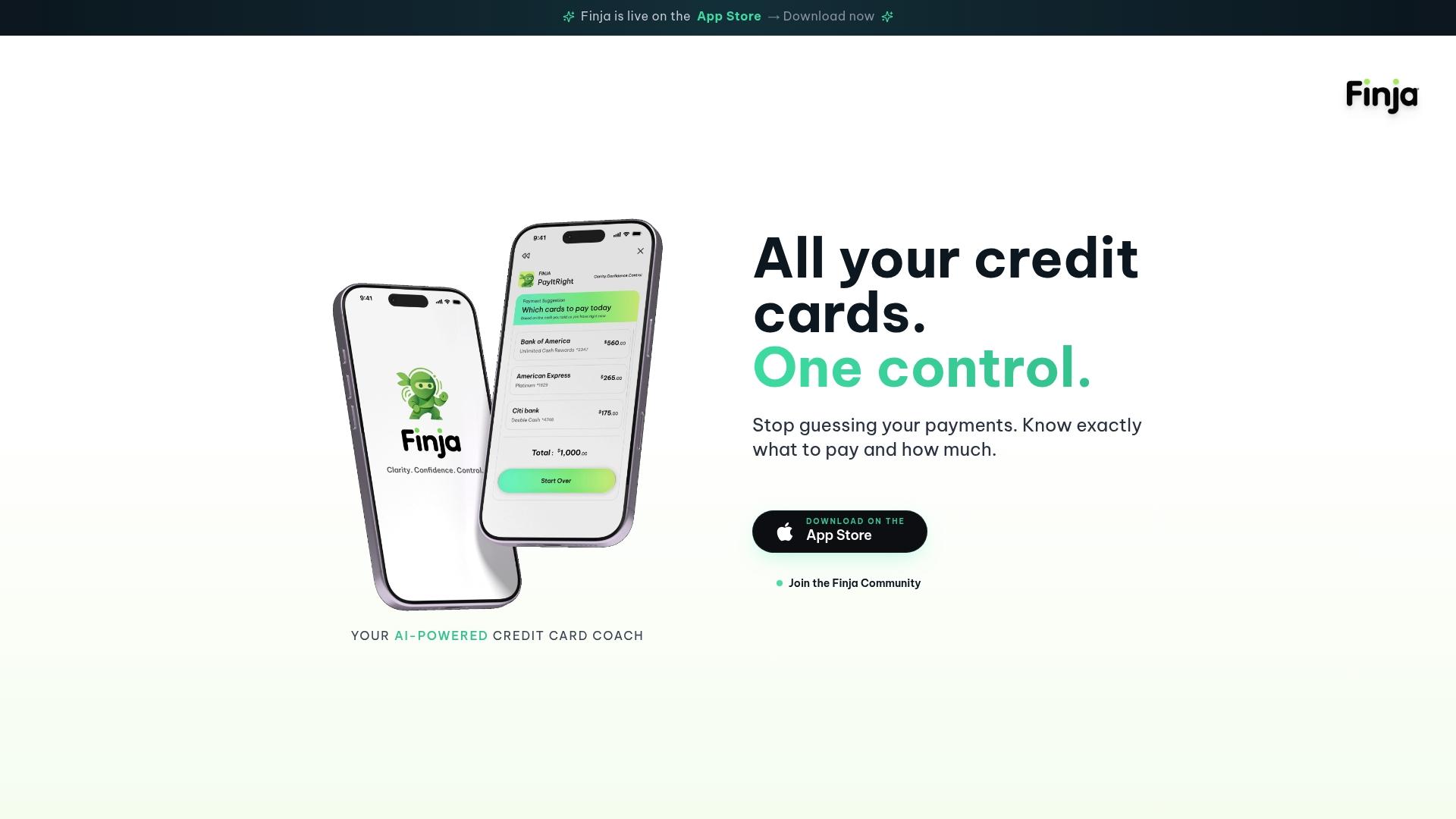
If you are weighing your next move, try Finja, your AI-powered credit card coach and see where each card stands before you ask any issuer for more. To keep spending in check once limits change, our guide to setting credit card spending limits can help.
What to do next
- List every card with its limit, balance and reporting date.
- Find the cards above 30% utilization that you plan to keep.
- Check whether the same issuer has idle room you could move.
- If you need a new limit, ask the issuer whether it uses a hard or soft inquiry.
- Hold off if a mortgage or car loan is near.
- After any increase, keep spending flat so the lower ratio actually shows up.
And if an issuer ever cuts a limit on you, the steps to take in the first 72 hours matter.
FAQ
Does requesting a credit limit increase always cause a hard pull?
No. Some issuers use a hard inquiry when you request an increase, and others use a soft one. Issuers that raise your limit on their own generally use a soft inquiry. Ask your issuer before you submit.
How many points does a hard pull cost?
A single hard inquiry usually takes fewer than five points off a FICO score, and the effect can last up to a year. Inquiries are about 10% of the FICO calculation, so payment history and debt levels matter more.
Can I move credit from one card to another without a hard pull?
Sometimes. Capital One says its credit-line transfer between eligible Capital One and Discover cards creates no credit inquiry, and a report on American Express transfers found no hard or soft inquiry. Rules, limits and eligibility differ by issuer, so check your account.
Will my issuer raise my limit automatically?
It may. Issuers often review accounts with steady on-time payments, payments above the minimum and rising income, typically after 6 to 12 months of on-time payments. These reviews generally use a soft inquiry that does not affect your score.
Is a bigger limit always better for my score?
No. A higher limit can lower utilization and help your score if your spending stays the same. If it leads you to borrow more, the benefit disappears and your debt grows.
Sources
- Frequently Asked Questions about Credit Limit Increases (Chase)
- Do Credit Limit Increases Hurt Your Score? (Chase)
- Requesting a Credit Limit Increase? Here's What to Expect (NerdWallet)
- What is a credit inquiry? (CFPB)
- Do Credit Inquiries Lower Your FICO Score? (myFICO)
- What Is a Hard Inquiry and How Does It Affect Credit? (Experian)
- Increasing your credit limit (Capital One Help Center)
- Do Credit Limit Increases Affect Your Credit Score? (CNBC Select)
- Automated Credit Limit Increases and Consumer Welfare (Federal Reserve)
- Why did I get a low credit limit on a credit card? (CFPB)
- Can You Transfer Credit Limits Between Credit Cards? (Experian)
- Line Transfer (Capital One)
- Chase adds self-service credit limit transfer tool (The Points Guy)
- How to easily move credit across your American Express accounts (The Points Guy)
- Why Was My Balance Transfer Request Denied? (Experian)